Consumers are wary of AI on social media, but they don’t uniformly refuse it. New Clutch data reveals exactly what types of AI content are acceptable, and when using it may cost your brand valuable consumer trust.
We’ve all heard that consumers despise AI, but we don’t always hear the nuanced — and more accurate — take. Consumer skepticism is real, but the good news is that it’s contextual, not absolute. Consumers don’t flat-out refuse to accept AI. They reject it when they encounter it in places that just feel wrong.
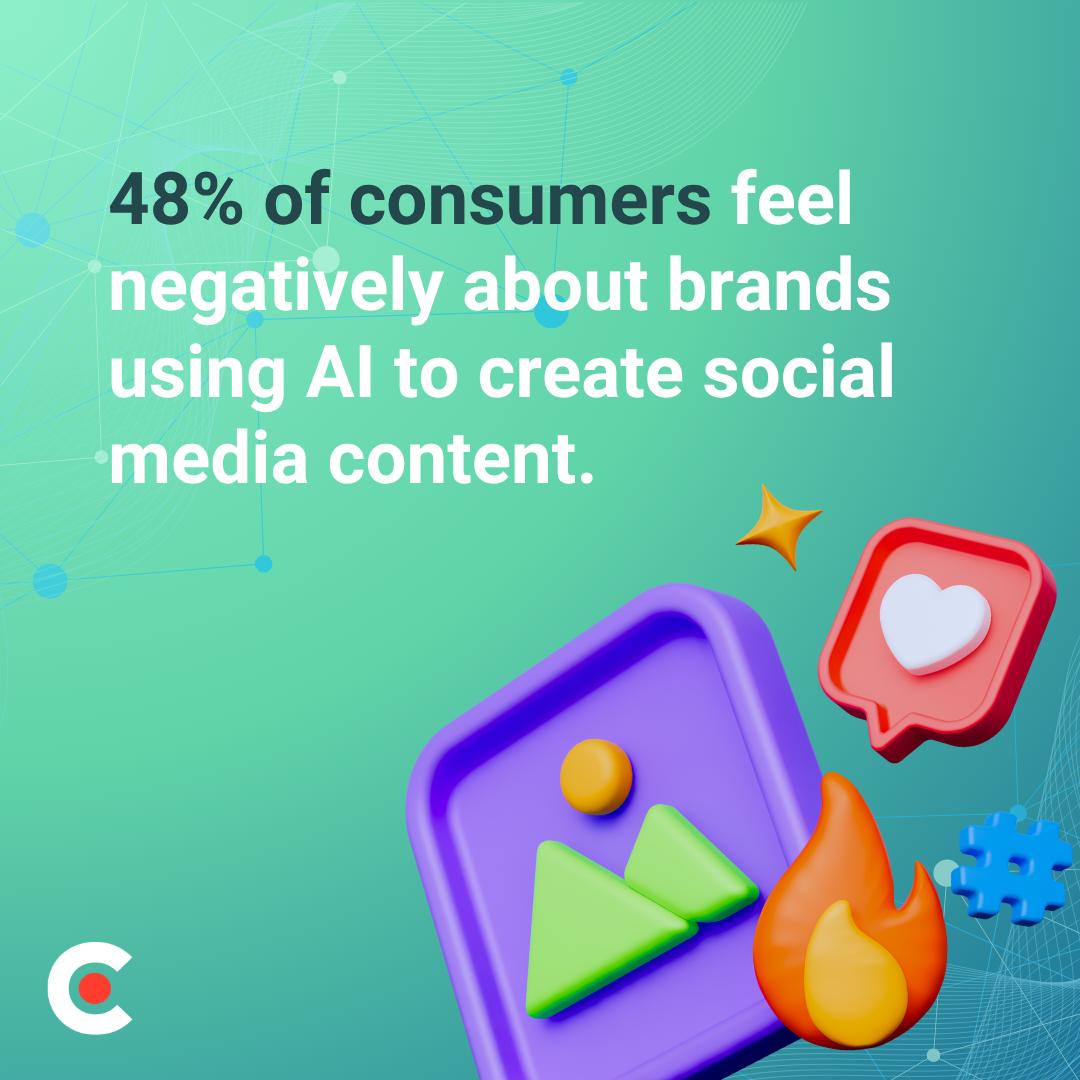
In August 2026, Clutch surveyed 601 people in the U.S. about consumer attitudes toward AI in marketing, where people find value in AI, when they worry about it, and how AI use affects their trust in brands, platforms, and influencers. Our survey uncovered a surprising caveat to the “consumers hate AI” narrative: While 48% of consumers said they feel negatively about brands that use AI to create social media content, 42% have an actively positive view of AI usage in education and explainer content. That’s not the only type of AI-assisted content they’ll accept, either.
Looking for a Social Media Marketing agency?
Compare our list of top Social Media Marketing companies near you
Let's take a look at how consumers really feel about AI on social media and map out the specific types of content they welcome AI for and those they don’t. With these insights, your brand can deploy automation where it adds value and avoid AI where it kneecaps consumer trust.
Consumers Aren’t Anti-AI — They’re Selective
In our survey, 48% of consumers feel negatively toward brands that use AI to create social media content. In comparison, 27% of respondents feel positively about it, and another 25% are neutral.
If you're only reading the headlines, consumer skepticism about AI use seems to outweigh enthusiasm.However, that is somewhat misleading. Many consumers who dislike AI use in social content shift to feeling positive about it when the content creator uses AI for the right tasks and doesn’t try to hide it.
What does this mean? The use case, not the technology itself, is what determines consumer acceptance. Whether consumers approve of AI’s involvement isn’t strictly black-and-white; it depends on the specific type of content it helps create.
For brands, assuming consumers will not accept AI can lead to flawed strategies, such as avoiding AI altogether or, worse, keeping its use under wraps. Understanding that consumer AI acceptance is selective points your team toward the smarter strategy: understanding what consumers consider acceptable uses of AI in marketing, and applying it in those specific contexts.
Where Consumers Welcome AI: The Green Zone
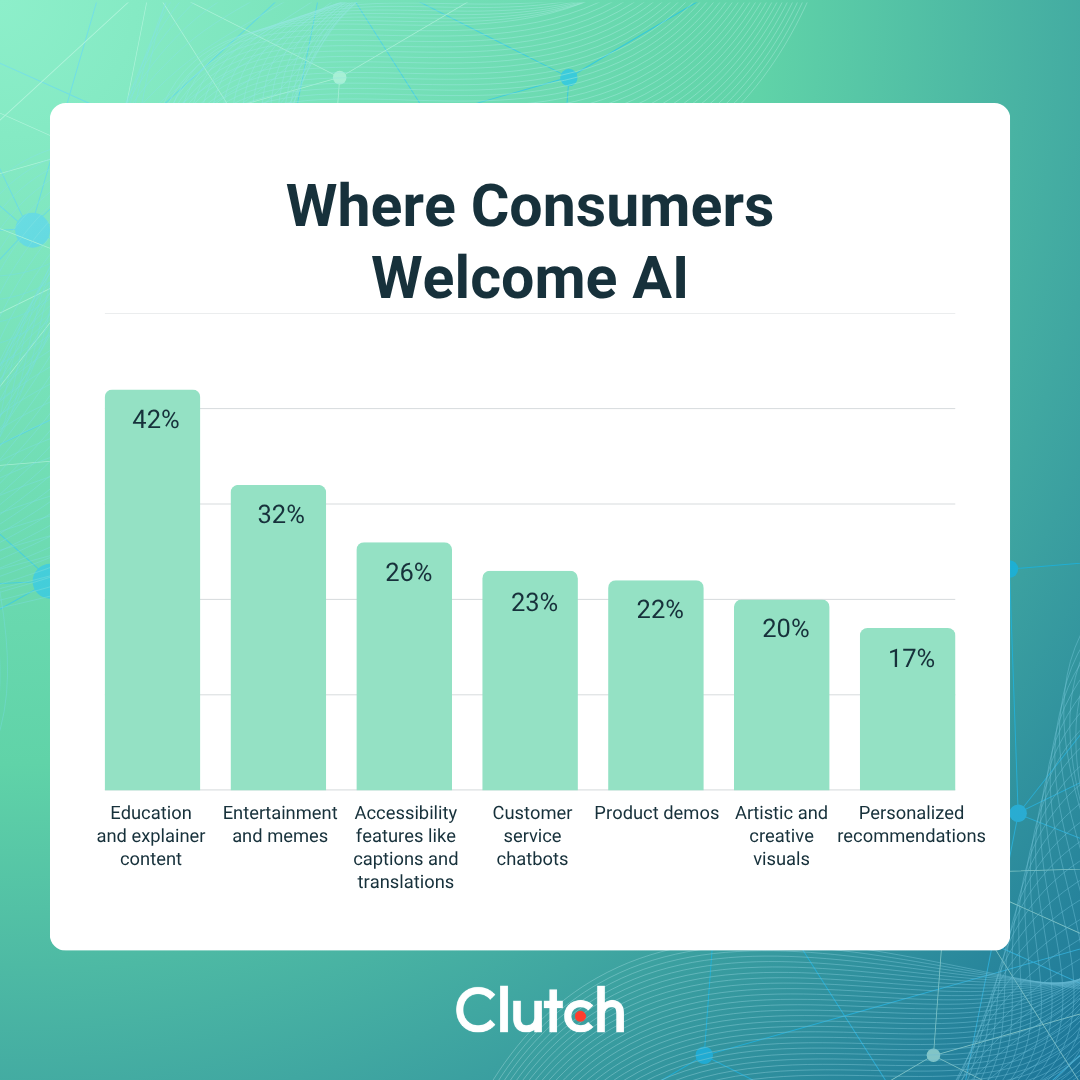
The survey asked how consumers feel about AI on social media, breaking content down into categories to provide more granular data. The percentages of consumers surveyed who feel positively about AI use in each category are:
- Education and explainer content: 42%
- Entertainment and memes: 32%
- Accessibility features like captions and translations: 26%
- Customer service chatbots: 23%
- Product demos: 22%
- Artistic and creative visuals: 20%
- Personalized recommendations: 17%
First, let's focus on the top four types of AI-generated content that more consumers trust, exploring why people accept it and how your brand can use AI to create them.
1. Education and Explainer Content (42%) — The Clearest Green Light
Unlike in marketing or the creative arts, where what matters is the human touch, lived experience, and personal perspectives, consumers tend to judge educational content more by its functional clarity, factual utility, and speed.
People are more open to AI-generated content in this area because they generally see machines as neutral, objective, and free of hidden emotional or commercial agendas. The content's provenance matters less as long as consumers are getting the information they need.
What Your Brand Can Do
Lean into AI when producing how-to content, product setup guides, explainers, summaries, and educational formats. You have the most leeway in this category, as consumers have gauged it as the safest use of AI and are most likely to accept generated content for educational purposes
2. Entertainment and Memes (32%)
More consumers accept AI use in entertainment and meme content, where the stakes are very low, and the primary goals are novelty, humor, and speed rather than accuracy. While AI errors can cause real-world harm in high-stakes fields like medicine, journalism, or finance, consumers already understand entertainment and internet culture as inherently playful and not necessarily true to life. When AI helps to create this type of content, it doesn’t have quite the same dangerous or deceptive feeling.
What Your Brand Can Do
You’ll likely get little resistance if you use AI to produce funny, entertaining, low-risk social content in which no one expects factual accuracy, human empathy, or documentary realism.
3. Accessibility — Captions and Translations (26%)
AI-assisted accessibility tools can produce auto-translations and captions at a volume and speed that human creators can’t match. The immediate utility AI offers in this category benefits the mainstream audience beyond the disabled community. Many young adults without hearing impairments routinely use captions, a growing generational preference that has widely normalized the technology.
Users see this type of AI accessibility feature as a practical convenience as well as disability support. Because of this, people consider such AI inclusion as pro-social and genuinely helpful to a wide swath of people, known for widening access rather than manipulating perception.
What Your Brand Can Do
To earn consumer trust, treat AI-powered accessibility functions as trust-building tools, not boxes on a compliance checklist. This AI use case is largely appreciated and worth being aware of.
4. Customer Service Chatbots (23%)
Customer service is another area where speed and utility win consumers over. AI-powered customer support chatbots provide 24/7 availability. They allow consumers to bypass lengthy telephone queues for routine requests that automated tools can easily handle, such as resetting passwords, checking business hours, or tracking orders.
In this case, however, there is a caveat: Consumers accept AI chatbots that actually solve their problems. If a support chatbot pretends to be human or makes it difficult for the user to speak with a real person, consumer acceptance stalls.
What Your Brand Can Do
If your brand deploys customer service chatbots for quicker resolution, transparency is essential. Disclose up front that the bot uses AI, and create a simple way for it to hand off the case to a human representative.
The Green Zone Takeaway
When AI provides information, utility, speed, or access, consumer acceptance increases. The obvious common thread across every use case in this section is a clear benefit to the consumer.
Where Acceptance Cools: The Yellow Zone
The last three items in the category ranking tell a compelling story about how consumers feel about AI on social media. Product demos (22%), artistic or creative visuals (20%), and personalized recommendations (17%) using AI received significantly less positive sentiment than the use cases in the green zone.
The closer AI edges to representing a product (such as demos or product visuals) or predicting the person (through personalized recommendations), the lower consumer acceptance tolerance falls. This is where AI treads into the uncanny valley and may seem to distort the truth or be just plain intrusive. It can feel disingenuous.
Nothing is strictly off the table, but if your brand decides to use AI to generate these types of content, proceed with a healthy dose of caution. To prevent a steep drop-off in consumer trust, only use AI in these areas with close human oversight, and disclose, disclose, disclose.
Where Consumers Draw the Line: The 28% Who Welcome None
A segment of consumers can’t be swayed by their anti-AI stance. The Clutch survey found that 28% of those surveyed view no AI use cases positively.
When you consider this alongside the 48% of consumers who view brands' use of AI to create social media content as an overall negative, it’s a flashing neon reminder that brands can’t just assume a baseline of goodwill. For a significant chunk of your audience, any visible use of AI is a strike against your brand.
There are a few AI use cases that are more likely to push people into that red zone:
- Undisclosed AI use
- AI that misrepresents itself, products, or people
- AI use that seems intended to replace the human element
Successful AI use boils down to segmenting your audience accordingly. Remember that no matter what you do with it, AI-forward content will inevitably alienate part of your audience. If you do use AI to produce social media content, providing honest disclosure and a human-made alternative is more than just an ethical stance but a crucial part of audience management.
What This Means for Your AI Strategy
Keeping in mind how consumers feel about AI on social media, we’ve created a simple framework to help marketers, developers, and product teams know at a glance when to charge full steam ahead with AI, when to proceed with caution, and when to keep AI out of the picture entirely.
We’ve broken this table down into three color zones:
- Green zone: All systems go! Use AI freely (but be careful to segment your audience to avoid blasting AI-generated content to the “AI-never” group).
- Yellow zone: Tread carefully. Use AI, but only with human oversight and transparent disclosure.
- Red zone: Freeze. These are the AI use cases consumers are most likely to reject.
| AI Use |
Content Type |
Examples |
| Green zone: Use AI freely |
Education or explainer content |
- Flashcards, quizzes, study plans, language practice
- Product setup how-tos
- Summaries
|
| Entertainment and memes |
- AI voice parodies
- Transparently, amusingly absurd deepfakes and anachronistic mashups
- Image generation failures
|
| Accessibility features |
- Live transcriptions and captioning
- Alternative text
- Text-to-speech or personalized synthetic voices for individuals without speech capabilities
|
| Customer service chatbots |
- Order tracking and shipping updates
- Basic FAQs
- Account and password actions
- Booking and reservations
|
| Yellow zone: Use AI with human oversight and disclosure |
Product demos |
- Tools that automate administrative and documentation tasks
- Creative and marketing production
- Customer support, operations, or HR products
|
| Artistic and creative visuals (as a collaborative partner) |
- Generating foundational textures or abstract backdrops
- Iterative concept art and world-building
- Composite photography
|
| Personalized recommendations |
E-commerce platform product recommendations
Streaming platform music, program, or movie recommendations
Higher education academic advising after tracking student grades, interests, and engagement
|
| Red zone: Never use AI |
Undisclosed AI use |
Writing, art, or customer service interactions that AI generated without acknowledgement |
| AI that misrepresents |
Mimicry of real human voices, fake video footage, deepfake content, or inauthentic reviews |
| Replacement of the human element in areas requiring high empathy, creativity, and unique life experience |
AI in counseling, art, creative writing, and mentorship |
Efficiency is ideal, but efficiency that your audience reads as cheapening does more damage than good.
The ROI question to ask yourself and your team isn’t “can we use AI here to save time?” Instead, ask, “Does AI add genuine, obvious value for the customer here?” The answer should guide your company’s AI strategy.
Respect How Consumers Feel About AI in Social Media
Consumer skepticism about AI on social media platforms isn’t a myth, nor is it overblown. It is, however, contextual. The same person who broadly distrusts AI content may welcome its use for the right job.
Though 48% of consumers feel negatively about brands using AI to create social content, 42% welcome it for educational content, 32% for entertainment, 26% for accessibility features, and 23% for customer service. Still, there’s one group, 28% strong, that accepts none of it.
To use AI successfully in your social media content, deploy it thoughtfully and only where it provides genuine value to consumers. Most importantly, be transparent about your usage. You can’t change how consumers feel about AI on social media, but if you employ these tools thoughtfully, you'll find your audience will be more likely to accept their use.
About the Author
Anna Peck
Content Marketing Manager at Clutch
Anna Peck is a content marketing manager at Clutch, where she crafts content on digital marketing, SEO, and public relations. Alongside editing and producing engaging B2B content, she plays a key role in Clutch's awards program and content initiatives. Originally joining Clutch on the reviews team, she now focuses on developing SEO-driven content strategies that deliver valuable insights to B2B buyers searching for the best service providers.
See full profile