
Task Automation: How to Cut Repetitive Work
Task automation saves time, gets work done faster, and reduces errors. Learn how to automate repetitive tasks step-by-step and how to decide what to automate.
Updated July 8, 2026

Companies are rapidly adopting AI for customer support, but consumers aren't impressed by chatbots that can't solve their problems. Clutch surveyed 422 consumers to uncover what people really expect from AI-powered customer service and found that speed and effectiveness matter.
"Can I speak to a human representative?"
It's a question many customers find themselves asking after interacting with an AI voice agent. Often, AI customer support solutions fail to understand their problem, offer generic answers, or repeatedly transfer them to another department.
Looking for a Artificial Intelligence agency?
Compare our list of top Artificial Intelligence companies near you
As businesses increasingly adopt AI-powered customer support tools — from chatbots and virtual agents to advanced LLM assistants — customers are learning that faster responses don't always lead to better outcomes.
In a survey of 422 consumers, 87% reported using AI customer support, and 72% use it regularly. Yet widespread adoption doesn't necessarily translate to customer satisfaction. When AI can quickly resolve simple issues, it creates a seamless experience. When it can't, customers want an easy path to a human who can.
Businesses that treat AI as a replacement for human support risk frustrating customers and eroding trust, while those that use AI to enhance the customer experience can build trust.
Key Takeaways
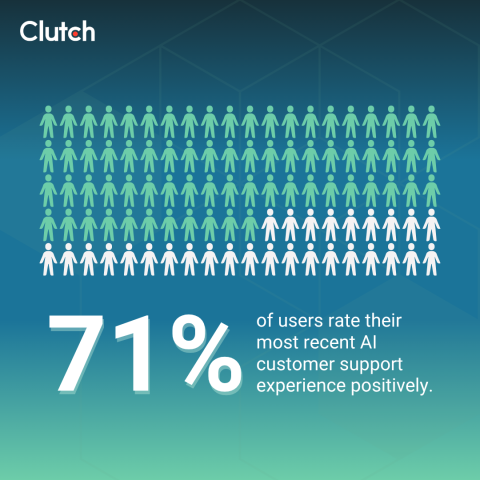
Overall, consumers appreciate AI-powered customer support systems, with 71% of users rating their most recent AI customer support experience positively.
Despite the growing adoption of AI customer support, many consumers remain skeptical of its ability to solve their problems. Nearly half (45%) say they feel frustrated when they realize they're interacting with AI instead of a human representative, often because they lack confidence that the system can effectively address their issue.
That skepticism is reinforced by the user experience. An overwhelming 85% of consumers report having to repeat or rephrase their question at least once to help the AI understand their request. When customers spend time repeatedly clarifying the same issue, AI quickly loses its appeal.
“Good AI support should understand context, remember what I’ve already told it, and ideally be able to take action on my behalf,” says Abhijith HK, the CEO and co-founder of Codewave. “If I have to keep repeating myself or jumping between systems, something’s broken.”
As AI becomes a larger part of the customer experience, its role must extend beyond answering questions to actively helping customers resolve issues.
According to Abhijith, the real value of AI customer support lies in its ability to move beyond information retrieval and actively facilitate issue resolution through task completion and workflow automation. “We’ve built systems where users can interact through voice, text, or even video, and the AI isn’t just answering questions, it’s actually pulling information, validating details, initiating workflows, and helping resolve issues end-to-end.”
Without the ability to resolve issues, even well-designed AI systems risk frustrating the very users they’re meant to help.
The vast majority of consumers (81%) expect AI to resolve their issue in less than five minutes, yet 59% have experienced slow or unresponsive AI support, indicating a substantial gap between expectations and reality.
When dealing with customers seeking help, speed is essential, but resolving issues quickly with AI can be challenging.
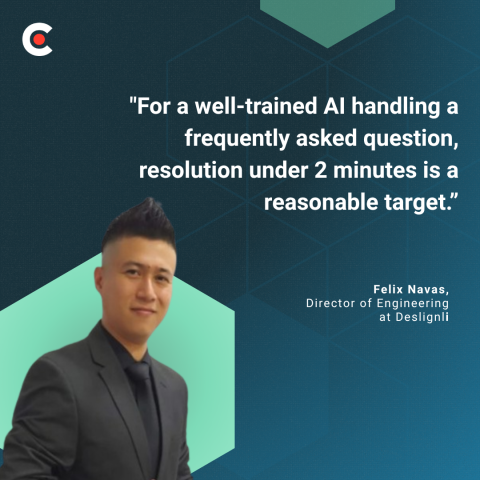
Felix Navas, Director of Engineering at Designli, explains that the amount of time it takes for AI to resolve an issue varies depending on the task at hand, saying, “It depends heavily on the use case. For a well-trained AI handling a frequently asked question, resolution under 2 minutes is a reasonable target.”
But quick resolution depends on a variety of factors, including the complexity of the issue, the quality of the AI's training, and the systems it can access to complete tasks.
“The factors that affect this the most are: how well the human team has adopted the tools on their end, whether the AI was properly trained on the semantics of the product's FAQ content and domain vocabulary, and model latency,” says Navas.
Ultimately, delivering fast, effective AI support requires companies to optimize training quality, system integration, and model selection around the specific use case, balancing speed and accuracy to ensure issues are resolved efficiently.
To close the gap between consumer expectations and reality, businesses must approach AI customer support as a full-scale infrastructure investment, not just a feature addition.
Learn more about the hosting and infrastructure requirements needed to support fast AI customer support resolution.
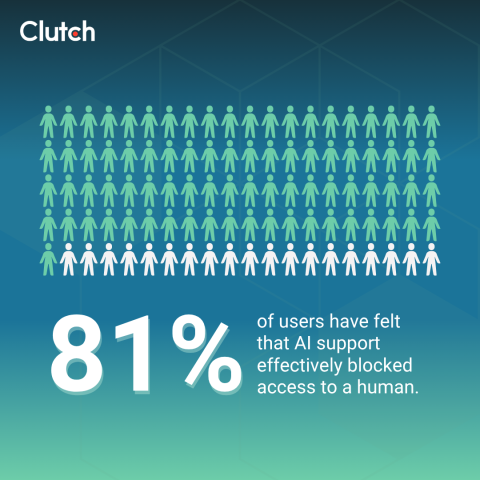
Even when AI customer support is fast, 81% of users have felt that AI support effectively blocked access to a human. This creates frustration when issues are too complex for AI to resolve, leaving users stuck without a clear path to human help.
When escalation did occur, consumers were frustrated by having to repeat their issue (47%), long wait times (16%), and agents losing context from their AI conversation (13%).
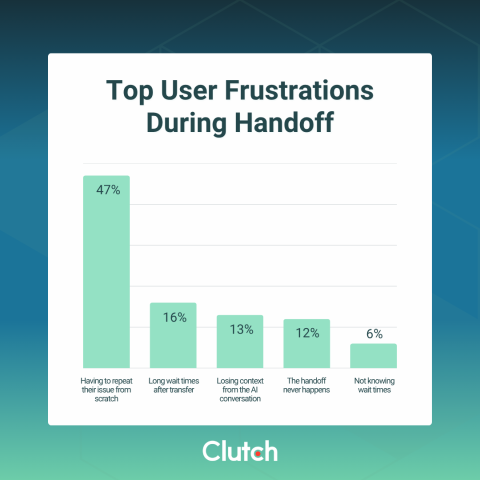
Ultimately, companies can address these frustrations by making it easier for users to reach a human agent and by offering that access earlier in the process.
“If the case needs to escalate, the total resolution time (which depends on complexity) should stay under 4 hours - with the handover to a human happening well before that, not at the tail end,” says Navas.
Ideally, customers should be directed to a human agent if they’re unable to resolve their issue within 5 minutes of contacting AI-powered customer support options.
More importantly, the handoff should be seamless, with human agents able to access the full AI conversation so customers don’t have to repeat themselves. This helps prevent context loss, where key details shared with the AI disappear during escalation.
Wait times should also be transparent, shown in chat through a queue position or countdown to reduce uncertainty.
To build trust and improve satisfaction, companies need AI systems that combine fast resolution with reliable, frictionless transitions to human support when needed.
Most conversations about AI and consumer data assume that users are wary of sharing personal information with automated systems. However, 62% of users accept AI having full access to their account history for more personalized help.
This suggests that consumers aren't inherently opposed to sharing data and are willing to do so when the benefit is clear to them. For businesses, that's an opportunity to create more effective customer experiences through personalization. However, that opportunity comes with a responsibility to protect customer information and be transparent about how it's used.

“Companies must approach this with a ‘responsible by design’ framework to maintain trust and compliance,” explains Alexey Spas, Founder and CEO of Instinctools. This means that companies need to go beyond regulations such as GDPR and CCPA. “Implementation should include robust user consent management systems and clear data retention and deletion policies.”
Transparency is particularly important. Customers should understand when their data is being used, why it is being used, and how they can control it. This can take the form of a disclosure at the start of an AI interaction and easy-to-access settings that allow users to view, manage, or opt out of personalization based on account history.
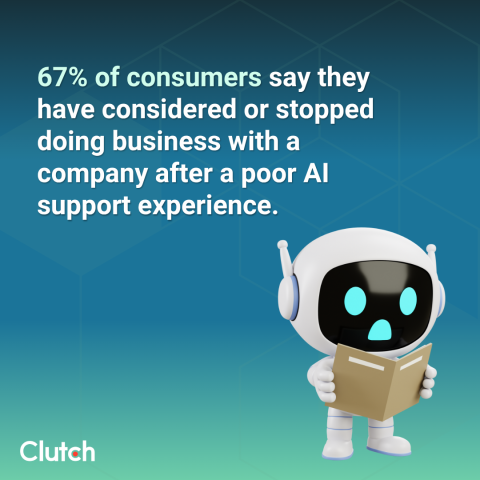
While AI customer support can reduce costs and improve efficiency, companies risk damaging customer trust if the experience falls short of expectations. In fact, 67% of consumers say they have considered or stopped doing business with a company after a poor AI support experience.
The stakes are high because customer support is often one of the most important touchpoints in the customer journey. While AI can provide faster response times, reduce agent workloads, and lower operational costs, a single frustrating interaction can leave customers questioning whether a company values their time and business.
For many consumers, an ineffective AI support experience reflects just as poorly on the company as a bad interaction with a human agent.
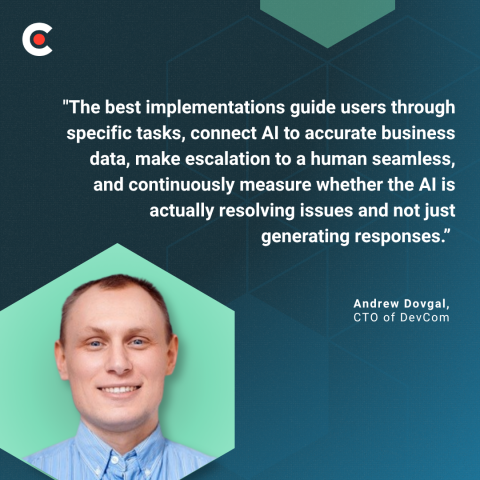
“Good AI customer support isn’t just about giving users a faster chatbot. From a product design standpoint, it means building a support experience that is clear, contextual, and trustworthy from the first interaction,” said Andrew Dovgal, the CTO of DevCom. “The best implementations guide users through specific tasks, connect AI to accurate business data, make escalation to a human seamless, and continuously measure whether the AI is actually resolving issues and not just generating responses.”
Companies that view AI support solely as a cost-saving measure risk creating experiences that frustrate customers and erode brand loyalty. The most successful implementations balance efficiency with effectiveness, ensuring AI can resolve issues quickly while providing a clear path to human assistance when needed.
For AI customer support to succeed, companies need to focus on what customers actually want from the experience. Our survey found that users are most satisfied when AI support feels helpful, transparent, and backed by human support when needed.
Users say they would be more satisfied with AI customer support tools if they could escalate to a human at any point (63%), the company was transparent about what the AI is capable of (51%), and if it provided more accurate, personalized answers (40%).
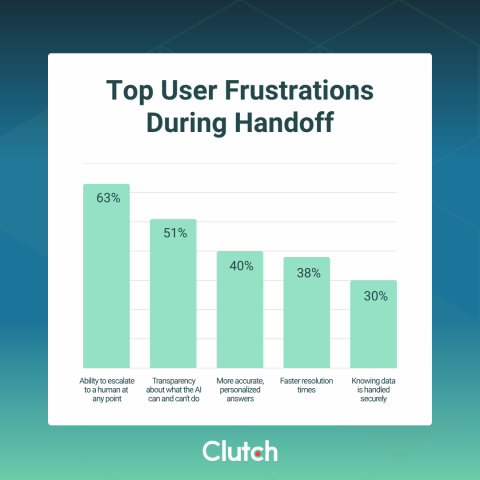
These findings suggest that trust in AI support isn't built through automation alone. Customers want confidence that the AI can help them, clarity about its limitations, and reassurance that human assistance remains available when needed.
Getting these details right is what separates helpful AI customer support that retains customers from clunky systems that lose them.
When done well, AI in customer support can improve the customer experience by delivering faster responses, reducing wait times, and helping customers resolve issues more efficiently. But customers ultimately judge support by whether their issue gets resolved quickly, accurately, and with minimal friction.
Ultimately, the companies that will win are those that use AI to enhance the support experience rather than replace the human elements customers still rely on. By combining efficiency with empathy and ensuring humans remain available for complex issues, businesses can build support systems that strengthen both trust and customer loyalty.