How to Use Claude Code if You're Not a Developer
Learn how to use Claude Code to build your own AI agents without a coding background, including setup, first steps, and safety tips backed by Clutch data.
Updated June 11, 2026
AI often seems like a magic spell that makes busywork disappear. From handling customer support tickets to generating videos, it can assist with almost every routine task. That's why many companies are racing to automate as much as possible.
The organizations getting the best results aren't just deploying more AI agents, though. They're taking a structured approach with plenty of guardrails. Markdown instructions, CI/CD pipelines, observability dashboards, and clearly defined agent autonomy levels help keep AI systems secure and trustworthy.
This article examines the benefits of the hybrid-human AI review model and why many organizations are using LLM-as-judge. It also gives tips for deciding which processes to automate and which should include human checkpoints. We'll also break down the ISO 42001 governance standard and what it means as you develop agents.
Looking for a Artificial Intelligence agency?
Compare our list of top Artificial Intelligence companies near you
Like "hallucination," "guardrail" has become another AI buzzword. That makes it easy to dismiss it as nothing more than a safety a filter that prevents agents from saying something offensive or wrong.
In reality, guardrails are the controls that keep AI systems safe and in line with your business values. They're the foundational rules that spell out how AI operates and what it isn't allowed to do. They also establish when humans should step in to make decisions.
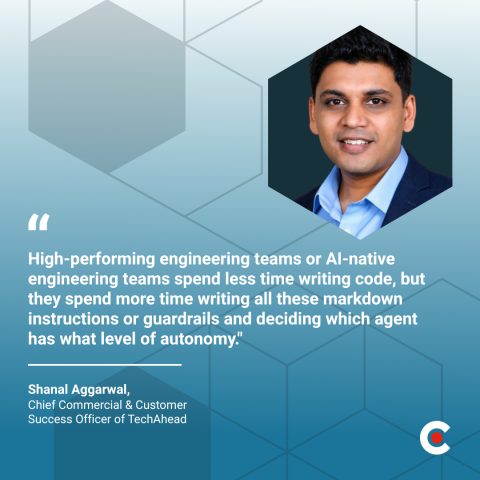
Shanal Aggarwal, the Chief Commercial and Customer Success Officer at TechAhead, explains, "High-performing engineering teams or AI-native engineering teams spend less time writing code, but they spend more time writing all these markdown instructions or guardrails and deciding which agent has what level of autonomy. Do they have access to the production server, or do they have just access to your staging environment?"
As Aggarwal notes, savvy engineering teams usually don't rely on one or two guardrails when designing AI systems. They layer multiple safeguards, such as:
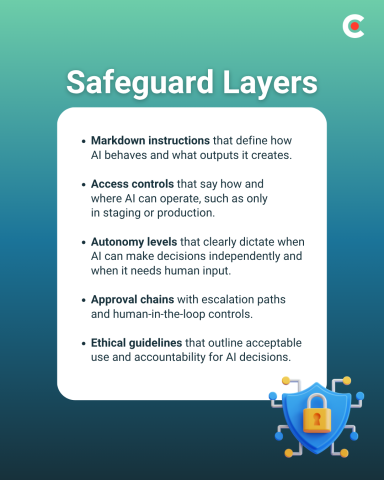
Suppose an engineering team is developing an AI agent that will handle customer support tickets. Without markdown instructions, the AI might talk about random topics instead of helping users check their order status. And if the team doesn't create approval chains, customers won't be able to talk to a human if something goes wrong.
These AI guardrails aren't static like a traditional firewall or pop-up blocker. Instead, they adapt to different contexts based on the perceived risk. For example, an AI agent may have less autonomy when working with sensitive financial data than when answering basic customer questions.
This flexibility allows AI models to behave predictably without restricting their capabilities too much. That helps companies strike a healthy balance between control and innovation, especially as they start to scale. After all, AI is only useful when it has enough freedom to act without constant oversight.
Don't assume you see everything that's happening with your company's AI usage. According to Ivanti's 2025 Technology at Work Report, nearly half (46%) of office workers say some or all of the AI tools they use haven't been authorized by their employer.
This "shadow" AI raises major security concerns. Let's say an employee is rushing to finish a client report before a deadline. They decide to upload confidential documents to a personal ChatGPT account and ask it to help draft the content. While this may seem harmless or even smart, it can expose sensitive client data.
"Having a human in the loop is extremely important," says Aggarwal. Proper oversight can prevent data leaks and unethical AI use.
It starts with building human checkpoints throughout the engineering process. Aggarwal explains, "You need to create those structures where you have different environments built in for your standard CI/CD operations from dev staging production. You should also have those right pipelines in place and have some sort of manual reviews along with automated reviews as well."
Adding AI agents to CI/CD helps these checkpoints function more efficiently instead of replacing them entirely. For instance, teams can use AI to detect bugs in code and suggest fixes. It can also trigger parts of the pipeline, such as running dependency checks or flagging anomalies in code. That allows engineering teams to get more done without losing control.
Many companies also use hybrid review models to govern AI usage. They combine AI and human evaluators to monitor and validate outputs. For example, large language models (LLMs) may assess and score outputs from another AI system. This approach is called LLM-as-a-judge, because Model A judges Model B's performance.
Meanwhile, human experts audit samples of the outputs to make sure the LLM is scoring them correctly. They also review exceptions and make high-risk decisions.
More organizations are using LLM-as-a-judge as AI systems grow larger. Humans can't evaluate millions of lines of code manually, no matter how many people are on the team. But an LLM can do a first pass and flag any issues or inconsistencies.
Transaction limits are another must-have guardrail. They prevent AI agents from making payments above a certain threshold. For example, if an agent is in charge of reordering office supplies, your company might set a $5,000 limit per transaction. If the system tries to go over that amount, the request automatically gets routed to a human for approval. That way, you don't have to worry about the system accidentally buying hundreds of printers or other unnecessary supplies.
Even with the best guardrails, no AI system is foolproof. A model's behavior can drift over time as it processes more data and interacts with new users.
That's not the only risk. As Aggarwal puts it, "Even after those instructions and structures, AI has this habit of losing context and hallucinating." For instance, a model that seems reliable at first may start generating incorrect outputs when you add more data.
Aggarwal continues, "While there are systems and these models are getting better at it, there are still these inherent issues within the technology for which you have to have those strong observable dashboards in place."
Your team can reduce the risk of these issues by baking observability dashboards into every pipeline from day one. These visualizations make it easier to track the system's performance and catch anomalies early.
Let's say you design an AI model to omit personal information from its outputs. If it suddenly starts leaking confidential employee data, a dashboard can flag the issue immediately.
An observability layer should also monitor for bias indicators, such as non-inclusive language. Safety signals can help detect outputs that don't comply with policies or regulations, too. For instance, a model may hallucinate incorrect medical advice despite its instructions.
Audit trails are another essential part of any AI pipeline. They trace every stage of the development process, including where data comes from and who approves each step. This helps engineers figure out what happened when something goes wrong, and who should take ownership.
These guardrails aren't just nice-to-haves. Many compliance frameworks require documented audit trails and governance systems for AI models.
One example is ISO 42001. It requires companies to create an AI governance structure and perform ongoing risk assessments. Similarly, the NIST AI Risk Management Framework encourages companies to practice transparency and use appropriate controls. Another popular framework is the EU AI Act, which requires organizations to keep monitoring AI systems after deployment.
Together, these guardrails help your team see the full picture and step in quickly when (not if) AI stops behaving as intended.
Resist the urge to try to automate everything immediately. Moving too fast will make it difficult to set up the proper guardrails. Instead, start with low-risk tasks that your team handles frequently.
Aggarwal suggests, "If there is a customer support request, if there is a bug that is there, the system can flag it and automatically create a Jira ticket. You don't really require a human going in and copying that from one tool to another and assigning it to someone."
Meeting notes and PR status updates are other solid options. These simple tasks don't take much time to automate, and the risk of something going wrong is minimal. Plus, you can quickly spot errors or hallucinations.
Of course, don't forget to build in guardrails and human oversight, no matter how small a task may seem. Let's say you develop an AI agent to approve employee reimbursements for client dinners and local travel. With transaction limits, you can empower the agent to approve anything up to $200, while larger expenses get sent to a human.
By starting small, you'll build your team's confidence and determine where you need human checkpoints. Once you've successfully used AI to automate simple tasks, it's time to tackle regulated or production-level processes. This might involve anything from automating vendor onboarding to approving access to highly sensitive documents.
Above all, don't rush. A thoughtful approach with the right guardrails is the key to successful, scalable automation.