
Cloud Cost Optimization: How to Prioritize Spending Without Sacrificing Performance
The article overviews the main cloud waste drivers and proven cloud cost optimization strategies to help companies manage cloud expenses.
Updated June 25, 2026

Consumers increasingly expect AI-powered customer support. But delivering a fast, reliable experience requires decisions about hosting and infrastructure that most businesses aren't considering. Here's what customers want, and what it takes on the backend to deliver it.
Imagine this: a customer is shopping on an e-commerce website late at night when they realize they entered the wrong shipping address. It’s outside of business hours, and they can’t call customer support, so they open the AI chatbot instead to change their delivery address.
In just a few minutes, they can change their address, and their order is delivered on time and without issue.
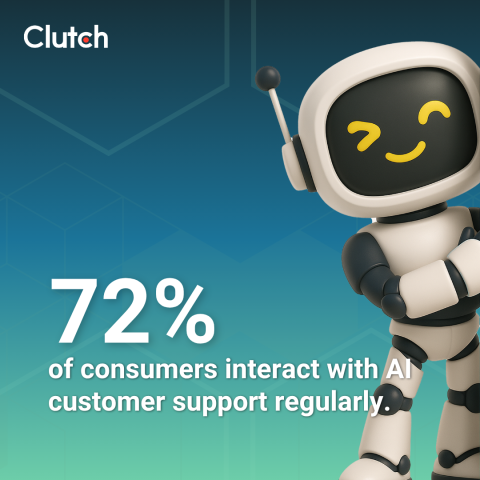
More and more frequently, users are expecting AI-powered customer service experiences like this. In a survey of 422 consumers, 72% interact with AI customer support regularly, with nearly half (46%) using it at least once a week.
However, even a simple customer interaction can trigger a complex chain of processes that directly impact a company's hosting and infrastructure needs.
In the example of a customer using an AI chatbot late at night to correct a shipping address, the company needs reliable cloud systems to keep the chatbot, order management platform, customer account data, payment systems, and supporting APIs available 24/7.
They would also need enough computing power to process AI requests in real time, retrieve relevant customer information, maintain conversation context, and securely update order records without delays or errors.
Without sufficient infrastructure in place, customers may experience slow responses, failed requests, or support systems that cannot complete tasks accurately.
As customer expectations for fast, seamless online experiences continue to grow, Clutch partnered with Nexcess to survey 422 consumers about the infrastructure and hosting capabilities businesses need to keep pace.
Key Takeaways:
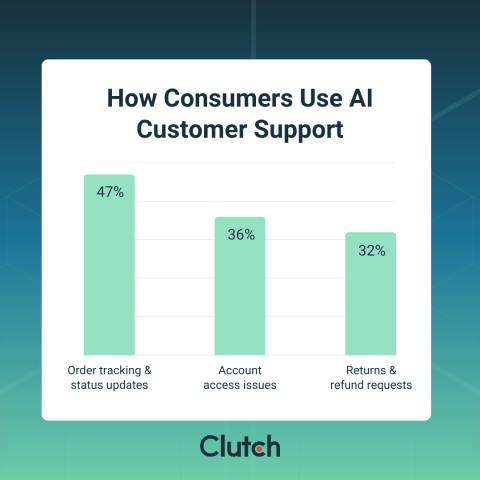
Consumers regularly interact with AI support, and many are open to using it for routine, transactional tasks. Nearly half (47%) turn to AI for order tracking and status updates, 36% for password resets and account access issues, and 32% use it for returns and refund requests.
However, not every experience with AI-powered customer support is positive. Over half (54%) of respondents didn’t have a positive experience in their most recent AI customer support experience, with 26% saying they still needed support, 19% saying the AI system didn’t understand the issue, and 9% saying AI made the experience worse.
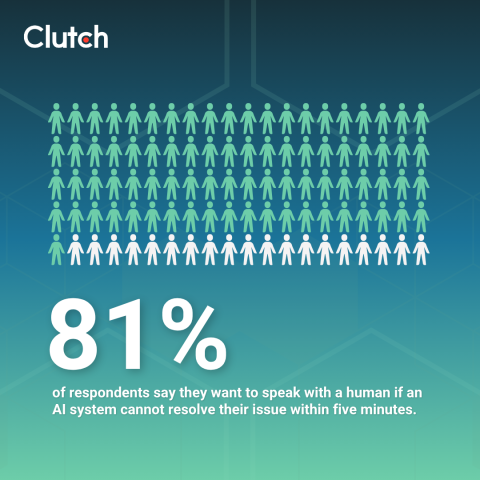
Poor customer experiences can quickly erode trust and impact sales. When AI-powered support systems fail to resolve issues efficiently, customers often become frustrated and seek help from a human agent instead. In fact, 81% say they want to speak with a human if an AI system cannot resolve their issue within five minutes, creating additional strain on support teams and diminishing the overall experience.
In many cases, though, the AI itself is not the issue. Rather, the infrastructure cannot support the speed and reliability that users expect. For businesses, this means that AI performance is closely tied to hosting and infrastructure decisions.
As AI becomes an increasingly important part of the customer experience, providing AI agents with tools to resolve an issue securely is no longer a nice-to-have feature. It is the difference between resolving a customer's issue and losing their engagement, loyalty, or purchase.
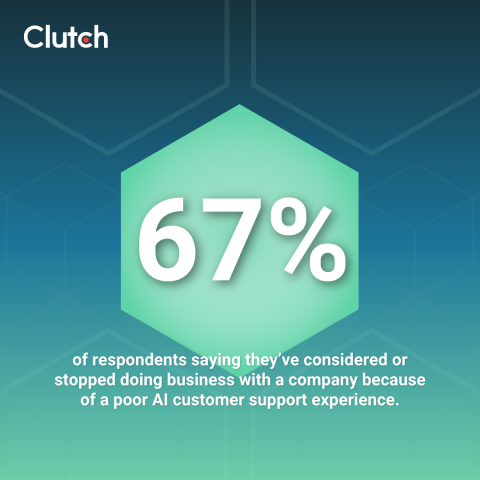
The stakes for providing fast and efficient AI-powered customer support are high, with 67% of respondents saying they’ve considered or stopped doing business with a company because of a poor AI customer support experience.
Sometimes, poor experiences are caused by poor infrastructure. When businesses fail to meet expectations for speed, reliability, and issue resolution, customers can become frustrated and leave the platform, ultimately affecting customer satisfaction and conversion rates.
This highlights an important shift in how businesses should think about AI performance. Poor infrastructure doesn’t just cause problems on the backend; it impacts retention.
That’s why investing in scalable hosting, reliable uptime, and infrastructure built for real-time AI interactions is essential for building long-term customer loyalty.
Many businesses are looking to leverage AI customer support systems to provide faster, more scalable, and cost-efficient service, but it’s only beneficial if they can deliver a seamless customer experience.
With a better understanding of what consumers expect when interacting with AI-powered customer support systems, businesses can determine where to invest to meet their needs. In 2026, consumers expect AI customer support to:
The biggest pain point for consumers using AI-based customer support is poor comprehension. More than 4 in 5 respondents (85%) said they often had to repeat or rephrase their questions to get the support they needed.
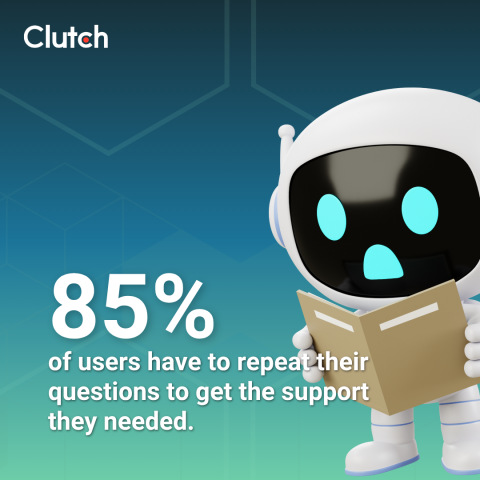
When users have to repeat the same question multiple times, they may believe that the system is unable to help them. One of the top reasons customers turn to AI support is the expectation of fast and convenient assistance. When the AI fails to understand a request the first time, the interaction immediately becomes more time-consuming and mentally exhausting.
Even worse, customers may interpret these failures as a sign that the company values automation over actually helping people.
The inability to retain and apply context is generally caused by an undersized context window or poor memory architecture, but storing and processing a full conversation history requires more GPU memory per request. Teams sometimes under-provision their inference infrastructure to truncate context to keep costs down, but it can cause user frustration.
Implementing a proper RAG pipeline to retrieve relevant history or cache conversation state can fix this issue, but it increases per-request memory and compute requirements.
On dedicated hardware like Liquid Web's L4 Ada inference servers, the full VRAM is available for exactly this kind of workload, so businesses don't have to choose between cost efficiency and a coherent conversation.
Generally, people are wary of AI accessing their data, and may be hesitant to share information if they are concerned about their data security. Still, 62% of consumers are comfortable with AI accessing their full account history if it improves the customer experience, underscoring the fact that most users simply want to resolve their issue.
To deliver that level of personalization and efficiency, businesses need infrastructure that securely connects AI systems to customer data sources such as CRMs, order histories, billing systems, and past support tickets.
This requires real-time data retrieval architectures and secure API connections that allow AI tools to quickly access relevant information and provide accurate responses without delays.
“Companies promise an assistant that "knows everything" and then wire it to a frozen snapshot. The model reasons fine. It reasons over stale facts,” explains Sergey Ermakovich, co-founder and CMO at HasData. Without access to current, relevant data, even advanced AI systems can provide incorrect or misleading information.
For instance, Cursor faced backlash after its AI support bot falsely told a customer that logging out when switching devices was an intentional company policy when it was actually a technical bug. “When Cursor's bot invented a logout policy this spring, that wasn't a model failure. Nothing connected it to the live system state, so it filled the gap with fiction,” says Ermakovich. This highlights the risks of deploying AI customer service systems without access to accurate, real-time information or adequate oversight.
At the same time, businesses must balance convenience with privacy and security expectations. As AI systems gain access to more sensitive customer information, infrastructure must also support strong security controls, encryption, authentication, monitoring, and compliance requirements to help protect customer data and maintain trust.
Nexcess helps businesses balance personalization and security by providing cloud infrastructure that supports compliance requirements such as HIPAA, PCI DSS, and SOC 2. Features like encryption, continuous monitoring, and managed security services help protect sensitive customer data while enabling AI systems to access the information needed to deliver personalized support experiences.
AI customer support systems aren’t always able to resolve a user’s issue. When that happens, the transition from AI support to a human representative needs to be seamless. User frustration quickly grows when customers are forced to repeat information or restart the conversation after escalation.
47% of respondents said repeating their issue is their biggest frustration during this process, while others cited long wait times (16%) and lost context between the AI and human agent (13%) as key pain points.
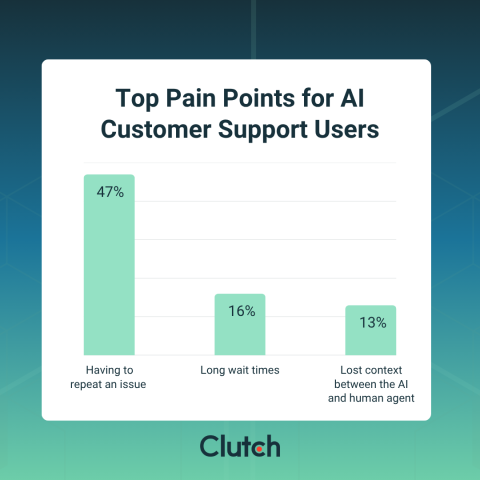
To ensure a seamless transition, support systems need to intelligently route conversations, preserve context throughout the customer journey, and transfer live sessions between systems without losing information.
Ideally, the human representative should immediately have access to the full conversation history, account details, and actions already taken, so the customer does not have to repeat themselves. Supporting this type of experience requires a hybrid infrastructure that connects AI systems, customer databases, CRM platforms, ticketing systems, and live support tools in real time.
Routing logic must be able to determine when an issue should be escalated, while context management systems need to continuously store and retrieve conversation data across channels and devices.
Without reliable backend integration and data synchronization, important information can be lost during handoffs, creating a fragmented experience.
Overall, consumers expect AI customer support systems to be fast and effective, yet 59% have experienced slow or unresponsive AI customer support.
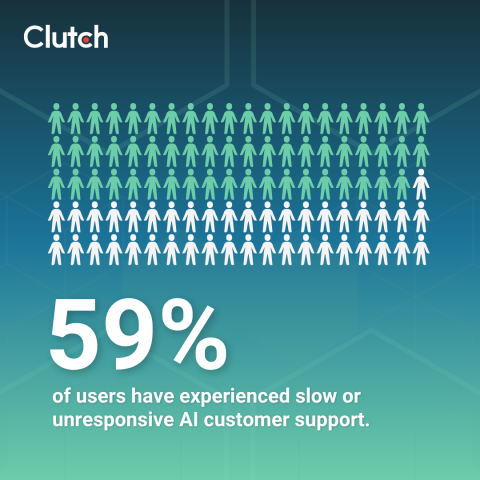
Delivering the speed consumers expect requires infrastructure built for low latency and high availability. Businesses increasingly rely on content delivery networks (CDNs) and edge computing to reduce response times by processing requests closer to the user.
Auto-scaling infrastructure also helps AI systems maintain performance during spikes in support traffic, while load balancing distributes requests efficiently across servers to prevent slowdowns and outages.
Chatbots are the most popular type of AI customer support, with 38% of consumers preferring them over other common AI customer support systems.
Chatbots may look simple on the surface, but conversational AI systems require a fairly robust backend infrastructure to function properly at scale.
At a minimum, chatbots need web server capacity to handle incoming user requests from websites or apps. Every message a user sends has to be processed by a backend server before a response is returned, so the system must be able to handle many connections without slowing down.
For more advanced, real-time experiences, chatbots also rely on WebSocket support. Unlike traditional request-response HTTP calls, WebSockets allow continuous two-way communication between the user and the server. This enables more natural, real-time “typing” conversations rather than delayed message exchanges.
Modern conversational AI systems also depend heavily on API connections to external model providers such as OpenAI and Anthropic. Each user message may be sent to an AI model, processed, and then returned as a generated response. This creates a constant flow of API traffic that the infrastructure must reliably support.
Because users expect near-instant replies, these systems also require low-latency response performance. Even small delays in processing or network communication can make the chatbot feel unresponsive, which directly impacts user satisfaction.
While very simple rule-based bots can sometimes run on shared hosting, modern conversational AI systems quickly outgrow that environment. That’s why chatbots typically require dedicated servers or cloud-based infrastructure with scalable compute resources, load balancing, and reliable uptime.
30% of consumers prefer AI virtual assistants, such as AI-powered voice agents and phone systems.
Unlike traditional voice systems that rely on phone trees and keypad prompts, modern AI voice agents use natural language processing to understand spoken requests and respond conversationally. This allows customers to explain issues in their own words rather than navigating through long menus or repeating simple commands.
Supporting these experiences requires a combination of AI technologies and specialized infrastructure working together behind the scenes.
Voice interactions are significantly more resource-intensive than text-based chat because systems must process speech in real time, convert spoken language into text, interpret intent, generate a response, and often convert that response back into speech instantaneously.
Communications platforms handle a significant portion of this infrastructure, including telephony networks, call routing, and voice communication systems. However, businesses still need robust hosting and backend infrastructure to support the AI systems powering these experiences.
This includes scalable compute resources, real-time API processing, low-latency networking, database connectivity, uptime monitoring, and infrastructure capable of handling many voice interactions without interruptions or delays.
7% of consumers prefer automated email responses. While less interactive than AI chatbots or voice agents, AI-powered email support systems still play an important role in helping businesses efficiently manage high volumes of customer inquiries.
These systems can automatically categorize incoming support tickets, prioritize urgent requests, draft suggested responses for support teams, or fully automate replies for simple issues such as password resets, shipping confirmations, or billing questions. Together, this helps businesses reduce response times and improve operational efficiency.
Compared to live chat or voice AI systems, AI email support is generally less latency-sensitive because interactions do not happen in real time. However, these systems still require reliable infrastructure and backend integrations to function effectively.
Businesses need dependable server uptime, secure email processing systems, and integrations with CRM platforms, ticketing systems, customer databases, and workflow automation tools to ensure requests are routed to the right place and quickly resolved.
Finally, 10% of consumers prefer in-app AI assistants over any other type of AI customer support system.
Unlike website chatbots, in-app AI assistants are embedded directly into a product or platform to help users without forcing them to leave the interface. Common examples include SaaS onboarding assistants that guide users through setup processes, AI troubleshooting copilots that help diagnose issues within software platforms, and contextual assistants that answer questions based on what a user is actively doing within the application.
Because these assistants operate directly inside the product experience, they require tight integration with the company’s existing infrastructure. They often need real-time access to user activity, account data, product documentation, and backend services to provide accurate, contextual guidance.
This creates additional load on the same infrastructure powering the core application itself. As a result, businesses need hosting environments that can support both the product and the AI assistant simultaneously without degrading performance.
AI customer support is quickly becoming the standard, but simply adding these tools won’t improve the customer experience without ensuring you have the infrastructure to deliver quick, seamless interactions.
Your hosting and infrastructure solution must be able to support real-time AI workloads, scalable traffic demands, low-latency performance, secure data access, and reliable integrations across the systems powering the customer experience.
As businesses increasingly rely on AI to manage customer interactions, infrastructure decisions are no longer just technical considerations behind the scenes. They directly shape customer satisfaction, trust, and retention.