Even for B2B companies, social media is one of the most effective ways to connect with potential customers. We sat down with Scott Emalfarb, CEO of Fresh Content Society, and Mandy McEwen, CEO of Mod Girl Marketing, to learn more about what social media trends they expect to take over B2B digital marketing in 2025.
The B2B social media trends defining 2027 are: measuring organic social ROI, investing in video, the evolution of B2B influencer marketing, personalized engagement, platform-specific content, leveraging AI for content, and — new this year — AI transparency and disclosure. The throughline: AI is making B2B content faster and cheaper to produce, but audiences increasingly reward the brands that use it and are open about it. Here’s how to put each trend to work.
By following the latest B2B social media trends, you can use that technology to its full potential and stay ahead of the competition.
Looking for a Social Media Marketing agency?
Compare our list of top Social Media Marketing companies near you
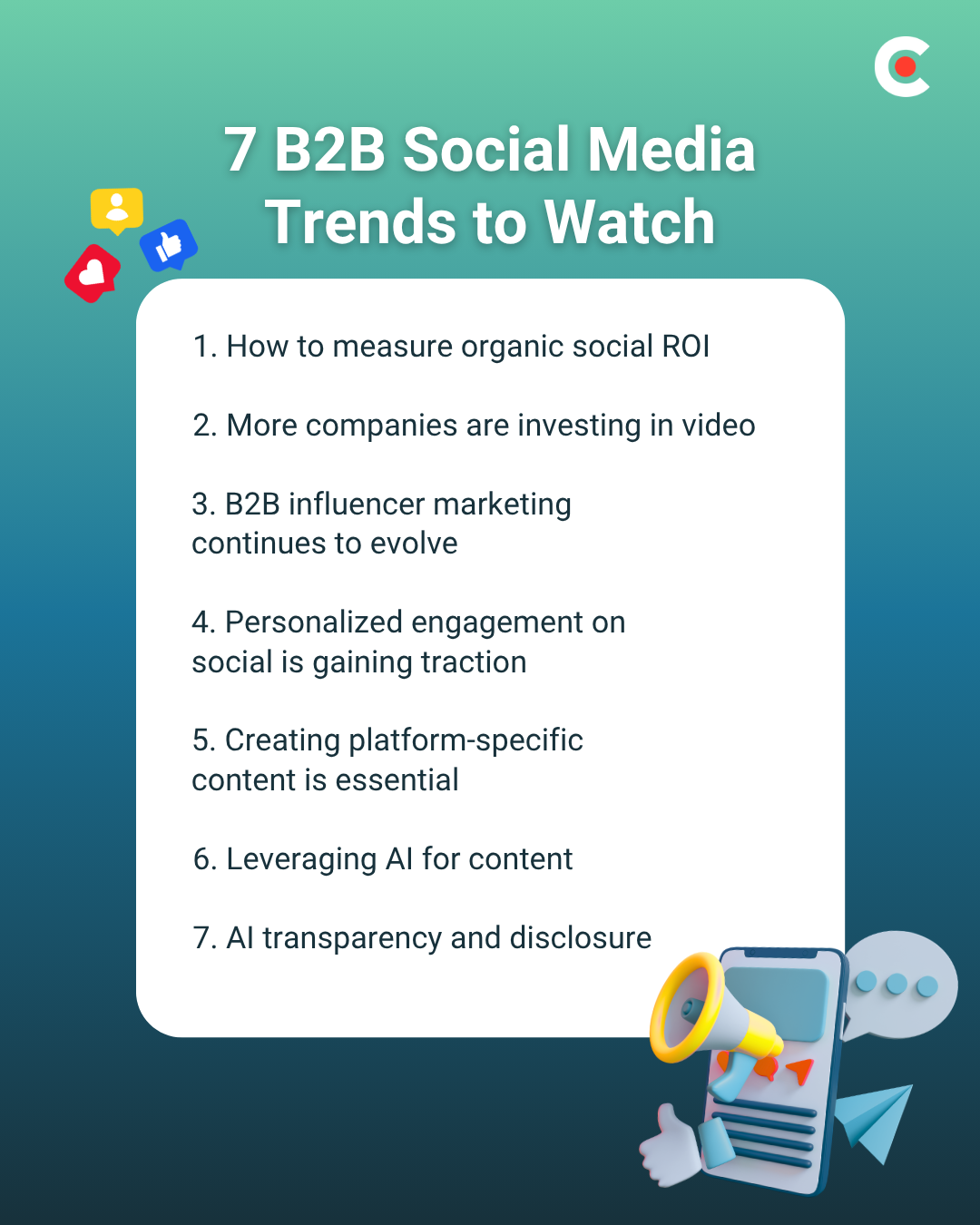
7 B2B Social Media Trends to Watch
- How to measure organic social ROI
- More companies are investing in video
- B2B influencer marketing continues to evolve
- Personalized engagement on social is gaining traction
- Creating platform-specific content is essential
- Leveraging AI for content
- AI transparency and disclosure
Looking for a digital marketing agency? Search for industry-leading service providers on Clutch. Filter based on client rating, pricing, services offered, and location to find the perfect partner for your project.
1. How to Measure Organic Social ROI
We all know that while creating a social media account is free, social media marketing itself is not: whether partnering with influencers or buying lighting equipment, you’ll need to invest money and time to create high-quality content that performs well on social media. However, it can be challenging for marketing leaders to attribute conversions and sales to organic social.
Of course, social media marketing provides intangible benefits that you can’t plug into a calculator. “Organic ROI is tough to measure because it doesn’t directly tie to revenue in a way that makes people comfortable," said Scott Emalfarb, Founder and CEO of Fresh Content Society. "You’ve got brand awareness, community building, and engagement metrics that don’t immediately scream ‘dollars,’ so everyone’s left trying to connect dots that aren’t always clear.”
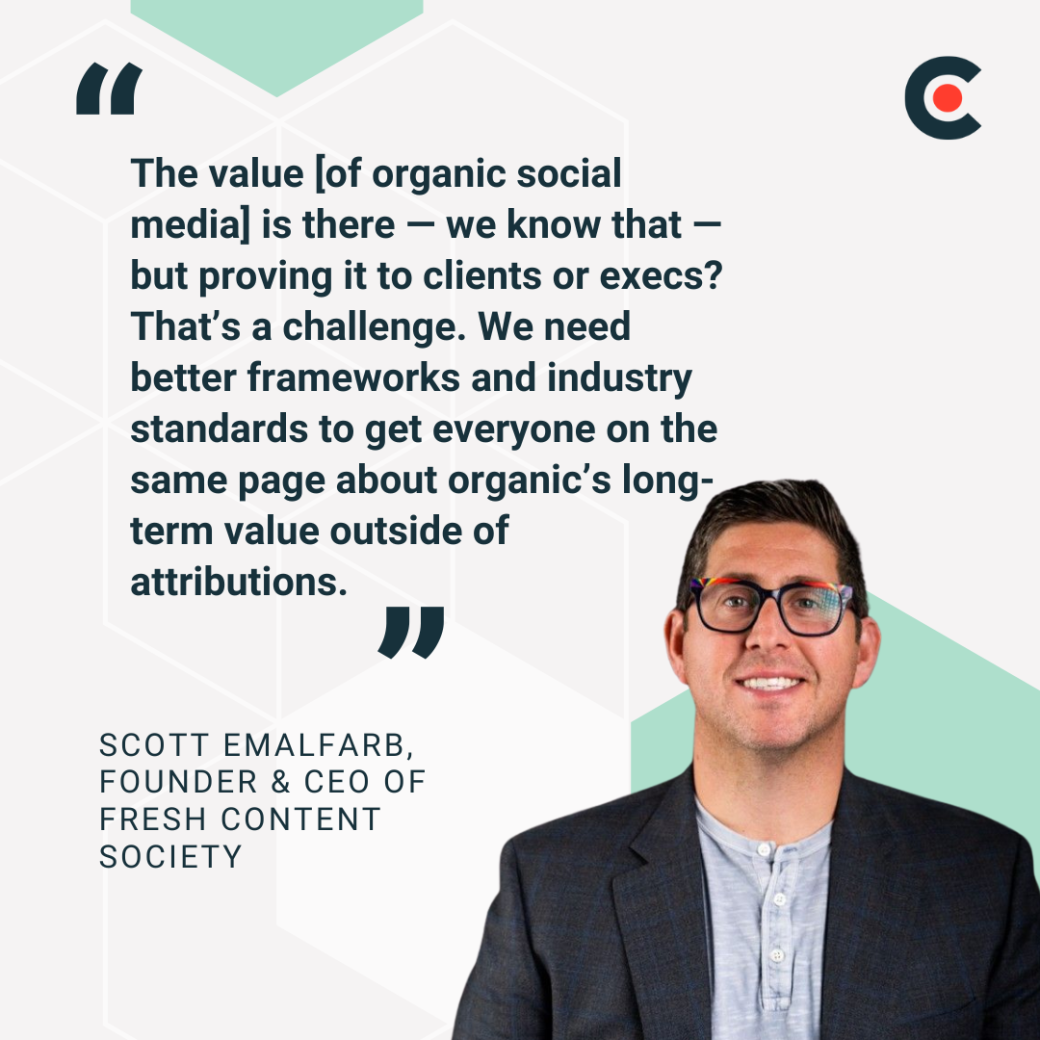
As a result, it can be hard to justify your social media marketing spend to stakeholders. Emalfarb adds, “The value is there — we know that — but proving it to clients or execs? That’s a challenge. We need better frameworks and industry standards to get everyone on the same page about organic’s long-term value outside of attributions.”
Generally, social media marketers need to identify the metrics that align with their business goals to show the impact of their work. Then, they need to assign a monetary value to those metrics based on the lifetime value of a customer, their conversion rate, and more.
Calculating your social media’s return on investment (ROI) enables you to measure the effectiveness of your marketing strategies. It also helps you identify the most successful content, so you can improve your efforts and grow your business.
ROI = ((Income earned - cost of investment) / cost of investment) x 100
For instance, if you spend $5,000 on an influencer campaign and estimate that the campaign generated $20,000 in revenue, your ROI would be:
(($20,000 - $5,000) / $5,000) x 100 = 300%
2. More Companies are Investing in Video
Text-based content still has a place, but audiences increasingly crave video — and short-form is where the engagement lives. Short clips earn roughly 2.5× more engagement than long-form video, and 49% of marketers now rank short-form as their highest-ROI format, ahead of any other content type . The pull is even stronger for business content specifically: 65% of viewers finish a business video under a minute, versus just 20% for videos over 20 minutes. For B2B teams, that’s a clear signal to lead with short, tightly focused clips.
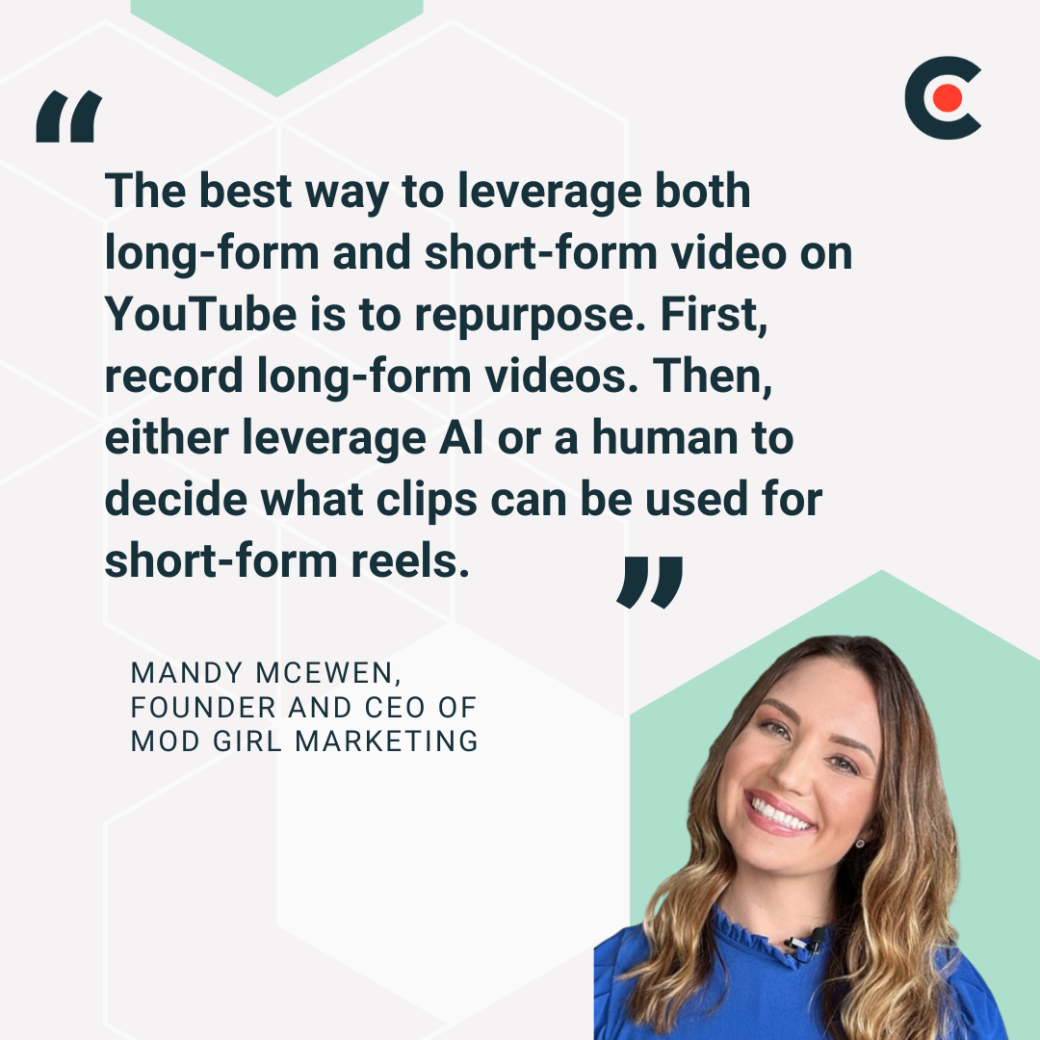
Platforms like Facebook and Instagram favor short-form video, while YouTube supports longer content. For many teams, repurposing is the way to invest more in video without multiplying the workload. “The best way to leverage both long-form and short-form video on YouTube is to repurpose,” said Mandy McEwen, Founder and CEO of Mod Girl Marketing. “First, record long-form videos. Then, either leverage AI or a human to decide what clips can be used for short-form reels.”
“The snappy, quick tips that can be explained in under 60 seconds — make those your reels. You can distribute them across YouTube, TikTok, Instagram, Facebook, LinkedIn, and X. Keep the in-depth explanations inside your longer videos,” McEwen continues. Mod Girl Marketing, for example, created a one-minute video teaching B2B clients how to optimize their LinkedIn profiles and shared it across channels: “This short-form video performed well … because it gives a simple tip that is applicable to anyone who has a LinkedIn profile.”
3. The Evolution of B2B Influencer Marketing
Partnering with influencers and content creators allows you to reach new audiences outside your usual networks. This strategy also builds your credibility. After all, people are more likely to trust recommendations from creators they admire than conventional ads.
People often use the terms influencer and content creator interchangeably, but they each offer value. Influencers are big names that have gained a loyal following for their personality or lifestyle — like Neil Patel. In contrast, content creators typically focus on producing videos in a specific niche, like cybersecurity or human resources.
B2B companies often struggle to choose between influencers and creators, unsure which one will have a bigger impact on their business. “There’s this ongoing tug-of-war between influencers and creators, right?” explains Emalfarb. “Influencers bring reach and recognition, but creators? They bring this creativity that resonates on a deeper level and often performs better long-term.”
Ultimately, Emalfarb recommends using both kinds of partners for B2B marketing. “We’re seeing brands grapple with who brings the most value, but it comes down to strategy: use influencers for reach and creators for relationship-building,” Emalfarb says. “Mixing them in a way that’s right for the brand takes finesse and strategic thinking.” By including both in your social media strategy, you can build your brand awareness and strengthen relationships with customers online.

4. Personalized Engagement on Social
Social media lets you engage with individual clients through comments, direct messaging, and posts. These personalized interactions increase brand loyalty and help customers learn more about your values. This engagement also lets you quickly respond to client concerns, protecting your reputation.
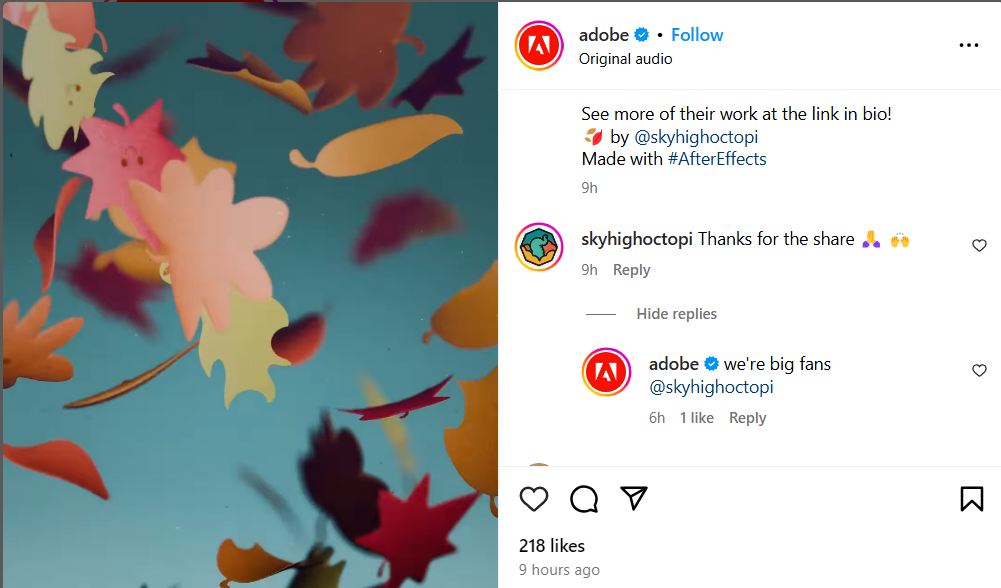
Adobe shares user-generated artwork created with its AfterEffects software on Instagram.
For instance, Adobe shares user-generated content on its Instagram page and responds to commenters. Similarly, HubSpot playfully responds to TikTok viewers with memes or lighthearted comments.
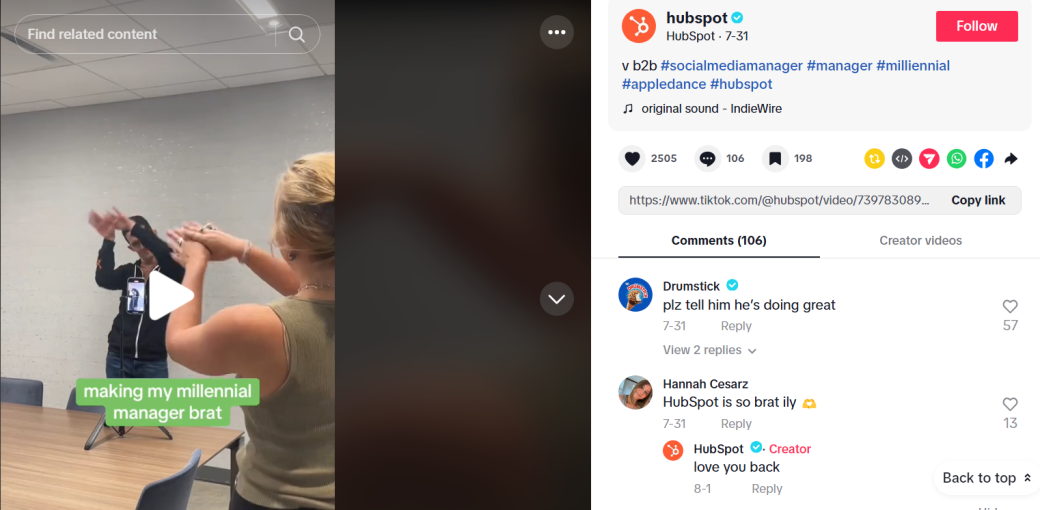
HubSpot often posts joking replies to user comments on TikTok.
These interactions make the brands seem more relatable and help users feel valued. Over time, this helps build brand loyalty and keeps your brand name top-of-mind.
5. Creating Platform-Specific Content
While it’s smart to repurpose content, you’ll need to tweak it for each channel. Facebook, TikTok, and other platforms have different features and user expectations. For instance, LinkedIn users typically prefer text-only posts, while Instagram is all about photos and videos.
“Each platform has its quirks, and the key to real growth is playing by those rules, but if you don’t have the resources, scaling this strategy can eat you alive,” Emalfarb explains. “It takes a solid game plan, a versatile team, and, frankly, enough budget to give each platform the attention it deserves without diluting the message.”
Yet, with proper planning and resource allocation, you’ll be able to leverage each social media platform to reach a wider audience or retarget those on multiple platforms. As you build out your content calendar, think about what you need to be successful on each platform, but also which platforms are most likely to help you reach your marketing goals. This will help you prioritize each channel and create more effective campaigns.
6. Leveraging AI is Still Topical
AI isn’t just a buzzword; it’s a core social media tool. Generative tools like ChatGPT and Jasper surface endless content ideas and speed up drafting, while text-to-image generators like DALL-E and Midjourney produce polished visuals in seconds. AI analytics tools can also deepen your read on engagement patterns.
The winning pattern in 2027 isn’t “AI vs. human” — it’s AI + human. Let AI accelerate ideation, drafting, and optimization, but keep human judgment on strategy, storytelling, and quality control before anything publishes. That efficiency creates room to test and iterate — which leads directly into the trend most likely to separate trusted B2B brands from the rest: being open about the AI you use.
7. AI Transparency and Disclosure Become a Competitive Edge
As AI moves deeper into B2B content pipelines, a new expectation is hardening around it: audiences want to know when AI was involved. That expectation is being set on the consumer side of social first — and B2B buyers are the same people scrolling the same feeds.
In Clutch’s 2026 survey of 601 consumers, nearly 90% said it’s important for brands and creators to disclose AI-generated content, and 30% reported seeing an unlabeled piece of AI content more than 20 times in a single month. More pointedly for marketers weighing how far to lean on AI: 53% said they’re less likely to buy from a brand they know uses AI in its social content.
Read carefully, that last figure isn’t an argument against using AI — it’s an argument against using it opaquely. The same research found consumers view AI positively when it adds clear value (42% for educational content); the trust penalty lands when AI is used to misrepresent or is hidden. For B2B brands, the takeaway is a disclosure habit, not an AI ban:
- Label AI-assisted and AI-generated content where it’s used, in captions or credits.
- Disclose how AI was involved — “edited” vs. “generated” earns more trust than a blanket “made by AI.”
- Keep a human accountable for accuracy and strategy, and say so when it matters (see Trend 6).
- Frame disclosure as part of the process, not a warning label — e.g., “We used AI to visualize this concept.”
Handled well, transparency lets B2B brands capture AI’s speed and cost advantages without paying the trust penalty — a genuine edge as more competitors quietly automate. For a deeper look at the consumer expectations behind this shift, see Clutch’s research on whether brands should disclose AI use and real AI disclaimer examples.
The 7 B2B Social Media Trends at a Glance
| Trend |
What to do about it |
| Measure organic social ROI |
Tie metrics to business goals; assign monetary value |
| Invest in video |
Record long-form, repurpose into short vertical clips |
| B2B influencer marketing |
Use influencers for reach, creators for relations |
| Personalized engagement |
Reply, DM, and feature UGC to build loyalty |
| Platform-specific content |
Tailor format to each channel's norms |
| Leverage AI (AI+human) |
Automate drafting/optimization; keep humans on strategy |
| AI transparency & disclosure |
Label AI use; disclose how; frame it as process |
Put These B2B Social Media Trends To Work in 2027
Organic social remains one of the most effective ways to engage B2B buyers and drive sales — even if its ROI is harder to prove than paid. The 2027 edge comes from pairing AI’s efficiency with the human judgment and transparency that audiences now expect. Experiment with these seven trends to keep your content fresh, grow visibility, and stay top-of-mind with the clients who matter. Need a hand with your social campaigns? Browse Clutch’s directory of social media marketing partners for vetted expert help.
Frequently Asked Questions
Measuring organic social ROI, investing in video, evolving B2B influencer marketing, personalized engagement, platform-specific content, leveraging AI with a human in the loop, and — increasingly — being transparent about AI use.
Increasingly, yes. Nearly 90% of consumers say AI disclosure matters, and 53% are less likely to buy from a brand they know uses AI — a penalty that falls hardest on brands that hide it rather than those that use AI to add value. Labeling AI-assisted content and explaining how it was used builds trust rather than eroding it.
LinkedIn remains the anchor for B2B reach and lead generation, but the strongest programs are multi-platform — repurposing video and tailoring content to each channel’s norms rather than betting on one.
Yes. Short clips consistently out-engage long-form, and a repurposing workflow (record long, cut short) lets B2B teams feed multiple channels from a single shoot.
About the Author
Hannah Hicklen
Content Marketing Manager at Clutch
Hannah Hicklen is a content marketing manager who focuses on creating newsworthy content around tech services, such as software and web development, AI, and cybersecurity. With a background in SEO and editorial content, she now specializes in creating multi-channel marketing strategies that drive engagement, build brand authority, and generate high-quality leads. Hannah leverages data-driven insights and industry trends to craft compelling narratives that resonate with technical and non-technical audiences alike.
See full profile