TikTok’s Creator Fund has revolutionized the digital economy for influencers, content creators, and even businesses. The program rewards creators for producing high-quality, engaging, and original videos. In this article, we’ll tackle the current state of the creator economy and how the Creator Fund is doing in 2025.
The creator economy will continue to soar in 2025. Thanks to TikTok’s global success and a new push for widespread digitalization, more social media users are monetizing their content than ever before.
In fact, the creator economy as a whole received upwards of $900 million in VC funding in 2024 alone, as top investors took a chance on popular creator platforms such as TikTok and Instagram.
Looking for a Social Media Marketing agency?
Compare our list of top Social Media Marketing companies near you
From angel investment and seed funding to platform-based monetization such as the TikTok Creator Fund, a new era of VC investment is rising, and social media is at the heart of its success.
The question is, how can your brand benefit from the creator economy? Read on as we delve into what the future has to hold for the creator economy and discuss what a peak in VC funding could mean for social media marketing in 2025.
Creator Funding is On The Rise
Investing in social content creators continues to remain a trend amongst investors in 2025.
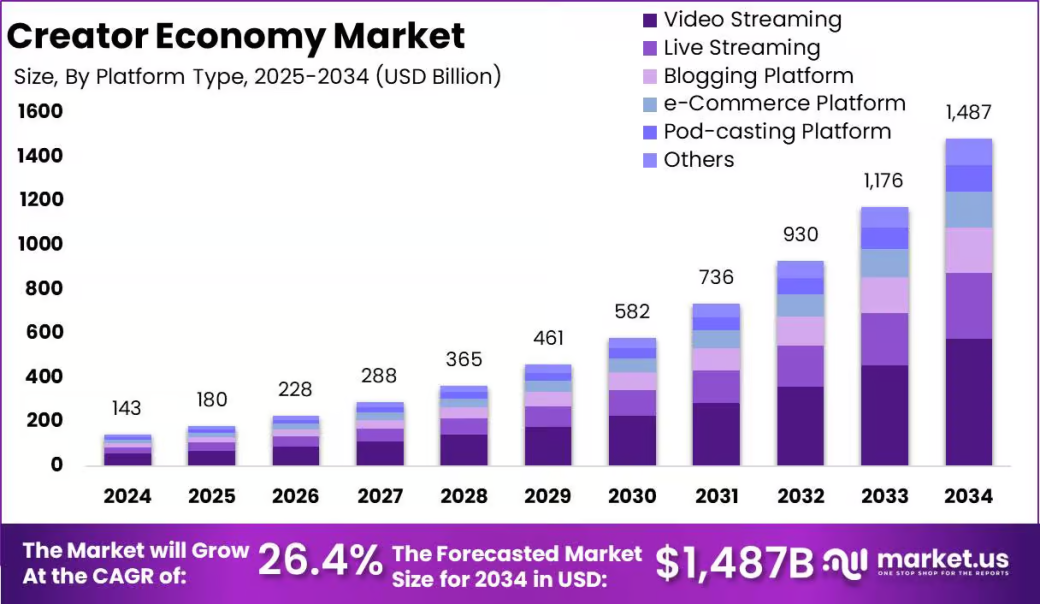
With a forecasted market size of $1,487 billion by 2030, funding continues to pour into video streaming on apps such as TikTok and, more recently, podcasting on Apple Podcasts and Spotify.
Source
In June 2022, YouTube veteran Caspar Lee and private equity expert Sasha Kaletsky released the first creator-founded, creator-backed venture fund, Creator Ventures, which aims to organically boost the creator economy and provide access to growth tools and insights for budding entrepreneurs.
After raising $20 million, the funding aims to support consumer socials and front-of-house creators and boost social media-based e-commerce. Popular YouTube creator Caspar Lee aims to invest $100-500k in series A startups and use his expertise to influence a new generation of creators.
“They like the idea that we understand the space which a lot of them now — especially in consumer social — need to understand when building businesses,” Lee stated. “They love how, through us as a platform, they can access various incredible creators and celebrities who can add great value.”
The Impact Of The TikTok Creator Fund
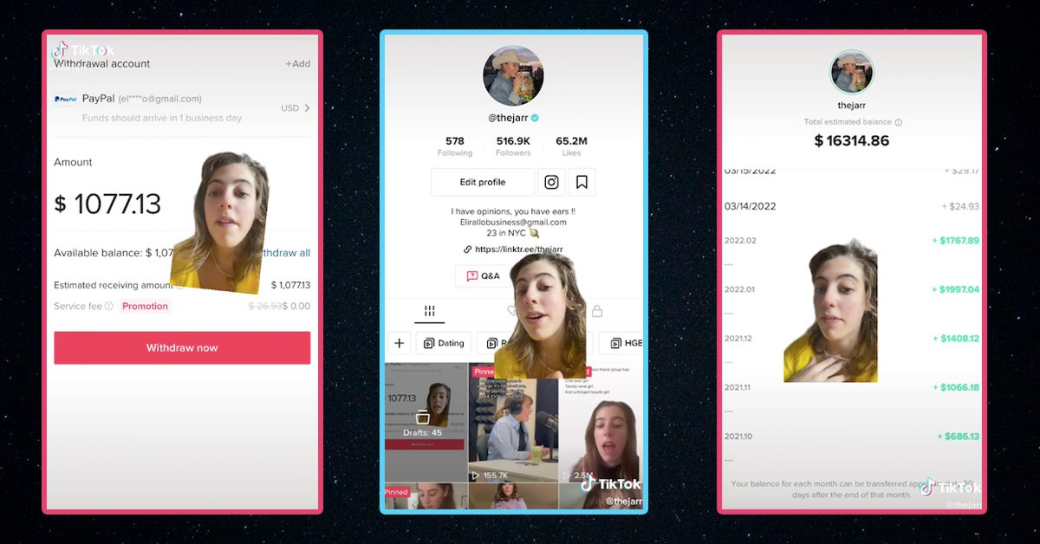
The TikTok Creator Fund took off in 2021. After an initial investment of $200 million in 2020, TikTok is aiming to expand the fund and hit a $1 billion goal by 2026.
Source
TikTok’s Creator Fund is based on creator metrics. These metrics measure a creator’s ability to reach a certain number of views and receive a high level of engagement. The Creator Fund is accessible to any TikTok consumer with the potential to go viral and follow TikTok’s mission statement, which states that all content should “inspire joy and creativity.”
The fund’s initial mission was to provide budding creators with the opportunity to rise up amongst their demographic without the need for large-scale outsourcing of funding. In response, 56% of the platform’s users have claimed they are inspired to create content after the fund promised to open itself up to a wide and diverse range of creators.
Creators receive funds through a series of digital transactions attributed to engagement stats and viewership. In return, TikTok is able to capitalize on a creator’s platform popularity and incentivize more content from its one billion users.
The question is, what could this mean for the future of social media creation? Has the Creator Fund's introduction changed how we communicate on social media?
Navigating Potential Challenges For TikTok Creators In 2025
While the Creator Fund may have raised the bar for social influencers in the last five years, there are still many challenges associated with entering into the creator economy as a creator and a brand.
Some of the challenges are:
- Potential TikTok ban
- Evolving algorithms that change the way content gets discovered
- Rising advertising costs
- Increased competition
- Ever-changing trends
- New platforms that enter the market
- Unethical data collection by some platforms
Navigating the Impact of a Potential TikTok Ban
While America’s short-lived TikTok ban was recently revoked, its potential to strike again in the future in the US or any other country for that matter poses a risk to those relying solely on TikTok’s Creator Fund for their income.
While it was brief, any ban on the TikTok platform could have easily severed audience connections, reduced follow rates, and disrupted any established pathways to monetized content.
For some, this could mean starting from scratch, especially if they were not frequenting a parallel platform such as Instagram or YouTube to share content.
The Economic Impact of an Evolving Algorithm
While TikTok has opened up many avenues for social media creators to monetize their content, income from these videos is less than stable as the algorithm constantly changes. A content format that was popular last week may be redundant tomorrow, so this becomes a risk for those who gamble their income on monetized content.
The modern-day TikTok landscape requires creators to be agile and extremely adaptable to all trends as they come in and out. Diversifying content formats will be essential if creators want to make the most out of the Creator Fund in 2025.
The key to succeeding as part of the creator economy is to add additional revenue streams from other creator funding options such as affiliate brand deals, influencer partnerships, YouTube funding and Patreon.
For example, an affiliate marketer can make up to $8,038 per month, according to experts from Hostinger.
As a content creator, it’s important that you’re earning money from your content in numerous ways. While the content itself may be monetized by TikTok, share affiliate product links and discounts in the caption to reinforce the success of a singular post.
How Does The Creator Fund Affect Brands?
With the Creator Fund in play, it’s no surprise that social media success is becoming harder on a modern-day playing field.
93% of marketers claim that social media competition has accelerated in the past few years. In the age of the digitally native consumer, both creators and advertisers must fight against an active audience for attention amongst popular platforms such as TikTok.
This said, a creator fund, like the one on TikTok, can impact a brand positively when used to its full potential.
While brands can’t receive payment as creators on platforms such as TikTok and Instagram, they are subjected to a broader pool of potential collaborators with a new incentive to produce as much content as possible.
With this in mind, let’s examine some of the advantages of the Creator Fund for brand marketing in 2025.
- Improved Content Quality: Creators who are well-funded are more likely to produce higher-quality content to maintain their status on the platform. With the ability to refine their skills, pour focus into their social media work full-time, and invest in powerful equipment, funded creators appear more attractive to brands looking for collaborations.
- Larger Pool Of Talent: With the Creator Fund in play, more creators than ever before are rising up within every niche and field they can fill in the hope that they can turn TikTok into their full-time job. This motivation breeds powerful content and widens the talent pool for brands from all industries.
- Higher Levels Of Audience Engagement: Funded creators tend to be more passionate about their niche and grow exponentially within their target community. This suggests that any partnered content will likely receive high levels of engagement, too.
While there tend to be more benefits for brands than negatives when it comes to the Creator Fund, it’s still a risky business that should be approached with caution.
Funded creators can still lose their accounts, get banned, and/or canceled by their own audience. The key to creating a successful brand X creator partnership is to choose a long-standing creator who has risen organically as an opinion leader within their niche. These types of influencers are safer bets than a small account that went viral overnight.
Creator Economy is Shaping The Future of Social Media
There’s no doubt that the creator economy is on the rise. The question is, can it be trusted?
In an era where more than half of social media content creators rely on the Creator Fund for a full-time income, the risks associated with trend switches, platform bans, and rising competition are volatile and should be cautiously approached.
The creator economy will certainly transform the future of social media consumption. The question is, who will come out on top?
About the Author
Dmytro Spilka
Director and Founder at Solvid
Dmytro is a Head Wizard at Solvid, a creative inbound marketing & software development agency in London. His work has been featured and mentioned in a wide range of publications, including The Next Web, Business2Community, Huff Post, Kissmetrics, Crazy Egg, Sitepoint, SEMRush, and more.
See full profile