How to choose the most effective platform for your digital marketing campaign? Grounded in practical expertise and hard data, the article offers insights into platform dynamics, promising content distribution channels, and optimal platform-related solutions.
A vital starting point for a digital marketing campaign would be to analyze the work of social media platforms, as they are the major hubs of online audiences and chief distribution channels of online content. While the supreme authority of social media platforms is axiomatic, there are figures to illustrate the magnitude.
Roughly 95% of Internet users are active on social media and are not confined to one channel of choice: a typical social media user visits more than 6 platforms each month. On average, users spend around 2.5 hours on social media daily, which makes up 14% of their waking time. Moreover, users appreciate the marketing opportunities brought about by social media: such platforms are the number one way to learn about brands and discover new products for Gen Z and Millenials.
Looking for a Social Media Marketing agency?
Compare our list of top Social Media Marketing companies near you
Building a successful social media presence requires a solid strategy with creative takes and influencer efforts, yet this is the next step to be undertaken jointly with a specialized agency. For now, let’s discuss the starting point.
Looking to hire improve your social media marketing strategy? Search for industry-leading social media companies on Clutch.
How to Choose the Most Effective Platform
To get started, it might be useful to evaluate key metrics that help gain valuable insights into the competitive landscape and identify the top-performing platforms. Metrics reflect the market dynamics and, thus, provide a solid foundation for comparing different options.
Which Platform Is the Leader
A wide range of metrics can be used to track the success of different platforms. For instance, Facebook appears to be by far the most popular social media by number of monthly active users, with YouTube and Instagram trailing behind as second and third.
At the same time, Facebook shares third place with YouTube for ROI, while TikTok proved to be the most profitable platform, showing a 54% ROI effectiveness, followed by Instagram with a 52% result. Expert forecasts are in line with this dynamics: TikTok short videos are predicted to deliver the best ROI by over half of experts, while Instagram Reels are in second place backed by 30% only.
Moreover, TikTok appears to be the social media platform used most widely in influencer marketing: over 68% of campaigns utilized TikTok, compared to 46% for Instagram and 33% for YouTube.
One of the most important metrics in influencer marketing is Cost per mile (CPM): the cost an advertiser pays for one thousand impressions an ad receives. Naturally, it varies significantly according to different business segments and specific influencer channels, yet, the average CPM can be tracked for every platform. Among major platforms, the most attractive CPM is found on Twitter and YouTube — $1.73 and $1.81 respectively, according to the latest 2024 data.
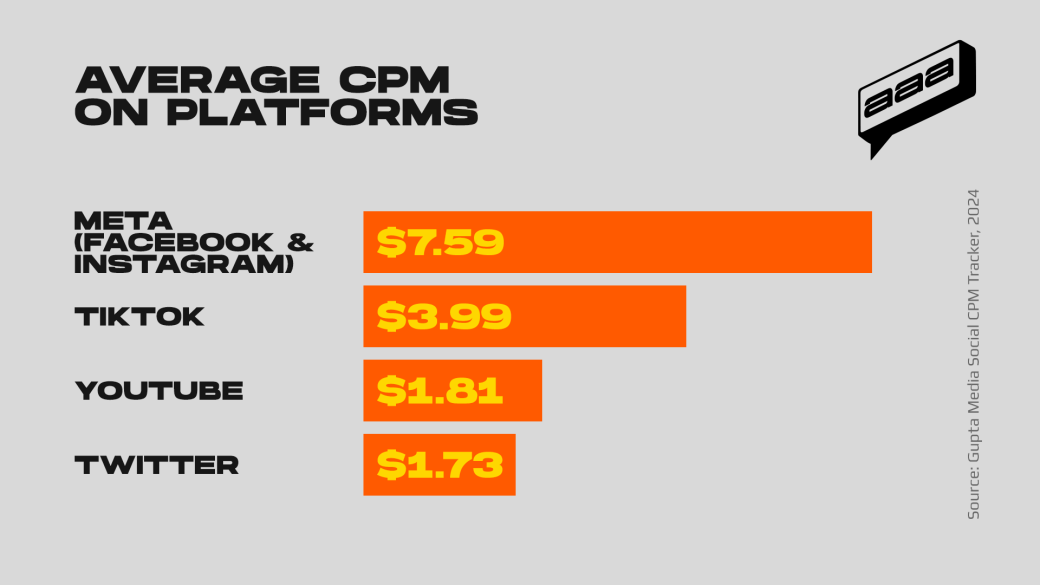
While this is just a snapshot, the picture is already quite diverse—some figures inevitably point to TikTok being the best go-to option, while others make YouTube seem far more attractive. This proves that each of the leading platforms can be highly efficient for different purposes, so metric analysis should always be integrated into the larger context of your campaign’s needs.
How to Make the Right Choice
The platform’s effectiveness largely depends on the specific goals of each campaign, the target audience, and your content’s niche. These three aspects are key factors to consider while choosing the platform.
Strategic goal
The golden rule is that your goals shape your campaign, including the platforms to host it. For instance, if you aim for brand awareness, Instagram might be an optimal choice: highly visual, it allows brands to produce eye-catching content and build a memorable brand image. If you wish to drive engagement, sparking discussions on Twitter might be a perfect strategy to shake your community. Community building sounds like a perfect task for streaming platforms, such as Twitch and Discord, whereas good old sales promotion and conversions can be achieved greatly through Facebook due to its immense audience and tradition for customer service interactions.
Target audience
While platform audiences are diverse, certain statistics about audience age, gender and GEO may guide brands toward choosing the platform where their consumers are likely to be large in number. For instance, TikTok and Snapchat are rock-solid ways to reach Gen Z and connect with younger audiences, whereas Facebook and YouTube are go-to platforms for targeting Millenials. Male audiences can be reached successfully on Twitter, while women are more active on Pinterest. Attention should be paid to country-specific preferences as well: for example, the Gulf region is heavily reliant on WhatsApp and sees the rise of Twitter usage, while most of Latin America is penetrated by Facebook.
Content niche
A necessary step for making an informed decision is to analyze the content that defines your potential platform of choice. For example, Instagram and TikTok are overflowing with visually appealing videos promoting fashion and beauty products; Twitch, Discord, and Reddit are the platforms to reach gaming audiences; while Twitter mostly revolves around social and political endeavors and, along with LinkedIn, is a perfect platform to promote B2B brands.
While painted in broad strokes, this overview gives a general idea of the key areas to focus on and briefly maps the platform landscape. Overall, we have attempted to build a roadmap to guide brands to their perfect platform, but separate analysis is needed for a more nuanced understanding of each option.
What New Platforms to Try
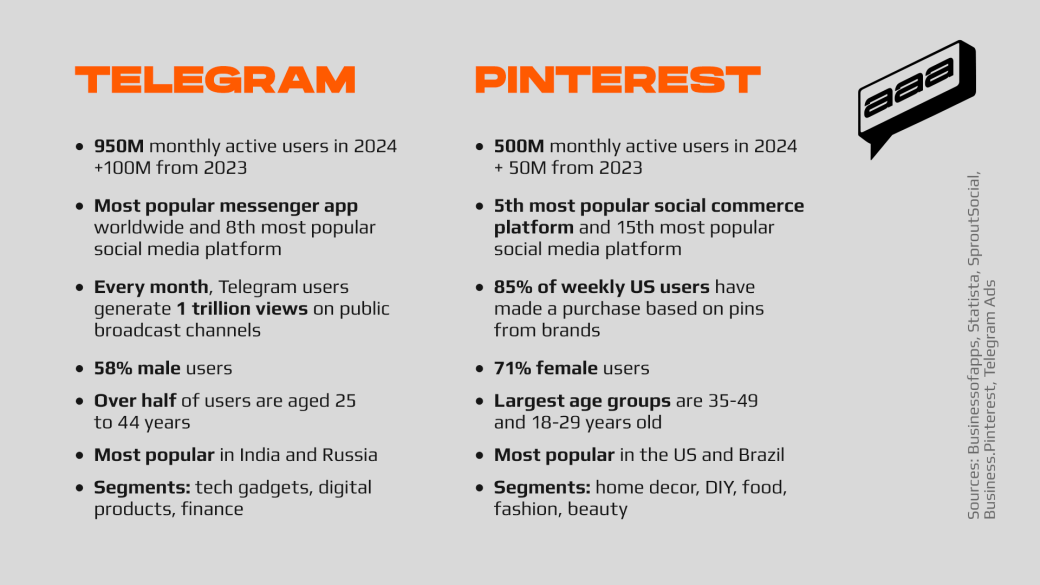
While popular social media platforms are a tried-and-tested way to build a media presence and connect with consumers, exploring new platforms brings many more opportunities. Being flexible, leveraging new platform-specific affordances, and experimenting with new formats and features is crucial for expanding reach, adapting to changing consumer tastes, and staying one step ahead of the curve. Our top two picks in the current market are Telegram and Pinterest.
Telegram
Telegram is rapidly expanding its user base beyond the CIS region. It has become a global hub for both personal and business communication and a platform for leading media outlets and blogs. We anticipate that Telegram will soon unveil new features, particularly in the realm of retail.
Two major options for businesses on Telegram are channels and groups. Groups offer a dynamic environment for real-time interaction with the audience, perfect for fostering a sense of community and building authentic relationships. Channels function similarly to traditional one-way broadcast platforms, providing an opportunity to reach wider audiences and establish brand authority. Thus, groups are a better fit for brands focusing on personalized offerings and deep community engagement, while channels are well-suited for businesses striving to inform and educate their audiences.
One of the most powerful benefits of Telegram is its potential for personalized reach: channels and groups appear directly in user’s chat lists, increasing visibility by a large margin. Other perks include in-built monetization opportunities through subscription-based models, easy-to-integrate bot-led automation, and robust data protection through encrypted communication.
Pinterest
The platform's all-time peak came during the COVID-19 pandemic, specifically during lockdowns and subsequent periods. Confined to their homes, millennials created mood boards featuring cozy living spaces, seeking inspiration and motivation. Currently, the platform sees another wave of growth driven by Generation Z, whose lifestyle is centered around aesthetics. They are fond of curating aesthetics — from seasonal themes to overall lifestyles — often resorting to mood boards to visualize their ideas.
Pinterest is a highly visual platform, which makes it an ideal marketing tool for visual-driven industries within eCommerce. 97% of searches on Pinterest are unbranded, showing that people use the platform as a discovery tool. Thus, the platform facilitates brand awareness through strong visual components and boosts visibility due to the specifics of audience behavior.
A strong advantage of this platform is high audience engagement: Pinterest drives 170% more total attention compared to other platforms. Moreover, pins have a long lifespan, allowing for long-term brand engagement, while anchor links can drive traffic to eCommerce websites.
How to Optimize Content
Each platform offers unique features to wrap the content around, yet there are general trends to take into account while building a presence on any social media platform.
Mobile Optimization
A vast majority of online audiences consume content from mobile devices. Not every household disposes of a laptop or a PC, but smartphones appear to be the most accessible devices worldwide. Notably, the number of logins from mobile devices peaks in Asia and Africa, while Latin America, Europe, and the US are more reliant on stationary devices.
Still, smartphones are widely regarded as the most convenient way of accessing social media. Thus, short and digestible text pieces and quickly loading media are major goals for mobile optimization.
To maximize reach, consider scheduling your integration based on user behavior. Thus, if you opt for mobile devices, your integration should be posted closer to the evening, while the daytime launch is a better fit for desktop integrations.
Short Multimedia Formats
Short videos continue to reign supreme in terms of preferred content type. Videos under 15 seconds lead the way, followed closely by slightly longer videos between 15 and 30 seconds.
At the same time, formats may vary by the specific preferences of the target audiences. For understanding, a sports integration targeting Brazil should take the form of a horizontal YouTube video, whereas a gaming integration in Singapore will deliver better results when carried out in a vertical format on TikTok. In this case, the decision will be largely determined by YouTube’s strong sports community and the rise of gaming content on TikTok, as well as TikTok’s roaring popularity in Singapore.
Moreover, it’s worth exploring format preferences for each specific platform. For example, 78% of Instagram audience use the app to view Stories, a potential that should not be overlooked in light of the Reels popularity.
How to Create a Year-Round Strategy
While digital marketing campaigns can incorporate strategies based on seasonal trends, such as holiday campaigns and major sales events, there is no pronounced dependency on seasonal fluctuations in terms of user activity and platform engagement. Mobile devices offer unparalleled flexibility, allowing people to consume content on the go anytime, from busy work schedules to leisurely vacations.
Thus, brand strategies are largely driven by the brand’s vision and market conditions. A well-crafted strategy ensures that channels and activities are optimized to engage and retain your audience year-round. Efforts of this kind require a nuanced understanding of the market, so reaching out to a team of professionals might be a perfect way to streamline the process.
Notably, the latest trend leans towards a multi-platform, mixed-media approach, since it unlocks greater creative potential and allows brands to transform advertising into advertainment. That said, understanding the unique capabilities of each platform and building a well-thought-out presence on the most relevant ones is a foundational step.
About the Author
Kira Chesalina, the Creative Director at AAA Agency, an international influence and special projects agency. AAA Agency creates authentic brand stories through collaborations with the best influencers and build audience trust with our clients.
Gaming stands as the cornerstone of AAA Agency's expertise. We specialize in crafting and implementing profitable Influencer Marketing initiatives tailored for game publishers. Our experience is proven by 100+ successful cases from satisfied clients: Wargaming, NCSoft, Lilith Games, Ubisoft, etc. And for 2023, the total reach of our campaigns in the Gaming vertical was about 11,000,000.
About the Author
Kira Chesalina
Creative Director at AAA Agency
Kira Chesalina, the Creative Director at AAA Agency, an international influence and special projects agency. AAA Agency creates authentic brand stories through collaborations with the best influencers and build audience trust with our clients.
Gaming stands as the cornerstone of AAA Agency's expertise. We specialize in crafting and implementing profitable Influencer Marketing initiatives tailored for game publishers. Our experience is proven by 100+ successful cases from satisfied clients: Wargaming, NCSoft, Lilith Games, Ubisoft, etc. And for 2023, the total reach of our campaigns in the Gaming vertical was about 11,000,000.
See full profile