Lead Quality vs. Lead Quantity: Why B2B Teams Are Rethinking Their Funnel in 2026
Bigger buying committees and tighter budgets are forcing B2B teams to rethink lead quality vs. quantity. Here's how top teams rebalance the tradeoff in 2026.
Updated May 29, 2026

Influencer marketing is one of the strongest approaches a brand can use to communicate with the audience. While traditional metrics can tell us a lot, they are not the whole picture. Sentiment analysis shows the true feelings of target audiences toward the brand’s campaigns and products.
Brands use advertising to communicate with their target audience, and influences are the messengers that carry brand ideas forward. Within this flow, brands naturally need some kind of feedback to know if the message has hit the target. Of course, we have metrics, engagement rates, and sales numbers — the solid figures. But what about emotions? While the numbers are very useful, they do not paint the full picture of an ad campaign.
That is why brands need sentiment analysis. It’s a marketing tool that helps brands look into the hearts of their followers. Using sentiment analysis can give you information about the reception of your brand’s partnerships with influencers on a more emotional level.
Looking for a Digital Marketing agency?
Compare our list of top Digital Marketing companies near you
The strategic application of brand sentiment measurement lies in identifying early warning signs of reputational risk and crisis mitigation.
Sentiment analysis (opinion mining) uses NLP and AI to determine whether an audience's feelings toward a brand are positive, negative, or neutral.
This analysis covers reviews, social media posts, and surveys to gauge the audience’s sentiment on a spectrum: positive, negative, or neutral. The newer tools driven by machine learning make it possible to understand more shades of meaning in the audience's feedback and make more informed decisions.
Sentiment analysis is important for brands because basic metrics such as audience reach, sales, views, and likes are not enough to understand the true impact of their content and products.
So, how exactly can brands benefit from sentiment analysis?
Of course, this is not an exhaustive list, but the main application areas of sentiment analysis already show it to be a powerful tool for brands.
Sentiment scores are calculated using two primary formulas: subtracting positive from negative words divided by total words, or the ratio of positive to negative words plus one. Your data type determines which method you use to accurately calculate sentiment scores.
Method #1: A total of positive words versus negative words in a given text. This method is often used for long-format content, such as big product reviews.
Formula: # negative words – # positive words divided by the number of words = sentiment score

In this example, marketers used a code to calculate the total number of words in each user review, and then assigned positive and negative labels to the words based on an existing list known as the Opinion Lexicon. Knowing these three values (positive words, negative words, and total number of words), marketers calculated the sentiment score for every user review following Formula #1.
Method #2: Ratio of positive and negative word counts
Formula: # positive words / # negative words + 1 = sentiment score
This method is preferable for scoring big data because it includes both positive and negative words. This way, the longer reviews do not affect the score too much, and the average result is more manageable. In this system, a score of 0 is exactly in the middle, or neutral. A higher score is related to positive, and a lower score is related to negative.
Brands like Airbnb, Peloton, and Nike demonstrate how sentiment analysis can mitigate backlash, amplify positive messaging, and guide agile campaign management. These cases highlight the shift from reactive monitoring to proactive emotional alignment in modern marketing.
In 2016, rental provider Airbnb used sentiment analysis to gauge public opinion and stem the public backlash after being accused of discrimination.
By actively monitoring social listening channels, the brand identified key areas of user frustration and tailored its messaging accordingly.

The brand launched its “We Accept” campaign, which not only helped repair Airbnb's reputation, but also contributed to real anti-discrimination efforts across the globe. The sentiment recovery result was significant, shifting the narrative from overwhelmingly negative to a unified, positive community response.
Peloton failed to apply sufficient sentiment analysis when choosing the influencer and tone for their controversial Christmas ad. The campaign was quickly labeled sexist and caused a lot of resentment among the company’s audience.
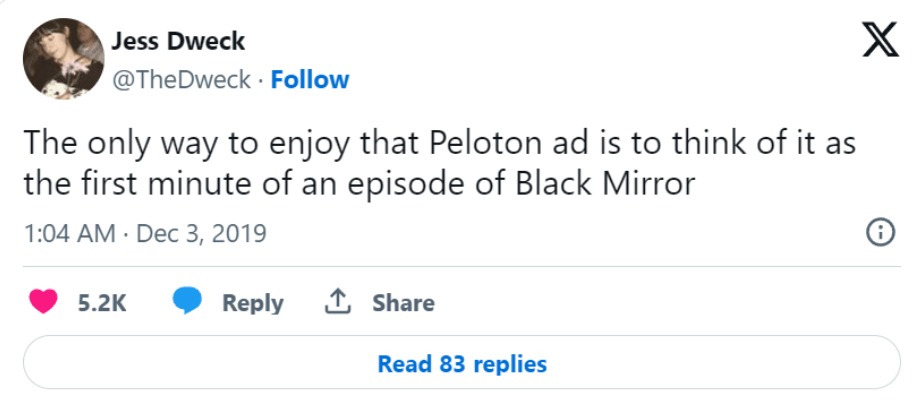
Ignoring these insights leaves brands vulnerable to reputational risks. Sentiment analysis could have helped the brand identify the potential for negative perceptions early and adjust the ad or select a different influencer better aligned with their brand values.
In 2019, Nike monitored real-time reactions across social media to identify which messages and athletes generated the most positive sentiment toward the company. The “Dream Crazier” campaign featured female athletes and was narrated by Serena Williams, the main idea being challenging gender stereotypes in sports. 
Sentiment analysis enabled agile campaign management and helped Nike navigate potential controversy.
Brand sentiment analysis relies on core technology like Natural Language Processing (NLP) and machine learning to track emotions across platforms. The market offers a slew of sentiment analysis tools, including Brandwatch, Talkwalker, and Meltwater, which utilize these architectures to provide real-time insights.
The key features of such tools usually include sentiment tracking across different platforms in real time, textual and visual content recognition, and analyzing performance metrics. However, every service is unique:
The table below compares the four leading platforms across core capabilities, ideal use cases, and pricing structure:
| Tool | Key Features | Packages | Best Used For | Pricing |
| Talkwalker | AI-powered sentiment analysis, multi-channel analytics, image recognition, customizable dashboards | Listen, Analyze, Business, Premium | Deep brand sentiment insights and competitive analysis; influencer marketing with heavy visual content | Custom pricing based on requirements |
| Brandwatch | AI-driven sentiment analysis, advanced data visualization, historical data access, flexible APIs | Consumer Intelligence, Social Media Management, Influencer Marketing | Comprehensive market research, competitor analysis, and influencer campaign tracking | Custom pricing based on requirements |
| Meltwater | Real-time media monitoring, multilingual sentiment analysis, influencer identification | Essentials, Advanced, Suite, Enterprise | Extensive media monitoring (including traditional/offline) and influencer identification | Custom pricing based on requirements |
| Sprout Social | Sentiment analysis, CRM integration, advanced analytics, social listening, influencer tracking | Standard, Professional, Advanced, Enterprise | Comprehensive social media management with CRM integration for influencer marketing | Standard $199/mo · Professional $299/mo · Advanced $399/mo · Enterprise custom (per seat) |
Note: Sprout Social is the only platform of the four with publicly listed pricing — the others require a sales conversation to sc
Selecting the right sentiment analysis tool requires evaluating three core factors: your target audience demographics, specific campaign goals, and relevant data sources. Answering the following questions would be a good starting point in the selection process:
Integrating sentiment analysis into influencer marketing involves three main steps:
Effective sentiment analysis requires setting specific numerical goals and combining sentiment scores with traditional metrics, while avoiding over-reliance on automated, context-blind calculations.
Effective sentiment analysis requires setting specific numerical goals and combining sentiment scores with traditional metrics, while avoiding over-reliance on automated, context-blind calculations.
The primary business ROI of brand sentiment analysis includes higher customer loyalty, reduced churn, and improved customer lifetime value. Positive sentiment directly increases repeat purchases, recommendations, and advocacy, making it a critical behavioral influence metric.
For best results, implement sentiment analysis at all stages of your advertising campaigns, from planning to post-campaign assessment.
Complementing sentiment scores with metrics such as brand mentions, reposts, comments, etc is important. Combined with your existing expertise, sentiment analysis can elevate your marketing strategy to a whole new level and lead to more successful partnerships.
Kira Chesalina, the Creative Director at AAA Agency, an international influence and special projects agency. AAA Agency creates authentic brand stories through collaborations with the best influencers and build audience trust with our clients.
Gaming stands as the cornerstone of AAA Agency's expertise. We specialize in crafting and implementing profitable Influencer Marketing initiatives tailored for game publishers. Our experience is proven by 100+ successful cases from satisfied clients: Wargaming, NCSoft, Lilith Games, Ubisoft, etc. And for 2023, the total reach of our campaigns in the Gaming vertical was about 11,000,000.