Evaluating an Marketing Agency in the AI Search Era
AI search has completely changed how people interact with online content. When an AI summary appears at the top of search results, Google users only click a...
Updated January 12, 2026

If your paid social efforts are stalling, the problem is likely with your creative. See here how leading teams are fixing ROI with performance-driven content.
Most teams are still trying to improve their performance by allocating better targeting or increasing their budget.
It’s a waste of time.
By 2026, media buying will be largely automated. Everyone’s using the same platform tools. Bidding, placements, and audiences are handled by AI. And the only thing left that actually impacts return on investment (ROI) is creative.
That’s why performance creative has become the growth engine for paid social. Not brand storytelling or “content pillars.” Just content that converts: tested, iterated, and built to drive CAC down and ROAS up.
And the budget shift proves it. Nearly 60% of marketing spend now goes to performance. Without the right creative, that spend goes nowhere.
Next, we’ll break down how performance creative is transforming paid social ROI in 2026, including frameworks, examples, and the strategies top agencies are implementing to stay ahead.
Performance creative is content built to sell, measured by CAC, ROAs, and CTR instead of aesthetic alignment or brand storytelling. And heading into 2026, it’s the only creative model that makes sense for paid social media advertising.
Why? Because everyone’s using the same tools.
In performance marketing, targeting, bidding, and placements are all standardized across social platforms. And the old tricks (audience segmentation, dayparting, ad scheduling) don’t drive results like they used to.
Creative is now the edge. And platforms know it. For instance:
This shift puts pressure on the creative content itself, and performance creative is built for that. It’s designed around buyer psychology, tested at scale, and optimized for conversion.
That’s why it’s now central to any performance strategy that expects measurable results in paid social media ROI.
Still spending hours inside Ads Manager trying to outsmart the algorithm? You’re solving the wrong problem.
Now, platforms do the buying for you. Meta Advantage+, TikTok Smart Performance, and Google PMAX… all of them minimize human input. Audience targeting and bid optimization are automated. The real differentiator is creative.
And the data proves it:
So yes, the best teams are fixing creative instead of adjusting budgets.
In real ad campaigns, fresh creative outperforms recycled content by two to four times. New hooks, better angles, platform-native formats; these are the variables that drive real lift. Especially on TikTok, where ad fatigue kicks in fast.
Paid social needs better inputs, not more spending. And creative is the only one left that you still control.
Better ads don’t happen by accident. Performance-driven creativity means setting up repeatable processes that identify what works, then scaling it quickly.
The teams that win run systems that make testing easier, iteration faster, and results more predictable.
This framework breaks that down into three parts:
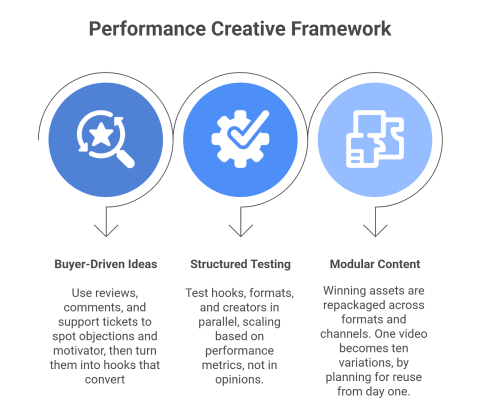
Each piece feeds the next. When all three are in motion, creative becomes a growth engine.
Let’s break it down.
Good creative starts where your buyer is.
The best teams mine support tickets, reviews, Reddit threads, and post comments to find real objections, questions, and motivations.
Instead of writing hooks from scratch, they reverse-engineer them from what people already care about.
This is how you get hooks tied to real purchase drivers, like:
Teams that truly scale creative run structured tests. The rest improvise, and it shows in the results.
The system is simple:
Most brands stop too soon, but performance creative doesn’t. It recycles winners, isolates what made them successful, and generates variations quickly.
And platforms reward that behavior. The brands that constantly refresh, personalize, and optimize their ad creatives consistently reduce ad costs.
Creative fatigue happens fast. And iteration is the only insurance.
Once you find what hits, you scale sideways.
A single winning asset can be repackaged into dozens of variations across platforms, placements, and target audiences.
Modular creative means building assets that can be edited, repurposed, and reused without starting from scratch. One short-form video becomes many, with minimal effort.
What works on TikTok can be repackaged as:
In short, a creative that scales means planning for reuse from day one.
In 2026, scroll-stopping will continue to outshine studio polish, especially on mobile.
That’s why user-generated content (UGC) and creator-led video content now dominate paid social media advertising. Beyond being trendy, they’re cheaper to produce, faster to test, and outperform traditional creative almost every time.
Let’s break it down:
Creator content is not packaged like an ad. It looks like a genuine take from someone you follow.
This “native” feel is exactly what platforms reward, and what users click on.
As SQ Magazine also reported, video ads across all platforms saw a 23% higher engagement rate than static posts in early 2025.
And with 92.4% of ad clicks now coming from mobile, video is the format that scales. Especially short-form, direct-to-camera content that mirrors organic feed behavior.
Teams that win with UGC don’t make one version.
They build out 5–10 modular variations from the start: new intros, new CTAs, new edits—all off the same raw footage.
Top-performing formats include:
This content works not because it’s raw, but because it’s engineered to feel raw.
According to the IAB, nearly 90% of advertisers plan to utilize generative AI tools to create video ads, and 40% of all video ads are expected to be AI-powered by 2026.
But that doesn’t mean performance is automated. GenAI helps scale content creation. But the angles, hooks, and creators still need to be chosen with intent.
The winning teams are combining artificial intelligence for speed with UGC for credibility and testing at a pace manual workflows can’t match.
Yes, it’s time for that big question.
Most brands hit a wall with creative long before they admit it.
If you’re running the same ads for weeks, that’s a red flag. And if CAC keeps creeping up, or your team can’t test fast enough to keep up with platform shifts, then yes, it’s probably time.
Here’s how to self-assess.
If you’re seeing any of this, internal production is holding you back:
Creative bottlenecks don’t just hurt results. They also waste ad spend.
What a performance creative partner brings to the table:
It’s not about outsourcing production. The point here is building a system that performs.
Also, timing matters:
According to WPP’s forecast in June 2025, global ad spend was expected to reach $1.08 trillion by the end of 2025, with 6.1% growth anticipated into 2026.
Yes, budgets are climbing. But more spending doesn’t guarantee results, especially if the creative can’t support the campaign goals.
To make things more interesting, Meta plans to fully automate ad creation and targeting with AI by the end of 2026. That means the gap between high-performing creative systems and everyone else will only get wider.
To stay in the game, you need to move quickly. And that often means bringing in a partner who already has the infrastructure.
Building a performance creative doesn’t demand a studio setup, in-house editors, or a six-figure media budget. What you need is structure and speed.
Here’s how lean teams are getting it done:
In 2026, creativity is the only lever that moves paid social performance.
Without a structure behind production, even great ideas fall flat, and you’ll leave results on the table. The brands that continue to scale will be the ones with systems that transform creativity into a growth engine.
If your creative process can’t keep up with spending, it’s time to rethink it. So, it’s up to you if it’s time to build a performance creative engine or bring in a partner who already has one.