
Evaluating an Marketing Agency in the AI Search Era
AI search has completely changed how people interact with online content. When an AI summary appears at the top of search results, Google users only click a...
Updated January 22, 2026

The marketing metrics your team tracks can directly impact its performance. This article breaks down the key metrics experts care about and provides guidance on how to optimize for them.
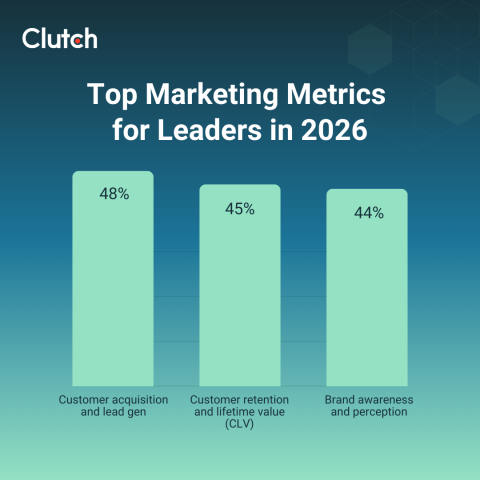
What does your leadership team care about? Clutch surveyed 337 marketing professionals to gather insights into the metrics that matter most in 2026. The results show that leaders are prioritizing marketing metrics that connect to tangible business outcomes, including customer acquisition and lead generation rates, customer lifetime value, retention rates, and brand awareness and perception metrics.
This article examines the survey metrics, explains why they are important to leaders, and provides practical strategies for leveraging them to enhance performance.
Charlie Marchant, CEO of Exposure Ninja, explains why stats like these are central to many teams: “To get the budget approved, marketers need to speak the same language as the board: commercial impact. That means aligning marketing metrics to revenue outcomes and being able to say with confidence, ‘This is what it’s worth, and here’s what we could get with more.’”

Discover what metrics your business’s marketing team should be focusing on in 2026.
Customer acquisition and lead generation topped the survey, with 48% of marketing professionals saying these metrics will matter most to leadership in 2026. Executives value these metrics because they easily connect to revenue.
For example, generating more leads is typically the first step toward increasing sales. Customer acquisition rates, on the other hand, help executives assess how effectively the company converts leads into paying customers. This data makes future revenue more predictable, which helps executives plan their investments more effectively.
These metrics can also provide insights into the company's current market position. For example, a rising cost per lead can signal messaging misalignment or an emerging shift in customer behavior. Tracking this data actively helps marketing teams adjust their approaches before wasting budget on an inefficient strategy.
Marketing teams looking to improve their customer acquisition and lead generation performance in 2026 can focus on the following tactics:
Ultimately, acquisition and lead-generation metrics matter to leadership because they directly drive growth. Marketing teams that actively track these metrics and show them to executives during reports tend to justify more future investment. It's harder for leaders to allocate funds to a team that can't show how its work directly impacts bottom-line revenue.
Forty-five (45%) of marketing professionals say customer lifetime value (CLV) and retention will be the most important metrics to their leadership teams in 2026. These metrics carry more weight as customer acquisition costs continue to rise across most digital channels. This trend is increasing the pressure to get greater long-term value from every new customer.
Industry data show that customer acquisition costs have increased year over year in competitive sectors like retail, underscoring the growing expense of winning new customers. As a result, leadership teams are shifting their focus beyond conversion to what happens after acquisition. Harvard Business Review data shows that improving retention rates by just 5% can increase profits by 25% to 95%.
CLV helps executives assess whether marketing and sales efforts are attracting customers who continue to generate revenue over time. For example, a strong CLV signals an efficient acquisition process and sustained engagement, whereas a lower CLV often indicates misaligned messaging, poor user experience, or inefficient channel targeting.

“Focusing on channels that can demonstrate real commercial impact, not vanity metrics,” recommends Pete Fairburn, Commercial Director at morphsites. As part of that process, you may need to invest in new strategies and tools that support:
The key takeaway is that marketing teams are focusing on customer retention almost as much as customer acquisition in 2026. These metrics matter because they help marketing teams demonstrate that the leads they convert drive revenue growth that leadership teams can count on.
Finally, 44% of marketing professionals think brand awareness and perception metrics will be the most important for their leadership teams in 2026. This is less important because it doesn't directly affect bottom-line outcomes, as acquisition costs and retention metrics do. But leadership recognizes the influence of perception on long-term demand and customer trust.
Perception significantly impacts a company's ability to grow efficiently. Strong brands with low acquisition costs tend to have short sales cycles and improved conversion rates across channels. That makes sense. When buyers already trust a brand, convincing them to buy its products becomes much easier.
Awareness also plays a role in competitive differentiation. As products and services become easier to replicate, leadership teams look at branding as a defensible advantage. Metrics such as sentiment analysis and engagement quality help executives gauge the strength of that advantage.
Modern AI tools enable teams to scale content production quickly, while also reducing the barrier to entry for competitors. This has led to an explosion of digital content online, making it challenging to cut through the noise.

Keith Kakadia, CEO of Sociallyin, believes, “The brands that stay focused, keep producing strong content, and aren’t afraid of AI will win.” In practice, that means building awareness and improving perception through tactics like:
The key insight is that awareness metrics remain essential to track, even if they don’t directly impact your bottom line.
Whatever digital marketing metrics your team tracks in 2026, they should align with outcomes that matter to executives. This helps leadership justify further investments in marketing employees and tools.
High-performing teams often focus on a small set of metrics that directly align with their business goals. Dashboards can help you make the connection visible to executives. They demonstrate how performance in areas such as acquisition and retention is connected to pipeline health and future revenue, visually simplifying the data.
Regular reporting will also play a crucial role. However, instead of simply sharing data, effective marketing teams utilize storytelling to explain what's happening. Adding a narrative to your metrics can help them connect with leaders and make sure the story you believe in comes across.
Finally, alignment becomes easier when teams across sales, finance, and leadership work together effectively. That means creating shared definitions of success and agreeing on consistent measurement frameworks to start. You may also want to schedule regular check-in sessions to keep these teams connected over time.
Leaders show a clear preference for digital marketing metrics that connect to tangible business outcomes. In 2026, this means focusing more on customer acquisition, lifetime value, and brand perception metrics. The teams that succeed in the new year will be those that consistently demonstrate the impact they're having.
As Kakadia says, “Leadership wants instant ROI and marketing rarely works that way.” But there are steps you can take to make the connection more visible. By prioritizing the right metrics and framing them in business terms, marketers can gain trust and outperform in 2026.