Lead Quality vs. Lead Quantity: Why B2B Teams Are Rethinking Their Funnel in 2026
Bigger buying committees and tighter budgets are forcing B2B teams to rethink lead quality vs. quantity. Here's how top teams rebalance the tradeoff in 2026.
Updated January 22, 2026

Marketing leaders are leveraging AI to enhance media buying performance across various channels. Learn how your team can do the same.
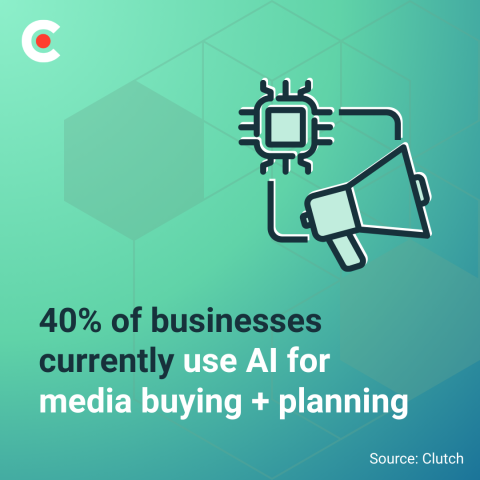
Artificial intelligence is reshaping many marketing verticals, including media buying. According to Clutch’s November 2025 survey of 337 marketing professionals, 40% currently use AI for media buying and planning. This demonstrates broad recognition of the value of AI tools in optimizing paid media strategy.
Looking for a Digital Marketing agency?
Compare our list of top Digital Marketing companies near you
However, AI tools aren’t perfect. While they can improve your speed and accuracy, they can also be challenging to integrate meaningfully into workflows and strategy. Even after you’ve done that, you could still face challenges around balancing AI’s speed with human oversight.
This article examines these challenges and provides practical solutions to address them. Keep reading to learn how they can improve your ROI in media buying by combining AI-driven insights with human judgment.
Legacy media-buying platforms were designed to help teams make decisions based on historical data reports. Many traditional dashboards struggle to process real-time analytics and limit interactivity. This increases the amount of time it takes to find valuable insights in up-to-date databases.
AI-driven systems are designed to anticipate outcomes and deliver expanded functionality. They adapt in real time and surface patterns that humans wouldn’t realistically detect at scale. Modern AI media-buying systems continuously ingest performance signals across channels, creatives, audiences, and time windows. This helps them identify where performance is likely to emerge next, enabling teams to target it proactively rather than reactively.
The shift enables a few key capabilities that weren’t practical in legacy models:
Practically, teams that use AI platforms gain a speed advantage that compounds quickly. They identify optimal strategies sooner and shift to them seamlessly, unlike many traditional media buying operations. That unlocks a variety of new capabilities, including:
AI helps teams manage challenges like rising media costs and fragmented channels more efficiently. This is why it’s become a core media-buying strategy for many marketers, as reported in the data surveyed by Clutch.
Media buying becomes a more proactive discipline with the aid of AI. It helps teams optimize their strategy upstream, rather than waiting for performance data to accumulate. AI impacts several aspects of the media buying process, including:
Here's a closer look at how this works in practice.
The audience you target with a media buying strategy is one of the best predictors of its performance. AI helps teams build audiences more effectively. It identifies emerging patterns across performance signals to help marketers find niche audience segments that humans don't notice.
AI uses lookalike modeling and microsegmentation to help companies identify target audiences that don’t fit neatly into standard definitions. The models also continuously refine themselves as campaigns run so teams can adjust mid-stream as data dictates.
Instead of asking, “Which audience should we target?” AI can reframe the question as, “Which audiences are most likely to convert under current conditions?” That distinction improves efficiency considerably in competitive media auctions.
Before AI, budget allocation in media buying was often a reactive process. Teams typically waited for performance trends to emerge before adjusting their behaviors, thereby risking missed opportunities in trending markets. Today, only about a third of marketing organizations utilize AI for media buying, underscoring the competitive advantage businesses can gain by adopting a more efficient model.
Predictive models enable more proactive budget allocation strategies. They help teams simulate outcomes of different scenarios and test their assumptions before allocating any spending.
The key benefit is greater predictability. Marketers gain an earlier understanding of where dollars should be allocated, which helps them optimize their spending strategies beyond what’s possible with legacy models.
AI also helps teams evaluate creative performance at scale. Tools analyze variables such as messaging, format, and visual composition to identify why certain assets perform better than others. For example, research by Google indicates that utilizing machine learning to evaluate and optimize creative elements shows ad effectiveness. It does so by identifying and using the messages and visual elements that are most likely to drive engagement.
This turns creative optimization into an insight-driven process. Instead of manually administering a variety of tests, teams can iterate faster and identify their best-performing creative elements sooner. That means less money wasted on non-optimized ad content.
Industry research shows that marketers are increasingly adopting AI-assisted approaches to creative variations. These tools help marketers manage creative elements at scale across audiences and channels, enabling them to connect with more leads.
Reporting is where many media buying strategies lose momentum. Manual analysis requires time and often yields fragmented insights and inconsistent interpretations across teams.
AI accelerates analysis and reporting by continuously aggregating data and flagging anomalies. It provides teams with real-time visibility into media strategy, rather than waiting for weekly or monthly reports to reveal key trends. This helps teams make faster decisions and leads to more precise ROI projections.
AI is a powerful tool for optimizing media buying. But integration shouldn’t happen overnight. The most effective teams integrate AI at specific decision points, utilizing it to enhance human judgment and expand over time as teams refine their approach. Here are some tips.
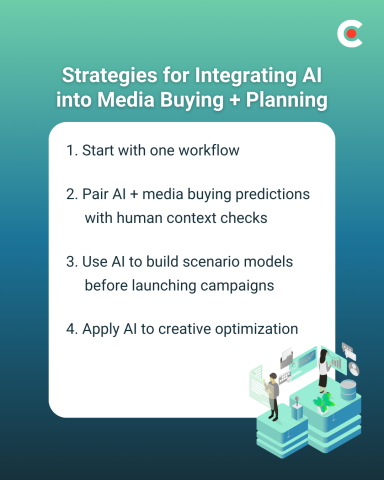
It’s generally best to start by integrating AI into one media-buying workflow. This helps teams validate performance and gradually adjust their operations, rather than making all adjustments at once.
Teams often start with AI-enhanced budget allocation, audience segmentation, or performance forecasting. Early successes can become repeatable frameworks for expanding AI use across additional parts of the media-buying process.
Research shows that marketing teams are most successful when they introduce AI into a single well-defined workflow. Then, expand gradually. This phased approach provides teams with time to validate outputs and refine internal processes before scaling AI to new channels and use cases.
AI is excellent at recognizing patterns, but it’s not always aware of the brand’s nuance or broader business constraints. For example, algorithms might flag edgier content as higher-performing, even when the material is unsuitable for the company's long-term branding goals or metrics. That’s why high-performing teams pair AI tools with human context checks.
Your marketing team should still be involved in the media buying process. Their role will begin to shift from execution to oversight and adjustment. For example, when using AI tools, humans should verify brand safety, campaign timing, sales priorities, and address regulatory concerns. These help align AI's pattern-recognition capabilities with real-world conditions.
Next, use AI to test scenarios before committing any budget to them. This is one of its most powerful capabilities, as it helps teams optimize spending before committing any dollars. Marketers use AI tools to simulate multiple audience, channel, and spending scenarios, among others.
For example, Google offers Customer Match, which enables businesses to upload first-party customer data to target and re-engage specific users. AI can help you collect and format this data, then find the best targeting strategies for your top leads.
Finally, use AI in your creative design process. It can help your team identify the messages, formats, and media placements that are most likely to drive the desired outcomes across channels and audiences.
AI creative tools won’t replace humans. However, they can help them iterate more quickly. For example, instead of A/B testing every element of a potential ad, AI can instantly identify the highest-performing combination of creative elements. That can save creative teams days of trial-and-error work and help companies bring campaigns to market sooner.
A broad ecosystem of tools supports AI-driven media buying. Instead of relying on a single platform, most teams invest in multiple platforms across different stages of the media planning process. This includes each of the following:
If you’re unsure about investing in these technologies, consider partnering with an AI-driven marketing agency. They can provide access and help your company benefit from AI media buying with minimal internal work.
AI-driven media buying enables teams to make more accurate decisions faster, resulting in benefits that can lead to improved outcomes like:
AI reduces the amount of manual work involved in media buying. It automates routine tasks to help teams adjust bids and compile reports faster. This makes marketing teams more efficient by freeing up human labor for the highest-value tasks.
AI also improves the accuracy of media planning decisions. It combines historical data with real-time performance signals to help teams adjust their campaigns based on live indicators. This means less guesswork and more consistent results across channels and audiences. Predictive AI models use historical data and statistical techniques to improve planning and decision-making performance.
Next, AI helps marketers identify where their dollars are most likely to yield the best results. It does so through more precise audience targeting and earlier optimization passes. This can directly increase your company’s return on ad spend across channels. Over time, incremental gains can compound into meaningful performance improvements that differentiate the company from its peers.
AI also improves agility within marketing teams. It detects performance shifts earlier, allowing teams to intervene before campaign efficiency declines. This minimizes a team’s downside risk, helping it adjust creative elements and audience segments to capture more upside.
Artificial intelligence is fundamentally changing how marketers make media-buying decisions. It brings predictive analytics and real-time optimization to a discipline that was historically backward-looking and reliant on manual analysis.
The most successful organizations treat AI as a strategic partner for humans, rather than a replacement for them. Its role is to surface patterns and model outcomes that would take people too long to do on their own. However, human marketers still play a crucial role in establishing the brand’s priorities, understanding market dynamics, and championing creative direction.
If you’re ready to integrate AI into your media planning strategy, start small and expand over time. This will give your team time to adjust, learn new processes, and discover what works before expanding into additional workflows. As media environments become increasingly complex and competition intensifies, human-led, AI-powered media buying could emerge as a core differentiator. Marketers who invest early in this partnership will be better positioned to drive sustained ROI in the years ahead.