Lead Quality vs. Lead Quantity: Why B2B Teams Are Rethinking Their Funnel in 2026
Bigger buying committees and tighter budgets are forcing B2B teams to rethink lead quality vs. quantity. Here's how top teams rebalance the tradeoff in 2026.
Updated February 19, 2026

Digital marketing rules have changed over the past few years.
AI transformed the content workflow, PPC leaned further into automation, and privacy moved from a compliance checkbox to a business strategy. For global B2B brands, the stakes are high, especially when there’s unregulated use of AI to entirely lift your marketing process.
But the opportunities are higher. If you combine pay-per-click advertising and AI effectively, you can improve ad accuracy, reduce acquisition costs, boost lead generation, and grow your revenue.
Looking for a Digital Marketing agency?
Compare our list of top Digital Marketing companies near you
In this article, we’ll share what’s working in PPC, how to use AI content responsibly and effectively, and how to utilize data privacy as a strategic advantage in 2026.
PPC (Pay-Per-Click) is an online advertising model where you pay each time someone clicks on your ad. It helps you drive traffic, generate leads, and increase sales through platforms like Google Ads and Microsoft Ads.
While pay-per-click advertising remains one of the best channels that delivers pipeline when you need it and accurate attribution when you measure it, a few things have changed in 2026.
Much of the work is now handled by machine learning. Tools like Google’s Performance Max, broad customer match with smart bidding, and responsive creative formats mean your campaign success depends more on structured data, first-party audiences, and clean measurement than on ad-hoc keyword tweaks.
With third-party cookies being phased out in Chrome, the Privacy Sandbox introduces new APIs that allow for private ad relevance and measurement over time. You can now leverage first-party data, modeled conversions, enhanced conversions, and server-side tagging to maintain signal quality without exceeding user consent.
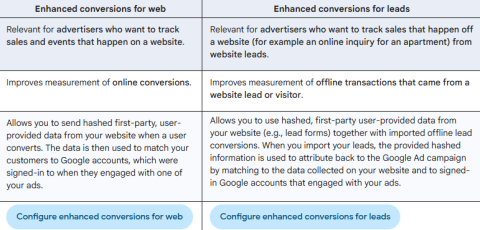
Web-enhanced conversions track on-site actions, while lead-enhanced conversions link offline sales back to website leads.
Data from all sources now shape the outcome
Importing offline conversions from your CRM and mapping GCLID/GBRAID also makes your bidding smarter where it matters most. Down the funnel, not just at the lead level. GCLID (Google Click Identifier) and GBRAID (Google Browser Identifier) are unique tracking codes that link ad interactions to user actions.
Running a PPC campaign is not rocket science. However, if you want each campaign to pull in the results you want safely, you need to do these:
High-quality first-party signals ensure your PPC automation learns from real intent and personalizes delivery. This matters in B2B because leads move through complex pipelines, and relying on generic lookalikes often wastes budget on low-intent traffic.
According to a BCG 2023 report, companies using first-party data for key marketing functions see up to a 2.9x revenue increase, 3-5% profit uplift, and 1.5x increase in cost savings.
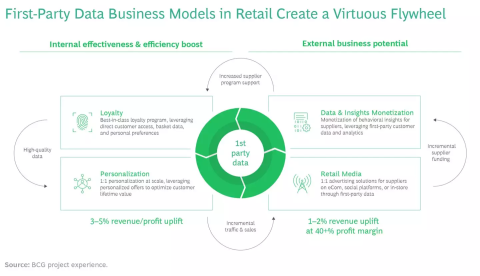
First-party data powers a retail flywheel that improves internal efficiency while unlocking new external revenue streams.
This helps you hyperpersonalize each campaign, reach the right audience at the right time, and reduce bidding cost.
Third-party cookies are disappearing, and that means data tracking via enhanced conversions will gain more traction. Tennis Express, a US-based sports and apparel retailer, used this approach to increase web conversions by 114%.
In Google’s own words, “When a customer converts on your website, your conversion-tracking tags help capture consented first-party data. Enhanced conversions for web hashes this data and securely matches it to signed-in Google Accounts, allowing conversions to be attributed to ads in a privacy-centric way.”
While enhanced conversions happen more securely than cookies, you still need to respect user consent. Here’s how:
This ensures no data is transmitted when a user declines.
Automation speeds up campaign execution, but strategy and accountability must stay in human hands.
Brandy Hastings, SEO Strategist at SmartSites, where he designs customer-centric and ranking content strategy for clients, says, “Automation for ad copy can slash hours from your campaign setting time, and smart bidding can help manage your spend. However, a lack of human oversight can lead to misaligned messaging or poorly regulated spend, which often occurs with diluted audiences. What you need is a Human-led strategy combined with AI tools.”
Here’s how:
Note that while AI is gaining traction, over 39% of Gen Z and 20% of Millennials still feel very or somewhat negative about using generative AI to create ads. That’s why regulated use and proper disclosure, when necessary, are essential to building consumer trust.
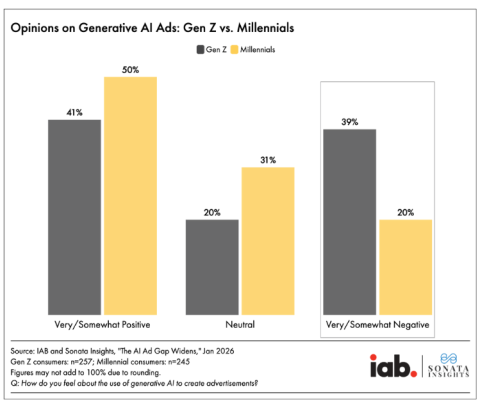
Gen Z shows more skepticism toward generative AI ads, while Millennials are more likely to view them positively.
Contextual relevance is how closely a piece of content matches the reader's intent, situation, and expectations at the moment they encounter it. It answers if an ad helps the reader do what they came here to do.
This is vital as individual identifiers become less reliable. To implement it:
Never chase keywords if they do not align with your audience’s real-time needs.
Smart marketers use automation to eliminate repetitive tasks and protect performance at scale.
Leon Huang, CEO at RapidDirect, oversees automation of custom machinery part creation for clients and advises “using automation tools to maintain account hygiene, so you can focus on strategy rather than manual fixes. This reduces human error and links your actual spend to the pipeline.”
Here’s how Leon suggests doing that:
Remember to use all tools with proper oversight.
AI now shapes how B2B teams research and distribute marketing content, but teams must control how they use it.
Tyler Denk, Co-founder & CEO at beehiiv, where he helps clients build newsletters that convert, says, “AI moved from novelty to normal. It drafts outlines, summarizes research, builds the skeleton of email newsletters, adapts tone to the audience, and helps localize content faster. The upside is speed and scale, which most B2B businesses need.”
“But the downside is equally large. First, AI creates very good copies, but they’re still far from human standards in terms of quality and empathy. Empathy drives campaigns,” Tyler adds.
Originality is another issue. AI tools primarily rely on existing content and regurgitate it in a slightly different format. They might also hallucinate facts, mimic your competitors' phrasing a little too closely, and flatten a distinct brand voice if you let it run unchecked.
Regarding privacy, disclosure, and bias, more than 82% of Americans in a recent survey view AI data loss of control as a threat.
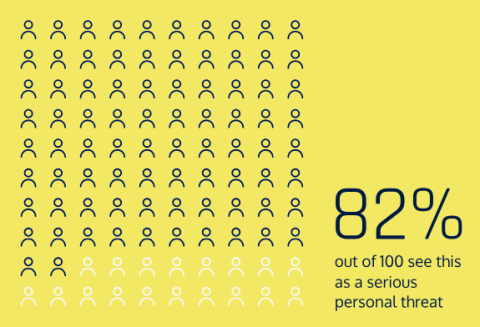
That’s why most countries set new obligations by risk category, with transparency and governance requirements for many marketing use cases. An example is the EU AI Act.
Let’s share a few steps to future-proof your marketing operations against legal risks associated with using AI content for marketing in general:
Strong marketing teams lead with strategy and use AI to support execution, not replace judgment.
Adrian Iorga, Founder & President at Stairhopper Movers, where he helps clients move or relocate their properties, shares how his team maintains top-quality, engaging content for marketing.
“Blending AI into your work works best when you stay in the driver's seat. That’s what we do. You should never let it control your narrative, but you can use it to support research or capture ideas. In some cases, where you need simple copies, you can use AI as a first draft engine while your team focuses on the storytelling and the big picture.”
To keep your AI aligned:
Also, ensure you review everything against your goals before you hit publish.
AI can write quickly, but it may repeat prior errors if you do not review the work. Always add a layer of verification to verify every claim has a real source. You can also use transparency tools such as C2PA to protect your reputation and demonstrate the credibility of your content.
Other things to do:
Always update old AI drafts when new data becomes available.
How your content performs should dictate what you do next. Track engagement and lead quality, monitor metrics, such as time on page and demo requests, and adjust your prompts based on what people actually click.
In addition:
You need to sync these loops across your marketing, strategy, and compliance teams for better implementation.
Privacy laws vary by region, and ignoring them can result in monetary fines and legal problems for your brand. Start by understanding regulations such as GDPR and CCPA. Map these rules to your content process to ensure your team handles cross-border data properly.
What you can also do is:
While not a conventional approach, audit your vendors to make sure they follow the same rules, so long as you share consumer data with them. Ensure you disclose this sharing to your audience before proceeding.
Compliance works when it becomes a daily habit rather than an afterthought. Design a clear data map and train your team to prioritize consent and keep privacy at the center of your work. This culture protects your customers while still enabling effective marketing.
Joern Meissner, Founder & Chairman at Manhattan Review, observes: “Conveying knowledge to others is even more fulfilling than grasping an idea itself. This highlights the importance of human expertise in any technical workflow. When teams share what they know, they make tools like AI more effective and aligned with strategy. In marketing operations, this means blending human insight with automation rather than relying on automation alone.”
A structured way to do that is:
Compile all these rules and share across your organization as mandatory reads.
Marketing in 2026 requires you to check two lists simultaneously. First, move faster with smarter tools, and second, slow down just enough to respect people's choices, especially if your goal is to combine PPC advertising with AI for improved outcomes
Start by cleaning up your conversion plumbing, writing your AI playbook, and refreshing your consent flows. Keep an eye on the evolving rules and the tech that supports them. Design safety guardrails and human oversight for AI use, implement automation to reduce your ad spend, and build a culture of compliance in your workplace.