Lead Quality vs. Lead Quantity: Why B2B Teams Are Rethinking Their Funnel in 2026
Bigger buying committees and tighter budgets are forcing B2B teams to rethink lead quality vs. quantity. Here's how top teams rebalance the tradeoff in 2026.
Updated April 7, 2026

In partnership with Conductor, Clutch surveyed 459 marketing professionals responsible for producing content to understand how their teams are responding to the era of AI and LLMs. Explore these findings to see how strategies, investments, and workflows are evolving in a rapidly changing digital ecosystem.
Large language models (LLMs) and AI-powered tools are fundamentally reshaping how people search, discover, and engage with information online. For content marketing, this marks a new era that is defined by experimentation, shifting best practices, and renewed questions about what quality content really delivers.
Looking for a Digital Marketing agency?
Compare our list of top Digital Marketing companies near you
To understand how marketing teams are navigating this transformation, Clutch, in partnership with Conductor, surveyed 459 marketing professionals responsible for producing marketing content in January 2026.
The data reveals a striking sense of optimism, with 81% of respondents feeling positive about the stae of content in the age of LLMs.

“Where I myself am an optimist is that I see the current state of content marketing as a sort of reset,” said Amanda Natividad, VP of Marketing at SparkToro, “None of us know without a shadow of a doubt what we will work, so there’s a lot of opportunity to experiment…”
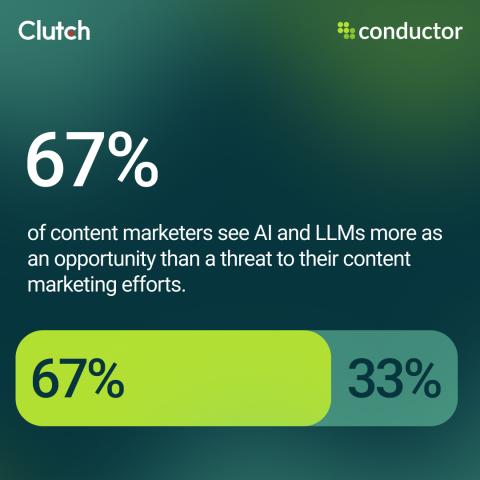
On top of that, 67% of respondents see AI and LLMs more as an opportunity than a threat to their content marketing efforts.
This report explores what’s driving that optimism. We’ll examine how content marketing strategies are changing in response to LLMs, where teams are investing their time and budgets in 2026, and the key challenges marketers are working to overcome as AI becomes an increasingly central part of the content ecosystem.
Just a few years into the era of AI-powered search, the shift in how content is consumed has been both rapid and significant. Nearly 25% of teams now report that LLMs are their primary audience for content.
These points underscore how quickly AI visibility is becoming a top business priority, while introducing a new core challenge for content marketers. How can teams effectively optimize content for three distinct audiences at once: humans, traditional search engines, and AI systems?
These goals are not at odds with each other. Creating high-quality, helpful content aligned with E-E-A-T principles remains a strong foundation for success across all discovery channels. Traditional search engines and AI systems alike are trained to surface and reward content that meets that foundation, meaning that human-first content strategies continue to deliver value in an AI-driven landscape.
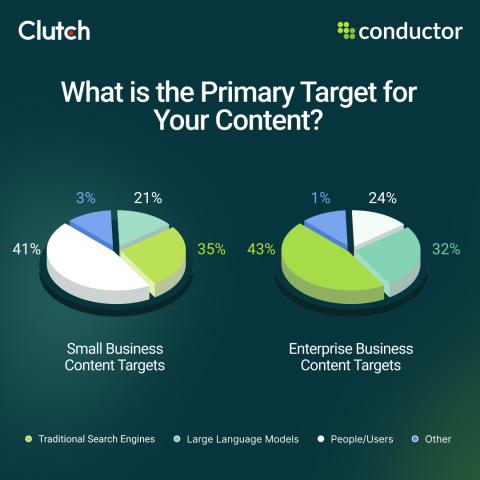
The prioritization of AI and LLM visibility is especially pronounced among enterprise organizations. Companies with 500-1,000+ employees are significantly more likely to identify LLMs as their primary content audience (32%) than smaller businesses (21%).
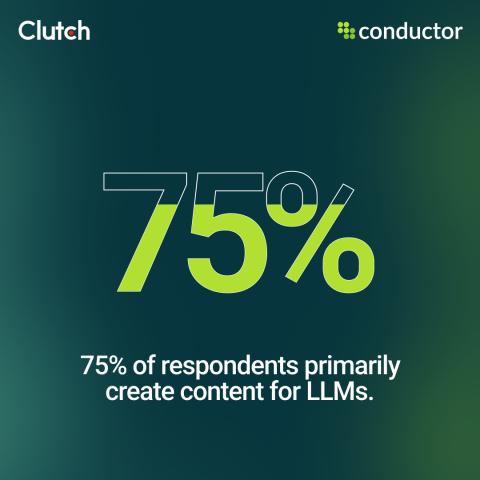
With a majority of respondents (75%) reporting that they create content primarily for LLMs, that figure rises with focusing on enterprise teams (85%), which highlights how larger businesses are moving fastest to adapt to AI-influenced discovery.
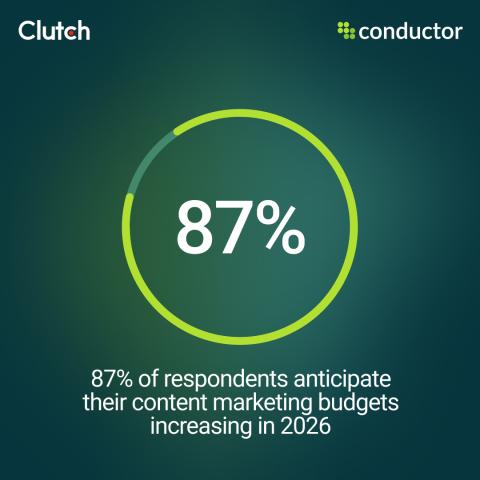
Content marketing budgets are growing, and with that growth comes higher expectations and tougher strategic choices. Eighty-seven percent of marketers anticipate their organizations’ content marketing budget will increase in 2026, signaling sustained confidence in content as a core strategic investment.
But more money doesn’t simplify the work. Instead, it raises the stakes: content now needs to perform simultaneously for human audiences, traditional search engines, and LLM-driven discovery.
At the heart of this shift is balance. Nearly three-quarters of organizations (74%) say they are primarily targeting either people and users or traditional search engines, rather than focusing on AI search experiences like ChatGPT or AI overviews (24%).
That split is evenly divided between 37% prioritizing people and users, with the other 37% focusing on traditional search engines. The data suggests that even a few years into widespread AI adoption, traditional search remains a powerful force, though its dominance is increasingly being challenged.
Where things get especially interesting is how priorities differ by company size. Smaller businesses (1-500 employees) are most commonly focused on targeting people and users (41%), emphasizing resonance, clarity, and trust with their audiences. Larger companies (over 500 employees), by contrast, most often prioritize traditional search engines (43%), reflecting a need to optimize for scale and discoverability across many channels and markets.
These differences likely reflect underlying realities like resource constraints and growth goals, which all shape how teams approach content. Smaller teams often win by being closer to their audiences. Larger groups, meanwhile, depend on systems and frameworks, with SEO best practices, to ensure content performs at scale.
What’s clear, however, is that organizations are no longer choosing between people-first or search-first content in absolute terms. Regardless of size, all content must now account for LLM summarization and AI-driven discovery, where context, authority, and clarity determine whether content is surfaced or cited into answers.
For content teams, rising budgets create more room for experimentation, but not reckless experimentation. Success in 2026 hinges on strategic alignment: understanding who content is primarily for, how it will be discovered, and what role it plays across human engagement, search visibility, and LLM interpretation.
As marketing teams adapt to LLM-driven discovery, video is emerging as a top investment priority. Video can build brand authority, which in turn affects LLM visibility.
More than half of marketers (52%) say video will receive the largest boost in investment for LLM visibility in 2026, reflecting a growing belief that video content is uniquely positioned to perform across both human discovery and AI-powered search experiences.
Short-form video, in particular, is gaining momentum. Over a third of marketers (36%) plan to significantly increase investment in short-form formats like TikTok and Instagram reels, despite social still not appearing as part of LLM citations.
These formats excel at reach and repetition, allowing brands to reinforce messages quickly, build familiarity, and stay present in fast-moving feeds where attention is scarce.
Among content platforms, YouTube stands out as a clear priority.
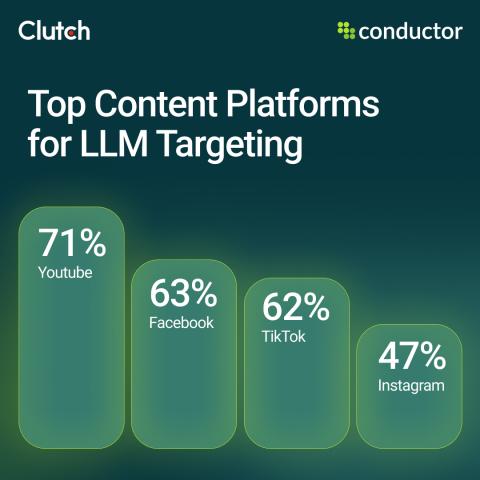
Businesses targeting people overwhelmingly identify YouTube as a top platform (70%), and nearly the same (71%) say it’s a priority for reaching LLMs. But for SEO teams, YouTube often feels like a black box: performance signals are harder to control, attribution is less transparent, and video optimization rules differ significantly from traditional search. Yet its scale, longevity, and integration into both search and AI-generated answers make it impossible to ignore.
What gives video its edge is its ability to combine narrative, authority, and context in a single format, while generating strong engagement signals. Transcripts, captions, and metadata also make video content highly reusable by LLMs, enabling AI systems to extract, summarize, and surface insights.
Video can no longer be treated as a one-off campaign asset, but it's not necessarily the primary driver of LLM citations. Much of video and social media’s powers with LLMs are unknown, but they do impact the broader authority that all companies seek to emulate online.
Content teams will need to build strategies where video serves as a foundational content asset designed to support human engagement, platform distribution, and now, LLM visibility.
As AI reshapes how information is discovered and trusted, content volume has become a proxy for visibility and authority. More than half of marketers (56%) report that their teams plan to produce more content in 2026, signaling a widespread push to increase presence across digital channels.
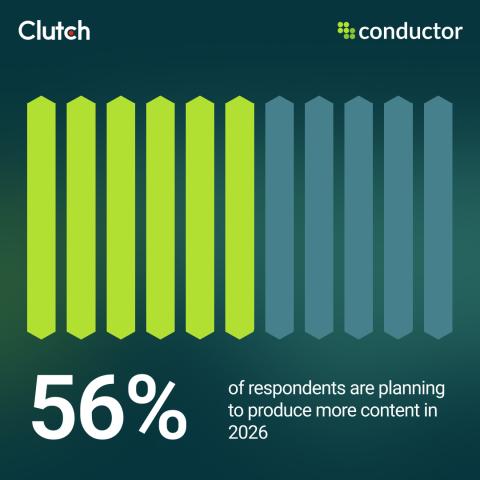
This growth is not driven by volume for volume’s sake, but it reflects a strategic response to heightened competition for credibility and attention.
Reputation management sits at the center of this shift. Among marketers, 41% cite reputation management as a top content goal, closely mirrored by leadership at 40%. This alignment between execution and executive priorities suggests that content is no longer viewed solely as a demand-generation lever, but as a core mechanism for shaping how brands are perceived.

“If there's a blemish on a review site or directory, you may never even get the visitor. But if your brand sparkles everywhere, AI is far more likely to guide prospects your way,” said Andy Crestodina, Co-Founder + CMO of Orbit Media Studios.
However, scaling content doesn’t automatically translate to a stronger reputation. In an environment where LLMs synthesize brand narratives from existing content, inconsistencies, inaccuracies, or low-quality outputs can dilute trust just as quickly as visibility can increase it.
For content teams, this creates new operational challenges and demands. Scaling responsibly requires governance, clear editorial standards, and shared definitions of accuracy, tone, and authority. The rise in content production reflects a recognition that brand perception is increasingly constructed at scale by humans and machines alike.
Organizations that treat content as a strategic, governed asset rather than a volume race are better positioned to build trust in this changing landscape.
As content becomes a primary driver of brand visibility and reputation, businesses are thinking about who owns it. Our data shows that 72% of marketing professionals report that their content is produced primarily in-house, whether through content-specific teams or blended roles.
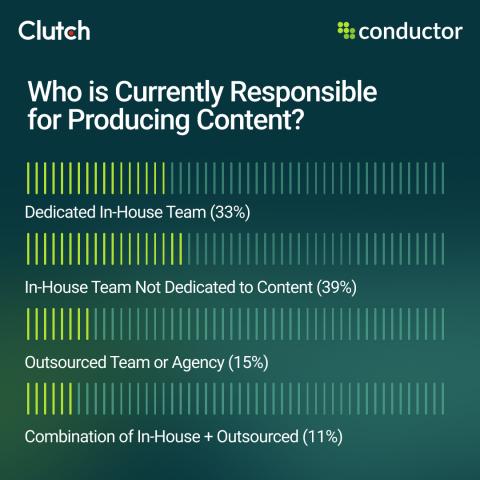
As the stakes rise, so does the need for content ownership. One-third of marketers (33%) say they plan to hire a dedicated in-house content team, signaling the growing value of content as a specialized function. This move reflects an understanding that effective content requires not just production capacity, but sustained focus on strategy and quality control.
The influence of LLMs and modern search further accelerates this trend. AI systems reward content ecosystems that demonstrate consistency, clarity, and authority over time. These signals are far easier to establish when a select group is responsible for managing content as a core priority. Dedicated teams are better positioned to define standards and evolve messaging as products, markets, and other areas change.
Ultimately, the shift toward in-house, dedicated content teams represents a move toward long-term brand ownership. By centralizing responsibility, organizations gain greater control over the narratives that both audiences and AI systems use to understand them.
Despite rapid changes in how content is discovered and consumed, traffic, a very familiar metric, continues to dominate how businesses define content success. Overall traffic, including organic search, AI-driven referral, and traditional referral traffic, is the most common primary KPI for content teams (41%).
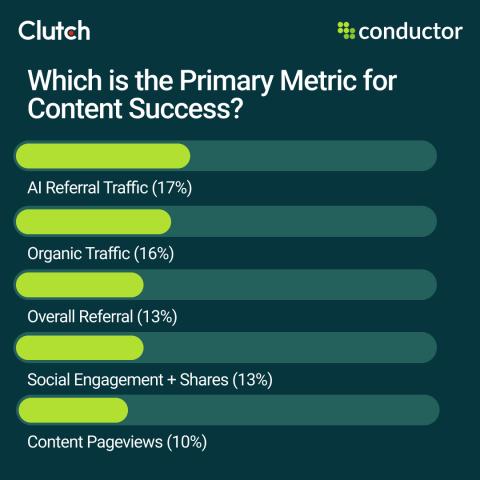
When organizations are focused on reaching people specifically, reliance on traffic increases further, with over half (51%) citing it as the leading success metric.
Organic traffic reflects performance in search, referral traffic captures distribution across partner and social channels, and AI referral traffic signals inclusion in LLM-powered discovery experiences. Together, these sources aggregate how effectively content is being surfaced by humans and machines alike.
Even as new formats and discovery channels emerge, volume-based indicators, especially traffic, remain dominant because they provide a familiar, scalable way to measure impact.
At the same time, this reliance on traffic introduces clear limitations.
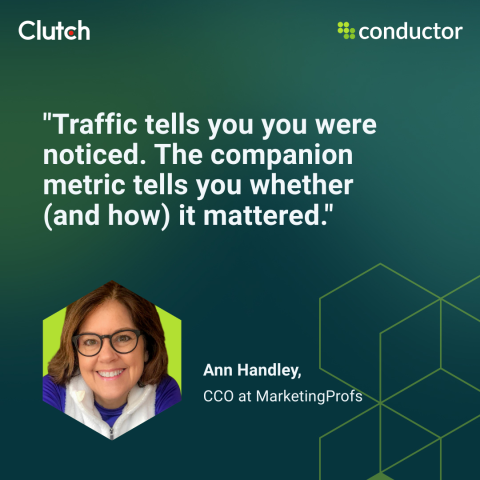
“Traffic is a useful metric when the goal is reach and discovery,” said Ann Handley, CCO at MarketingProfs. “But it’s misleading when it stands alone for success.”
Not all AI-driven interactions result in traditional visits, and some high-value brand exposure may never register as a click.
Handley believes the smarter move for businesses is to pair it with a second, meaningful metric, such as return visits, conversions, citations, brand lift, or comments.
As LLMs increasingly mediate discovery, influence can occur without resulting in traffic, creating a growing gap between visibility and measurable outcomes.
Despite these shortcomings, teams are moving forward without perfect reporting, recognizing that waiting for fully formed attribution models risks falling behind competitors who are already shaping AI-generated answers today.
“Traffic tells you you were noticed. The companion metric tells you whether (and how) it mattered,” said Handley.
Teams continue to rely on it because it consolidates performance across channels into a single, actionable metric that directly influences what content gets produced, optimized, and scaled, reinforcing reach as a foundational objective even as definitions of engagement expand.
While traffic continues to anchor decision-making, measurement frameworks must evolve alongside content strategies to account for AI-driven discovery.
AI-powered tools have moved from experimentation to a staple for content teams. Seventy-five percent of marketing professionals report using AI as part of their standard content process, indicating that AI is no longer a novelty but a normalized component of everyday operations. Rather than replacing human judgment, these tools are being integrated where they can be used most efficiently at scale and speed. Teams know that visibility in AI-generated answers is becoming critical.
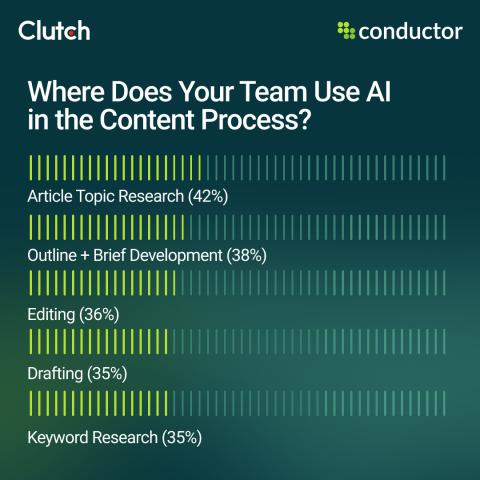
The most common application of AI sits at the earliest stage of the workflow. Among users, 42% rely on AI primarily for article research, highlighting ideation as the dominant use case.
Early-stage research is relatively low risk, yet highly important. AI excels at identifying content gaps, surfacing trends, and mapping opportunities across competitive and search landscapes. It works well with tasks that would otherwise consume significant amounts of manual effort.
“The real leverage for us humans is that we can use [AI] to pressure-test positioning, generate angles, and turn messy notes into a clean point of view before anyone touches the draft,” said Natividad.
Marketing and content teams are using AI across all stages of the content workflow: outlining, drafting, editing, optimization, and performance analysis.
This pattern of adoption suggests that teams are being deliberate about where AI adds value and where human oversight remains essential. While AI can accelerate practices, editorial control is still a factor. As content increasingly shapes brand perception and informs LLM-generated narratives, organizations are maintaining human accountability over final outputs, standards, and positioning.
In 2026, 27% of marketing professionals are investing in proprietary research reports & whitepapers to increase visibility with LLMs. By investing in data-backed research, brands can create unique, citable assets that increase the likelihood of being referenced in AI-generated answers. This also differentiates their original content from generic blog content, giving brands a stronger strategic advantage.
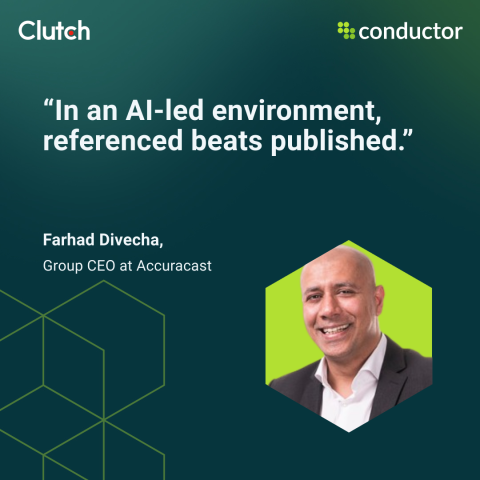
“The value is leverage,” said Farhad Divecha, Group CEO at Accuracast. “A single credible dataset gives publishers a reason to cover you, and it gives the market something concrete to reference. In an AI-led environment, referenced beats published.”
As AI becomes embedded across content workflows, differentiation will come not from whether teams use AI, but from how they use it.
Natividad continues, “if we pair LLM-assisted drafts with tighter editorial standards and real customer evidence, we can ship more useful content more consistently.”
Businesses will need clear guidelines defining where AI-generated content is encouraged and where greater caution is required.
As content grows in strategic importance, alignment on what “success” actually means becomes a differentiator. A majority of teams (83%) agree with how their brand’s leadership defines content success, signaling high alignment and collaboration between marketing teams and executives.
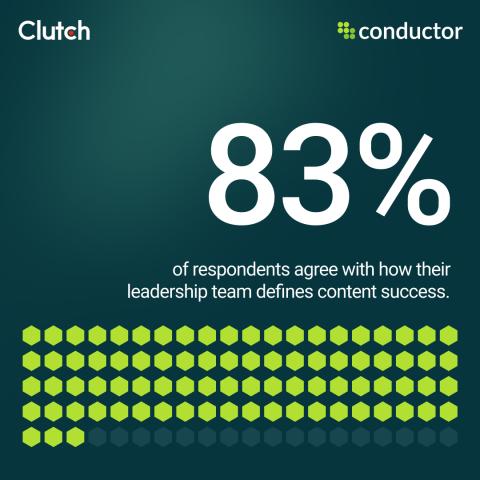
When teams and leadership share a definition of success, expectations and performance criteria are clearer. Content priorities, investment decisions, and resource allocation can be evaluated against a common set of goals, reducing friction.
However, agreement alone doesn’t eliminate complexity, especially when AI is a large influence. Leadership definitions of success are often high-level, focused on outcomes such as growth or visibility. Content teams must still translate these objectives into actionable metrics and workflows that account for evolving channels and LLM-driven discovery. Businesses with shared success criteria are better positioned to adapt to these changes.
As AI reshapes how content platforms and results are surfaced, teams that start from a common understanding of success can adjust tactics more quickly and effectively.
Content marketing is no longer defined by a single channel, format, or metric. It is shaped by how well businesses and organizations balance human engagement, search visibility, and LLM-driven discovery.
Our data shows that marketing professionals aren’t retreating from content in the age of AI, but doubling down with larger budgets, expanded teams, and more defined strategies. As content volume scales, reputation management and consistency are critical to maintaining trust, no matter the audience.
In the next phase of content marketing, competitive advantage will come from intentional choices for scaling, investment, and discovery.
In January 2026, Clutch and Conductor surveyed 459 marketing professionals who are responsible for producing marketing content about their thoughts on the state of content in the age of AI.
Of the respondents, 76% work at an organization with 1-500 employees, and 24% work at an organization with 500-1,000+ employees. 45% of respondents identify as managers, with 15% at the associate level and 12% at the specialist level. About 21% are at a director level, with around 8% identifying themselves at a C-suite level position.
In terms of demographics, 46% of respondents identify themselves as male, with 54% reporting as female.
29% of respondents were ages 18 to 29; 48% of respondents were ages 30 to 44; 23% of respondents were 45 and older.