
How to Measure SEO Success When Traffic Declines
Organic traffic is down, but is your SEO failing? Learn which metrics show real SEO success when AI Overviews and zero-click searches are reducing clicks.
Updated February 20, 2026

Users now ask complex questions in one single query, and the answer appears directly in an LLM interface. Optimize your SEO strategy today to stay visible in LLM-driven search.
Large language models (LLMs) have fundamentally changed the way people ask questions and get information online. Users can now get direct answers within AI chat interfaces, bypassing search engines entirely.
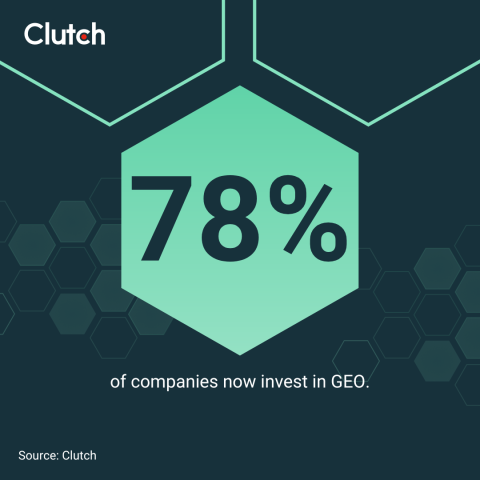
This shift is already showing up in marketing budgets. A recent Clutch survey found that the majority of companies — 78% — now invest in generative engine optimization (GEO). It signals how leaders already treat LLM-driven search as a core marketing channel.
Looking for a SEO agency?
Compare our list of top SEO companies near you
Read on to learn more about how LLMs are reshaping search behavior and what you can do to adapt your SEO strategy to show up in LLM-driven search results.
An LLM is an artificial intelligence system trained on massive text datasets to understand patterns and generate human-like responses. Models like ChatGPT, Claude, and Google’s Gemini are a few popular examples.
In AI search engines, the LLM synthesizes information from many sources and directly answers a question. For example, Google describes its AI Overview feature in Google Search as a way to help with more complex questions that previously took multiple queries.
This shift in search now creates a new competition for visibility inside AI-generated answers, instead of just traditional page links in Google, Bing, or Yahoo.
Large language models are changing user search behavior in three key ways:
These shifts in traditional search behavior demand a change in your SEO approach.
Adapting to LLM-driven search requires a complete strategic shift in how you approach traditional search marketing. The following five practical tactics will help maintain visibility in AI answer engines as search evolves:
LLMs extract and present answers synthesized from multiple sources. To appear in AI answers as one of the cited sources, you need clear sections that directly answer user queries. For example:
Also, add structured data where it fits. Use schema types such as Product, Organization, or Service to clarify entities.
While search engines don't promise a specific boost from schema, structured data helps models understand page meaning at scale and can influence which snippets or citations appear. Google’s documentation for site owners confirms that AI features like AI Overviews and AI Mode look for content that answers a query directly and clearly.
These assets give AI a clean snippet to quote and give users who land on your page a quick way to scan for answers.
Both LLMs and SEO rely on signals of expertise and trust. Google’s guidelines continue to emphasize experience, expertise, authoritativeness, and trustworthiness (E-E-A-T). Even though these are not a single numeric score, they frame how search quality raters and even AI systems evaluate helpful content.
One simple way to demonstrate E-E-A-T is to make real expertise obvious across your pages. A few practical ways to do this include:
All these expertise signals establish your brand as an authority on any topic or industry and give AI a clear reason to cite you in relevant user queries.
Generative Engine Optimization sits next to traditional SEO, not apart from it. Treat both as a part of "search marketing." Your goal is to make content easily cited by AI while still ranking in traditional organic results. Here are a few practical tactics to optimize for both GEO and SEO:
Marketers are already implementing this combined GEO + SEO approach, which is reflected in their increasing spending on GEO. 63% of marketers in our Clutch survey said that they plan to increase their GEO budget in the next 12 months.

The traditional SEO process worked by creating pages that revolved around a primary target keyword. For a complex answer, a user often had to visit multiple pages, each of which focused on such target keywords.
LLM-driven search changes that model completely. It bundles user queries into one question to provide the single best answer. Thus, page optimization around one target keyword is no longer efficient in an AI-driven search environment. Instead, create in-depth pages that answer all relevant questions users might have about a topic.
Here are simple steps you can take to refresh old content and optimize it for AI-driven search:
However, a rise in zero-click searches means traffic to your website might not increase even when AI visibility improves. So, look for indirect benefits of zero-click marketing, such as increased brand mentions and brand authority building. Those are real signals that the optimization effort is working for your target audience, who might read AI summaries and then search for your brand.
Traditional SEO key performance indicators (KPIs) lean on user clicks and website visits per session. AI answer engines change that. You now need metrics that capture visibility and influence before a click occurs.
Build a KPI set that pairs AI search intent coverage with downstream impact across your products or services.
These KPIs give marketing leaders a view that matches how search works now. You then evaluate coverage in AI answers and connect that exposure to actual demand across your products and services.
LLMs now sit at the front of search experiences and synthesize information into quick answers. All AI answer engines reiterate a goal of saving people time by directly presenting a clear response. This change in search behavior explains why GEO budgets have climbed.
However, AI-driven search is still in its early stages of development. Teams that adapt now with GEO + SEO will likely protect and grow their presence across AI answers. Want to accelerate your LLM-driven search strategy in the right direction? Choose the right partner from our vetted list of top generative engine optimization companies.