10 Actionable Link Building Tactics to Build Brand Authority & Legitimacy
Discover 10 actionable link building tactics to boost brand authority and rankings. Learn how quality backlinks build lasting trust in the AI search era.
Updated June 22, 2026

AI overviews have changed how people find information online. Learn how your business can adapt to stay competitive.
If you’ve noticed a dip in organic marketing results lately, you’re not alone. AI-generated overviews, or AIOs, are reshaping what it means to research information online, which is translating to less traffic for many websites.
Eric Elkins, CEO of WideFoc.us, explains: “If you’ve done a recent Google search, you likely didn’t even get to the links below the AI summary.” Instead, more users are finding the answers they need in the AIOs, which don’t generate any clicks.
Looking for a SEO agency?
Compare our list of top SEO companies near you
These concise, AI-generated summaries appear at the top of search result pages. Google is pushing them heavily as large language models (LLMs) like ChatGPT eat into its share of search traffic.
Businesses need to rethink their SEO strategies in this shifting landscape. The first step in that process is answering questions like: What is an AIO, how do they work, and what do they mean for your business?
AIO stands for AI overview. AIOs are general summaries of a user’s search results. For example, if someone looks up “how to get more SEO traffic,” Google would offer general, AI-generated instructions above any specific web page results.
This has led to the growth of zero-click searches — where users get the information they need without ever visiting a website. In the past, companies tried to earn high SEO placements for targeted keywords. That strategy is still relevant, but it’s no longer the only thing you need to focus on.
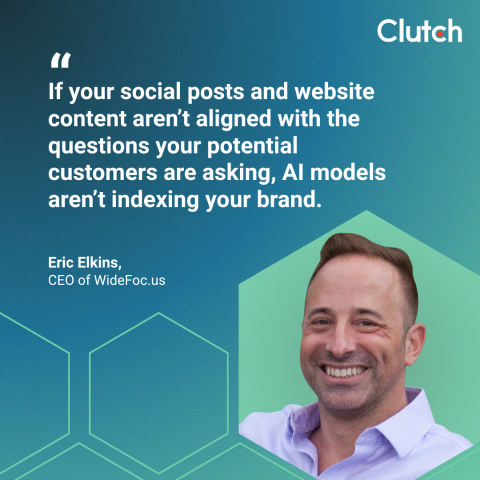
Elkins puts it like this: “If your social posts and website content aren’t aligned with the questions your potential customers are asking, AI models aren’t indexing your brand and serving it up. Which means you’re invisible when consumers and B2B decision-makers are out there looking for the solutions you provide.”
Unlike older SERP features like featured snippets and knowledge panels, AIOs are fully generated text. They’re not pulled from any web pages, but they may cite sources where relevant. This means traditional ranking factors still matter, but building content domain authority is becoming more important.
Google’s goal with AI overviews is to keep users inside its ecosystem. It tries to answer users' questions directly instead of sending them to a website that contains the information they want. This reduces the company’s reliance on external clicks and makes it more competitive with growing AI tools like Claude and Grok.
Google is clearly showing signs of trying to make AIOs a larger part of its business. It’s supporting this shift with initiatives like Search Generative Experience (SGE), AI-powered “follow topics,” and integration with Gemini, Google’s LLM.
Google’s AI overview strategy focuses on:
Even if your SEO traffic is still solid, it’s worth developing an AIO strategy today. It will likely only become more important over time. The sooner your strategy reflects how AIOs surface and cite information, the stronger your long-term visibility will be.
Users typically look for fast answers with minimal friction. They don’t want to click through several websites to find the details they’re after, especially when it’s easier than ever to get personalized information through LLMs.
This has had the biggest impact on companies' discovery phase of the funnel. We’re moving from a world that valued keyword-matching and backlinks above all else to one that favors semantic understanding and intent.
That has implications for your content strategy. Instead of designing blog posts around common keywords, you may want to start building around common user questions. That could mean targeting “What to look for in the best running shoes?” instead of a more traditional keyword like “best running shoes near me.”
AIOs are changing what it means to “rank” on Google. SERPs that include an AIO have an average clickthrough rate (CTR) that is 34.5% lower when compared to pages without an AIO. As of March 2025, 1 in 5 Google searches produce an AIO, so even top-ranking sites may see their CTR drop by a meaningful percentage.
Google now aims to provide users with enough information within its interface to keep them from visiting external sites. That means less engagement for brands, which has a ripple effect on overall marketing and sales performance:
Given all this, you may get the impression that improving visibility on Google has become close to impossible. But that’s not entirely true. You can still get cited or referenced in AI overviews, which function like a new form of brand placement. If these feeds surface your content regularly, you’re still part of the discovery layer — even if users don’t always click through.
So, the goal isn’t necessarily to maintain the same CTR you had before AIOs. You want to earn a spot inside these summaries and find new ways to measure how those placements impact your bottom line.
As AIOs become more critical to marketing success, we’ll likely see new tools emerge for tracking ROI. For now, you may need to develop your own internal method before making a significant investment — especially if you have to connect any marketing dollars you spend to a measurable outcome.
AIOs are changing the SEO game. Instead of chasing raw rankings, you need to optimize for inclusion inside Google’s generative AI layer. That means designing content in a particular way and redefining what success looks like.
Here’s a closer look at what your SEO team can do today to get started:
The first step is finding your AIO inclusion opportunities. The best way to do that is through reverse engineering. Start by searching for your priority keywords. Then, note which ones generate AI overviews and analyze the kinds of content that Google features in its summary.
AIOs typically favor concise, factual summaries written in plain language. You may not need to rewrite your entire blog for them. But it’s often helpful to break longer articles up into clearer question-and-answer segments. The goal here is to make your expertise easier for Google to find.
It may take some trial and error to figure out what works for your brand. But as you move forward, try to design content that directly addresses at least one common user question in clear, actionable language.
Traditional SEO emphasized including the right keywords and backlinks in a piece of content. AIOs work differently, rewarding depth of information and domain authority. The systems penalize you for "fluff," so try to be clear and to the point as much as possible.
It’s also important to be original. Featuring internal data, firsthand experience, and other unique insights can help you stand out in ways that general AI answers value highly. You may also want to consider updating older content with more credible sources and clearer answers to the user queries you’re targeting.
Next, AIOs favor sites that demonstrate a consistent expertise in a given subject area. For example, if you only cover SEO once, your site is unlikely to be included in AIOs related to it. But if you write about SEO best practices weekly, you become a trusted expert worth referencing.
That makes it important to develop content clusters around key themes for your business. For instance, if your company sells cybersecurity and compliance services, you might create blog groupings around each of the major services you provide.
It’s also important to monitor your AIO appearances as much as possible, so you know what works best for your brand. Tools like Semrush are beginning to support this, but you may need to do some of the work manually until tracking technology evolves.
Finally, you may need to start tracking new metrics to verify that the steps you’re taking have their intended effect. That could mean developing an internal dashboard that tracks your frequency of AIO citations, brand mentions, and engagement from users who later navigate to your site.
AI overviews are changing how people find information online — and impacting SEO marketing in the process. Traditional strategies built around keywords and click-through rates are falling out of favor.
To maintain your digital visibility, you may need to rethink your content strategy. Redesigning your pages to provide clearer answers is a key step. You’ll also want to develop content clusters that demonstrate your expertise. Ultimately, AIOs are still an evolving area of digital marketing. They’re worth your attention today, but haven’t replaced traditional SEO practices entirely.