Lead Quality vs. Lead Quantity: Why B2B Teams Are Rethinking Their Funnel in 2026
Bigger buying committees and tighter budgets are forcing B2B teams to rethink lead quality vs. quantity. Here's how top teams rebalance the tradeoff in 2026.
Updated July 21, 2026

AI tools are changing how people find information online — and your marketing may need to adapt to keep up. This article explores the emerging strategy of GEO marketing, which can help your business get featured in AI-generated answers.
For years, SEO has been the preferred tool for many companies seeking to expand digital visibility. However, traditional search engines like Google are starting to lose market share. Alternatively, more and more users are looking for information through generative AI tools like ChatGPT and Claude.
This presents a challenge for businesses trying to increase online visibility. As AI continues to reshape the search landscape, more marketers are turning to generative engine optimization (GEO) marketing as a solution.
Looking for a Digital Marketing agency?
Compare our list of top Digital Marketing companies near you
GEO gets your content featured in AI answers, which builds credibility and boosts brand recognition. For some businesses, it can even lead to direct sales. But GEO marketing also has some important limitations that will impact how you approach any investment in it.
This guide covers everything you need to know, including when to use GEO, the best use cases for it, and more tips from marketing experts.
Read more about GEO and SEO in our latest survey report.
GEO is becoming more widespread as people move from using Google to search for information to asking AI tools instead. Companies that use GEO are aiming to be featured in AI-generated answers. The idea is that users will see the brand mentioned, develop trust, and eventually move into your sales funnel.
So, instead of trying to rank first on Google for a keyword, you’re trying to be a reliable enough source for AI platforms to reference. The key insight is that people are clicking on fewer links. Or rather, zero-click behavior is becoming the new normal. This means visibility inside large language models (LLMs) is becoming critical for online visibility.
Here’s a quick look at GEO vs. traditional SEO/PPC models:
The question for many leaders is how much to spend on GEO versus alternative methods.
“Seeing positive ROI via deals closing or purchases or qualified leads coming in would cause us to increase GEO spending," says Jacqueline Basulto, CEO of SeedX. "If the spend is not leading to qualified leads or good outcomes, we would decrease.”
If you decide to spend on GEO, you could see several benefits. First, you gain visibility in zero-click searches, which are becoming more common. Second, you build brand trust and topical authority through repeat inclusions. This boosts your brand's perception and can help to fill your funnel over time. To know whether this strategy is working, brands need visibility into how often they're actually appearing in AI-generated answers, and where. An AI Visibility tool like PromptRush tracks brand mentions across ChatGPT, Gemini, Perplexity, and AI Overviews, showing which prompts surface your brand versus competitors.
GEO marketing results are more difficult to track than traditional SEO and PPC campaigns. This means you may need to be more strategic about how you invest in it. For example, companies in some industries may see minimal impact from GEO campaigns, while those in the following sectors could experience more direct value:
If your business has multiple locations, GEO can help to ensure consistent visibility across every market you’re targeting. For example, a chain of dental clinics could appear in results for “best dentist near me” in multiple cities simultaneously.
AI systems value location-based and structured data, such as service area pages and schema markup. So, a GEO campaign might involve optimizing those parts of your website for AI inclusion.
The goal for these businesses is often to connect localized content to intent-driven information.
For example, you could share location-specific reviews, directions, and hours to target users searching for a “dental clinic open near me.”
GEO is also a powerful tool for service businesses that concentrate on particular geographic regions. For example, it’s useful for IT services and cleaning companies that lack physical storefronts but serve multiple ZIP codes and states.
A GEO campaign in this area might look like optimizing content to show your service coverage, areas of expertise, and authority. Doing so could help you expand your reach beyond your main locality to appear in AI summaries in more places. But what does that mean in practice?
Jack Oddy, managing director of Soap Media, says, “We’ll increase GEO based on things like AIO prevalence rise on priority terms, our inclusion rate climb, and lead quality and assisted conversion from answer surfaces improve. Those rules are the backbone of how any of our service deliveries evolve: evidence-first, revenue-led, and agile.”
Businesses need to consider what makes sense for them.
Finally, GEO is a good fit for searches around local discovery and research. It aligns with traditional SEO keywords like “best of,” “top-rated,” and “near me.” Plus, it positions you as a valuable resource for people researching broader questions, such as “how to choose a solar installer.”
If you’re wondering when to use GEO, you’ll see the best results when targeting the discovery and consideration phases. It makes your brand visible when users are learning and comparing, but not necessarily when they’re ready to make a purchase.
Some use cases for GEO are highly valuable, but others are less impactful. Like all marketing tools, it’s something to use when it makes sense for your broader goals. However, it isn't a silver bullet that will help you fill and convert every stage of your funnel.
With that in mind, here are some key areas where GEO tends to fall short:
First, retail tends to be a poor fit for GEO unless you’re trying to build basic brand visibility. AI-generated answers typically summarize product information instead of directing users to specific product pages.
This means you won’t see as many clicks and conversions with GEO as you would for PPC ads. These tend to deliver a better ROI for transactional and product-specific searches. So, if that’s your goal, as it is for many retail businesses, then GEO probably won’t make sense for you.
GEO lacks immediacy. It can help your brand build a reputation and grow its customer base over time, but it doesn’t actively create new leads in the same way that PPC and SEO campaigns do. Therefore, it’s a poor fit for direct response work like urgent lead generation and promoting limited-time offers.
It's key to remember that AI overviews summarize information, but rarely sell or persuade. So, you can use GEO to summarize and inform, but not usually to drive direct conversion results.
Another factor to consider is that you’ll have limited control over how your content gets presented by LLMs and AI overviews. The models may cite your website as a resource or mention your company as an option, but it won’t necessarily be in the context you need to drive sales.
Similarly, AI-gen visibility metrics are still in their early stages. There isn’t yet a standard way to track your inclusion in results or the traffic you generate from AI summaries. If that’s something you need to make the business case for GEO marketing, you may need to wait a few months to a few years to see further development.
Ultimately, GEO can generate clicks and conversions, but its ROI is much harder to measure than that of other marketing channels.
Given the pros and cons of GEO marketing, it’s only a fit for some businesses in its current form. Answering the following questions will help you decide if it's right for you.
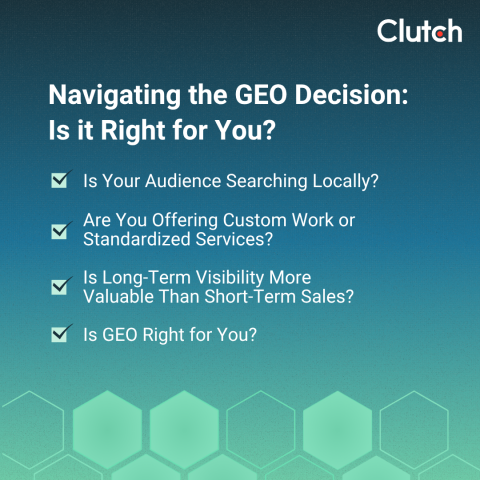
GEO is most effective when targeting local searches with intent modifiers. For example, it’s great for keywords like “near me,” in [city],” and “best [service] for [region].” That makes it ideal for businesses such as HVAC companies, healthcare clinics, multi-location franchises, and law firms.
AI overviews tend to favor businesses with consistent local schema, Google Business Profiles, and region-specific content. So, if you focus on this, it may be right for you. But if your audience isn’t bound to a particular geography, the benefits of GEO decline significantly.
You may also see greater benefits if you offer custom work instead of standardized services. For instance, marketing agencies, architects, and personalized B2B solutions tend to do well with GEO.
The reason is that AI models reward context-rich, expertise-driven explanations. These types of businesses tend to share thought leadership content that targets specific niches. If that describes your company, GEO could help you establish credibility and discovery among audiences researching complex problems in your sector.
Standardized services often get collapsed into general summaries in AI overviews and LLMs. For example, when users search for “best running shoes,” they might see an overview of what features to look for in running shoes instead of particular product recommendations.
Another key question is what you’re trying to achieve with your marketing budget. If your goal is to maximize sales in the near term, then GEO in its current form is a poor fit for you.
However, if you’re more interested in building a brand reputation and increasing general digital visibility, GEO could be ideal. It can help you improve trust, educate your target audience, and generate long-term pipeline growth. This can be useful while using other strategies to achieve your near-term goals.
In general, GEO complements traditional SEO and paid search, it’s not a complete replacement. It’s ideal for brands that target customers in specific locations. Many brands also use it to establish themselves as thought leaders in sectors like complex B2B and personalized architectural work.
GEO probably isn’t right for your business if your goal is time-sensitive or based on generating a countable number of leads. In these cases, it may be worth experimenting with GEO, though it’s probably not worth a large percentage of your marketing budget yet.
Ultimately, marketers need to be strategic about how they use GEO. It can be a powerful tool for local businesses and discovery-stage queries, but it shouldn’t be a primary focus unless you fit one of these specific use cases.
Your strategy should continue growing as more users research information through AI platforms. Over time, it’ll likely become easier to track results, which means it’s a tactic worth monitoring.