Evaluating an Marketing Agency in the AI Search Era
AI search has completely changed how people interact with online content. When an AI summary appears at the top of search results, Google users only click a...
Updated November 20, 2025

As more businesses turn to digital marketing, data analytics is more important than ever. Learn how tracking marketing KPIs can help you improve your performance and stay competitive.
Marketing has always moved quickly, but in 2026, it’s changing at breakneck speeds. With new innovations like artificial intelligence, marketers have a lot of room to experiment, but these tools come with challenges.
Consumer behavior is also shifting. Today’s customers are more knowledgeable and have access to better tools.
Even with all these changes, small and mid-sized companies continue to face many challenges, including:
That’s where marketing key performance indicators (KPIs) come in. These metrics help you understand how your campaigns are doing so you can make smarter decisions.
But even businesses that track KPIs don’t always use them effectively.
Rafal Blecharz, VP and Head of Creatives at Animwood explains, “What hasn’t changed is the reluctance to share marketing results. Transparency often reveals wasted money and resources, making many companies hesitant to disclose their data with vendors.”
Even recent Clutch data shows that nearly 10% of marketers don’t measure search performance at all.
This article highlights the benefits of monitoring marketing KPIs. We’ll also share expert tips to help you get great results and data from thought leaders about what they’re focusing on in 2026.
At first, tracking KPIs might feel tedious or unnecessary. After all, you’ll know if your marketing works by looking at sales, right? If only.
KPIs aren’t just for data lovers anymore. They’ve become essential for measuring your campaign’s effectiveness. These handy metrics go beyond sales numbers, allowing you to see the full picture of your marketing efforts — from engagement to web traffic.
Performance metrics help you step up your strategy, too. They show you what’s working and what you need to improve. That way, you can make smarter decisions based on data, not your gut. Take budgeting, for example. With KPIs, you can focus your money on the strategies that are getting results.
KPIs also make it easier to keep up with the growing complexity of marketing channels. Businesses often use several platforms, each with its own way of measuring success. On social media, for instance, it’s all about those coveted comments and likes. But for email, click-through rates are king. KPIs help you bring all this data together to see what’s working.
Finally, KPIs allow you to sync your campaigns with your business goals. By choosing relevant metrics, you can ensure you’re progressing in all the right places. For instance, if brand awareness is a top priority, you might track social mentions and web traffic.
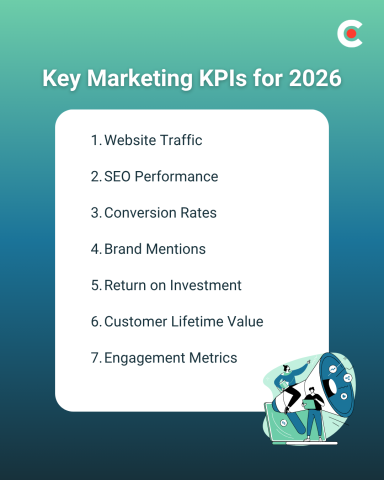
If you search online for examples of KPIs, you’ll find countless marketing metrics to choose from, but that doesn’t mean you need to track them all.
Today’s marketers are focusing on the KPIs that directly impact campaign performance and business goals. Tracking too many metrics can lead to information overload and slower decision-making.
Instead, start with a few essential marketing KPIs that give you clear, actionable insights
Your website is the heart of your business’s marketing efforts. It’s the place where you share your brand voice and make sales. But you can’t do these things if no one actually visits it.
Clutch data finds that 37% of marketers prioritize website traffic.
Web traffic reveals how many users access your site. But that’s not all. It also shows where your visitors come from so you can identify which campaigns drive the most traffic and which aren’t getting attention. If you only get a trickle of users from paid ads, that’s a clear sign you need to try another approach.
This KPI can help you understand your audience better, too. Tools like Google Analytics often track metrics like:
This data helps personalize your marketing. Does 20% of your traffic come from Canada? Try targeting Meta ads there to get even more attention. Or, if 70% of your audience is female, you might appeal to them with blog posts and videos related to their interests.
SEO focuses on improving your visibility in search results. With KPIs, you can see if your efforts are working or if it’s time to switch tactics. As search engines evolve with AI-driven algorithms and generative search experiences, marketers must pay close attention to SEO marketing metrics to understand how content is being surfaced and how user behavior is shifting.
Here are a few useful examples of KPIs and marketing metrics in the SEO realm:
SEO takes time, so it’s often difficult to see progress. However, by monitoring these KPIs, you can ensure you’re on the right track.
Additional Reading: '6 New SEO Metrics for an Evolving Search Landscape'
Conversion rate measures the percentage of users who respond to a call to action (CTA). That might involve:
Comparing conversion rates across different CTAs is a great way to determine which messaging most captures your audience’s attention.
Lead generation is a key step in the conversion process. It is the point where a visitor takes action (like filling out a form or downloading a resource) and becomes a lead.
Clutch data found that 27% of marketers prioritize lead generation as a marketing metric.
While conversion rates can apply to many actions, lead generation is one of the most common and measurable types of conversions, especially in B2B or service-based marketing.
Customers often talk about brands on social media and websites. You can see how often people discuss your business by tracking brand mentions.
Our data shows that brand awareness (23%) is another marketing metric that marketers prioritize.
As your brand awareness grows, so will the number of mentions.
Of course, not all mentions are created equal. While some customers may leave flattering comments, others may critique your business. Keeping an eye on these conversations lets you act quickly to protect your reputation if necessary.
Most businesses don’t have an unlimited marketing budget, so tracking return on investment (ROI) is essential. This metric shows you how much you’re gaining compared to what you’re spending. Here’s the basic formula:
ROI = [(Revenue – cost ) / cost] x 100%
Suppose you invest $3,000 in an influencer partnership, resulting in $5,000 in sales. Your ROI would be [($5,000 - $3,000) / $3,000] x 100 % = 66.7%.
Clutch data shows that 32% of marketers prioritize sales attribution. Sales attribution helps determine which marketing efforts are actually driving revenue, making it a core part of calculating and understanding ROI. It connects the dots between campaigns and sales, making it a key priority.
Customer lifetime value (CLV) estimates how much money you’ll earn from a client throughout your relationship.
Measuring CLV can be tricky, but it typically involves these steps:
This might sound complicated but don’t worry. As long as you’re consistently gathering sales data, you can calculate CLV without much hassle.
Here’s a quick example to illustrate:
Based on this data, your CLV would be $300 x 2 transactions x 3 years = $1,800. That means each client is worth about $1,800 to your business, an excellent incentive to build your customer base!
Of course, CLV can vary a lot by industry. A busy convenience store may have hundreds of thousands of customers yearly but small average orders. Conversely, a luxury car dealer might have fewer customers but a much higher CLV. Be sure to check industry benchmarks to see how your business stacks up.
Engagement metrics track how your audience interacts with your content. Users respond to emails differently than TikTok videos, so tailor your KPIs for each platform.
For social media engagement, use these metrics:
For email, these KPIs will help you track engagement:
If your engagement is low, you’re not hooking your audience. Consider creating more relevant content or experimenting with different formats, such as funny videos or how-to guides.
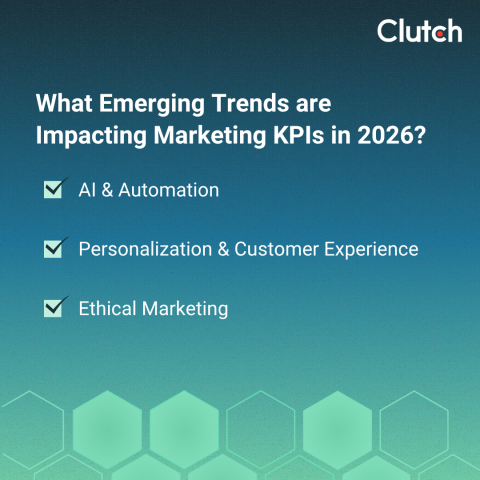
Marketing isn’t static, and neither are KPIs. Here are three trends that are changing how businesses track their performance:
If you’re impressed by traditional data analytics, AI takes things to a whole new level. With machine learning algorithms, AI can process vast amounts of data at incredible speed, uncovering patterns and insights that would be nearly impossible to detect manually.
Many businesses now rely on AI for predictive analytics, which uses historical data to forecast future trends, customer behavior, and sales performance. For instance, by analyzing transaction data from the past five years, AI can help predict which products are likely to perform best this quarter. That means you can proactively tailor your marketing strategy to focus on high-potential items, driving more efficient and effective campaigns.
AI also plays a key role in automating marketing analytics. Instead of manually pulling reports from multiple platforms, AI-powered tools can automatically aggregate and analyze data in real time.
As technology advances, 73% of customers expect businesses to offer more personalized experiences. But how can you tell if they’re actually responding to your efforts? With marketing KPIs, of course.
These metrics can help you measure how customers feel about your personalization:
Use these KPIs to fine-tune the customer experience and uncover any flaws. Suppose, for instance, you have an excellent click-through rate, but you notice many users abandon their carts. That suggests your personalization is working — you’re getting customers to take the next step. However, your check-out process might be confusing or glitchy, decreasing sales.
Customers don’t just want to buy great products; they also want to support businesses that make a difference. A 2023 McKinsey and NielsenIQ report found that sales for products claiming to be environmentally and socially responsible grew 1.7% faster than those for other products.
With marketing KPIs, you can ensure your ethical marketing efforts are paying off. This might involve tracking brand mentions or customer sentiment to see how customers view your mission.
Monitoring KPIs might seem challenging, but go ahead and put away your calculator and spreadsheet. With analytics technology, you can track and assess metrics automatically.
As Jacqueline Basulto, CEO of SeedX, explains, “Marketing tools have become smarter and better at tracking. It's easier now to track the true impact of marketing on business outcomes with tools like the Meta Pixel.”
The result? Deeper and more accurate insights without the hassle. There’s no one-size-fits-all approach to tracking marketing KPIs.
“We use custom dashboarding on CRM [customer relationship management] tools like Hubspot and SalesForce and create custom solutions on Looker Studio,” Basulto says. They also rely on "the usual Google Analytics, Search Console, and in-platform tools.”
Of course, you don’t need to go all in right away. Consider trying one or two tools that fit your goals.
If you want to boost web traffic, why not try Google Analytics? It’s free and easy to set up. Or, if increasing social media engagement is your priority, you could get started with each platform’s built-in reporting tools.
Traditionally, KPIs were seen as the domain of analysts and data teams. But in 2026, marketing KPIs are essential tools for marketers looking to stay competitive in an ever-evolving landscape. These metrics help track performance, optimize campaigns, and tie marketing efforts directly to business goals and outcomes.
Still, defining success in marketing isn't always straightforward. Recent data shows that marketers prioritize very different goals—37% focus on website traffic, while others emphasize sales attribution (32%), lead generation (27%), or brand awareness (23%). Surprisingly, nearly 10% don’t measure search performance at all.
That’s why choosing the right KPIs isn’t a one-time task. As new tools, technologies, and user behaviors emerge, your metrics should evolve, too. Regularly reassess what you’re tracking, experiment with new marketing metrics, and align them with your current goals.