
Evaluating an Marketing Agency in the AI Search Era
AI search has completely changed how people interact with online content. When an AI summary appears at the top of search results, Google users only click a...
Updated March 6, 2026

Despite popular belief that radio is on the decline, brands like Home Depot, GEICO, Indeed, and McDonalds continue to invest heavily in radio ads because they’re a cost-effective way to target local audiences. Learn how to write a radio ad script to expand your business’s brand awareness and name recognition.
Video may have killed the radio star, but radio itself is still alive and well.
Thanks to a dwindling audience of radio listeners, many argue that radio is dying but that couldn’t be further from the truth. In fact, radio seems to be growing — a 2022 report on the state of radio advertising expects the market to reach $23.3 billion by 2026, compared to the 2021 market value of $18.34 billion.
This is largely because radio advertising remains a cost-effective way for small and large businesses to target local audiences. Approximately 156 million Americans listen to radio daily, making it an effective way for companies to increase brand awareness, name recognition, and direct traffic to their sites.
Additionally, a growing interest in digital radio, streaming music services, and podcasts, have created a new market for programmatic audio ads — another advertising medium that requires companies to create engaging audio ad scripts that capture an audience’s attention.
Read on to learn how to write a radio ad script that will grow your business.
Planning to start your own ad campaign? Work with a leading advertising agency to get the most out of your campaign. Find them on Clutch's directory of top advertising companies.
The language and tone of your ad can leave a lasting impression on listeners and impact their perception of your brand.
Writers developing radio ad scripts need to have a solid understanding of what appeals to customers to create a convincing ad that increases sales. Additionally, they need to be conscious of their word choice to avoid off-putting messages.
Consider your target audience — what motivates them? What do they like? What do they dislike?
Use this information to create content that can help you connect with your audience.
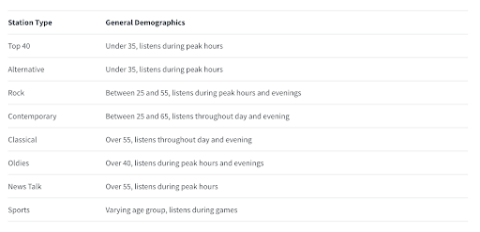
While many people think that radio has a very general audience, companies can target specific demographics based on the location of the station they use and the type of music that stations play.
For example, younger listeners generally listen to stations that play Top 40 songs, while those between the ages of 25–55 prefer rock.
If you have the budget to advertise on several different radio stations, consider altering your radio ad script to target the listeners of that specific station.
Do your research and ask the stations you’re working with if they have data about their listeners before you start writing your radio ad script.
Unlike television ads, which often rely on visuals to create emotions and develop a story, your radio ad must use words to describe the product and create that emotional connection.
By using descriptive adjectives and storytelling devices, companies can use radio to develop the same connection with listeners.
If you’re having a hard time writing a radio ad script that sounds engaging, use these prompts to get started:
In addition to the script itself, think about the other sounds you can use to make the audio more engaging. You could add a jingle or use sound effects to provide context or catch your audience’s attention.
For example, this radio ad for Pringles doesn’t have a long script — the narrator simply asks “Who took my Pringles?” Then the writer uses the sound of crunching chips and a burp so listeners would understand that the narrator was able to get their chips back.
Even without an extensive radio ad script, the writer was able to use sound effects to catch the listener’s attention and tell a story.
Radio ads are particularly effective at growing brand name recognition and awareness. By including brand messaging, such as slogans, catchphrases, and key values, companies can increase the likelihood that potential customers will remember their brand.
For example, Subway repeats its brand name and slogan at the end of every radio ad script, saying, “Subway. Eat Fresh.”
Thanks to the slogan, Subway’s name stays at the top of their listeners’ minds. Hopefully, the next time they’re hungry, they will be looking
Like any type of advertisement, incentives can go a long way in converting customers. People love a good deal. In your radio ad script, include information about existing promotions, upcoming sales, and discount codes that help your customers save money.
Phrases like, “Save up to 10% by saying that Bobby Bones sent you,” can encourage customers to finally make a purchase that they’ve been considering for a while. By adding exclusive deals to your radio ad, customers will be more likely to follow up on the ad.
Additionally, promo codes can help you gather information about the efficacy of your radio ad campaigns and help you target customers more effectively.
Calls to action (CTAs) help companies know what they should do next. Without them, listeners would not know what to do to learn more about a company. Therefore, they’re essential for converting listeners into customers.
Phrases like “Visit our ___ location on [address] for our Summer Kickoff Sale,” or “Visit our website for more information,” tell listeners exactly what to do. Be clear and concise.
Getting feedback from others is a valuable step in editing and refining a script because it reveals how the message sounds to fresh ears. Writers are often too close to their own work to notice unclear phrasing, awkward pacing, or moments where attention might drop, especially in a radio ad, where every second counts.
Input from colleagues and clients can help identify whether the script is engaging, easy to follow, and aligned your business goals. Feedback also highlights which lines stand out, which details are unnecessary, and whether the call to action is clear and memorable.
Creating multiple versions of a radio ad script allows advertisers to A/B test different approaches and identify which one resonates most with listeners. By adjusting elements such as the opening hook, tone, pacing, or call to action, marketers can compare performance and see which version drives more engagement or responses.
This process helps remove guesswork and replaces it with data-backed decisions, ensuring the final script is as effective as possible. A/B testing also reveals subtle insights about audience preferences, making it easier to refine messaging and maximize the impact of future radio campaigns.
Radio ads are usually 30 seconds long for several reasons: on one hand, broadcasters usually sell ad time in 30-second intervals to ensure that they can fit ads into their rotation. ADs longer than 30 seconds are also more expensive.
More importantly, though, listeners tend to lose interest after 30 seconds. To keep your audience engaged with your radio ad, it
A 30-second radio ad should be roughly 150 to 170 words in length.
If you’re planning to use your radio ad script programmatic audio ads, you may want to limit the word count even more.
Writing a 60-second radio ad requires extra care to keep listeners engaged while making the most of the longer format. Because broadcasters typically sell airtime in 30-second increments, a 60-second ad costs more and needs a clear purpose to justify the investment.
Attention is the biggest challenge: listeners often start to tune out after the first 30 seconds, so the message should be structured to feel dynamic rather than drawn out. A strong approach is to treat the ad as two connected 30-second segments—opening with a compelling hook, reinforcing the core message midway, and ending with a clear call to action.
In terms of length, a 60-second radio ad usually falls between 300 and 340 words, though it’s often smart to stay on the lower end, especially for programmatic audio ads. Clear pacing, simple language, and repetition of key points help ensure the message stays memorable from start to finish.
Proper script formatting is essential when creating a professional commercial script, especially for radio and audio ads. Most advertisers use a two-column layout to keep everything clear and easy to follow during audio production.
The left column lists the speaker’s role—such as Announcer (ANNCR) or Voiceover (VO)—along with production cues like SFX or MUSIC, while the right column contains the actual dialogue and any descriptive notes.
Within this structure, the script should be organized into three main parts: the hook, which grabs attention right away; the pitch, which communicates the value proposition or key message; and the call to action (CTA), which tells listeners what to do next.
Using this format helps voice actors deliver lines accurately, allows sound engineers to time effects and music correctly, and gives producers a clear roadmap for execution, making the entire production process smoother and more efficient.
As discussed, it’s important that radio ad scripts only take about 30 seconds to read. That means that companies need to pack a lot of information into just a few moments, without losing the listeners’ interest.
Here is a basic template that can help you keep your 30-second radio ad script short and succinct.
Suggested length: 5 words
The segue is the hook that catches the listeners attention. It should only be about a sentence long. Consider using greetings like “Good morning, San Diego,” or questions such as, “Do you have a hard time keeping your sink clean?”
Suggested length: 10 words
The intro is a little longer than the segue and should introduce your business. Talk about your products or services so that listeners know exactly what your business provides.
Suggested length: 30 words
This is the main part of the ad and is where you state your case. Tell a story that explains how your product or service benefits your audience and what problems they solve.
This is also a great opportunity to offer information for events, sales, or promotions that can help sway your customers. Use this to convince them to visit your website or brick-and-mortar store.
Suggested length: 5–10 words
Tell your customers what to do next with a call to action. Simple CTAs that tell listeners to call, visit your website, or visit an in-person store are most effective.
Suggested length: 10 words
The wrap-up shouldn’t be more than a sentence and should summarize what the ad was about. Remind your listeners what your business offers and how you can help them.
This is also a great opportunity to strengthen your branding. One way to conclude your radio ad script is to restate your brand name and your slogan to help listeners remember what your business is.
Sound: Light background chatter, plates clinking.
Narrator: Looking for a place the whole family will love? Come to __________ Restaurant.
Kid: Can we come back tomorrow?
Narrator: Fresh food, friendly faces, and something for everyone. Visit __________ Restaurant today or online at __________ dot com.
Narrator (smiling): __________ Restaurant—where families gather.
Sound: Music fades out.
Looking for inspiration for your radio ad script? Review these examples of 30-second radio ad scripts or listen to the radio to get a better understanding of what appeals to listeners.
Example 1: The Circus
Sound of a cheering crowd.
Kid 1: WOW! I can’t believe we saw acrobats flying through the air like that!
Kid 2: My favorite part was the man who breathed fire! How did he do that?!
Kid 3: I can’t wait to go back to the circus again!
Narrator: Come and see a show you and your family will never forget. Take your family to the _____________ Circus now playing at the ______________.
Tickets are on sale now! Log on to _______ dot com for more information. Get your tickets today at the __________ Box Office or by calling___-___-_______. (Sound of music out)
Sound: Car engine revs, upbeat rock music begins.
Friend 1: New car already? Didn’t you just start looking?
Friend 2: Yep. I went to Timmy’s Automotive and I was driving home the same day.
Narrator: Looking for a car shouldn’t be stressful. At Timmy’s Automotive, it’s fast, simple, and affordable.
Salesperson: We’ll work with your budget and find the right car for you.
Customer: I didn’t think I could afford this, but you made it easy.
Narrator: With a huge selection of new and pre-owned vehicles, flexible financing, and a team that puts you first, it’s no wonder drivers trust Timmy’s Automotive .
Sound: Car door closes, engine starts.
Narrator: Visit us today at Timmy’s Automotive, or browse inventory online at Timmysauto dot com.
Narrator (confident): Timmy’s Automotive. Drive happy. Drive home today.
Sound: Music fades out.
The cost of writing and airing a radio ad varies depending on the size of the market, the length of the ad, the time it airs, and the popularity of the radio station. Consequently, prices range from $200 – $5,000 per week.
For example, it is more expensive to advertise in larger cities, like New York or Chicago than it is to advertise in Richmond or Buffalo because the ad will reach a larger audience.

Source: 2nd Kitchen
It is also more expensive to advertise during rush hour — between 6 am–10 am and 3 pm–7 pm — compared to midday or late at night.
On average, companies pay around $20 for a 30-second ad to reach 1,000 listeners during peak times of the day, but will spend just $10– $15 during off-peak hours.
Before getting started, create a budget that you want to stick to. Then look for a radio station that appeals to your target audience and ask for a price quote.
Once your radio ad is live, you’ll want to measure the impact it is having on your business. To do so, you’ll need to set up clear ways to track listener response and tie it back to results.
Common methods include using vanity URLs, unique promo codes, or dedicated phone numbers so you can see exactly how many listeners take action after hearing the ad.
Some radio stations will be able to estimate impressions and reach, but that isn’t always accurate. You should be tracking metrics like:
With this information, you can estimate the impact the radio had on your business and calculate ROI. Overall performance can help you determine the effectiveness of the ad and improve the performance of future campaigns.
Contrary to popular belief, radio remains one of the most popular ways for people to consume media. On top of that, the popularity of digital radio, streaming music services, and podcasts continues to grow.
Consequently, radio ads and programmatic ads have become an effective way for companies to reach their target audiences and grow brand awareness.
Whether you’re planning to write a traditional radio ad script, it’s important that you keep your ad short and engaging to capture your audience’s attention.
Use information about your listeners to write ad scripts that appeal most to your target audience and evoke mental images. Then be sure to use incentives and strong CTAs to increase engagement and attract new customers.