Lead Quality vs. Lead Quantity: Why B2B Teams Are Rethinking Their Funnel in 2026
Bigger buying committees and tighter budgets are forcing B2B teams to rethink lead quality vs. quantity. Here's how top teams rebalance the tradeoff in 2026.
Updated November 4, 2025

AI answer engines now decide which brands get seen first. Make the case that GEO deserves a real budget because AI citations and brand mentions can drive high-intent traffic.
AI answer engines now sit between your buyers and your brand. When someone asks ChatGPT, Perplexity, or Google a question relevant to your industry, they get a curated answer with only a handful of links cited. If your content doesn't show up in those summaries, you lose the brand mentions and clicks.
Generative engine optimization (GEO) has quickly evolved from an experimental strategy to a core pillar of digital visibility. Shaping your content so that AI systems can find and cite it is just as important as SEO and paid advertising — not a supplementary tactic you test when there's leftover budget.
Looking for a Digital Marketing agency?
Compare our list of top Digital Marketing companies near you
Here's how to make the business case for a dedicated GEO budget by tying the investment to ROI and strategic value.
Read more about how businesses are feeling about GEO in our latest survey report.
GEO means shaping your content and brand signals so large language models (LLMs) and AI-powered search platforms can find, understand, and cite it in generated answers. GEO focuses on answer engines (AI-powered tools that answer user questions directly), such as Google’s AI Overviews, ChatGPT's search features, Perplexity, and Microsoft Copilot in Bing. That shift requires new prioritization and a budget line of its own.
Google AI Overviews are rapidly growing in search results.
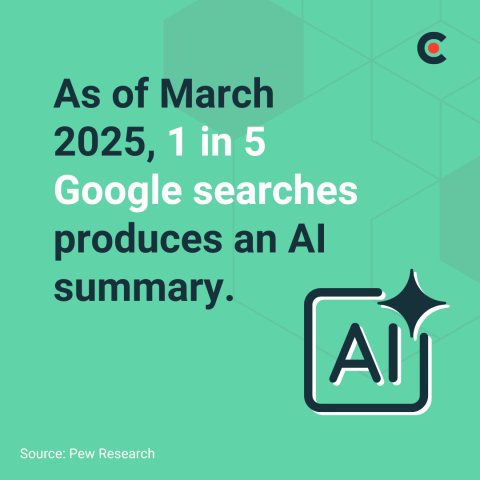
As of March 2025, 1 in 5 Google searches produces an AI summary. Users who encounter an AI summary click on a traditional search result link in 8% of all visits. Those who don't encounter an AI summary click on a search result nearly twice as often (15% of visits).
Search behavior also keeps evolving. In addition to traditional search engines like Google and Bing, people are now increasingly using AI answer engines. OpenAI, for example, claims to have 700 million weekly active ChatGPT users, and 77% of U.S. users use it as a search engine. Perplexity processes over 780 million queries monthly.
The usage pattern is consistent. People ask a question and read a synthesized response, and if they want to dig deeper, they click through to one of the few sources listed. GEO helps you win a spot on that short list.
There are two implications of the rise of GEO. First, AI answers now narrow what people see to a handful of cited sources, so winning citations is how you capture demand at the top. It's just as important that those answers describe your brand facts correctly when users ask for them. GEO is the way you can guide what facts those AI tools pull.
GEO sits next to SEO and content strategy, not apart from them. It uses many of the same inputs — structured content, clear messaging, authoritative sources — that matter to search engines and LLMs.
The key to securing investment is translating that strategic overlap into clear ROI.
Building a compelling business case starts with connecting GEO to measurable outcomes such as high-intent traffic and efficiency gains.
When framing your budget request, position GEO as the need for an evolving online business environment. The cost of not adapting as search behavior shifts could far exceed the investment required to maintain visibility.
Jack Oddy, managing director of Soap Media, explains the allocation approach: "As with all of our strategic partnerships, we allocate budget based on unique business needs and position. It's also important to note that GEO is not a replacement, but more of an advancement."
The market is already moving forward with GEO. Jacqueline Basulto, CEO of SeedX, outlines their commitment: "We are doubling our budget and allocating half to GEO and half to traditional SEO. We are recommending to our clients that they do the same."
This balanced approach acknowledges that both traditional search and AI-powered discovery will coexist, at least in the near term.
Your financial modeling should account for the full funnel (from first discovery to purchase). Start with a survey to estimate what share of your audience uses AI tools for research. Then, factor in the possible boost from GEO at each step. This way, you can project the revenue difference when your brand is absent from those answers versus cited in a set share of relevant queries.
GEO raises the odds that AI answers will pull from your verified sources and cite them. Do this by shaping product pages, documentation, guides, case studies, and PR so that answer engines can find and reuse clear facts. When models lift from those assets, it's likely that the wording and numbers match your brand. Over time, repeated citations build authority and increase how often you get mentioned in single-answer results, which becomes a real competitive edge.
Just as businesses optimize for SEO to rank higher on Google, GEO increases the frequency of brand mentions in AI-generated answer result pages. In a single-answer interface where only a select few brands get mentions, consistent visibility becomes a huge competitive advantage.
Translate your GEO strategy into a plan with clear milestones. The steps below give you a simple sequence you can present, fund, and measure.
Start with a baseline. Identify pages that already appear as sources for AI answers. You can do this with tools like Ahrefs. Then, group findings by topic cluster. For each cluster, document the current revenue contribution from organic search and the presence or absence of AI citations.
Go after changes that are quick to implement and could make a reasonable impact. For instance:
Also, consolidate overlapping pages so that one definitive resource carries the message you want to convey.
Decision-makers need to see how GEO investment translates to results. Here's a sample budget scenario with clear expected outcomes:
Tie each scenario to specific KPIs (such as citation frequency, AI referral traffic, and conversion rates) so stakeholders see exactly what each GEO budget level will deliver.
Numbers matter, but so does the narrative. Connect the investment to your organization's broader business objectives.
If, for example, your company wants more brand mentions, track them on tools like Ahrefs, and show how the AI platform's visibility directly supports that goal. If the focus is on defending market share, demonstrate how competitors gaining AI visibility while you don't represents a real threat.
Then show them the proof. Pull up actual AI responses for queries in your space. The abstract concept of "AI search" becomes concrete when stakeholders see their own prospects getting competitor recommendations from AI platforms.
Finally, address likely objections proactively. If stakeholders worry about budget constraints, show how GEO can work alongside SEO to improve existing pages. If they question whether AI search will really matter, present the rise in the use of AI search engines, as we mentioned earlier.
Having clear responses to predictable pushback increases your odds of approval.
The shift to AI search isn't a temporary trend. AI platforms already provide instant, synthesized answers that traditional search can't match for many queries. As these systems improve and more people discover them, adoption is already accelerating.
Building GEO capabilities now means developing organizational expertise that compounds over time. Teams that try to understand how AI systems select and cite sources, what content formats work best, and how to structure information for AI consumption will reap the benefits in the form of increased brand visibility across AI answers. Your 2026 budget for GEO is just the starting point.
If your business relies on organic discovery, GEO isn't optional. Answer engines now decide which sources people see first. A dedicated GEO budget thus protects today’s demand and opens new opportunities as AI progresses further. To benefit from this fast-growing new traffic channel, build your case with a baseline audit, quick wins, realistic scenarios, and a clear narrative that links spend to revenue.
Want to accelerate your GEO strategy? Choose the right partner from Clutch's vetted list of top generative engine optimization companies.