
How to Measure SEO Success When Traffic Declines
Organic traffic is down, but is your SEO failing? Learn which metrics show real SEO success when AI Overviews and zero-click searches are reducing clicks.
Updated May 29, 2026

Generative engine optimization (GEO) is reshaping search by prioritizing AI-driven content retrieval over rankings. To stay visible, businesses must integrate GEO with traditional SEO so their brand will be recognized in both AI-generated answers and conventional search results.
Search as we know it is evolving fast. Traditional SEO has long been about rankings, keywords, and backlinks, but AI-driven search engines are rewriting the rules. The real question isn’t “How do I rank No. 1?” but rather “How do I make sure my brand shows up in Google Search results, AI-generated responses, and other large language models?”
Welcome to generative engine optimization (GEO), a new framework for visibility in AI-driven search.
Looking for a SEO agency?
Compare our list of top SEO companies near you
I’ve seen firsthand how businesses struggle to adapt to the AI search revolution. This article breaks down what GEO is, why it matters, and how you can optimize for AI-driven search to future-proof your online presence.
Unlike traditional search engines, which rank pages based on indexed content, AI-driven search platforms — like Google’s AI Overviews, ChatGPT, Gemini, and Perplexity — work differently.
Instead of ranking and displaying blue links, AI models:
Example: When a user is searching, “What are the best running shoes for flat feet with high arch support?” instead of simply listing the top 10 running shoe brands, an AI search model might generate a personalized response like this:
For flat-footed runners in 2025, Nike’s ZoomX Invincible Run 3 and Brooks Adrenaline GTS 22 offer the best arch support based on expert reviews and customer feedback.
AI models don’t care about keyword-stuffed pages. They care about structured, authoritative data that helps them build intelligent, contextualized answers.
Because AI models don’t rank pages traditionally, traditional SEO metrics like organic rankings and SERP click-through rates are becoming less relevant.
Businesses need to track GEO-specific success metrics, such as:
These metrics reflect a broader shift in how visibility and influence are measured in the age of AI-driven search. To stay competitive, businesses must rethink their success indicators by focusing less on rankings and more on relevance, authority, and presence within AI-generated experiences.
Users are moving away from simple keyword searches and toward long-form, nuanced queries and voice searches. AI understands conversational prompts better than traditional search engines.
Before: “best running shoes”
Now: “What are the best running shoes for flat feet with high arch support?”
The difference? AI isn’t just matching keywords — it’s analyzing intent, context, and entity relationships to generate the most relevant response.
AI search engines are often just step one in the research process. After interacting with AI-generated responses, users tend to:
Takeaway: To maximize visibility, businesses need to ensure their brand appears in AI responses and has a strong presence across search engines, external websites (aka websites that aren’t the brand’s site), and social platforms.
While keywords have long been a top priority in businesses’ SEO strategies, entities are more critical for GEO. Entities are concepts, brands, people, and topics that AI understands and connects in its knowledge base.
Large language models build foundational knowledge by taking in large amounts of content from various unstructured data sources.
During training, LLMs identify patterns based on how often and in what contexts certain entities and words appear together.
So when you pose a question to an LLM, it’s not sifting through a facts database; it’s using its understanding of entities to predict what words should logically be included next in the response.
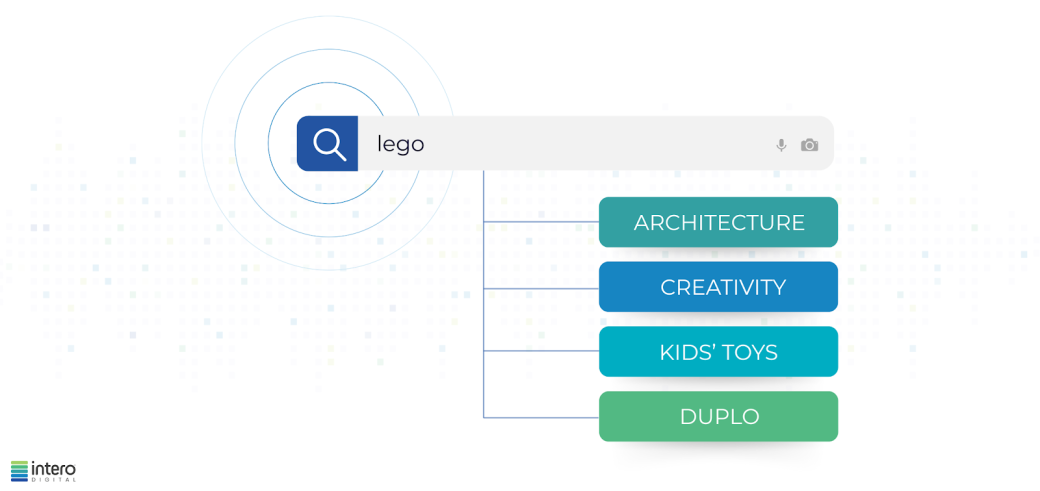
Example: LEGO is an entity. It’s connected to related entities like creativity, architecture, kids’ toys, DUPLO, and “The LEGO Movie.” These relationships tell search engines that LEGO isn’t just plastic bricks — it’s play, STEM education, nostalgia, and branded content gold. So when someone is wondering about the “best STEM toys for kids” or “movies that promote creativity,” LEGO has a seat at the table.
AI models pull data from structured sources like:
If your brand lacks a structured presence in knowledge graphs, AI might simply ignore it.
Takeaway: Implement schema markup on your website to define your brand, products, and services in a way that search engines and AI models can easily recognize and retrieve.
Not all AI-driven search engines work the same way. Some rely on static training data while others use real-time retrieval (retrieval-augmented generation, or RAG).
Here’s a quick look at how different AI models handle search queries:
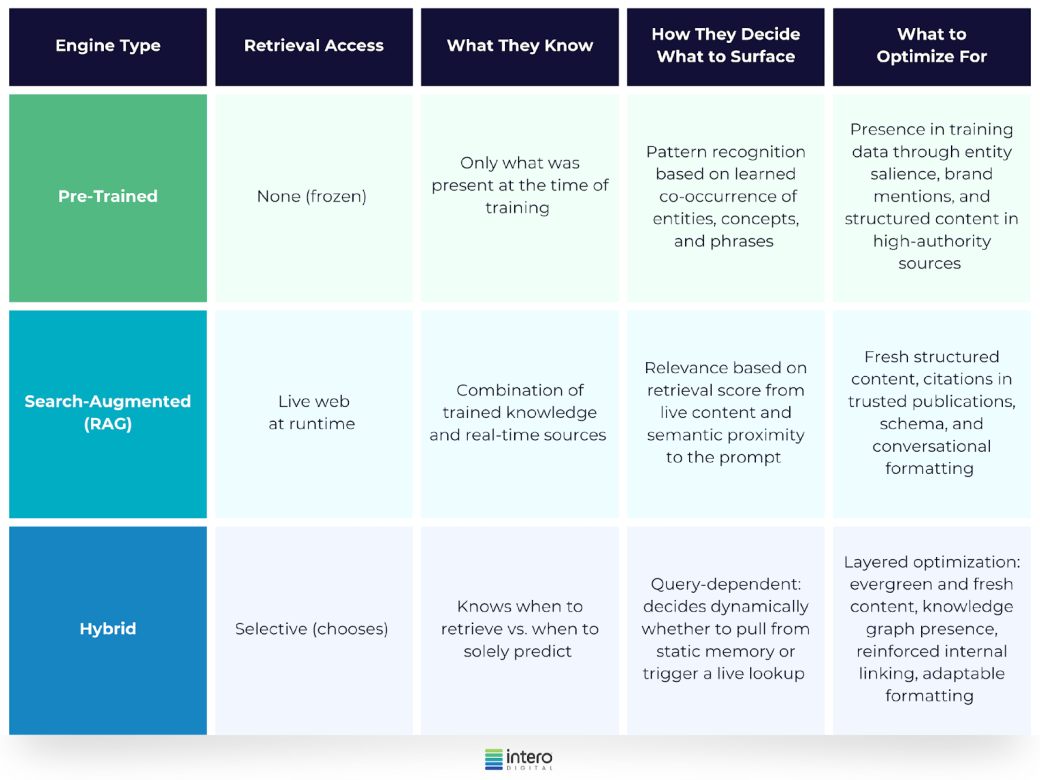
Takeaway: There’s no one-size-fits-all strategy. Businesses need tailored GEO approaches for each AI search platform.
Now that we understand the shift, here’s how you can get started with future-proofing your search visibility in the AI era:
Generative engine optimization (GEO) isn’t just an update to SEO; it’s an evolution of search. While GEO relies on some of SEO's core components, it emphasizes others that weren’t as mission-critical before generative engines entered the scene.
Businesses that adapt now — by focusing on entities, structured data, and AI search optimization — will stay ahead of the search revolution. Those that don’t? Well, they’ll risk becoming invisible in the next era of online discovery.