10 Actionable Link Building Tactics to Build Brand Authority & Legitimacy
Discover 10 actionable link building tactics to boost brand authority and rankings. Learn how quality backlinks build lasting trust in the AI search era.
Updated March 11, 2026

Search engines aren't going extinct, but there's a new contender vying for attention: AI. As this rivalry heats up, understanding when to focus on AI referrals and when to lean into organic search will help you stay visible.
Technology keeps changing how people discover information. Twenty years ago, drivers clutched coffee-stained MapQuest printouts and prayed they didn't need to make a detour. Now, GPS often reroutes you before you even realize the road is closed. An even more drastic shift is happening in online searching.
Search engines aren't fading away like MapQuest, but they're not the only entry point anymore. Instead of automatically turning to Google, more users are experimenting with AI tools. For example, a customer might ask ChatGPT, "Can you recommend blue dresses for my best friend's wedding? The invitation says cocktail attire, and I already have gold heels." The chatbot will scour the web and compile a list of wedding-appropriate dresses.
Looking for a SEO agency?
Compare our list of top SEO companies near you
While AI and search engines both aim to recommend valuable content, they do so in different ways. If your company wants to capture traffic from both gateways, you need to adapt how you present information.
AI cares about clarity and usefulness, while search engines look for relevance and quality. As the gap between these channels grows, marketing teams will need to optimize content for both — not an easy feat.
To learn more about how AI is shaking up the industry, Clutch partnered with Conductor to survey 459 marketing professionals responsible for producing content. Their priorities were evenly divided, with 17% focusing on AI referral traffic and 16% focusing on organic traffic.
Drawing on our data, this guide breaks down the differences between AI referral vs. organic traffic. We'll also share best practices for creating content for both channels, so you don't have to double your workload.
AI referral traffic happens when an AI platform sends users to your website, either directly or indirectly. It includes:
Let's say a user asks Gemini to recommend nearby camping gear stores so they can stock up on firewood. The chatbot will generate a list of local options and may link directly to each business's website. If the customer clicks one of the links, it counts as an AI referral.
On the other hand, organic traffic comes from visitors who discover your content through unpaid search results. This usually happens through search engines like Google or DuckDuckGo. Some marketers also count referrals from unpaid social posts as organic traffic. For example, a customer might look up your website after seeing your product in a friend's Instagram Reel.
Both channels consider the user's intent when suggesting content. They analyze factors such as language and location to deliver the most relevant results. That's why an adult searching for farm equipment in Dallas probably won't get recommendations for toy tractors for sale in Massachusetts. It's not relevant.
They also favor high-quality content, but they have different criteria. AI prefers clear, well-structured content that answers questions or provides practical tips. This matter-of-fact content is easy for LLMs to summarize or excerpt. If a user asks, "What's the best bedsheet material?" the AI may quote an article with that exact heading.
Meanwhile, search algorithms consider more nuanced quality signals when ranking content. Google, for instance, considers backlinks, domain authority, the helpfulness of titles, and other factors. Because of these differences, a web page may excel in SEO but rarely get referrals from AI, or vice versa.
Before ChatGPT became a household name, AI referrals were barely a blip on marketers' radar. However, our survey shows that marketing teams are now dividing their focus between discovery channels. Overall, 17% say they're prioritizing AI, and 16% favor organic search.
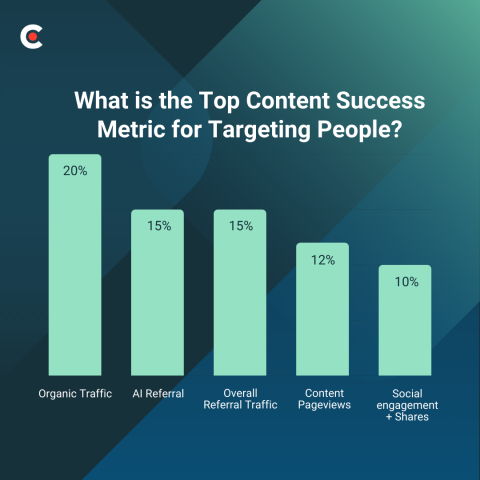
The responses remain almost evenly divided when marketers were asked about how they target content to different audiences. When they're trying to reach humans directly, 20% of marketers optimize for organic search, and 15% do so for AI.
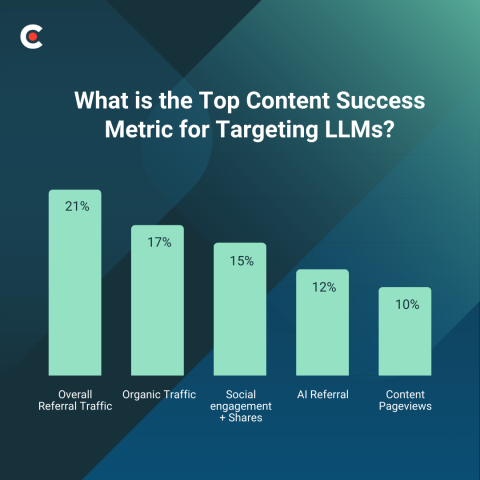
When LLM visibility is the goal, 17% still rely on organic traffic strategies, while 12% optimize their content for AI.
This lack of consensus suggests that marketers are hedging their bets rather than going all in on a single channel. It makes sense. Adobe reports that AI referrals in the U.S. increased more than tenfold between July 2024 and February 2025.
Businesses that optimize their content for AI now can get a head start on competitors who are less forward-looking.
Resist the urge to abandon organic search, though. Plenty of users still rely on familiar search engines to find information. Plus, AI interfaces may borrow from search mechanics to decide which content to recommend. Take Google's AI Overviews, which frequently appear at the top of search results pages. These summaries tend to spotlight content that follows SEO best practices, even though they're not strictly part of organic search.
By designing content for both AI and organic search, you can reach people using either channel or embarking on blended journeys.
There's no such thing as "AI-only optimization." Every AI platform has a human audience that's asking questions and consuming information, and that's who you're ultimately targeting. If you try to pander to algorithms with exclusively AI-friendly content — such as writing hundreds of Q&As or exclusively using bullet point lists — you'll end up pushing away your real audience.
Instead of choosing between AI referrals and organic traffic, focus on practices that appeal to both.
AI and search algorithms share the same goal: to connect users with the most valuable and relevant content. Meet this demand by consistently producing helpful, well-written content. Follow these tips:
Google tends to reward high-quality content with higher organic rankings, bringing more visitors to your site. Creating clear and factual writing also increases the odds that AI will cite your work.
Neatly structured content is easier for both humans and AI to understand. Divide your content into sections with descriptive headings and subheadings, so it's obvious what each section covers. And make sure the content flows logically. For example, if you title a section "What Are Equestrian Sports?", the very first sentence should include a concise definition.
Semantic clarity matters, too. Use precise language and steer clear of confusing metaphors and jargon. If an everyday reader doesn't understand what you're saying, assume AI won't, either.
Google uses the E-E-A-T framework to assess content quality. It stands for Experience, Expertise, Authoritativeness, and Trustworthiness. Check all these boxes by including authority signals, such as:
These authority signals also tell AI models that your content is accurate and credible. As a result, they're more likely to refer readers to it.
You may feel tempted to cover as many topics as possible to give yourself more opportunities to get discovered. But writing a lot of one-off posts isn't the solution. If you spread yourself too thin, you risk confusing the algorithms and your human audience. Plus, you won't have the expertise or time necessary to create consistently great content.
Instead, stick to one or two topics and focus on going deep in these areas. For instance, IT Goat focuses on cybersecurity industry challenges and trends. If a business owner asks AI for resources for fending off hackers, it might refer them to one of these posts. This expert, people-first content may also rank high in organic search results.
Organic traffic strategies don't always translate neatly to AI models. That's because AI gravitates toward clear, straight-to-the-point answers. If you pack your content full of keywords or fluff, the AI model will move on to another source.
AI also doesn't give backlinks as much weight as traditional search algorithms. It looks for the best answers, not who's winning the popularity contest.
If you're aiming to bring in more organic traffic, follow these tips:
Is attracting more AI referral traffic your number one priority? Try these tactics:
Both AI referrals and SEO take time to work, so don't expect to see instant results. Focus on slow, steady growth. Measure your AI visibility by tracking metrics like brand mentions and referral traffic. For organic search, look at impressions, keyword rankings, and the number of web visitors.
While AI and SEO strategies don't perfectly overlap, you shouldn't separate them. That will only waste time and make your content feel like a Frankenstein-esque monster. Instead, aim to create content that performs well across both discovery paths.
Here are a few examples of meaningful content that will pique the interest of humans and AI alike:
Teach your content marketing team about how search engines and AI models assess content. You could also include people from both sides, such as an SEO specialist and an AI engineer. They can help you stay up to date on the latest organic and AI search trends.
Finally, create a mixture of trendy and evergreen content. A healthy balance will deliver a quick payoff in short-term traffic while also growing your business's long-term visibility. It's a win-win.
As our survey results show, there's no clear winner in the AI referral vs organic search race yet. Marketers prioritize both discovery paths equally. This split suggests that companies are covering all their bases by optimizing content for humans and AI.
As more people turn to AI to locate information, AI and search experiences will likely converge. Prepare for this seismic shift by adapting your content strategy today. By creating content that ranks well in search results and is cited by AI systems, you'll reach your audience wherever they roam.
In other words, the future belongs to teams who understand how their users find content, not just where. Get started today by creating more answer-oriented content and making sure your expertise shines through in every piece.