
Podcast SEO in 2027: How to Make Business Episodes Findable
Learn how transcripts, question-led titles, structured data, and guest links help business podcasts get found on YouTube, Apple Podcasts, and Google.
Updated April 1, 2026

AI is reshaping how marketers approach content creation, but it’s not a replacement for human creativity. Discover what the data says about how marketing professionals use AI as a tool throughout the content creation process, plus tips on incorporating AI strategically from ideation to final polish.
Using AI tools has become increasingly common for both large and small businesses, putting marketing teams under more pressure than ever to produce content that both ranks well and stands out from the rest. Some businesses are depending on AI to fully automate content creation.
Pratik Thakker, Founder and CEO of Insidea, says, “AI has compressed the content lifecycle. Research, outlining, and drafting now happen faster than ever, which means execution is no longer the bottleneck.”
Looking for a Content Marketing agency?
Compare our list of top Content Marketing companies near you

But content generated by AI doesn’t always connect with human readers. Instead of turning over your entire content production process to AI, you can get the best of both worlds by using AI as a tool at different stages.
To find out how marketers are actually using AI in content marketing, Clutch, in collaboration with Conductor, surveyed asking 459 marketing professionals. The data shows they are using AI as a tool in key areas of content creation — from article topic research to drafting — rather than fully automating their processes.
This article breaks down five practical applications of AI in content marketing and how your team can use it as a tool to keep up with content schedules without sacrificing the human touch.
Content marketing is in a period of change. The rise of AI tools has shifted how businesses create content to help others discover their brand and offerings. Depending entirely on AI to produce content can lead to text that doesn’t engage audiences and struggles to stand out against competitors.
However, AI can still play an important role in certain phases of the content creation process.
Combining these five methods of effective AI use can help teams maximize visibility, improve content, and speed up the entire process:
When your team sets out to create content, you need to start from a strategic foundation. If the content you’re producing doesn’t cover a topic your customers care about, it’s likely a waste of time and resources. Topic research is an important first step because it narrows a broad idea into specific concepts that align with your target audience's needs and your business’s objectives.
Traditionally, topic research was often a massive undertaking. You’d have to brainstorm ideas, look at past performance, industry analysis, and customer feedback, and use gut instinct to identify potential trends. Today, you can use AI to get relevant topic suggestions in seconds based on search trends, keyword patterns, and competitor content.
Our survey found that 42% of marketers turn to AI for researching article topics. AI systems can quickly scan the internet and navigate massive datasets to identify applicable insights. This means less effort from marketers and faster results.
However, AI alone can’t replace human judgment and decision-making. For example, say you want to create a blog post about text message marketing to establish your authority and promote your services.
When you plug that prompt into an AI tool to get a few ideas for blog post direction, you might get generic topic suggestions like “benefits of text message marketing” or irrelevant suggestions like “why SMS marketing is a thing of the past.” Without human discretion, you risk creating content that doesn’t connect with users and fails to drive real impact.
The people on your team are essential for aligning content with the brand, messaging, and long-term business goals. Teams that can effectively combine the efficiency of AI technology with human judgment position themselves to produce consistently high-performing content.
One overlooked way that AI enhances content workflows is by producing outlines. Outlines let you establish how the content aligns with your short- and long-term business objectives. AI tools excel at organizing information and arranging ideas into a logical sequence that readers find both useful and easy to follow.
We found that 38% of the marketers surveyed use AI for strategic outline development. AI tools can quickly produce a clear structure with supporting ideas as a framework. Coming up with an outline first also provides opportunities to determine the best places to add keywords, authoritative links, and signals that can help the content rank in search results.
With the AI outline as a starting point, you can build on this foundation by adding or removing headers and subtopics to home in on specific objectives and improve the overall flow. This collaborative effort allows AI technology to handle the heavy lifting in structure, while giving your team the opportunity to apply judgment and creativity. The end result is a more refined piece of content that takes less time to produce.
Entering a prompt into an AI chatbot and publishing what it spits out isn’t a recipe for success in the field of content creation. However, AI tools can turn out decent first drafts to help you get a project off the ground. Our data found that 35% of marketers use AI to produce first drafts. This makes it much more efficient to turn an initial concept into a finished product and allows writers to get a head start on their work.
Staring at a blank page with a blinking cursor can be intimidating, especially when you need to produce content that delivers results on a deadline. AI-assisted drafts get you off to a good start with a usable foundation that you can mold into something that hooks users and provides genuine value.
But don’t be so quick to post AI-written drafts without polishing them. The initial drafts AI produces often lack originality and human sentiment. This makes it vital to add your personal touch and refine the brand messaging. Human creativity and industry-specific insights keep content useful and relevant to the reader. This value, in turn, drives engagement, conversions, and other measurable results.
Savvy marketers leverage AI at every major step in creating a solid piece of work. Once you have a well-written article, you can turn to AI again for assistance with editing and optimization. Clutch data shows that 36% of marketers use AI tools to assist them with editing.
Because of their efficient pattern recognition capabilities, AI tools can quickly scan a document and identify flaws. AI excels at:
While skilled editors can make these adjustments, AI can finish them in seconds. By making it especially valuable for teams managing large content libraries on platforms like Document360.
With the benefits in mind, it’s also important to remember that human editors are equally important. AI still makes mistakes, especially with messaging and tone. Hallucinations, which are false or invented responses that the AI states with confidence, are another issue plaguing these tools. The likelihood of a hallucination varies depending on the task, but hallucinations in general tasks occur between 2% and 5% of the time.
In an attempt to improve readability, an AI-generated version of an article may simplify concepts or remove text critical to the topic. Human editors are still better at spotting inaccuracies and oversimplifications and fixing them. Because of this, human editors should have the final say on when a draft is ready to publish.
Before your team green-lights a piece for publication, you need to know that it will be discoverable. Keyword research and search alignment are crucial to ensuring your intended audience actually sees your content. Without strategic keyword research, well-made content could end up ignored and discarded. This is why 35% of marketers are using AI tools to optimize their content for keywords and search alignment, according to Clutch data.
In the past, marketers stuffed keywords into their content to rank higher in search results. However, algorithms have vastly improved and now look at more areas, such as how the content satisfies user intent, topical depth, and overall relevance.
Content also appears in more places than SERPs. For example, today’s companies must optimize their content so that AI chatbots reference it after it’s been indexed. AI tools can quickly analyze text patterns to determine themes, concepts, search intent, keywords, and phrases. These capabilities not only help algorithms find the right audience for your content, but also make it easier to optimize it.
AI can offer suggestions for optimization and improvement. However, the final say should rest with the humans responsible for the content. Your team knows how to prioritize what matters most to your target audience and make sure the content remains engaging despite changes. When you use AI as a tool for keyword research and optimization, you can elevate well-written content and increase the chances that the right people see it.
When it comes to producing quality content, incorporating AI into key areas offers significant benefits. However, there are several traps you can fall into that lead to generic content and weak discoverability.
Some common mistakes to avoid when using AI in content marketing include:
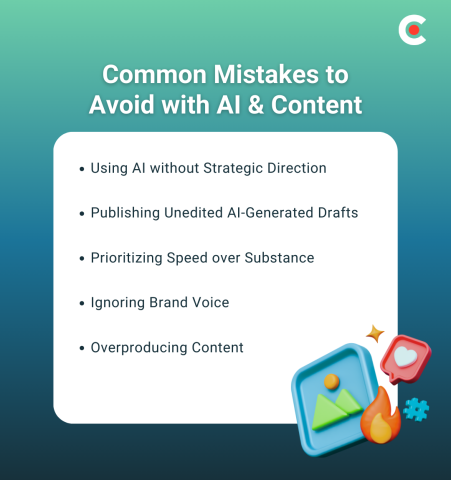
Without an effective strategy, the content that AI produces doesn’t land with audiences. If you enter a simple prompt into an AI chatbot without defining your goals, audience, brand identity, and messaging, you risk putting out surface-level content.
Good content addresses relevant customer pain points and links to business objectives. Without this, readers will be quick to disregard it and may lose trust in your brand.
Because AI chatbots are capable of quickly producing drafts that are free of grammar and spelling errors, it can be tempting to publish them as-is. But AI systems aren’t perfect and can produce drafts riddled with easy-to-miss factual errors and generalizations. Your team must act as editors to guarantee accuracy and brand consistency in all content. Skipping this can lead to a loss of credibility and trust from consumers.
AI makes creating content fast and effortless, but that doesn’t translate to success. Jack Hayes, Managing Director at Champions Speakers Agency, says, “The win is speed. The risk is sameness and errors.”

When you make speed the only goal, content comes out with little depth, original insights, or unique perspectives. Readers are more likely to skip repetitive content that comes out fast in favor of in-depth pieces that build authority and address real pain points.
Content with a distinct style, tone, and voice shapes your brand’s personality. AI tools tend to use the same generic style and voice, no matter the topic. Readers are more likely to recognize and remember unique brands. Content infused with a strong voice influences how people feel about your brand and leads to more engagement and sustained loyalty over time.
When content floods every corner of the internet, it can be tempting to prioritize quantity over quality. After all, don’t more articles mean more traffic? The truth isn’t that simple. Algorithms like the one that powers Google rank content based on its usefulness and the expertise of the person or organization publishing it. Producing a large volume of general content doesn't help you show readers or algorithms that you have expertise and useful information to share. It can also overwhelm readers, driving them instead toward other sources that prioritize usefulness.
Creating high-quality content and releasing it on a strategic schedule leads to a stronger, more consistent performance over time.
Incorporating AI into content marketing offers several clear advantages when used strategically. If you overrely on AI tools and chatbots to create lengthy pieces from prompts, you run the risk of publishing generic content that readers learn to ignore. However, using AI for strategic topic discovery, outline development, first-draft generation, editing, and keyword research helps you produce better content faster.
AI content creation should be a collaborative effort, balancing the efficiencies you get from AI tools with the specialized knowledge your smart, savvy human team has about your business’s objectives, brand voice, and audience needs. When you successfully incorporate both sides, you’ll waste less time, sharpen content focus, improve creativity, and scale strategically.