
Why Your B2B Outbound Emails Never Reach the Inbox (And What It Costs You)
Your B2B cold emails might be landing in spam, not inboxes. Learn how to check placement and the 4 fixes that actually move the needle—not copy edits.
Updated March 11, 2026

AI is changing how humans and LLMs use and discover content. Marketers can use the right AI metrics to determine and adjust content performance.
Measuring content performance has always been challenging, and adding AI into the mix has introduced many new variables for marketers to consider.
Clutch, in collaboration with Conductor, recently surveyed 459 marketing professionals responsible for producing marketing content about their thoughts on the state of marketing in the age of AI. Their responses show that five key metrics are becoming increasingly important for assessing content performance as AI adoption accelerates.
Looking for a Content Marketing agency?
Compare our list of top Content Marketing companies near you
This article breaks down the top five AI metrics marketers are using to determine content performance. Get a leg up on the competition with practical strategies marketers can use for analyzing and optimizing content that targets both human audiences and Large Language Models (LLMs).
The mainstream use of AI has led to a decrease in click traffic, but it's still an important factor. AI chatbots provide links and recommendations that direct users to a specific destination based on their questions.
When AI systems, such as ChatGPT, Perplexity, and Claude, offer a link, it becomes measurable referral traffic that businesses can track through tools like Google Analytics 4 and Adobe Analytics. AI referral traffic allows companies to monitor trends and volume over time and compare that engagement against other traffic sources.
Though it’s a relatively new metric, it is already influencing how marketers evaluate performance. Our data found:
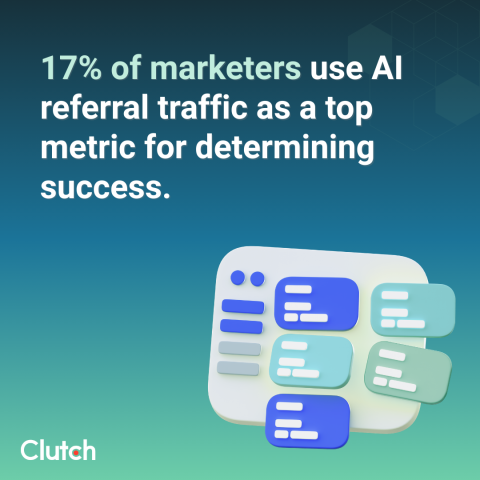
Businesses can also see how AI systems drive discovery and influence their visibility through referral traffic. Because AI chatbots, search tools, and recommendation platforms are becoming major discovery channels for users, tracking how these systems link content is increasingly important for understanding performance.
Businesses and marketers can implement specific strategies to make AI systems work for them. The most effective ways to increase AI referral traffic include:
With this data, businesses and marketing teams can adjust content to optimize performance with the highest-performing AI systems. Experimenting with content formatting for AI consumption allows companies to determine better ways to optimize their content for AI discovery and visibility.
When visitors discover content naturally through search engine results, without paid advertising, it’s considered organic traffic. Users searching for a specific keyword and then clicking on a business’s link in the search results reflects both high consumer trust and an effective SEO strategy by the marketer.
Organic discovery has begun to change with AI. Recent research finds that 80% of search users use AI summaries to find answers around 40% of the time. This shift has caused a drop of up to 25% in traditional organic traffic. However, it is still an important metric for measuring brand authority and long-term discoverability. Organic traffic also informs AI-driven search results, making it a continuously relevant metric.
Clutch research found that organic traffic remains a top metric for marketers, despite recent changes. Of the marketers surveyed:
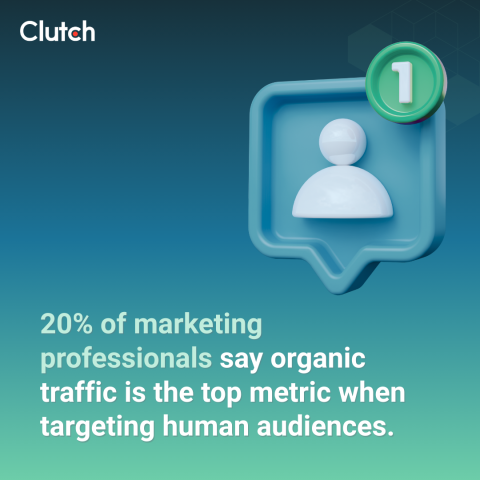
Organic traffic compounds over time, increasing visibility and growth without exhausting a company’s budget. This makes it a worthwhile metric for businesses to monitor and strive to improve.
One of the most effective ways to optimize organic traffic is to conduct keyword research. In the past, marketers focused solely on human-made search queries. However, modern search behaviors have expanded to include AI interactions and prompts.
This development has made it essential for marketers to adjust their keyword research strategies to incorporate both approaches. Combining AI-assisted SEO tools, such as Ahrefs and SEMrush, with traditional keyword analysis methods is an excellent way to understand organic traffic.
Another AI content optimization strategy is to produce effective evergreen content. This type of content remains relevant for a long time and consistently attracts organic traffic. For example, a blog titled “What Is Organic Traffic?” that breaks down the basic concepts will remain useful and may rank in search for years. Optimizing this blog with internal linking, content clusters, and SEO best practices can further strengthen its performance.
Using social media platforms has become a must for any serious brand. Social channels enable businesses to publish and distribute content to large global audiences, boosting visibility and trust.
The major platforms, such as Facebook, YouTube, TikTok, and Instagram, all use engagement indicators that signal clear interest and value in content. Some of the most important engagement metrics to track on these social platforms include:
Clutch's survey found that social engagement and shares are a top metric for marketers:

Engagement with social media content gives marketers an understanding of what connects with audiences and how content goes viral. These insights offer a helpful perspective on how content spreads through networks and influences AI recommendations.
To optimize engagement on social media posts, marketers should aim to create content that is shareable. This type of content can range from short-form TikToks to detailed infographic images to lengthy text posts with concise takeaways.
Many users are more likely to engage when prompted. When marketers create environments that foster discussions and encourage audience participation, they build lasting communities that feel valued. This can also result in user-generated content (UGC), where audiences voluntarily produce content related to the brand that can act as promotional material.
Aligning messaging with platform trends and AI signal cues can further increase engagement across social platforms. Farhad Divecha, Group CEO at Accuracast, states, “The most important change we see is content teams taking AI answers into account, and creating content that answers questions in an AI-friendly manner.”
One of the most efficient ways to build an engaged audience is to find what works. Scheduling posts ahead of time helps maintain a steady flow of content, which can strengthen some ranking signals that boost visibility in user feeds. Analyzing engagement patterns and social media metrics also points markets in the direction that works.
Using A/B tests and experimentation strategies helps brands make better decisions to increase human engagement and interest, which, in turn, reinforces the signals used by AI systems.
Keyword ranking is where content appears on a search engine results page (SERP) for a specific search term or phrase. When someone types a word into a search engine looking for answers or additional information, the search engine displays the most relevant and authoritative content first.
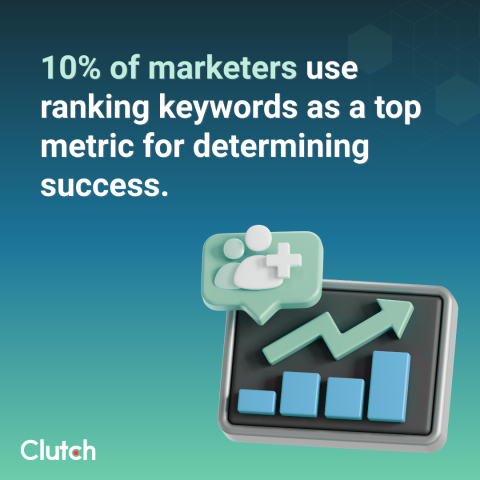
Keyword ranking now extends beyond sites like Google and shows up in responses and results from LLMs. According to Clutch’s data, 10% of marketers rank this as a top overall metric, while 9% prioritize it for humans and 8% prioritize it for LLMs.
Ranking highly for keywords directly affects organic discoverability and perceived authority, making it a key metric to track. One strategy to optimize for this is to use AI-powered keyword analysis to expand topics. AI tools can help marketers connect content to related concepts, questions, and semantics that might otherwise go overlooked.
By expanding topic relevance, the content becomes more aligned with keywords in both human searches and AI systems. However, it’s not enough to simply pack a large amount of keywords into content to make it rank. AI systems and search engine algorithms look for content that matches user intent. Long-tail conversational queries that mirror how real people ask questions and how LLMs interpret language perform well.
For best results, marketers should monitor SERPs and track competitors to see where their content ranks. This can help them identify weak areas and provide a path toward improvement.
Even if content already ranks at or toward the top, it’s unlikely to remain there without constant updates and adjustments. Brands must continually refine their content and strategies to stay relevant in keyword rankings.
One final metric that remains important in the age of AI is content page views. These views show the total number of times a user sees a piece of content or visits a website.
Marketers use this metric to gauge audience interest. Today, this count includes views from social platforms, search engines, and shared links, as well as views by AI systems.
The view metric shows a piece of content’s reach and initial engagement, helping marketers determine whether it's being distributed effectively. Because AI systems don’t leave an impression by clicking like a human would, page views give possible indications that content is being promoted by AI.
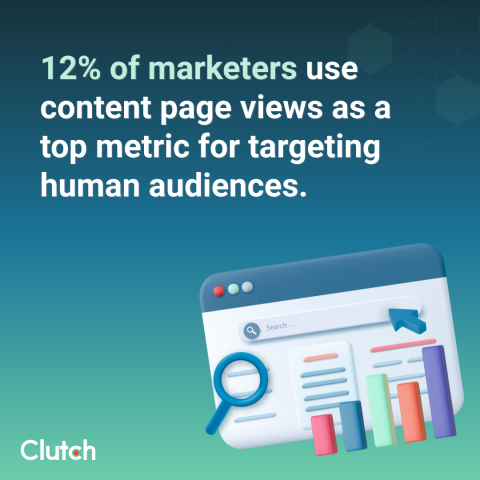
Clutch’s data shows that 10% of marketers prioritize content page views as a top metric. While 10% look to it for LLMs, slightly more marketers surveyed (12%) see it as the primary metric for targeting humans.
For better content page view metrics, it's essential to optimize meta titles and descriptions. This helps content reach the right audiences and stand out in search results. It also signals to AI systems that relevant information is available. It’s equally important to have engaging calls to action (CTAs) to increase clicks and, in turn, content page views.
Distributing content across multiple channels and platforms is another way to increase exposure. Along with using AI platforms, scheduling posts for release across various social media channels, and sending newsletters that link back to content can create a compounding effect. Using A/B testing to determine the best layout and formatting can improve engagement and make it easier to determine what works for future content uploads.
However, content page views only tell part of the story. To get a more complete understanding of user behavior and preference, it’s best to pair page views with other metrics, such as scroll depth and time on page.
As AI continues to reshape the way content is accessed, marketers must hone their strategies and make adjustments to remain visible and effective. There isn’t one single metric that fully measures content performance. AI referral traffic, organic traffic, social engagement, keyword rankings, and page views work together to paint a complete picture of success.
By leveraging all of these metrics, your team can gain a holistic view to create content that is discoverable by AI systems and LLMs while also engaging and visible to human audiences.