
How to Measure SEO Success When Traffic Declines
Organic traffic is down, but is your SEO failing? Learn which metrics show real SEO success when AI Overviews and zero-click searches are reducing clicks.
Updated August 6, 2026

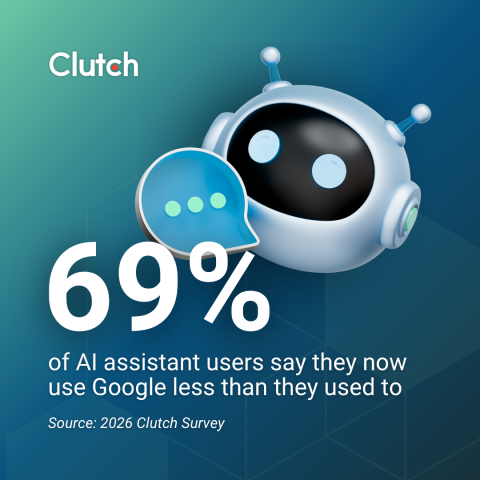
69% of AI assistant users say they now use Google less than they did before. Here's what that means for how customers find your business in 2026.
For decades, showing up on Google was the price of entry for business visibility. For customers to find you, you had to build a website, optimize for search, and earn your rankings. It took some effort, but the process was pretty straightforward.
Then, AI assistants disrupted everything related to online business visibility.
Looking for a SEO agency?
Compare our list of top SEO companies near you
In fact, 69% of AI assistant users say they now use Google less than they did before. Plus, 32% say they now turn to an AI assistant first when they need information, edging out the 28% who still go to Google first.
That shift is already affecting how customers find businesses like yours. Rather than a list of links, AI synthesizes and recommends in a single response. If you're not showing up in that answer, you may be invisible at exactly the moment a customer is forming an opinion.
This report breaks down how AI usage is reshaping search behavior in 2026, what customers are actually doing inside these tools, and what businesses need to understand to stay visible in an AI-first information landscape.
The numbers tell a story that would have seemed unlikely just a few years ago: A majority of those who have tried an AI assistant say they turn to an AI assistant first when they need information (32%) than those who still go to Google first (28%). Plus, among AI assistant users, 69% say they use Google less than they did before because of AI, with 47% saying they use it significantly less.
With a shift as significant as this, businesses are scrambling to figure out where they need to show up.
The good news is that users aren't abandoning Google wholesale. Instead, they're redistributing their attention based on what each tool does best.
AI has taken the lead on tasks that require synthesis and generation:
These are tasks where users want a direct, processed answer rather than a list of sources to sift through.
Google, meanwhile, still holds ground where currency and locality matter. When asked which tasks Google still outperforms AI, users pointed to real-time news (37%), finding local businesses (37%), and shopping comparisons (35%) as areas where search still has the edge.
However, one data point captures the competition better than any other: quick, direct answers ranked equally as a reason to choose AI and a reason to choose Google — both at 37%. This tie indicates that users are genuinely divided on which tool does this better, reinforcing that the two are becoming direct competitors for the same everyday behavior.
To complicate things further, Google is increasingly becoming an AI-first experience. When asked how they feel about AI-generated answers appearing at the top of Google Search results, 47% said they love it, and 24% find it a helpful addition.
For businesses, the takeaway isn't to abandon SEO or declare one platform the winner. It's to recognize that the search landscape is now fragmented, and your customers may be finding information about you, your category, or your competitors through channels you're not currently optimizing for. A visibility strategy built entirely around traditional search is no longer sufficient.
Knowing that customers use AI is only half the picture. Understanding how they use it reveals the patterns that shape how customers research, compare, and make decisions, and where in that process your business needs to show up.
The data shows that, of those who use AI assistants, their AI usage clusters tightly around a handful of core behaviors. These behaviors signal how AI is deeply embedded in the research and consideration phase of a decision:
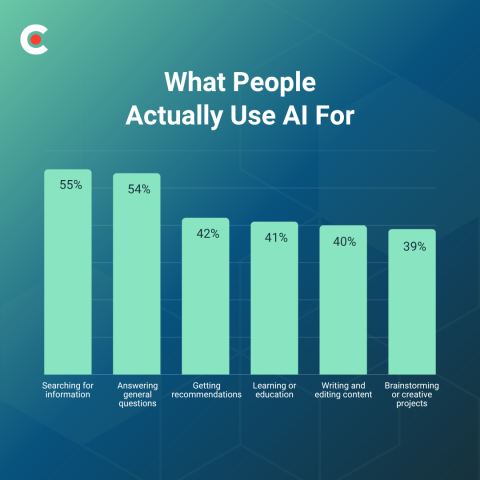
These habits also cross the work-personal divide. More than half of users (52%) say they use AI for both work and personal tasks, meaning the same tool someone uses to look up a restaurant recommendation is the one they're using to evaluate a service provider or compare products. AI has become a single, unified research habit that is shaping decisions across the board.
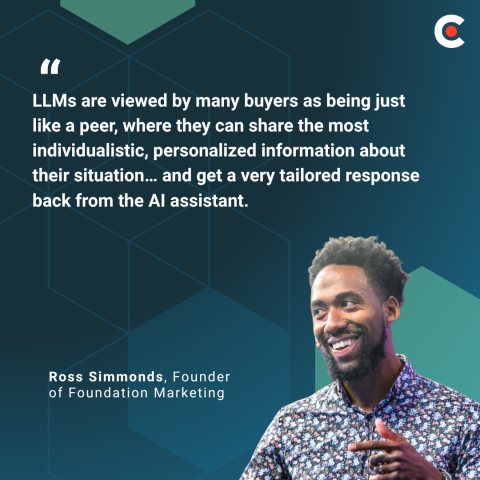
Ross Simmonds, Founder of Foundation Marketing, explains this behavior shift in the B2B context. He points out that buyers are “no longer relying on Google to just get referrals. Instead, they're starting with in-depth conversations in LLM to better understand what [the right solution is and] who the right service provider [is] for their individual need[s].” He continues, “Because of this shift, LLMs are viewed by many buyers as being just like a peer, where they can share the most individualistic, personalized information about their situation… and get a very tailored response back from the AI assistant.”
Notably, while AI adoption is widespread, its average use case is quite narrow. Despite daily use, 63% of users admit they're only scratching the surface of what AI can do, and just 5% feel they use it to its full potential. Most people have found a few things AI does well for them and stopped there.
For businesses, this is all incredibly useful information. Customers aren't using AI in unpredictable or sprawling ways. Rather, they're asking questions, getting recommendations, and forming opinions through a fairly consistent set of behaviors.
Brands that understand how AI synthesizes and surfaces information for those specific use cases will have a meaningful advantage over those still optimizing only for traditional search.
Knowing that customers are researching and forming opinions inside AI tools is important. But there's a harder question underneath it: what are those tools actually saying about your business? Being present in AI-generated answers is only valuable if the information is right. And right now, there's no guarantee it will be.
According to Clutch survey data, 56% of users regularly encounter unhelpful, confusing, or outright wrong AI responses. That's a majority of users, experiencing bad information on a frequent basis. On its own, that's a product problem. But paired with how much users trust those responses, it becomes a business problem.

Despite the error rate, 42% of users say they completely or mostly trust AI information at face value. Only 9% say they don't trust it much or at all. So when AI gets something wrong — about your business, your pricing, your services, your reputation — the majority of users reading that response won't stop to question it.
What makes this harder to address is that the experience feels seamless. Nearly half of users (49%) say getting useful results from AI is "very easy," and even the 37% who rephrase their questions to get better answers ultimately trust what they end up with. The friction that might prompt someone to verify an answer simply isn't there.
The result is a low-scrutiny information environment. Users get answers quickly, accept them readily, and move on. For businesses, that means misrepresentation can quietly shape how a potential customer thinks about your brand before they ever visit your website or make contact.
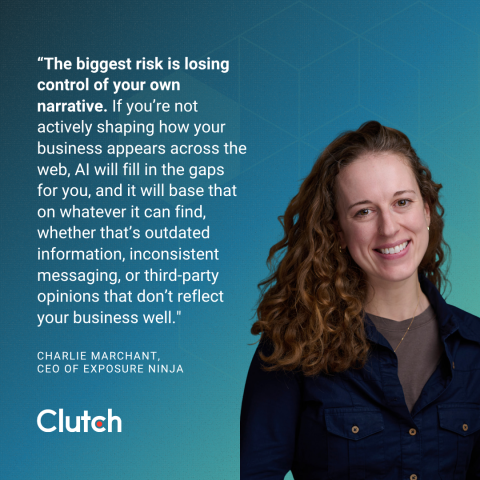
“The biggest risk is losing control of your own narrative,” states Charlie Marchant, CEO of Exposure Ninja. She explains, “If you’re not actively shaping how your business appears across the web, AI will fill in the gaps for you, and it will base that on whatever it can find, whether that’s outdated information, inconsistent messaging, or third-party opinions that don’t reflect your business well.”
Showing up in AI-generated answers is one challenge. Making sure those answers are accurate is another. Getting your information right across AI platforms is rapidly becoming the new baseline of brand management.
To show up within AI (and to show up accurately), Custom GPTs offer a direct path in. Rather than relying on AI to surface the right information about your business, they let you build a branded presence inside the AI assistant that customers already use most.
Custom GPTs are third-party apps built directly inside ChatGPT, and they represent one of the most direct ways a business can establish a branded presence within the AI tools customers use daily.
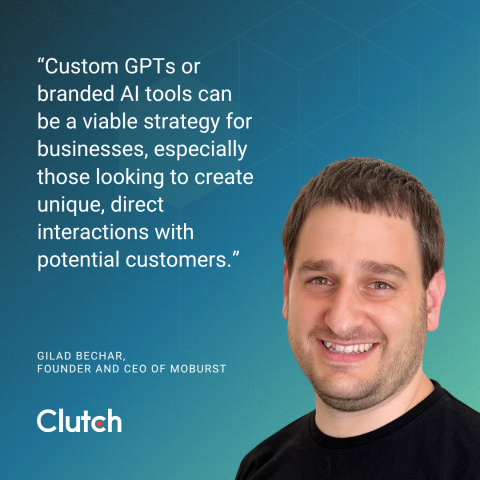
Gilad Bechar, Founder and CEO of Moburst, believes that investing in Custom GPTs is “a viable strategy for businesses, especially those looking to create unique, direct interactions with potential customers.” He explains, “This strategy is especially beneficial for businesses in industries with specialized needs, as it allows them to tailor AI models to reflect their brand's voice and specific offerings.”
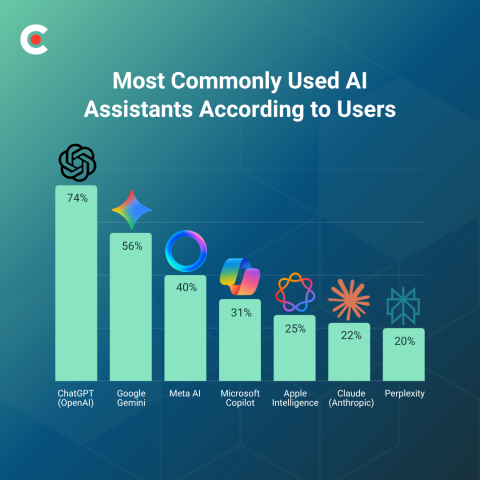
The opportunity starts with scale: ChatGPT is by far the most widely used AI assistant, with 74% of survey respondents using it.
Trust is already built into the equation — at least for recognized brands. Among ChatGPT users, 55% say they are more likely to trust a Custom GPT made by a brand they already know. Transparency matters too: 46% say they want a clear explanation of what data the app accesses or collects. For businesses that can offer both familiarity and clarity, the trust barrier is low.
When asked what types of Custom GPTs they'd be interested in using, respondents pointed to a wide range of categories:
Satisfaction among those who have used a Custom GPT is high. Forty-five percent describe their experience as "very helpful," and just 1% found it unhelpful. The product experience, when users get there, delivers.
The catch — and the opportunity — is discovery. Despite the GPT Store living directly inside ChatGPT, 27% of AI assistant users had no idea Custom GPTs existed at all. That's a significant awareness gap, but it cuts both ways: businesses that actively promote their Custom GPT have a genuine first-mover advantage over those waiting to be found organically.
Another advantage of investing in Custom GPTs or branded AI tools is that “they allow you to make your intellectual property and unique frameworks accessible in more than one form,” says Keenan Beavis, Founder of Canadian AEO Agency Longhouse and AEO Thought Leader and Author of AnswerMapping: Become the Answer AI Recommends. “By sharing your main points online, you make it as easy as possible for AI to quote you, share your concepts, or cite your work as a source,” making your brand even more visible within LLMs.
The infrastructure is there. User appetite is broad. And trust follows brand recognition. For businesses, Custom GPTs offer a direct way to control how they appear in the AI platforms customers already use by building something worth finding.
This shift from Google toward AI assistants is already affecting how customers discover and form opinions about businesses before they ever make contact. Here's what the data signals most clearly for businesses navigating this landscape:
The first click is no longer guaranteed to be Google. 32% of users now go to AI first when they need information, and that number will only grow as AI assistants become more capable and more embedded in daily life. Being present and accurate in AI-generated answers has become essential for businesses.
Customers use AI specifically during the information-gathering phase. The top AI use cases — researching, getting recommendations, brainstorming, and comparing options — all happen before a customer reaches a website, a storefront, or a sales conversation. Your brand narrative must be consistent across all platforms in order to be delivered accurately to your potential customers via AI assistants.
Inaccuracy is a silent brand risk. More than half (56%) of users regularly encounter wrong AI answers, and most accept them without pushing back. If AI misrepresents your business, services, or category, most users who encounter that information will simply move on with the wrong impression, without ever flagging it.
Privacy hesitation is real, and trust is the antidote. Eight in ten users say a privacy or data concern has actively stopped them from using an AI assistant or sharing certain information at least once. Brands that signal trustworthiness and transparency have a meaningful advantage in how freely customers engage with AI tools. By extension, it also impacts how openly they interact with any AI experience tied to your brand.
Understanding the shift is one thing. Acting on it is another. Here's where to start.
The first step is rethinking your content strategy. AI doesn't index pages the way Google does. Instead, it synthesizes information from across the web and surfaces what it deems most relevant and clearly stated. That requires a different approach than traditional keyword SEO.
Start by creating content for your website that directly answers the questions customers are asking AI during the research phase — not just the queries they type into Google. Think about the specific questions someone might ask an AI assistant about your category, services, or competitors, and ensure your content addresses them clearly and directly. This can be done on a dedicated FAQ page or in FAQ sections on a product or service page.
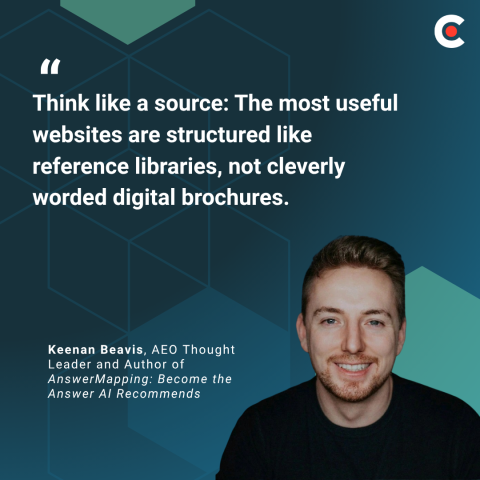
Format matters too. Structured, clearly written content that answers questions directly translates better into AI-generated answers than thin or jargon-heavy pages. Beavis advises, “Think like a source: The most useful websites are structured like reference libraries, not cleverly worded digital brochures.” If AI can't easily summarize what your business does and why it's worth considering, there's a good chance it won't.
Finally, make sure your basic business information is accurate and consistent everywhere it appears online. AI synthesizes from multiple sources, such as your website, review platforms, directories, press mentions, and more. Inconsistent or outdated information across those sources increases the risk of being misrepresented in AI-generated answers.
Visibility in AI isn't just about your own website. It's about where AI draws its information from and making sure your brand is well represented there.
Marchant explains, “AI tools don’t just look at what you say about your business. They look at what the rest of the internet says. That includes review, comparison sites, forums like Reddit, and articles from trusted publications. In fact, the majority of AI responses are built from third-party sources. Your own website only makes up a small portion of what gets referenced.”
So, invest in earning third-party mentions and citations. This is where earned media matters most, and working with a digital PR agency can help you secure the press coverage and trusted publication mentions that AI tools draw from when they describe your brand.
Pro Tip: Build a presence on the specific platforms that ChatGPT, Gemini, and Perplexity pull from. Understanding those sources and ensuring your brand appears there is becoming a core part of any visibility strategy.
If your business has a branded AI tool — like a Custom GPT — promote it actively. The data shows that 27% of ChatGPT users didn't even know Custom GPTs existed. Passive presence inside AI platforms isn't enough. Drive awareness of your AI touchpoints the same way you would any other channel.
Most businesses have never stopped to ask a simple question: what does AI actually say about us?
Simmonds states that the first step brands should take is to “run a audit on how likely their brand is to show up for key category and brand-related queries associated with their niche.”
Marchant agrees, putting it plainly: “You can’t improve your AI visibility if you don’t know what AI currently thinks your business is.”
Start by auditing how your brand appears in AI-generated responses across major platforms, including ChatGPT, Gemini, Perplexity, and others. Ask about your business directly. Ask about your category. Ask about your competitors. The answers will tell you more about your current AI visibility than almost any other exercise.
From there, focus on building brand recognition and consistent messaging broadly. In an AI-first landscape, familiarity functions as a trust signal before a customer ever reaches your website. The more consistently your brand shows up — across platforms, publications, and AI-generated answers — the more credible it appears when it does.
AI assistants have achieved something rare: near-universal behavioral adoption in just a few years. The tools are embedded in daily life, the habits are formed, and the search landscape has already shifted as a result.
The businesses that will win in an AI-first information landscape aren't necessarily the biggest or the most established. They're the ones who not only understand how these tools synthesize, surface, and recommend, but also take deliberate steps to show up accurately and consistently within them. That means rethinking content strategy, investing in brand presence across the sources AI draws from, and regularly auditing how your business appears in AI-generated answers.
The question is no longer whether your customers are using AI to find information about businesses like yours. They are. The question is whether your business is showing up when they do — and whether what they find is accurate, consistent, and reflective of what you actually offer.
For businesses looking to optimize their presence in an AI-first search landscape, partnering with a top SEO agency is a strong starting point.
This report is based on a survey conducted on March 25, 2026, using the online polling platform SurveyMonkey. We surveyed 558 adults in the United States between the ages 18-99 of all income levels. All survey respondents confirmed that they have used AI assistants before. The respondents were 48% male and 52% female.
Participants were asked a series of multiple-choice and single-selection questions about their usage of AI assistants. Quotas were applied to ensure a balanced distribution across demographic segments. All respondents were required to complete the survey in full to be included in the final analysis.