
How to Measure SEO Success When Traffic Declines
Organic traffic is down, but is your SEO failing? Learn which metrics show real SEO success when AI Overviews and zero-click searches are reducing clicks.
Updated December 3, 2025

Here’s an actionable checklist to help you assess your brand’s presence across major AI platforms and improve its visibility. You’ll learn how to apply the CAT framework and E-E-A-T principles to strengthen your content, authority, and technical foundations, which will increase the chances of your brand appearing in both traditional search engines and LLM-powered tools.
Over the last few years, working to increase online visibility has evolved dynamically. That’s because the way users search for information online is changing more rapidly than ever.
According to data cited by Semrush, traffic from AI search grew from 17,076 to 107,100 sessions year-over-year between January and May 2025 across analyzed websites, representing a 527% increase.
Looking for a SEO agency?
Compare our list of top SEO companies near you
ChatGPT alone gathers 800 million active users every week, making it the fourth most visited website globally. Furthermore, Semrush predicts that traffic from AI-powered search tools may surpass traffic from traditional search engines as early as 2028.
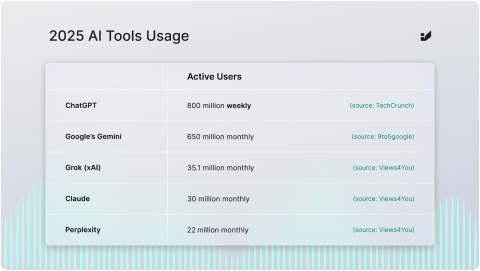
This does not mean that traditional SEO is dead, though. It simply depicts the evolution of user behavior. Today, it makes little sense to separate SEO from AI search. Users look for answers, regardless of which tool they choose. Your goal is to make sure that your content is quoted, recommended, and discovered wherever that search happens.
CAT (Content, Authority, Technical) is a framework based on our AI search optimization experience, to help brands and content teams build visibility across the entire search ecosystem: in both traditional search engines like Google and Bing, and in the new generation of AI-driven search tools such as ChatGPT, Gemini, Perplexity, or Claude.
CAT is future-ready and integrates SEO with AI search to create one clear optimization process for all search channels. It increases the chances of being cited by AI systems and helps protect long-term visibility. It is also a practical foundation for the growing popularity of multimodal search. The framework serves as the baseline for the optimization work we deliver for our clients.
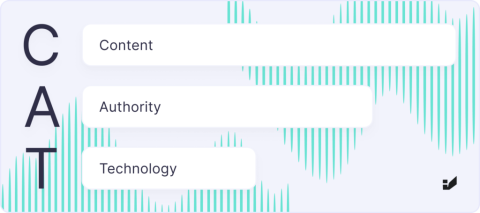
The actionable checklist below, based on the CAT framework, helps you take a holistic approach to your brand’s visibility, regardless of where your potential customers are searching today.
The first step in improving your visibility is to understand your current standing. In traditional SEO, a wide range of commercial tools support this process. Unfortunately, when it comes to traffic from AI tools, insights from these platforms are not yet sufficient for a comprehensive analysis.
For instance, in Bing Webmaster Tools, Microsoft officially states that Search Performance data does not cover generative chat experiences. In practice, some signals do appear, but they are heavily anonymized. Due to these limitations, assessing the business impact of AI search as a new traffic channel is challenging.
Still, we can go beyond traditional tools to collect qualitative data that helps us understand how a brand appears in AI-generated answers. To evaluate whether and how your brand is mentioned, follow these audit steps:
To audit your brand’s visibility in AI responses, begin by testing how models answer different types of queries:
Direct questions, for example:
Comparative queries:
Queries about the best options:
Problem-based queries:
Queries across the sales funnel:
Do not rely on a single tool, because your customers may use different LLMs. Moreover, each model utilizes its own data sources, resulting in distinct outputs. Check your visibility on platforms such as:
Testing various queries on different platforms will give you a broader perspective on your brand’s visibility across AI search channels.
Visibility is more than being mentioned. You need to understand how AI presents your brand. Review whether mentions are positive, negative, or neutral, and in what context your products or services are recommended.
Mentions matter more than links in AI answers, but citations are still important. Verify whether your website is referenced as a source. If your domain appears in citations, it is a strong signal that the model considers your content trustworthy and valuable.
As mentioned earlier, standard analytics, including Google Analytics 4 (GA4), do not capture the full extent of AI-generated traffic. Server logs reveal bots such as GPTBot, OAI-SearchBot, or ChatGPT-User. Research shows that GA4 underreports these visits significantly: in one case, logs detected 197 visits from ChatGPT-User in five days, while GA4 registered only 5.
From server logs, you can:
From an AI search optimization (AISO) perspective, focus on:
These metrics help you understand not only how often your brand appears in LLM-generated answers, but also discover the tone that shapes users’ perception of your authority.
To actively build your brand’s visibility in generative chat experiences, you need to implement an AI Search Optimization (AISO) strategy. It expands traditional SEO practices to match the way modern AI systems read, interpret, and use online content.
Proving your Experience, Expertise, Authoritativeness, and Trustworthiness (E-E-A-T, as referred to by Google) helps you optimize for both traditional search results and AI chatbots, because AI tends to favor content from credible experts.
The recommended E-E-A-T focus shows that AI search and traditional SEO follow the same principles of credibility and expertise. By strengthening these signals, you support visibility in both environments, because high-quality, trustworthy content works across all search channels.
Aim to answer potential user questions directly, using natural language. A clear structure makes it easier for AI systems to extract specific information.
A clear structure helps LLMs process your content. The easier it is for the model to extract information from your site, the higher the chance that your material will be used effectively when generating answers for the user.
Help algorithms understand your website’s context by adding schema markup. Key types include:
Using schema markup gives algorithms clear context about your business and content, which increases the chances that your pages will be interpreted correctly and shown in richer, more relevant search results.
AI evaluates a brand’s credibility based on signals from the wider internet.
Strong authority signals outside your website help AI understand how the market perceives your brand. When reputable sources mention you and users speak positively about you, models are more likely to treat your brand as trustworthy and include it in their recommendations.
Determine whether and how language models can utilize your content. Files such as LLMs.txt may eventually become a standard for controlling access, similar to robots.txt in traditional search. For now, if visibility is your priority, allow AI crawlers to access your content by enabling them in your robots.txt file.
If you spot broken URLs receiving traffic from AI-generated links, consider implementing 301 redirects from incorrect URLs to valid ones. This step is crucial because broken URLs disrupt crawling and indexing signals, which can limit how AI systems establish relationships between your pages. Correct 301 redirects help maintain authority, preserve link equity from AI-generated referrals, and ensure that models reference the right version of your content.
Considering the pace of SEO change driven by the rapid growth of LLMs, it’s clear that we need to prepare for fast adjustments in our visibility strategies. Google still plays a major role in how people search; however, new platforms are reshaping the way users explore information, compare products, and make purchasing decisions.
As a result, optimizing online visibility has become more complex. The most effective approach is to pair practical knowledge of LLMs with the capabilities of today’s analytics tools, take a holistic view of optimization, and, as always, stay focused on business goals.