
How to Measure SEO Success When Traffic Declines
Organic traffic is down, but is your SEO failing? Learn which metrics show real SEO success when AI Overviews and zero-click searches are reducing clicks.
Updated April 24, 2026

AI agents and LLMs scan, summarize, and filter information before a user even clicks. That means in a world increasingly powered by automation, your website and content might be invisible if it isn’t optimized for machine readers.
Many marketers may still be focusing on rankings or traffic. They could be adjusting meta tags, rewriting introductions, testing page speed, and auditing internal links. While these tasks are still critical, the landscape has changed, and there are additional opportunities when optimizing for AI agents or LLMs.
LLMs process your content in ways that traditional SEO doesn’t. Perplexity reveals competitors who organize content clearly. ChatGPT bypasses cluttered pages and pulls summaries from other sources or unique passages from given pages. Google's AI Overviews condense your long-form content into short paragraphs or just brand mentions and direct users to a listing page you can't control.
Looking for a SEO agency?
Compare our list of top SEO companies near you
If autonomous agents don’t process your site, you may not be slipping in traditional SERP rankings, but you could also be excluded from the decision-making process that many people use: LLMs.
I see a lot of chatter on LinkedIn where I believe people are getting this wrong. Some folks think SEO is dead, but in my opinion, and based on my experience, it's not; in fact, it's far from it.
A strong SEO foundation is now the baseline requirement for strong answer engine optimization (AEO). To appear in LLMs, your website needs a clean structure, clear meaning, crawlable content, and a consistent focus on topics within your industry. This makes your site usable for both humans and LLMs/Agents. If you want to appear in LLM responses, you should NOT skip traditional SEO.
If your content cannot be crawled, it cannot be summarized. If your structure is poor, it can't be cited. If your brand lacks fresh reviews, it loses trust. (This is especially true in my experience with agentic web optimization.)
AI agents seek usable, clear, and verifiable content. Effective SEO is essential; it’s still the foundation. This is even more important when LLMs use search in their outputs.
The person behind the screen isn’t doing the research; LLM agents are based on the user's prompts.
AI systems browse, filter, compare, and summarize content to help users find answers and act faster. You are writing not just for people but for the systems that determine which content to display.
These systems do not act like people. They don’t scroll, explore your navigation, or guess your intent. However, they do make up a lot of random nonsense from time to time. This is often referred to in our industry as hallucinations.
They scan for structure, clarity, and content that expresses intent. If your content doesn’t deliver this right away, they move on without notice. You will lose visibility and might not understand why.
Agentic web optimization is the practice of structuring your digital presence so it's usable and actionable for both human visitors and the AI agents that increasingly shape what gets seen online. It goes beyond traditional search algorithms — it's about ensuring your content is accessible, clear, and valuable enough that intelligent systems choose to surface it.
AI tools and agents are already part of everyday digital life. Top search engine results still matter a lot, but they're no longer the only path to visibility. Agentic web optimization means continuously refining your strategy so your content isn't just found — it's selected and highlighted by AI systems.
AI agents, including chatbots, summarizers, and task runners, analyze content, interpret user intent, and take action with minimal human input. They don't browse your site the way people do. They scan for structured data, extract what's useful, and move on.
For businesses, this means technical SEO is no longer just about information architecture or JavaScript rendering — although those remain critical. It's about structuring your site so AI agents can navigate it as smoothly as a human can. These systems use large language models and machine learning to generate insights that go beyond what traditional analytics offer, and they work best when fed clean, structured data backed by regularly updated models.
As more agents get built into search engines and platforms, they're the ones deciding what content rises to the top and what gets ignored. Multi-agent systems take this further, enabling groups of agents to collaborate on complex goals that a single agent can't tackle alone. The more your site supports these systems with structured data, actionable elements, and robust analytics, the more likely you are to maintain visibility.
Agentic AI has changed the rules of AI search engine optimization. Traditional SEO focuses on pleasing human users and search engine crawlers. Agentic SEO requires a different lens: optimizing for the AI agents that now filter, summarize, and recommend content. This means adopting natural language processing principles to keep your content contextually relevant and high-quality, and implementing model context protocols to enable agents to communicate effectively with your site.
That said, traditional SEO — on-page, off-page, and technical — still forms the foundation. These fundamentals enable LLM agents to understand, interact with, and trust your content. Agent optimization builds on that foundation, making your site not just visible but also usable and actionable for intelligent systems.
AI platforms provide the infrastructure that powers all of this at scale, coordinating specialized agents across tasks like content management and automated generation. Businesses that integrate these platforms into their workflows can adapt more quickly, implement advanced optimization techniques, and maintain a competitive edge in search results increasingly curated by AI.
As the agentic web becomes commonplace, businesses that adjust their SEO strategies to prioritize AI-driven interactions will retain visibility, authority, and high search rankings.
AI agents and LLMs prefer structured, clear content. Use straightforward headlines, concise summaries, a semantic approach, and machine-readable markup such as structured data.
If your site resembles a brochure full of generic headlines and big “walls” of text-only content, software looking for clarity may not utilize it.
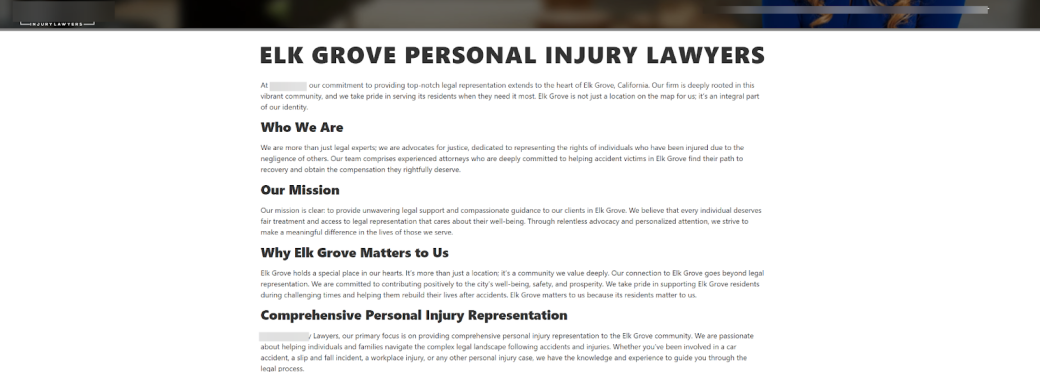
Here’s an example of a web page that is basically just a “wall of text,” and you know what? Not only does it not work well in traditional SEO, but it most certainly does not help this brand get discovered by LLM agents.
Start with your highest priority pages. Open with a clear statement about what you offer, who it’s for, and what happens next.
Headings should reflect the actual structure of your content. CTAs should be actual HTML elements, not background images or styled divs. Trust signals, such as testimonials and partner badges, should exist as text with structured markup rather than hidden within sliders or images/graphics.
I’m not suggesting your pages have no text. I’m suggesting that the text be chunked into identifiable passages that LLMs can leverage.
If your website buries its most important value under visual clutter, it may not be processed by any agentic system. In my experience, these agentic platforms prioritize information (passages) over visuals. According to ChatGPT 4o, agents focus on clarity, authority, structure, and freshness. Structure also includes structured data markup.
Most good websites are designed for human browsing. AI systems do not browse; they act, simulate decisions, filter, and route.
Incorporate schema that supports those focuses: Product, Service, Local Business, FAQ, and How-to. These are not tricks; they are signals that help machines understand your content and its purpose. BTW, this has been part of “traditional” SEO for years.
Conduct a different kind of audit. Ignore whether the page looks nice. Ask yourself these four questions:
If the answer isn't yes to all these questions, your website has clear SEO opportunities that will feed AI agents.
Analytics can be misleading. You might check CTR, bounce rate, or scroll depth and think everything is fine, but these metrics were designed to measure human behavior. Not AI agents, though there are some workarounds with server log reviews and tools like ScreamingFrog’s Log File Analyzer.
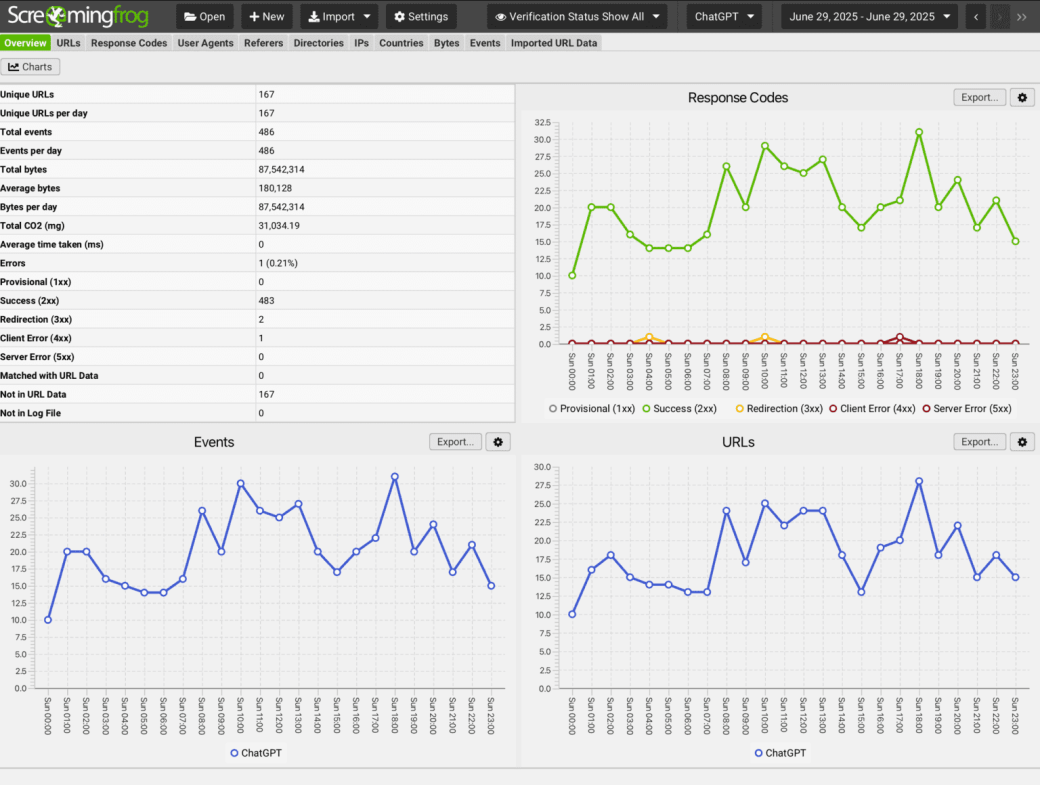
AI agents don’t click, scroll, or fill out forms. They evaluate your page, extract what they need, and move on.
Watch for other signals. Are impressions increasing while clicks remain flat? You’re being shown but not engaged. Is brand search volume rising without an obvious traffic source? Your content may be cited in summaries or AI responses. Are sessions showing multiple pageviews with no interaction? AI agents could be assessing your site. Are you seeing referral traffic from tools like Perplexity or ChatGPT? Your content is likely already being processed.
You don’t need to overhaul your entire site. If you have invested in SEO, you are in a good position. However, you must refine your structure and rethink how each page communicates intent.
You are no longer just optimizing for rankings but for LLM inclusion. You want to be part of the dataset that AI agents use to form answers. You want to be selected, not just indexed.
SEO is not obsolete; it's essential. Without it, you likely won't even be considered.
You can't gain visibility in LLMs without making your content crawlable, trustworthy, and machine-readable. Accuracy is important, but LLMs crave your personal perspective and experience.
Now, discoverability appeals to two audiences: humans and machines. Machines determine what humans see.
Many of your competitors are likely not considering this yet. They still focus on optimizing blog posts for long-tail keywords, hoping for rankings that more often than not attract clicks.
This is your opportunity. If you shift focus now, you won't just maintain your position; you'll gain ground while your competitors fall behind without noticing.
For the most part, Google algorithm changes are rolled out slowly over a 2-4 week period. Over the last 2-3 years, however, these updates have become much more robust and roll out much faster. LLM agents, on the other hand, have evolved rapidly over the last two months and will continue to evolve.
Agents are already crawling your content. AI systems are influencing visibility. The shift is live here and will continue to evolve very quickly.
If your site isn't built for agentic use, it won't be effective for agentic users, and adoption of LLMs is growing rapidly. And when I say, rapidly, it’s probably the understatement of the century. Take a look at this data:
According to a 2026 Clutch survey, 69% of AI assistant users say they now use Google less than they did before, and 32% say they turn to an AI assistant first when they need information. The same survey also found that of those who use AI assistants, nearly three in four (72%) use them daily or multiple times a day.
Additional data showcases the rise of AI adoption:
The window to adapt to LLMs is still open, but it’s closing fast. The sooner you align your web strategy with agentic expectations, the more likely it is that your content will stand out in an AI-shaped digital landscape.
Agentic AI and autonomous agents have transformed the rules of search engine optimization. While traditional SEO is focused on pleasing human users and search engines, agentic SEO requires a different approach: optimizing for the AI agents that now filter, summarize, and recommend content. This involves adopting natural language processing to ensure your content is contextually relevant and high-quality and implementing model context protocols so agents can communicate effectively with your site.
Traditional SEO is still critical and includes:
They form the foundation for LLM agents to understand, interact with, and trust your content. Agent optimization is about making your site not just visible but also usable and actionable for intelligent systems.
As the agentic web becomes commonplace, businesses that adjust their SEO strategies to prioritize AI-driven interactions will retain visibility, authority, and high search rankings in a rapidly changing digital landscape.