
Getting Ready for 2027: 5 Lead Generation Platforms to Find Better Prospects
Get ready for 2027 with 5 lead generation platforms that help you find better prospects faster. Compare top tools to sharpen your pipeline strategy.
Updated October 1, 2026

Bigger buying committees and tighter budgets are pushing B2B marketers to rethink whether more leads or better leads actually drive the pipeline. Here's how top teams are rebalancing the tradeoff in 2026.
B2B funnels today are very different from those of a few years ago. More buying committees exist. More steps occur digitally before a single phone call. Teams are asking a straightforward question with major implications: should we focus on getting more names, or should we go deeper with the right people?
The lead quality vs. lead quantity argument is being discussed again, but under vastly different conditions. The funnel you build drives your revenue, determines how many employees you hire, and how you spend every marketing dollar. This is a decision that impacts everything from what creative assets you develop to how you configure your CRM.
Looking for a Digital Marketing agency?
Compare our list of top Digital Marketing companies near you
Lead quality in B2B refers to whether the potential buyer fits your ideal customer profile and shows signs of interest in purchasing your solution. We refer to firmographic and technological characteristics, engagement across multiple channels, and signals such as project activity and budget cycles.
Lead quantity refers to the number of new contacts or accounts added to your pipeline during a certain timeframe. These include generating additional contact lists, growing email lists via opt-in, registering attendees to your webinars, and scanning attendee badges at live events (volume that continues to provide momentum at the top of the funnel).
In previous years, these terms referred to opposing concepts. Quality is more about a prospect's fit and intent based on the ideal customer and signs they’re ready to buy. Quantity simply refers to the number of new names that entered your pipeline. For years, teams focused on volume because it looked attractive on dashboards. But as disciplines evolved with the implementation of lead scoring, account-based strategies, and greater alignment between sales and marketing, quality began to gain traction.
Today’s buying groups consist of 6 to 10 decision-makers and influencers. Each member does their own research and compares notes throughout the process. Gartner has studied this dynamic for years, and there appears to be no slowdown.
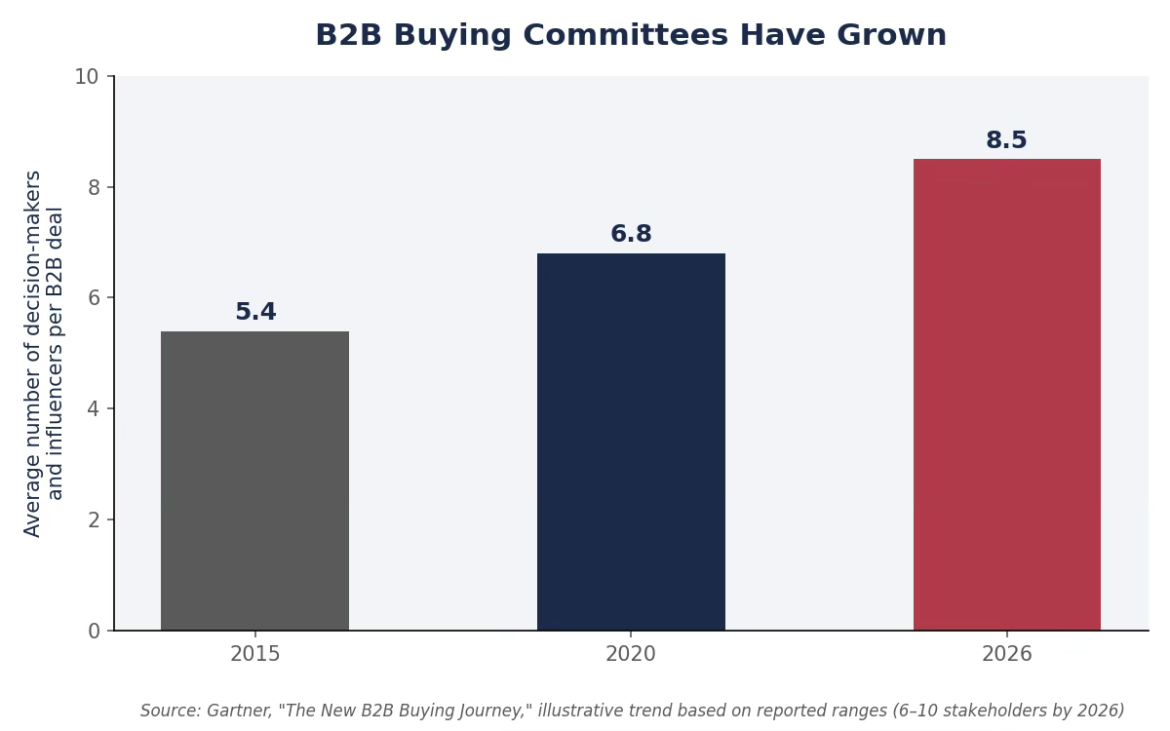
The average B2B buying committee size has continued to grow since 2015. Omnichannel behavior is the norm. According to McKinsey, B2B buyers regularly use 10 or more channels throughout a single purchase. Digital self-serve purchases are common, as are remote and in-person interactions.
Gavin Yi, CEO and Founder of Yijin Solution, sees this buying committee dynamic firsthand, selling precision manufacturing services to product teams. "Each quote request touches an engineer, a procurement lead, and often a plant manager before anyone signs off, and each of them is evaluating something different," he says. "Treating that as one lead instead of one buying group is how marketing and sales end up misreading the funnel. The account is the unit that matters, not any single name on it."
Privacy and data shifts also add another layer of complexity. With Google’s announcement that third-party cookies are on the way out in Chrome, teams are relying upon first-party data, partnerships, and intent signals that respect user consent.
Alistair Hinchliffe, Product Manager at GetTerms, sees this shift show up directly in how companies handle consent on their own forms. "A lot of teams are bolting first-party data collection onto a privacy policy that hasn't been touched in two years," he says. "If the policy doesn't clearly cover what you're now collecting and why, you're building a data strategy on a legal foundation that won't hold up. Getting that document right isn't paperwork; it's what actually lets you use the data you're collecting."
Advances in tech raise the bar for personalized experiences. AI-powered tools can identify account-level intent signals and customize messaging at scale. Salesforce's research shows that many marketers are leveraging AI to support their marketing efforts.
Echo Mao, Head of Marketing at AIReel, sees the same shift happening specifically in video. “A rep used to have time to personalize a deck for an account, not a video, because video took too long to produce for one buying committee,” she says. “Once you can generate a short, personalized video in minutes instead of days, video stops being a top-of-funnel-only channel and starts showing up in outreach and follow-up, right where B2B teams are already trying to prove relevance fast.”
Buyers continue to expect you to know their business before engaging in discussions. Non-relevant generic outreach lands in the trash, and blanket campaigns burn budget without building relationships. Personalized video content can extend that approach by adapting messages to specific audiences, stages, and buying contexts without manually creating every variation. That's why so many teams are designing new funnels around personalization and intent signals rather than using mass appeal campaigns.
There's still a real pull toward volume. A larger top of the funnel can broaden your market presence and generate more at-bats. New segments emerge, awareness grows, and you learn which messages resonate most quickly.
But volume comes with a tax. Your sales team spends hours sorting through leads that will never convert, and that filtering drains resources you could put toward closing the right deals.
High quantity also means tougher filtering. If routing rules and scoring aren't strong, reps get flooded with misfits and stalls. Attribution gets fuzzy. CAC creeps up even when CPL looks good because handoffs leak.
We've all seen the play: a big push on webinars or content syndication fills the CRM. On paper, it's a win. Three months later, the pipeline is thin, and the team is tired. That doesn't mean quantity is wrong. Volume without a quality plan tends to boomerang.
When you tune your funnel toward fit and intent, a bunch of things stabilize. Conversion rates improve, win rates improve, and sales cycles often shorten when the buyer has identified a viable solution to their issue.
These advantages notwithstanding, quality offers comparative advantages regardless of the trade-off. Conversion rates improve, ROI improves, and relationships formed through quality-driven leads translate into renewal and referral opportunities. Quality-driven leads can be more expensive and require additional time to cultivate; however, a smaller pipeline of the right leads will almost always outperform a larger pipeline of the wrong leads.
Deven Patel, Founder of Role, built his own company around a related idea: verifying data at the source instead of trusting it secondhand. Role pulls job listings directly from company career sites rather than aggregating them from other job boards.
"Once information passes through enough intermediaries, you can't tell what's still accurate," he says. "Lead data has the same problem. A list bought from three vendors back has almost certainly drifted from reality. Verifying fit and intent against the source, not against someone else's database, is what actually makes a lead 'quality' instead of just recent."
There are challenges. Your pipeline might look lighter for a while. Cost per lead and cost per opportunity can rise. You'll need cleaner data and a closer partnership with sales to define "good" with precision. Lead capture tools such as Poptin can also help by collecting additional information through customizable forms, giving marketers more data to use when qualifying prospects.
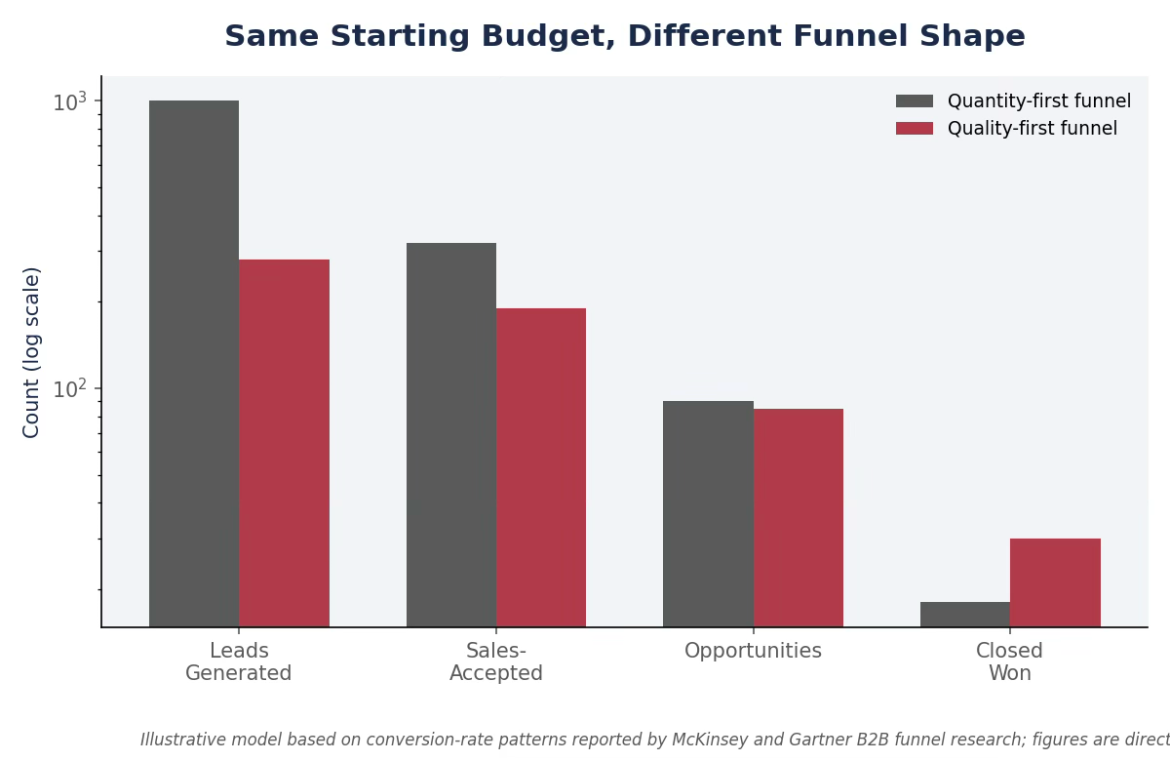
But the long-term math tends to favor quality, especially in complex, high-ACV sales.
There's no universal ratio that will work for every organization. The primary objective is to segment leads against clear quality metrics, firmographics, engagement, and buying intent, and let the data show where attention yields the greatest ROI. Creating tiered lead levels this way enables you to maintain volume in the background while your team focuses on the prospects most likely to close.
Most teams working through this balance end up with a similar approach. Define "quality" together with sales and marketing aligned on ICP tiers, disqualifiers, and intent thresholds. Document it and revisit quarterly. Segment by buying signals using engagement recency, depth of content consumed, product interest, and account-level research spikes to create A/B/C (or 1/2/3) tiers.
Route with intent. Send Tier A to reps within SLA, Tier B to assisted nurture with sales alerts on meaningful actions, and Tier C to automated long-term nurture. Score smarter by blending fit, behavior, and intent in your model. Even a simple logistic approach beats points-only systems.
Invest in first-party data. Tighten form strategy, enrich accounts responsibly, and capture meaningful signals from your own product, website, and community. Build program pairs: for every reach tactic, such as content syndication, pair it with a quality driver, such as targeted field events or 1:Few ABM.
Measure pipeline efficiency by tracking opportunity creation rate, stage-by-stage conversion, sales cycle length, win rate, and ACV by lead source and tier, not just MQL volume.
Research indicates that teams using advanced analytics and systematic testing in sales and marketing can see material improvements in revenue growth and ROI over time. What matters is discipline, not a perfect formula.
AI is already reshaping how we score, route, and nurture, and it's proving to be a way to serve both goals at once. It can evaluate signals at a scale no human team could match, then automatically personalize follow-up. The real shift is that automation lets you handle high volume without sacrificing quality: the system surfaces the leads worth your reps' time while keeping the rest warm until they're ready.
Predictive scoring learns from closed-won and closed-lost patterns, not just clicks. Conversation intelligence picks up pain points and competitive mentions from calls and routes accordingly. Content generation drafts first-pass, on-brand emails tailored to persona and stage, with humans in the loop. Real-time account monitoring alerts sales when buying signals cluster across a committee.
It's not magic. You need clean data, clear guardrails, and human oversight. But the direction is clear. As more teams adopt responsible practices, the split between quality and quantity won't feel like an either-or; systems will manage it and help you do both well, per MIT Sloan.
Quality or quantity? Nowadays, it’s neither/or when finding that right blend of both is what defines success. To start, create a group definition of “good” leads and develop a segmentation strategy that fits your sales process; then define how you measure “real” pipeline versus “raw” leads. Volume has its place, especially for learning and reach. Quality keeps the machine efficient and your team sane.
Start small and take it slow. Identify your ICP tiers, refine your scorecard, and pilot one program that trades vanity volume for clear intent. Allow the results from this data to show you where to expand and invest further. The teams that keep testing, keep aligning, and keep listening to buyers will find the mix that works.