Lead Quality vs. Lead Quantity: Why B2B Teams Are Rethinking Their Funnel in 2026
Bigger buying committees and tighter budgets are forcing B2B teams to rethink lead quality vs. quantity. Here's how top teams rebalance the tradeoff in 2026.
Updated September 16, 2026

Most brands still judge an agency by gut feel and a report deck that looks busy. Here is a more honest framework, built on retention data, attribution accuracy, and the real reasons client relationships fall apart.
Ask ten marketing directors how they know their agency is doing a good job, and you will get ten different answers. Some point to rankings. Some point to a dashboard nobody fully trusts. A surprising number just say “it feels fine,” which is not exactly a metric. That gap between how agencies are evaluated and how they should be evaluated is costing both sides real money.

Looking for a Digital Marketing agency?
Compare our list of top Digital Marketing companies near you
The stakes are rising, too. Gartner's 2025 CMO Spend Survey found that 39% of CMOs plan to cut agency budgets this year, and the top action tied to those cuts is eliminating underperforming agency relationships and streamlining the roster.
Translation: agencies are getting cut not because budgets vanished, but because nobody could prove the work was worth the invoice. That is as much a measurement problem as a performance one.
None of this is really about catching agencies doing something wrong. Most underperformance is not malicious; it is drift. Reporting formats calcify. Nobody updates the KPIs after the original campaign goals change. A review process built around the right questions catches that drift early for both sides, before six months of budget go toward a strategy that quietly stops working.
For a long time, checking on an agency meant glancing at keyword rankings and calling it a day. That scorecard is aging badly.
An Ahrefs analysis of 146 million search queries found that Google's AI Overviews now appear on 20.5% of all keywords, and on 57.9% of question-based searches. When the search result itself answers the question before anyone clicks, ranking position stops being the reliable proxy for value it used to be. An agency can hold a page one ranking and still watch organic traffic slide, and that alone should make any client wary of single metric report cards.
It is not just search, either. The 34th edition of The CMO Survey, which polls senior marketing leaders at U.S. companies, found that artificial intelligence now powers 17.2% of marketing activity, roughly double its 2022 share, with leaders expecting that share to reach 44.2% within three years. As AI absorbs more of the execution work, the old proxies for agency effort, like hours logged or deliverables shipped, matter less than what those deliverables actually produce. Effort was never really the point. It just used to be easier to measure outcomes than to measure.
So what actually moves the needle? Fewer vanity numbers. More business outcomes.
Here is a stat worth sitting with. According to Predictable Profits' 2025 Agency Growth Benchmark, drawn from more than 300 seven and eight-figure agencies, eight-figure agencies retain 92% of clients annually, compared to 78% for seven-figure agencies. That fourteen-point gap is not really about talent. It is almost entirely process, which means it is something a client can assess before signing a contract, not something they discover the hard way eighteen months in.
Zoom out further, and the picture gets more sobering. Research pulling from Bain and Harvard Business Review puts the average professional services retention rate at 84%, with top-performing firms exceeding 95%, and notes that a 5% lift in retention can raise profitability by 25% to 95%. If an agency's client roster looks more like a revolving door than a lasting partnership, that is worth asking about directly, not assuming it is normal.
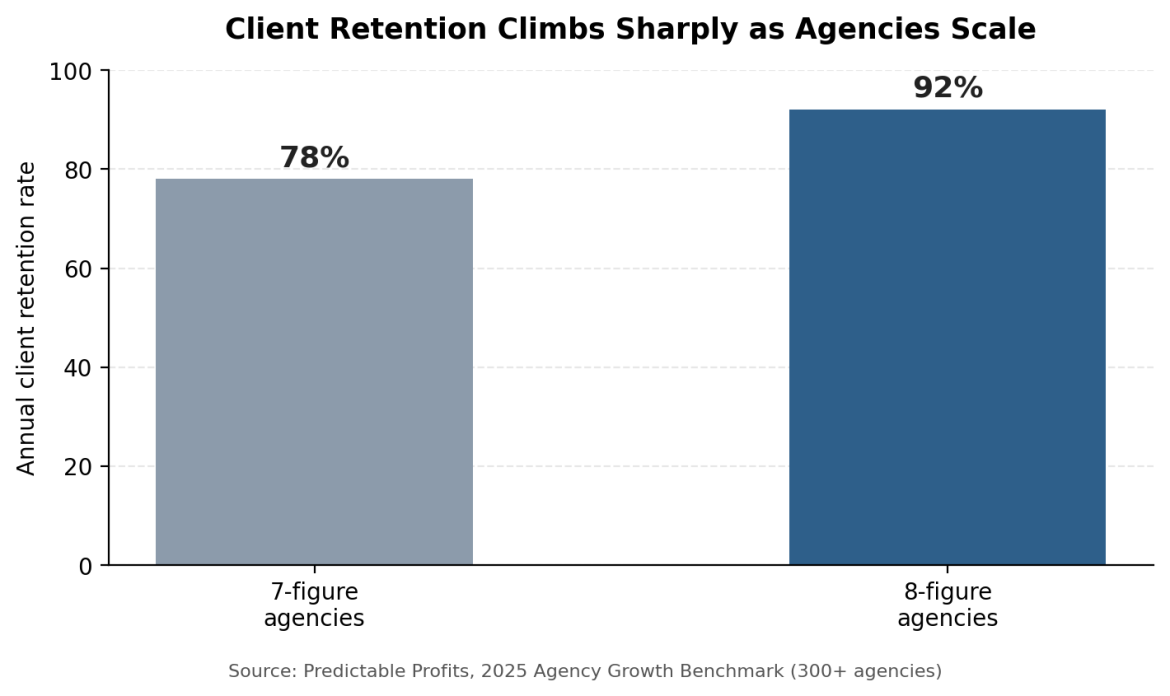
Client retention by agency size. Source: Predictable Profits, 2025 Agency Growth Benchmark.
There is also a longer arc worth considering. The 2025 ANA and 4As Client-Agency Relationship study found that average agency-client tenure has more than doubled since 2016, now sitting around seven years versus 3.2 years previously. Longer relationships tend to track with stronger performance, if only because trust and institutional knowledge compound over time. Ask a current or prospective agency how long its average client sticks around. A dodge is an answer, too.
It is tempting to assume budget cuts explain most agency breakups. The data says otherwise. A Setup Marketing Relationship Survey of more than 400 brand and agency professionals found the top reason clients ended agency relationships in 2025 was not budget. It was dissatisfaction with delivery, cited by 48% of clients, up fourteen points from the year before. Separate churn research points to a lack of communication, cited by 28% of departing clients, along with failure to demonstrate ROI and missed deadlines, as the recurring culprits, and adds that price is rarely the primary driver for well-managed accounts.
There is a newer wrinkle, too, and it is easy to miss because nobody formally cancels. Focus Digital's 2026 churn analysis describes a “soft churn” pattern in which 60% of senior marketing leaders reduced agency spend due to AI, quietly cutting retainer value by 20% to 30% without any formal termination. Anyone only tracking full client losses might be missing the slower bleed happening right now, inside accounts that technically still exist on paper.
Delivery. Communication. Proof of ROI. None of that is exotic. It is just harder to fake than it used to be.
Here is where things get uncomfortable. Attribution, the whole mechanism agencies lean on to prove their work drove results, is shakier than most reports let on. One analysis of attribution accuracy found that only 29% of marketers express high confidence in their attribution numbers, while 71% say their measurement program needs real improvement.
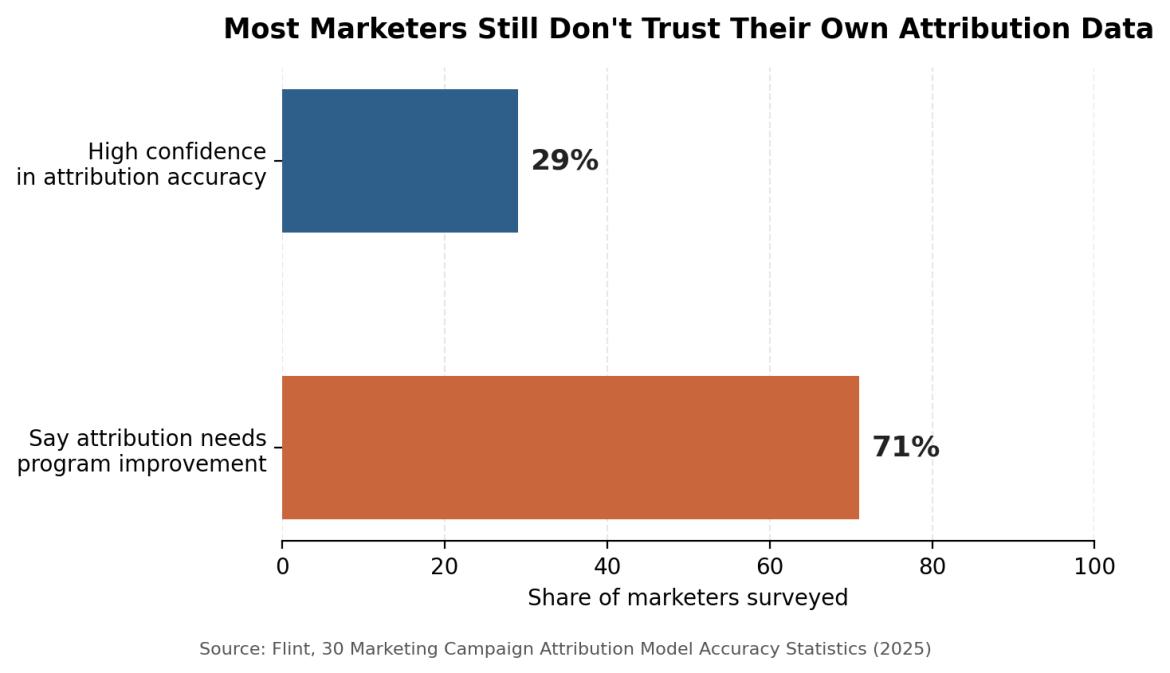
Marketer confidence in attribution accuracy. Source: Flint, Marketing Campaign Attribution Model Accuracy Statistics, 2025.
This is not a knock on any single agency. It is structural. Signal loss from privacy changes, customer journeys fragmented across devices, and offline touchpoints that never leave a clean digital trail all make a single tidy number, something like “this campaign drove $40,000 in revenue,” harder to defend than it sounds on a slide.
A MarTech.org survey of marketing stacks found 65.7% of respondents named data integration as their top martech management challenge, ahead of budget or skills gaps. So when an agency hands over a report that looks suspiciously clean, it is worth asking what sits underneath it. A little healthy skepticism goes a long way here.
None of this means attribution is useless, of course. It means one dashboard, one model, one number should never be the whole verdict. Multi-touch attribution and incrementality testing exist for a reason, and agencies leaning on more than last click data tend to tell a more honest story, even when that story includes some uncertainty.
So how should a brand run this evaluation without turning it into a witch hunt? A few things worth putting on the table every quarter.
None of this requires exotic tools. It requires asking the uncomfortable question and actually sitting with the answer, instead of nodding along because the deck looked polished.
Worth a caveat here. Not every red flag means the relationship is broken. A dip in retention during a recession year, or a rocky first ninety days while an agency learns a new account, is not automatically a sign of poor performance. Context matters, and a brand that fires an agency after one soft quarter without asking why is just going to repeat the same cycle with the next one. The goal is a pattern, not a single data point.
Agencies that handle this well tend to share a few habits. Structured quarterly business reviews, for one. One 2026 benchmarking report tied agencies that run consistent QBRs to client retention rates 15% to 20% higher than those of agencies that skip them. Agencies that do this well are also upfront about what their numbers can and cannot prove, and they tend to treat a client asking hard questions as a sign of a healthy relationship rather than a threat to one.
The bar for evaluating agency performance has moved. Rankings and vanity metrics used to be enough to justify a renewal.
They are not anymore, not with 39% of CMOs actively trimming their agency rosters and attribution confidence sitting under 30% industry wide. The agencies holding onto clients over the next few years will be the ones willing to be measured on retention, honesty about ROI, and how they communicate when things do not go perfectly.
Everyone else is likely headed for a harder conversation at renewal time, whether they see it coming or not.