
How to Define Brand Values That Guide Every Business Decision
Brand values are the principles that guide company decisions, define what a brand stands for, and shape how it treats customers, employees, and partners.
Updated September 14, 2026

Brands have a clearer grasp of what consumers need thanks to modern data practices, but consumers still feel uneasy about data tracking. Here are some ways to rebuild brand trust without overstepping boundaries.
Modern data practices have made it easier than ever for brands to understand their customers. Customers see proof of this every day in personalized recommendations, targeted offers, and eerily well-timed suggestions.
This data accuracy, however, doesn't automatically translate into brand trust.
Looking for a Public Relations agency?
Compare our list of top Public Relations companies near you
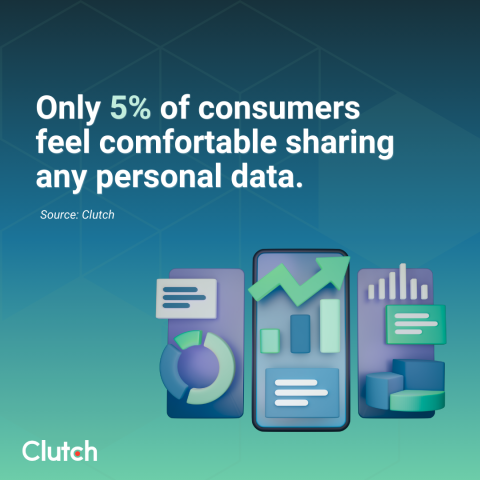
In December 2025, Clutch surveyed 402 consumers about their attitudes toward data privacy. While 87% of consumers believe the data brands track about them is accurate, only 5% feel comfortable sharing any personal data.
This gap matters. When consumers don't trust how brands handle their data, even if that data is accurate, they're less likely to engage with the brand or stay loyal. This article explores why consumers can believe data tracking is accurate but still feel uneasy about it, and what brands can do to rebuild trust without overstepping boundaries.
Today's consumer data ecosystem is bigger and more interconnected than ever. Brands routinely collect data across websites, mobile apps, payment platforms, loyalty programs, and third-party integrations.
Brands most frequently track the following types of consumer data:
Advances in analytics and machine learning have dramatically improved data accuracy. As such, brands can now easily build detailed, consistent profiles that reliably predict preferences, intent, and purchasing behavior.
But improved accuracy doesn't guarantee consumer trust.
Many consumers now know that "transparency" exists primarily to enhance the brand's reputation rather than to protect consumers. Plus, even when disclosures exist, important information about users' rights and what brands actually do with data is frequently buried deep in dense privacy policies that require scrolling for minutes.
As Quincy Samycia, CEO and Founder of The Branded Agency, puts it: "Most brands get [data transparency] wrong by hiding behind dense privacy policies or vague statements like 'we value your privacy.' That doesn’t build trust. Proof does."
In practice, this means that data accuracy and privacy practices alone aren't enough to build brand trust. Consumers need to see how transparency actually changes their experience and level of control.
So if consumers are so uneasy about data tracking, why do so many still believe brands have accurate information about them? There are a few main reasons:
Taken together, these repeated signals make it difficult for consumers to deny that brands know a lot about them, even if they don't feel comfortable with how brands and third parties might use that knowledge.
If consumers believe brands have accurate data about them, why doesn't that confidence turn into trust? There are three main trust blockers: lack of transparency, unclear data usage, and fear of misuse or overreach.
Many brands claim to be transparent about their data practices. But even when they provide online data privacy policies, that's often as far as it goes. Most of the time, these documents are infamously difficult to navigate, requiring tons of scrolling and written in dense legal language that obscures how data is collected, shared, or retained.
Alistair Hinchliffe, Product Manager at GetTerms, explains, "Transparency is not just about giving people more information. It's about making that information useful. A privacy policy can explain what data a business collects, but if users still don't know why it is collected, how long it is kept, or what they can do about it, they haven't really been given control. Good privacy practices should answer those questions clearly and make the next step obvious."
Clear, useful privacy information gives people more control over their data.
Even when consumers make an effort to understand a privacy policy, they're often left unsure what certain terms mean. Phrases like "we may share your information with third-party advertisers to help with personalization" raise obvious questions, such as:
Even when specific user rights are listed, many consumers feel they have little control over what happens to their data once it's collected. And they may be more likely to perceive overreach if they don't understand why certain data is collected.
Consumers fear brands misusing their data or losing control over it altogether. High-profile data breaches, including the June 2025 leak of over 4 billion user records that affected almost every Chinese citizen, have heightened awareness of privacy risks.
Even brands with strong security practices aren't immune to risk, as proven by the early 2024 National Public Data breach. This company aggregates and manages large volumes of consumer records for conducting background checks. When it was hacked, the breach affected up to 170 million people in the U.S., U.K., and Canada.
As a result of such incidents, consumers know that once data exists, it can be exposed, sold, or repurposed in ways they didn't anticipate.
Taken together, these three concerns explain the disconnect reflected in Clutch's survey data. In retrospect, it's clear why 87% of consumers may believe the data brands track about them is accurate, but only 5% feel comfortable sharing any personal data — because accuracy alone doesn't address the underlying unease around visibility, control, and potential harm.
Although accuracy doesn't build trust, brands can rebuild it. But overcorrecting doesn't help. If transparency efforts feel performative or excessive, consumers are more likely to see them as red flags trying to hide something.
Ultimately, brands should design data practices that quietly and consistently earn trust, rather than insistently trying to convince consumers they're trustworthy. Here are ways to get started.
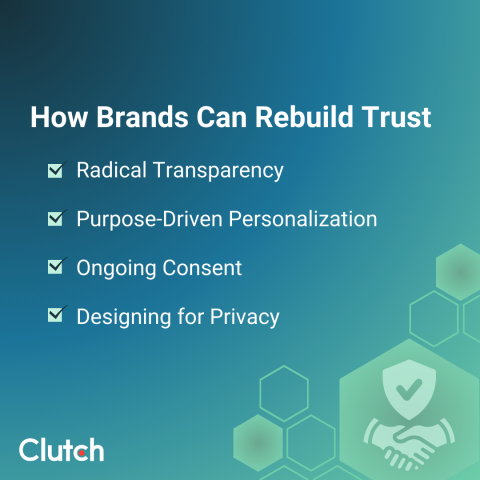
Transparency works best when it's practical, not performative. Focus on making privacy policies easy to find — for example, through an obvious footer link and at every point where data collection occurs.
Make the policies themselves clearer by including simple explanations, in straightforward, non-legal language, of why you are collecting certain data, how you use it, and what purpose it serves for the consumer. The easier the explanations are to understand, the less arbitrary and intrusive they feel to consumers.
Many brands already rely on personalization, assuming that tailored recommendations automatically show they care about the customer experience. They may assume that if personalization helps users discover new products or content, that should already be enough to build goodwill.
Sometimes it is. But personalization only adds value when it clearly benefits the consumer, not just the brand.
Using data to genuinely help consumers find relevant options and save time can feel helpful and intuitive. On the other hand, using it to show marginally related products or overly specific recommendations often has the opposite effect. In those cases, personalization can detract from the user experience and start to feel more like surveillance than assistance.
The key is selectivity. Personalization works best when you're deliberate about how you use consumer data. You don't need to act on every insight or deploy every technical capability.
Many brands treat consent as a one-time step, a checkbox, or a broad opt-in that users rarely think about again. Once a user gives consent, it's often assumed to be permanent.
From the consumer's perspective, that can feel like a loss of control. Preferences change over time, as do comfort levels around data use.
As such, brands should treat consent as an ongoing relationship. Users should have an easy-to-access panel for reviewing, adjusting, or withdrawing permissions as needed. Occasional reminders, such as banners or emails for subscribers, can also reinforce the idea that consent isn't fixed. Consumers who know they can change their minds are more likely to trust the brand in the first place.
Another way to build trust is to collect less data in the first place. Brands can do this by seeking only the data needed to deliver a product or service, rather than gathering extra information "just in case" it becomes useful later. For consumers, brands that collect less data tend to feel more careful and easier to trust, especially if they already worry about data misuse or breaches.
Minimizing unnecessary data collection also reduces cybersecurity risk. The less data a brand holds, the less information is at risk in the event of a breach. As such, consumers are more likely to trust companies that limit how much data they collect in the first place.
Despite growing frustration around data tracking, most consumers aren't asking brands to stop collecting data entirely. Instead, they want:
Together, these expectations show that consumers aren't entirely against giving their data to brands. But they’re more likely to give information to brands when data practices feel fair, useful, and under their control.
Technology has made it easier than ever for brands to collect accurate, detailed consumer information. As our data shows, accurate data can benefit users by enabling more accurate product and service recommendations. But accuracy alone doesn't determine how data collection feels to consumers. Even when it works, the process can still come across as intrusive, unclear, or excessive.
As public awareness of data breaches and exposure risks grows, consumers have become more protective of their personal information. But they aren't outright rejecting giving data to brands. Instead, they're weighing whether the benefits are real, and whether sharing data puts them at greater risk than it's worth.
To build brand trust, businesses need more than technical precision. They need to give users clearer choices and more visible control, explain what consumers actually gain from sharing their data, and show restraint in the amount of information they collect and use. Together, these practices help turn data practices from something consumers tolerate to something they feel comfortable participating in.
Ultimately, trust is the missing link between insight and impact. As you build your privacy and data governance policies, keep in mind: Accuracy may earn attention, but trust earns permission.