
How to Define Brand Values That Guide Every Business Decision
Brand values are the principles that guide company decisions, define what a brand stands for, and shape how it treats customers, employees, and partners.
Updated February 12, 2026

Consumers routinely exchange their personal data for personalized convenience online. But comfort levels with different types of information vary widely, which could shape your data collection strategy moving forward.
Personal data is the lifeblood of digital marketing and sales, but privacy concerns run high. 70% of people now worry about data privacy and security when using digital services. These fears often translate into consumers being less willing to share their personal data.
However, not all information feels equally sensitive. According to a new Clutch survey, among 402 consumers:
Looking for a Public Relations agency?
Compare our list of top Public Relations companies near you
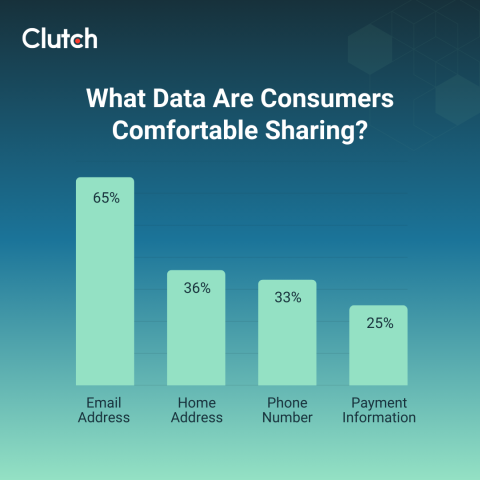
There are reasons why certain data types are perceived as lower risk. Examine the incentives that motivate consumer data sharing and learn what these numbers mean for your brand.
Researchers say that perceived risk and control are the key factors impacting when people choose to share their personal information online. Consumers essentially ask themselves how much harm could occur if the data in question were misused, exposed, or shared beyond its original purpose.
When people believe they can manage their data, they’re often more likely to share it. But when they feel a loss of control or don’t know how someone might use it in the future, their comfort level falls.
With that in mind, consumers tend to sort their data into three categories, which sometimes overlap:
Every individual has their own comfort level for sharing information from each of these categories. However, people tend to be more willing to share information they can easily change or ignore, like an email address.
The organization requesting a person's data is one of the most important factors influencing willingness to share. In other words, people feel safer sharing their data with companies they know and trust. That means consumers may be willing to share more with you if you can first win their trust.
Familiarity is another major factor impacting perceptions of data risk. Types of data that consumers have shared for years feel normalized, even when underlying risks persist. So you could struggle to get information that is unusual to share online, even if it presents less risk than certain data that is more commonly shared.
Perceived risk and control matter a lot. But people also consider things like how trustworthy your company is and whether they’ve shared similar information online before.
According to Clutch’s survey, 65% of consumers say they’re comfortable sharing their email addresses with brands. That’s one of the largest percentages among data types, signaling a low risk perception among consumers. This is largely driven by control.
Email feels manageable compared to other types of data, as Adam Bird, director of strategy at DEKSIA, explains: “The reason 65% of consumers feel most comfortable sharing email addresses isn’t that email is safer. It’s because it’s the one place we have agency. We can block senders, flag spam, and punish bad actors for sending things we didn’t want.”

In other words, consumers know they can easily unsubscribe from messages they don’t want or even abandon an address entirely with minimal friction. This differs from physical addresses, phone numbers, and payment details, which expose users to greater direct risks.
Email also offers a clear and familiar value exchange. Consumers understand why brands ask for it and what they’re likely to receive in return. Decades of normalization have trained users to expect the collection of email addresses, so the perceived risk remains low even as awareness of data privacy increases.
For brands, the takeaway is that email is often the easiest piece of consumer data to collect. However, it’s also a channel where you can quickly lose trust if you fail to meet their expectations.
Our data also found that 36% of consumers are comfortable sharing their home address with brands. That’s barely half the percentage who are okay with sharing their email — a clear signal that perceived risk rises as data moves from the digital to the physical.
A home address is permanent in a way that other data isn’t. It can’t be easily changed or discarded like an email address. Plus, it directly connects a consumer’s online behavior with their physical location. This heightens concerns around potential misuse and loss of control — especially as cyberattacks and other risks to IT systems continue to increase.
Consumers are most willing to share their home address when doing so supports a clear need, such as:
Hesitations tend to surface when address collection feels unnecessary. If you only sell a digital product but ask for a consumer’s home address, they may not want to share it and could choose to shop elsewhere if that conviction is strong enough.
The key takeaway for brands is to collect home addresses only when required to support the consumer’s goals. If you need to collect an address, try to explain the reason clearly if it's not obvious, and note how you’ll safeguard their data to reduce perceived risk.
Clutch’s survey found that 33% of consumers are comfortable sharing their phone number with brands, slightly less than their home address. This makes the phone number another high-sensitivity data type, where collection must be part of a carefully curated process.
Phone numbers can feel as personal as the home address. They’re difficult to replace and challenging to shield from misuse once shared. And many people have had the same phone number longer than they’ve lived at the same address.
Many consumers associate sharing their phone numbers with spam texts and robocalls, which has eroded trust over time. Brands often collect phone numbers as a matter of routine. But customers are most willing to share them when the data is tied to a clear purpose, such as:
Frequency and control also play major roles in consumers' comfort levels with their data. Consumers are far more receptive to brands that set clear expectations around how often they’ll communicate via call or text. They also value an easy way to opt out of future messages.
Phone numbers can be very useful to brands, but collect them sparingly. When numbers are contacted too frequently or shared unnecessarily with third parties, it can erode trust and credibility in your brand over time.
Finally, Clutch’s survey found only a quarter of consumers are comfortable sharing their payment information with brands. That makes payment details the most sensitive data type covered in the study, and it’s obvious why.
Payment data represents direct access to a consumer’s finances. This creates a perceived risk of sharing the information. Even if the risk of misuse or illegal sharing is low, the potential ramifications are massive, ranging from fraudulent charges to long-term account disruption.
People are still willing to share their payment information with brands. But they rarely do so unnecessarily. Comfort tends to increase in situations where:
Brand trust matters a lot here. Consumers are far more likely to enter payment information when they recognize a brand and see visible security signals on the checkout page. This assures them that safeguards exist if something goes wrong while making them less likely to doubt that anything will.
For brands, this is a reason to add third-party checkout options to your e-commerce flow. For example, you could give customers the option to pay with Google Pay, Apple Pay, PayPal, or other services they already use.
That way, they don’t need to share their payment details directly with your business but can still buy from it. This can be a good move if you’re a growing brand that is having trouble getting people to complete the checkout process.
If your business wants to gather more consumer data, start by considering what incentivizes users to share it.
Across all data types, willingness to share generally increases when the value exchange feels fair. For example, low-risk data, such as an email address, is often quickly exchanged for immediate incentives, such as a 10% discount for first-time buyers. But you might not get a user’s bank account details for the same coupon.
Other incentives that brands leverage to motivate data sharing include:
As data sensitivity increases, users need more value from brands to share their information. When companies try to extract higher-risk data in exchange for vague promises of personalization, it often sparks resistance.
However, there's a thin line between incentive and manipulation. As Quincy Samycia, CEO and founder of The Branded Agency, puts it, “If the incentive feels disproportionate to the data being asked for, consumers sense manipulation instantly.”
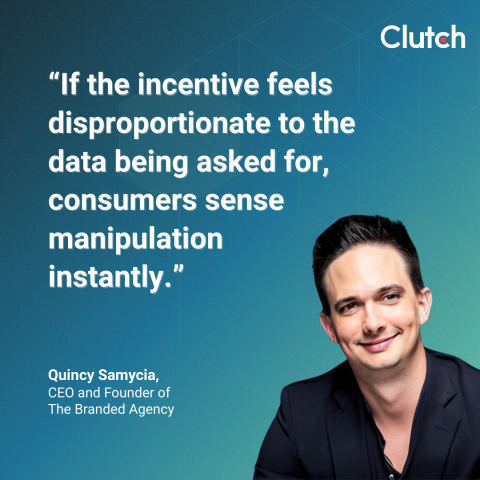
This means the benefit you offer should feel connected to the request you’re making. Effective incentives are transparent and tied to benefits the user cares about.
If your company would like to collect more information from consumers, building trust is essential. People make fast judgments about whether a brand deserves their information, often based on how the request is framed or how much control they feel they’ll retain.
Brands that collect data responsibly tend to follow a basic set of principles that signal respect and restraint:
Applying these principles consistently will help your brand build and retain user trust over time. That’s one of the most important factors to get right when trying to collect (and benefit from) more user data.
Consumer comfort with data sharing follows a clear hierarchy based on perceptions of risk and control.
If your company is having trouble collecting the type of data it wants, work to reduce risk and increase consumer control. It’s also important to provide clear value alongside those requests, as Bird explains: “When collecting information from audiences or customers, follow up with a specific use of that information. Create strong feelings of reward and value for participating. People will share when they see real value created in return.”
Ultimately, data collection should be a clear and proportional exchange of value between the company and the consumer. When you ask for data and offer something of value in exchange, the likelihood of receiving the information you want increases.