
Why Salesforce Staff Augmentation Is Becoming a Strategic Choice
Salesforce staff augmentation is no longer a stop-gap. Learn why more businesses now use external specialists to access expertise, move faster, and scale...
Updated February 12, 2026

Data privacy concerns are growing, and consumers want to know that brands are safeguarding their data. But even as awareness grows, there’s a gap between concern and action. Data scrubbing services are gaining traction as a way for consumers to protect their data and for brands to secure long-term consumer trust.
Consumer concerns around data privacy continue to grow as we enter the age of generative AI. People have become increasingly aware of how much of their personal information exists online and how easily third parties can access it. Yet, according to new data from Clutch, that awareness hasn’t translated into proportional direct action. We surveyed consumers for their thoughts on data privacy and discovered that:
This points to a broader challenge. Many people and brands are aware of the risks around data privacy, but a much smaller subset knows what to do about it. Data scrubbing services may be gaining visibility, but their practical value is still misunderstood.
Looking for a IT Services agency?
Compare our list of top IT Services companies near you
This article takes a closer look at data scrubbing and how it works. We outline five reasons consumers are using these services to protect their online privacy and what it could mean for your brand.
Data scrubbing services help people find, remove, and correct personal information that’s publicly accessible online. These companies scan hundreds of data broker sites, people search engines, public records, and other databases to find and summarize your personal data. Once a data scrubbing service finds your information, it can take action to remove, suppress, or correct it. The exact process varies by provider and jurisdiction. But it often involves submitting opt-out and suppression requests on behalf of the user.
Many platforms also offer continuous monitoring. This helps ensure that any information found and removed doesn’t reappear over time — a common issue as brokers refresh their databases. Data scrubbing covers many types of information, including:
Some companies also use data scrubbing services for their customer and lead databases. The companies behind these services can correct outdated and inaccurate records, which may otherwise reduce campaign performance and erode brand trust.
Data scrubbing could become increasingly popular as states institute new legislation to protect digital privacy. For example, California is preparing a new online tool called DROP that lets residents and authorized agents send deletion requests to data brokers in a more streamlined way.
In today’s digital economy, consumer and business information is constantly being collected and resold across broad data broker networks. Users rarely have clear visibility or meaningful control over how their personal information proliferates.
Data scrubbing services give you back control over your data. They offer a more structured, lasting way to reduce data exposure and strengthen online privacy. Here are five reasons why you may want to use one for yourself or your company:
The Federal Trade Commission (FTC) has been warning for over a decade that data brokers maintain detailed consumer profiles and sell them with limited transparency. This means personal data rarely lives in a single place. It’s often copied, resold, and distributed across hundreds of third-party platforms. Consumers and brands rarely have visibility into this process.
Data scrubbing services are an efficient way to tackle this problem. Instead of targeting one website at a time, they:
For consumers, the value lies in having fewer exposed records, which can support personal privacy preferences and prevent digital retargeting. However, just 25% of those surveyed by Clutch have considered using these services, showing a gap between recognition and action.
For brands, data scrubbing can reduce attack surfaces and provide greater control over how sensitive information circulates online.
Privacy and security concerns are among the main reasons people use data scrubbing services. When personal data proliferates across multiple third-party sites, it increases exposure and risk. Each record becomes another potential entry point for fraud and unauthorized data use.
Data scrubbing services reduce that risk by limiting the amount of personal information available online. That means:
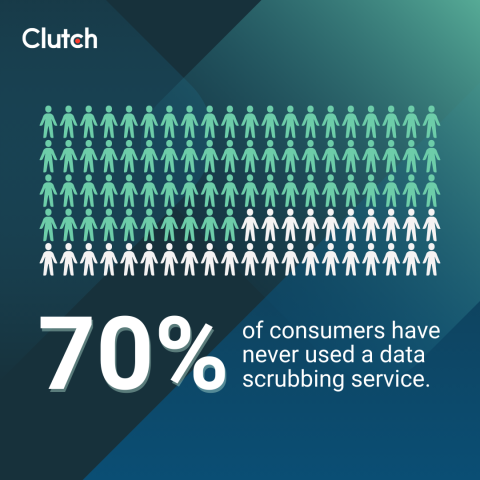
In short, data scrubbing can be a preventive tool for security and privacy, and it has become a growing consumer expectation in the wake of privacy legislation like Europe’s GDPR. Although 70% of people haven’t used a data scrubbing service, that could change as digital privacy initiatives continue to gain steam. With GDPR fines reaching $1.4 billion in 2025, the use of data scrubbing services could grow as more people get interested in cleaning up old records and protecting their online privacy.
Given the breadth of broker networks and the constant resharing of data, manually managing the exposure is rarely feasible. To do so would mean contacting hundreds of data brokers directly — each with their own opt-out process, verification requirements, and response timelines to manage.
Scrubbing services eliminate the complexity to save you time by:
So, instead of chasing down all of your individual records, you’ll get a single workflow to manage. That can save hours of time and eliminate the complexity that prevents most people from taking action.
For organizations, unmanaged data exposure is as much an issue of reputation as it is of privacy. When customer and executive information is easily discoverable online, it raises questions about your company’s commitment to security and data ethics.
Data scrubbing helps your brand demonstrate that it’s taking privacy seriously. It’s a way to show that you’re taking steps to:
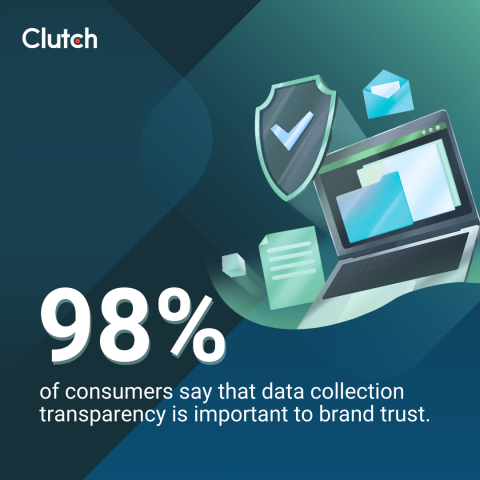
Taking this proactive stance can strengthen consumer trust and support your compliance narratives. It’s a step toward helping your company stand out from the competition on privacy — something that’s increasingly shaping consumer buying decisions. After all, 48% of people say they’ve experienced at least one kind of security failure in the past year, and 98% of the consumers Clutch surveyed say that data-collection transparency is important to brand trust.
Unfortunately, data removal is not permanent. Brokers regularly refresh their databases as new entries become available. Information that has already been deleted can quietly reappear months or even years later.
This is difficult to manage as an individual or company with competing priorities. Scrubbing services provide long-term protection by offering:
This type of ongoing maintenance makes data scrubbing an important piece of a sustainable privacy strategy. The bottom line is that it takes constant monitoring to keep your sensitive information offline, and it’s much easier to do so with a third-party scrubbing service.
While many services promise broad coverage and complete removal, the reality is that effectiveness can vary significantly. Some providers only focus on surface-level sites, while others monitor deep broker networks and public databases. Pricing, automation, and ongoing support can also vary widely and significantly impact your experience.
While data scrubbing is a valuable tool for protecting personal privacy and brand reputation, some services are better suited to your needs than others. Here are some key factors to consider as you look for a provider.
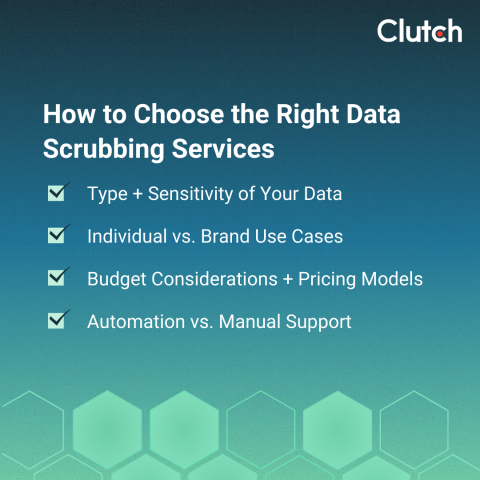
Generally, the more sensitive your data is, the more comprehensive your scrubbing solution needs to be. Basic, low-cost services often only target popular people-search sites. But higher-tier platforms scan deep broker networks and more public record databases.
So, what kind of service do you need? Start by assessing what type of data you have exposed and where it appears. Consider how easy it would be to cross-reference and what it would cost you if the data proliferated across a broad broker network.
For example, if your information is tied to a regulated industry, you may need a more robust, expensive solution with deep coverage and ongoing monitoring. But if you’re more concerned about personal privacy, an affordable and basic service could meet your needs.
Some data scrubbing services are designed for businesses, while others are built for people. If you’re an individual trying to control your data, look for scrubbing services that focus on:
If you’re part of an organization looking for data management support, the services you target will focus on different tasks, such as:
Clarifying whether you’re protecting a single person or an entire organization will help you narrow down your options substantially. Or, if you need help in both areas, consider a scrubbing service that offers all of these features.
Data scrubbing services typically use subscription-based pricing. This means your costs will vary based on the size of your data footprint or the depth of the broker networks you need to monitor.
Entry-level plans often focus on a limited set of popular people-search sites, while higher-tier options go deeper and include ongoing monitoring. Some platforms charge per person, while others charge based on the number of records or data sources you want to monitor. Enterprise solutions sometimes bundle all of this support into a single, higher-cost plan.
The best option for you will vary based on your goals. However, one-time removal services may look cost-effective but rarely account for data reappearance. So, even if using one costs less today, you might have to pay for the same service again a few months down the line.
Subscription models, on the other hand, provide ongoing protection and predictable costs. They can scale over time as your privacy needs change and keep you protected from data reappearing.
Some data scrubbing services are fully automated, while others provide manual support. The difference in approach will impact your costs, accuracy, and scalability, among other concerns.
For example, automated services tend to deploy faster and cost less. But they can struggle with complex cases and non-standard data sources. Without human oversight, a scrubbing service could miss key pieces of information that you’d like to contain.
Hybrid and manual services tend to offer greater accuracy and better handling of edge cases. However, they also typically cost more.
The right service depends on your data footprint and goals. If your exposure is already fairly limited, automation may be all you need. But if your information is spread widely or tied to sensitive business issues, manual support can add an important layer of protection.
Data privacy has become a mainstream concern, as more people and brands recognize how their sensitive information circulates online. However, awareness of the problem does nothing to reduce exposure. That’s why data scrubbing services exist.
They offer a more practical way to limit data exposure, replacing fragmented efforts with automated, structured processes. These monitor your information continuously to help takedowns stick and manage your digital footprint for life.
For individuals, scrubbing services lead to fewer exposed records and less unwanted contact. For brands, they deliver stronger privacy, reduced risk, and clear accountability to consumers. Just be sure to consider your goals and exposure tolerance when choosing a data scrubbing provider.