
12 Years With Clutch: How Intuz Builds on a Partnership That Delivers
A Relationship That Has Stood the Test of Time Intuz is an AI consulting and development company established in 2008, with operations in Silicon Valley...
Updated February 12, 2026

Generational attitudes toward personal data sharing diverge. Here’s what it means for your branding and marketing strategies.
Personal data is the currency of the digital experience. It enables personalization, predictive analytics, AI-driven services, and many of the tools people rely on day to day.
As data collection expands, so do questions around risk and trust. Today, 70% of people worry about data privacy and security when using digital services. However, some age groups are more concerned than others.
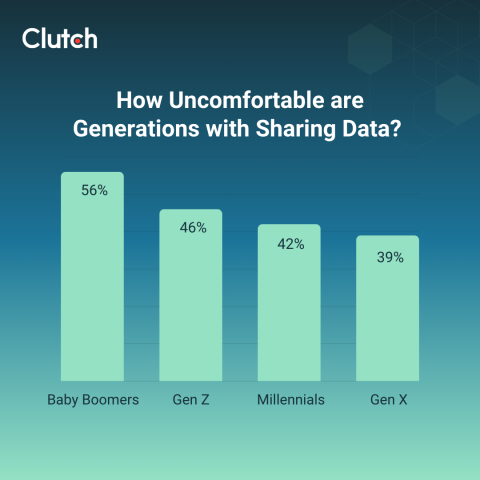
A new Clutch survey of data privacy by generation has found that baby boomers are the most uncomfortable sharing their personal data, with 56% expressing discomfort. They’re followed by Gen Z at 46%, while millennials and Gen X are a bit more willing to share.
These generational differences are important for brands to understand. They impact not only whether you’ll be able to collect data from your target audience but also how members of each age group feel about your company. This can influence conversions, long-term loyalty, and other critical bottom-line metrics.
This article takes a closer look at how comfort with data sharing varies by generation, and what it can mean for your marketing and branding strategies.
Attitudes toward data privacy are shaped by a variety of factors and vary among individuals within the same age range. However, the way that a generation first encountered digital technology seems to have a meaningful impact.
Each generation entered the digital landscape under different conditions, which influences how they interpret personal data collection today:
Baby boomers grew up in a mostly analog world, where personal information was rarely shared digitally, if at all. They experienced digital systems layering on top of their existing habits later in life, which made data collection feel riskier and less expected.
While each generation cares about protecting their personal data, they often have different reasons for doing so. That’s a key point for brands.
Businesses can stand out by marketing themselves on the privacy they offer, and major companies like Apple have already begun doing so. But the approach you take should reflect the concerns of your major demographic groups.
For example, Gen Z worries about digital surveillance, while Gen X values transparency and the ability to opt out of data collection. The best way to address these concerns depends on which group you’re targeting. Gen Z might prefer marketing that emphasizes how you prevent digital surveillance, while Gen X may be more convinced by showing how easy it is to stop unwanted data collection.
Baby boomers have the highest level of discomfort with sharing their personal data, with 56% uncomfortable doing so. This reflects both an elevated perception of the risks involved and a lower baseline trust in digital systems.
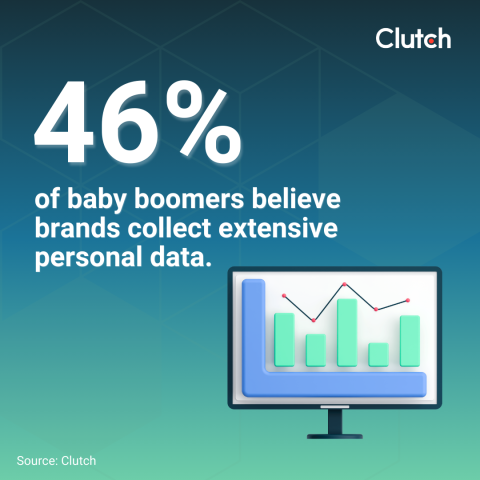
Clutch’s survey also found that nearly half of baby boomers (46%) believe brands collect extensive personal data, including preferences, location information, and detailed online behavior. Many believe that data collection is a broad, continuous process that’s largely invisible to them.
Younger generations grew up with data-driven digital systems, but baby boomers experienced digital adoption later in life — often amid high-profile data breaches and privacy scandals. Because of this, the age group has come to view sharing personal data as more of a liability than a benefit.
Convenience and personalization tend to carry less weight for baby boomers than security and clear limitations. Key drivers of this discomfort include:
Brands hoping to collect personal data from baby boomers need to show restraint and clarity in their processes. That involves providing clear assurances of security and explicit parameters for what data will be collected, how it will be used, and why the user benefits from providing it.
Gen X has a more nuanced view of personal data sharing. They’re generally more open to it than baby boomers, with only 39% of Gen X feeling uncomfortable sharing their personal data online.
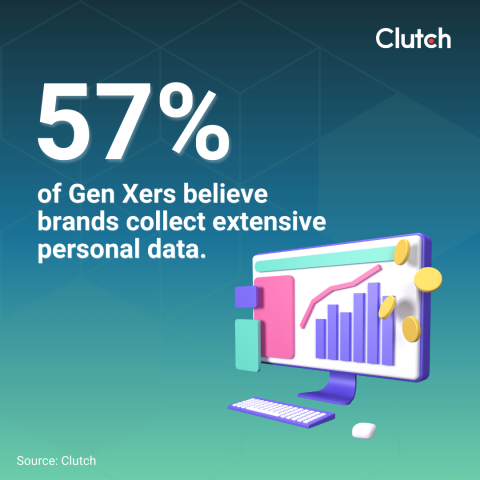
Interestingly, Gen X has one of the broadest views of the scope of data collection, with Clutch's data indicating that 57% believe brands collect extensive personal data from them. This is more in line with older generations and reflects the cohort's lived experience with the expansion of data collection over time.
Gen X tends to evaluate data sharing practically. They’re less likely to reject data collection outright, but more likely to scrutinize how it happens. Comfort increases for Gen X consumers when brands provide:
Ultimately, Gen X is control-oriented when it comes to sharing their personal data. These consumers are willing to do it under the right conditions, but only when they retain some agency.
Brands looking to collect data from Gen X should focus on transparency and customizability. When this cohort feels like they have control over what you collect and understand how you’ll use the information, they become increasingly likely to share it.
Millennials are similar to Gen X in that they approach personal data sharing pragmatically. They’re willing to share when the benefits they receive outweigh their growing privacy concerns. However, 42% of millennials still report feeling uncomfortable sharing their personal data, so many still worry about these issues.
Millennials were early adopters of social media and mobile services, so they’re used to trading personal data for customization and access. Reflecting this, 34% have high or very high trust that device makers will protect their data, while only 20% of older generations feel the same.
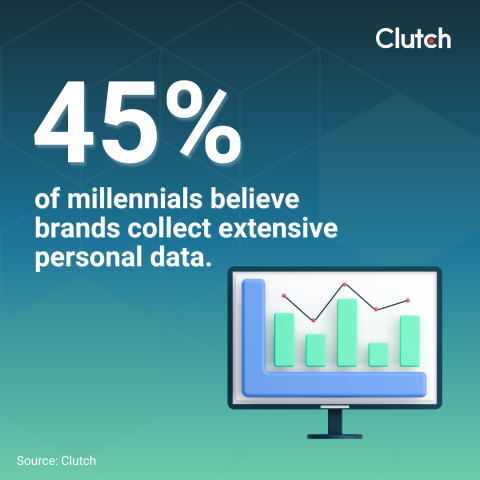
In our survey, 45% of millennials said they believe brands collect extensive personal data, fewer than Gen X and baby boomers. Key characteristics of this group’s privacy attitudes include:
For brands, the key insight is that millennials should be approached with a clear value proposition. Transparent data-use policies and privacy controls remain important. But millennials, in particular, want to know what they’ll get in exchange for providing their data to your company.
Finally, 46% of Gen Z respondents report feeling uncomfortable sharing their personal data online. That puts them second only to baby boomers. However, one distinguishing feature is that 46% of Gen Z also believe brands collect only some personal and behavioral data, such as purchases and browsing habits.
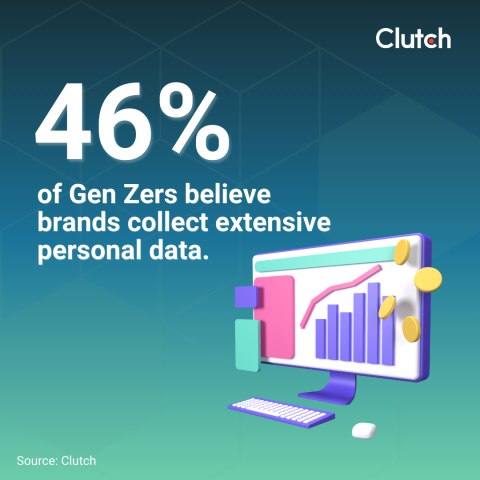
This suggests that, unlike members of other generations, Gen Z doesn’t automatically assume brands are building expansive personal profiles with their data. This is grounded in a belief that brands mostly gather observable behavioral signals rather than intimate personal details.
In theory, that should make this generation more comfortable with sharing their data. But tensions remain high. That may be because Gen Z experiences privacy as an emotional and cultural issue. Several factors shape Gen Z’s elevated privacy concerns:
For Gen Z, privacy anxiety is less about the volume of data collected and more about the potential consequences of exposure. This means brands targeting Gen Z may need to focus more on the emotions around privacy concerns than the actual scope of what’s being collected. This group ultimately values transparency over hyperpersonalization.
Across generations, discomfort with data collection is as much about consumers’ beliefs as the information actually being retained.
For example, older generations tend to assume that data collection is extensive and difficult to control. This amplifies their concerns even when actual data collection is fairly limited. Younger generations assume a narrower scope of behavioral tracking. But they still experience high emotional discomfort with it for other reasons.
The key insight is that perceived risk doesn’t scale with data volume, which is positive news for brands. In fact, 60% of Gen Z and millennials believe the benefits of online services outweigh their privacy concerns.
When consumers believe data collection is non-transparent and hard to control, even collecting a minimal amount of data can feel invasive. But when your practices are clearly explained and transparent, a broader collection can feel more acceptable. In this context, misunderstandings are what increase anxiety and erode brand trust more than differences in data types.
Privacy expectations are shaped by generational factors, so a single messaging strategy may not work for all your audiences. Instead, focus on:
Ultimately, 75% of consumers say they won’t purchase from an organization that they don’t trust with their personal data. For brands, this means connecting with every targeted age group on the privacy issues that matter to them has become essential to bottom-line performance.
Generational differences in comfort with sharing personal data illustrate how privacy perceptions can vary with lived experiences. Baby boomers and Gen Z may have the highest levels of discomfort with data collection, but for very different reasons. Older users worry about extensive data collection, while younger consumers have anxiety around identity and misuse.
Personal data should continue to underpin the digital experience for years to come, which creates a clear mandate for brands. Your business can succeed by understanding how its target audience thinks about privacy risks and by designing a communication strategy that aligns with those perceptions. That could mean emphasizing user control, a limited collection scope, or value.
Responsible data use has become more than a compliance exercise. It’s a clear trust signal that can impact sales and usage for years to come. By respecting the approaches the different generations take to data privacy, you can demonstrate responsible use of the information you collect and win trust from consumers, from baby boomers to Gen Z.