Lead Quality vs. Lead Quantity: Why B2B Teams Are Rethinking Their Funnel in 2026
Bigger buying committees and tighter budgets are forcing B2B teams to rethink lead quality vs. quantity. Here's how top teams rebalance the tradeoff in 2026.
Updated January 22, 2026

Predictive marketing, which applies statistical modeling and machine learning to first-party data, is becoming more powerful as AI capabilities continue to increase. But what does it mean for your team?
Researchers say organizations that rely heavily on data to back decisions are three times more likely to report significant improvements in decision-making than those relying on less data. As a result, data-driven decision-making has become a baseline expectation in marketing.
However, as budgets tighten and channels fragment, leaders must do more to deliver standout value to their companies. Executives increasingly expect marketing departments to own growth, ROI, and technology alignment.
Looking for a Digital Marketing agency?
Compare our list of top Digital Marketing companies near you
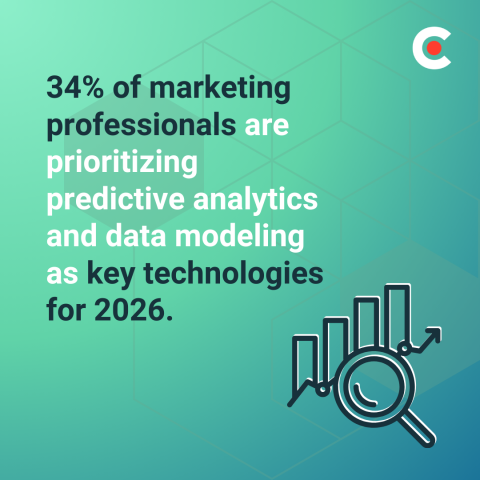
That’s why predictive analytics is poised for a big year. According to Clutch’s survey of 337 marketing professionals, 34% are prioritizing predictive analytics and data modeling as key technologies for 2026. These platforms help teams forecast customer behavior, campaign results, and ROI before making budget decisions.
Explore what a predictive analytics strategy in marketing is, where it delivers the greatest impact, and how to approach these strategies based on your business needs. Predictive modeling could be what your marketing team needs to shine in 2026.
Predictive marketing uses data and analytics to anticipate what customers are likely to do next. Companies can understand trends as they emerge, respond to opportunities, and cut risk in real time.
With reliable predictions, marketers can make more confident decisions earlier in the planning process. Teams that only focus on past performance may struggle as more competitors adopt these tools to move with greater agility.
Predictive analytics applies patterns in data to predict future behavior. In marketing, common sources of this data include:
Armed with this data, predictive models can help marketing teams estimate a variety of potential outcomes, such as:
Teams use these insights to make smarter budget allocation and creative decisions. Instead of reacting to performance after campaigns run, teams using predictive models can make informed decisions before launching.
For example, one study found that teams using LinkedIn ABM predictive analytics increased campaign performance by as much as 35% to 40%. The model forecasts which accounts are likely to engage and convert before campaigns launch to improve targeting and ROI.
Predictive approaches make it easier to scale marketing efforts without adding complexity because they automate decision-making that would otherwise require manual analysis. With these analytics, teams can identify high-impact opportunities even as they spend less time working directly with data.
Several emerging trends are also pushing predictive marketing into the spotlight. AI and analytics tools have made predictive analysis easier by lowering the cost and skill required to generate forward-looking insights. First-party data is also becoming more valuable as consumers prioritize online privacy.
To start, it’s best to apply predictive modeling in a few high-impact areas. This will help your team get up to speed with the technology and prove value. These areas may deliver the most immediate impact because they use the data teams already have and influence revenue quickly:
Focus on the highest-value opportunities for your business first. For instance, if you have a high churn rate, churn prediction models would be a great place to start. Or, if you want to improve conversions of existing leads, sales enablement technology may be a more effective first investment. Then, continue investing in these capabilities over time as your team becomes more familiar with them.
The key to building a successful predictive marketing strategy is getting specific about what you hope to accomplish. That could increase conversion rates, boost discoverability, or maximize value from a limited media buying budget, among other goals. Here are some important considerations as you get started.
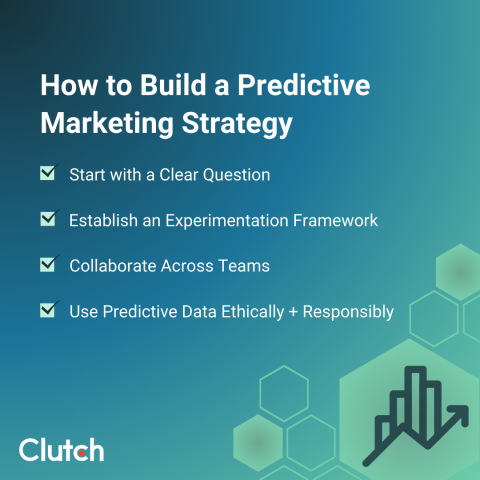
First, your team needs a clear objective, and that means defining the business question you hope to answer. You’ve probably already framed these questions internally in one form or another. Examples of questions you might ask include:
Starting with a clear question is important because it keeps your efforts aligned with tangible business goals. For example, L'Oreal Taiwan used predictive analytics to forecast which online visitors were most likely to buy in-store over the next two weeks.
By analyzing website behavior and offline purchase data together, they improved targeting and optimized media allocation before launching their new seasonal campaigns.
Simplicity is also important in the early stages of predictive marketing. A focused question will keep the full team united around a single task while validating the value of predictive tools. It’s typically more effective to expand the scope over time, once a marketing team is more familiar with using predictive processes to improve performance.
It’s important to note that predictive insights are just that — predictive. They don’t guarantee results and can be proven wrong as market conditions evolve. That’s why companies like Uber use predictive analytics to model future demand and resource allocation. They validate models through controlled testing before scaling widely.
The goal is to put your predictive insights to the test so you can measure their real-world impact and see if it aligns with what the model estimated. If early results are promising, then that’s the reason to increase your budget allocation. However, you shouldn’t spend a lot to execute a predictive strategy without first validating the results.
For example, you might run a series of A/B tests to compare predictive-driven decisions against existing approaches. This could help you understand if the segmentation change a model suggests will actually deliver more value to your business in the form of a higher conversion rate.
You can create your own experimentation framework based on the tests that make the most sense for your business needs. The key is to treat predictive analytics as a hypothesis that needs confirmation — not a clear answer that should be trusted absolutely.
The value of predictive marketing depends on both the insights delivered and how well they’re applied across marketing, sales, and leadership teams. Collaboration is essential, as each group will have its own take on predictive data and its own expertise to contribute.
Alignment starts with shared goals and clearly defined metrics for success. For example, the cross-departmental goal might be to improve your conversion rate. In this case, the metric for defining success would likely be conversion percentages on the platforms you target.
Clear communication will be important throughout. Leaders may want to create documentation around these processes so teams know what to expect and the collaboration framework becomes repeatable.
The primary concern is avoiding the use of predictive marketing in isolation from other departments and broader business objectives. It should be integrated into team-wide performance pushes and aligned with leadership’s top priorities to encourage ongoing buy-in.
Data is the foundation of predictive marketing. As capabilities expand, the importance of ethical and responsible data use will become increasingly evident. Marketing leaders will need to strike a balance between optimization and consumer trust, regulatory compliance, and long-term brand reputation concerns.
The first step in using data responsibly is to be transparent about when you collect it. You may also want to give customers an opt-out option, so those who don’t want to be included won’t hold the practice against your brand.
Teams should understand the origin of their data and how it’s utilized in models. Regular reviews can help identify potential biases in data or modeling approaches. This can be especially useful when predictions affect targeting, pricing, and access to offers.
Compliance with privacy regulations should be treated as a foundation, not a constraint. Building predictive strategies that respect consent, data governance standards, and regional regulations reduces risk and ensures predictive marketing remains sustainable as expectations continue to evolve.
By using data modeling to predict consumer behavior, teams can achieve more with the same marketing budget they have today. However, many organizations struggle to move from experimentation to reliable impact. As your team goes through this process, it may experience several common challenges:
This is why developing a repeatable framework for testing predictive insights is so important. If any of these problems impact your results, they’ll show up in your testing, and you’ll be able to adjust your strategy before overspending.
Predictive analytics in marketing is gaining traction as leaders face growing pressure to improve performance. It differs from traditional analysis in that predictive approaches focus primarily on what will happen next, rather than what has happened previously. This helps companies market themselves more effectively based on emerging trends.
The organizations that derive the most value from predictive marketing begin with a robust data foundation. They ask clearly defined business questions and align efforts across teams to translate predictive insights into better marketing decisions. Ultimately, a predictive analysis strategy enables teams to transition from reactive marketing to proactive growth.