Task Automation: How to Cut Repetitive Work
Task automation saves time, gets work done faster, and reduces errors. Learn how to automate repetitive tasks step-by-step and how to decide what to automate.
Updated September 29, 2026
The emergence of generative AI throughout the influencer marketing landscape has been breathtaking in its rapid growth from a novelty to the cornerstone of countless campaigns. But how are the biggest names in social media making the most of the transformative technology?
The global market for generative AI in marketing is building momentum and is expected to grow from a value of $2.48 billion to a $35.12 billion industry by 2034, according to Yahoo data. The omnipresence of artificial intelligence today means that its involvement in creating engaging marketing campaigns has become an essential practice for businesses and influencers alike.
Utilizing the power of AI is fast becoming a game changer among social media’s biggest accounts.
Looking for a Artificial Intelligence agency?
Compare our list of top Artificial Intelligence companies near you
Whether it focuses on using immersive imaging tools based on text prompts, high-quality filters to transform multimedia content, or supporting the musings of just about any question that an influencer can think of, artificial intelligence is fundamentally changing the way we use social media.
Generative AI also appears to be having a positive effect on productivity among marketers. In the United Kingdom, 77% of marketers claim that using GenAI-assisted content has boosted their social media engagement and impressions, while 53% believe that generative AI content performs better than content created solely by humans.
However, the mass adoption of generative AI among social media users has led to plenty of concerns that networks are beginning to suffer in the absence of an organic human touch when posting and replying to content.
This calls for a more nuanced approach to deploying Gen AI effectively. So, how can influencers master the art of generative AI in their marketing campaigns?
Generative AI has gone from novelty to default in influencer marketing: brands now commission AI-assisted creator content at scale, and most influencers reach for GenAI tools every week. But consumer trust hasn’t kept pace. In Clutch’s 2026 survey of 601 consumers, 45% said they wouldn’t knowingly engage with — or trust a recommendation from — an AI influencer, and 71% would question a human influencer’s recommendation if they knew AI was involved in the content. That gap — booming adoption, lagging trust — is the real story for brands: the payoff from generative AI in influencer marketing now depends as much on how transparently you use it as on how well you use it. Below are three examples of GenAI in action, followed by the trust reality that should shape how you deploy them.
Firstly, let’s take a look at why generative AI influencer marketing has been so popular despite the relatively short existence of platforms like ChatGPT. There are plenty of benefits to adopting Gen AI content as part of an influencer marketing strategy, and the many perks include:
Given that the remote digital services market is expected to grow from $16.56 billion in 2021 to $109 billion by 2030, representing a CAGR of 23.4%, generative AI is a tool that can enhance the quality of marketing campaigns for marketers and influencers who occupy work-from-home (WFH) roles around the world.
The quality of automation tools can ensure productivity without the need to build costly marketing teams that could interfere with creativity.
The successful examples of generative AI in action among influencers and their marketing campaigns are growing at a rapid pace, but some strong use cases stand out for their reach and ease of use:
As an emerging technology, countless trends have emerged as influencers and social media users learn its capabilities.
One popular trend at present, which is associated with extremely easy-to-generate content, is a movement where social media influencers ask large-language models (LLMs) unconventional questions and post the results.
These questions generally involve something too complex for a human to answer simply. They can range from asking ChatGPT to create a business from scratch to writing poems about celebrities or public figures.
However, one of the most effective visual trends that has helped influencers connect with brands has been the recent AI doll trend, where social media users and brands alike have been busy asking ChatGPT to render an image of themselves as action figures.
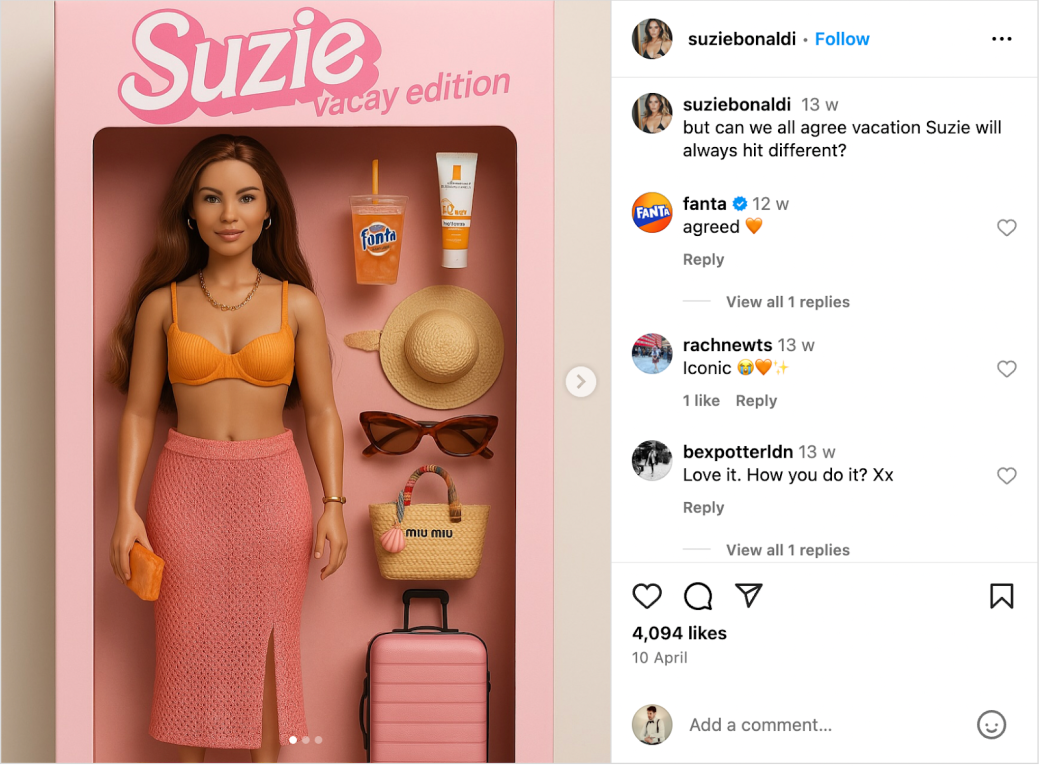
Because the trend has been so accessible for all social media users due to the renderings coming from simple text prompts, the engagement potential of including trending AI creations is extremely high.
In the case above, a fashion and beauty influencer has used the AI doll trend to engage with Fanta, while other brands opted to work with famous customers and advocates to grow their engagement. For example, UK fashion retailer Primark used an employee who has amassed more than 150,000 followers on TikTok to participate, gaining over 2,000 likes in the process.
Another excellent way for influencers to not only enhance the quality of their marketing campaigns but also bolster their social media presence is to collaborate with companies to showcase the capabilities of the technology.
That’s what Noorie Ana, an influencer with 140,000 followers on Instagram, did as part of a collaboration with Adobe Firefly to create next-generation fashion content.
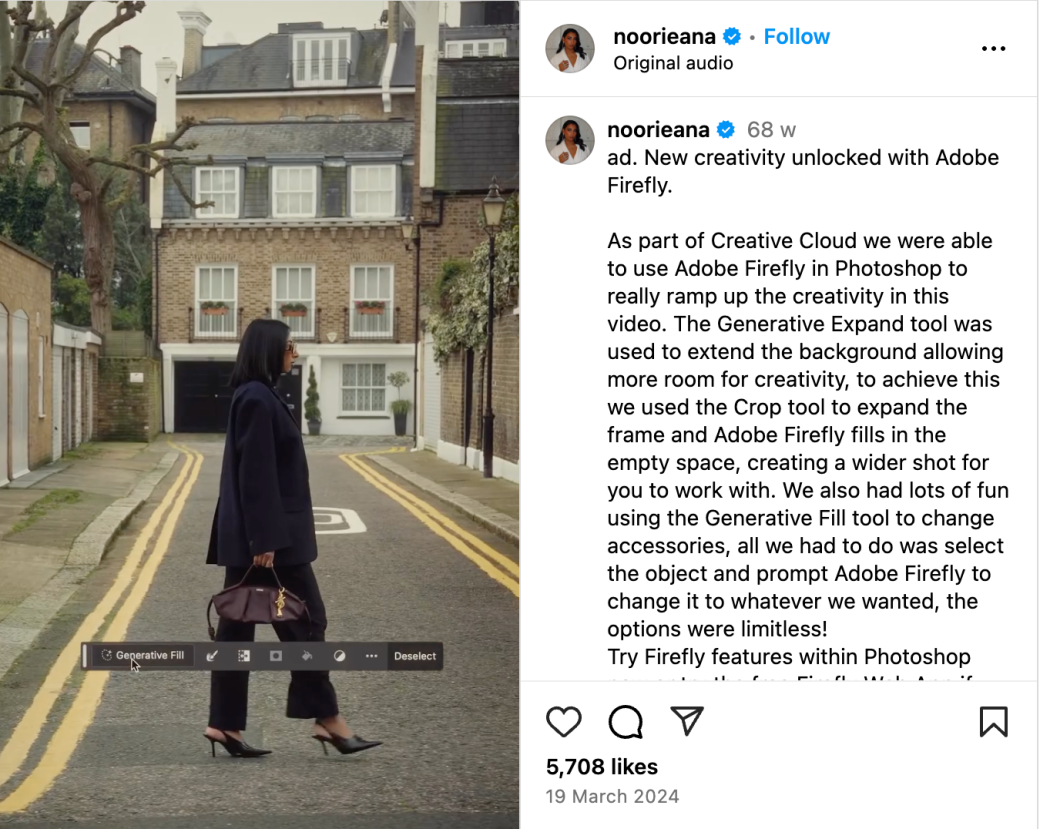
This form of generative AI post combines cutting-edge fashion content with a tutorial on how social media users can learn to use the technology.
Because of its status as an emerging technology, we’re set to see many more influencers turn to how-to's and tutorials in collaboration with AI firms to showcase the capabilities of artificial intelligence to wider audiences.
By combining the core functions of generative AI tools with engaging multimedia footage of the positive effect they have on the influencer’s content, this marketing strategy not only helps to showcase user advocacy but also serves as social proof for other would-be adopters.
Given that 93% of consumers believe that online reviews influence their purchase decisions, using influencers as social proof for new AI tools is a winning formula.
The use of digital twins is a groundbreaking new facet of influencer marketing that could open the door to fresh opportunities and the potential for far greater levels of audience engagement.
Digital twins refer to the duplication of influencers and individuals who exist in the real world to replicate their identity in virtual environments.
In July 2025, H&M launched a marketing campaign featuring the digital twins of 30 different models to create AI-generated pictures for their social media posts.
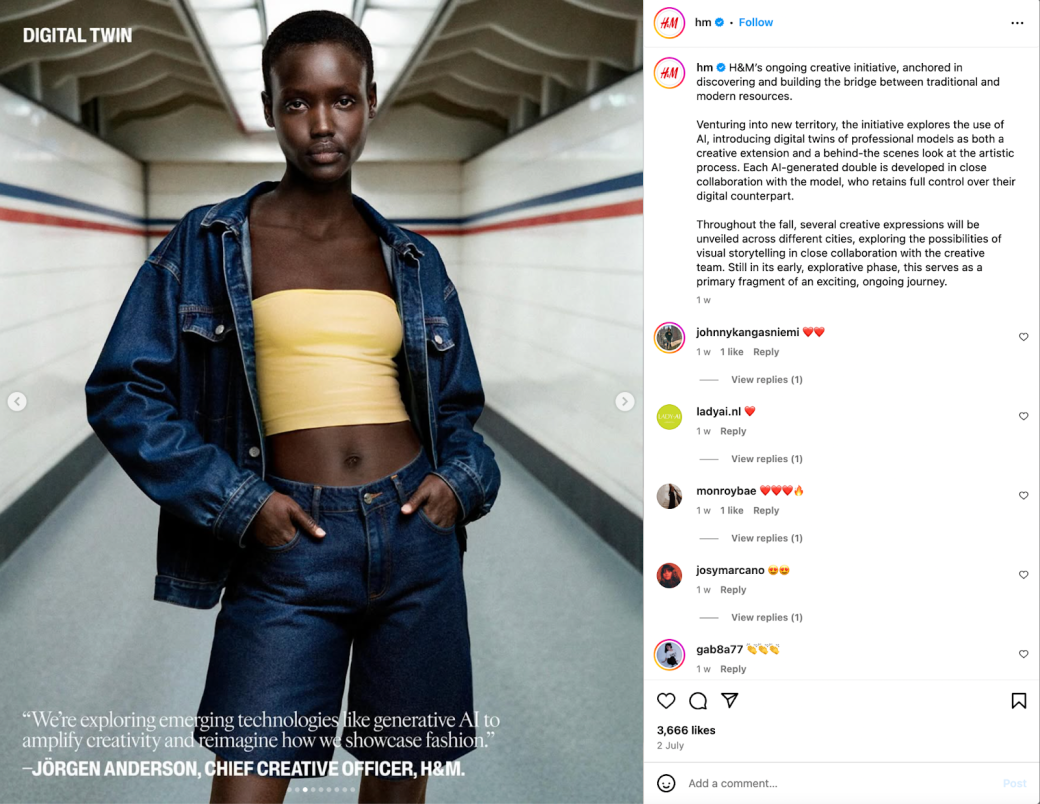
Although the concept of having digital twins replace existing models and influencers seems controversial—and there certainly are questions to be raised over the possibility of unrealistic implications for aging and manipulations in the future—all models retain the rights to their twins. As a result, influencers can remain in full control over how their image is used by brands.
The notion of influencers using digital twins as a core component of their marketing campaigns means that the volume of collaborations that they choose to become a part of can be virtually limitless. This can open the door to a new age of brand advocacy and the ability to choose to seamlessly collaborate with favored companies all over the world without requiring a physical presence.
Here’s what the optimistic case leaves out: adoption is racing ahead of acceptance. Awareness of AI influencers is still low — only 40% of consumers say they’re even aware of them — and among those who are, resistance runs high. 45% say they wouldn’t knowingly engage with an AI influencer or trust a product recommendation from one, a real ceiling on the format’s current appeal.
The sharper risk sits with human influencers who use AI. 71% of consumers say they’d question a human influencer’s recommendation if they knew AI was used in the content. The question audiences are asking isn’t just “is this influencer real?” — it’s “did AI change the authenticity of the recommendation?”
And people overestimate their own radar. 57% are confident they can tell whether an image or video is AI-generated — yet 30% report seeing unlabeled AI content more than 20 times in a single month. AI influencers are specifically engineered to blur that line, so a great deal slips past even confident viewers. Confidence isn’t the same as detection.
That skepticism carries a price tag. 53% of consumers say they’re less likely to buy from a brand they know uses AI in its social content. Read carefully, that’s not a vote against AI — it’s a vote against opaque AI. The trust hierarchy is also shifting in brands’ favor: consumers now lean toward brands (40%) over influencers (14%) for product recommendations — but that advantage is fragile if AI use makes a brand’s content feel less authentic.
The takeaway for brands betting on AI influencers: the resistance is strong enough to carry genuine recommendation and purchasing risk. The move isn’t to avoid generative AI — it’s to use it where it clearly adds value and to be transparent about it, so efficiency doesn’t come at the cost of credibility.
Generative AI genuinely is the new normal in influencer marketing — the examples above show the creative upside is real, from accessible trends to full digital-twin campaigns. But the data shows the ceiling just as clearly: audiences reward brands that use AI to add value and are upfront about it, and penalize those that let AI quietly blur authenticity. The brands that come out ahead won’t be the ones using the most AI in their influencer programs — they’ll be the ones using it transparently, where it earns engagement instead of eroding trust. Treat GenAI as a productivity and storytelling tool, disclose it where it matters, and keep the human judgment that audiences are still looking for.
Need help building an influencer strategy that uses AI without losing the plot? Browse Clutch’s directory of social media marketing partners for vetted expert help.
It’s the use of generative AI tools — for content creation, trend analysis, personalization, and even fully AI “digital twins” or virtual influencers — within influencer campaigns. For a deeper look at fully synthetic creators specifically, see our guide to what AI influencers are.
Largely not yet. 45% of consumers say they wouldn’t knowingly engage with or trust a recommendation from an AI influencer, and 71% would question a human influencer’s recommendation if they knew AI was used in the content.
Increasingly, yes. 53% of consumers are less likely to buy from a brand they know uses AI — a penalty that falls hardest on brands that hide it rather than those that use AI to add value and label it clearly.
Three current examples: AI trend content like the doll/action-figure trend (Fanta, Primark), influencer-led tool showcases (Noorie Ana × Adobe Firefly), and digital-twin campaigns (H&M’s 30 AI models).