
Task Automation: How to Cut Repetitive Work
Task automation saves time, gets work done faster, and reduces errors. Learn how to automate repetitive tasks step-by-step and how to decide what to automate.
Updated February 26, 2026

From cautious experimentation to measurable ROI, here’s how product teams are deciding when AI belongs on the roadmap and when it doesn’t.
Explore survey insights from SaaS founders and product leaders on how they’re navigating AI adoption in 2026, highlighting where AI is creating real value, what’s holding teams back, and how non-technical and technical founders approach product decisions differently.
AI adoption in SaaS isn’t just hype; it’s reshaping how teams build products, prioritize features, and define competitive differentiation. Based on a cross‑industry survey of founders, product leaders, and operators, this article highlights how SaaS teams are thinking about AI, what opportunities they see, and how they are validating AI‑powered ideas today.
Looking for a Artificial Intelligence agency?
Compare our list of top Artificial Intelligence companies near you
To understand how SaaS companies are building with AI today, we surveyed founders, product managers, and operators from sectors including healthcare, marketing, sports tech, IoT, B2B tools, and platform‑as‑a‑service products. Our goal wasn’t to glorify AI or warn against it, but to map how teams are learning and adapting in real time.
SaaS teams are actively integrating it into products and workflows. But adoption is uneven. Technical and non‑technical founders view AI through different lenses, and teams are cautious about how and when to embed it.
→ Explore the full guide to see how AI is reshaping SaaS product strategy.
In conversations with non-technical founders, insights were gathered on how they are adapting to AI-driven disruption in their business models, exploring their confidence levels, the challenges they face, and the support they wish had been available earlier.
A key finding from the study is that background influences AI thinking:
This split isn’t a divide; it’s actually complementary. Together, these perspectives shape how teams prioritize AI in their roadmaps.
Across industries and company stages, the answers consistently pointed toward practical, efficiency-focused applications rather than flashy, experimental AI features.
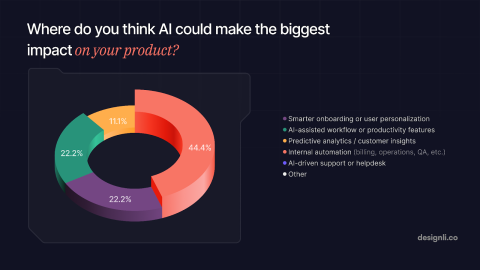
Founders are seeking ways to automate manual tasks, accelerate customer value, and make more informed product decisions.
→ This reflects a growing realization: AI doesn’t need to be customer–facing to generate value.
→ This indicates a preference for tools that remove friction rather than add complexity.
→ This aligns with broader SaaS trends: the faster users achieve value, the better retention and product engagement become.
Users can easily integrate AI tools that enhance automation and work as a decision support.
When asked about their biggest concern, founders didn’t focus on whether AI is “trendy”, they focused on risk, clarity, and execution.
These concerns suggest that founders aren’t resistant to AI; they are just cautious. They want clarity on timing, ROI, and execution risk before fully committing.
When evaluating AI tools, founders prioritized validation and strategic clarity. Market hype did not override the need for real use cases and measurable impact.
For teams navigating AI decisions today, the pattern is clear: AI adoption isn’t about moving first, but intentionally, when the risk is manageable. They are deliberately cautious, waiting for clearer signals around ROI, readiness, and integration complexity.
We asked founders how they decide what to build next, how much AI trends influence those decisions, and how teams validate AI-powered ideas before committing to them.
Founders emphasized practical needs over theoretical innovation. AI trends influence awareness and discovery, but they rarely drive decisions alone.
This underscores that leaders ask not “Can we build this?” but “Should we build this now?”
Founders approach AI experimentation with methodology.
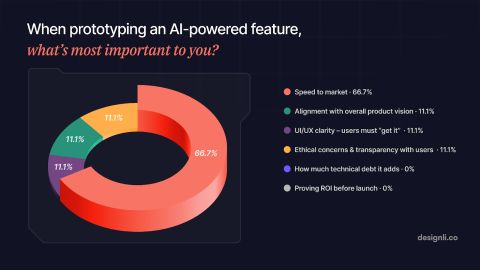
Key priorities when prototyping:
Common validation methods include internal dogfooding to catch issues early, limited betas to observe real user behavior, and public iteration to shorten feedback cycles. Rather than obsessing over perfect releases, effective teams iterate based on direct user feedback and measurable outcomes.
When asked about AI capabilities they wish they had, founders say they wish they had.
Intelligent automation
Smarter insights and summaries
UX-enhancing capabilities
These features remain unbuilt due to a lack of technical confidence or capacity, unclear ROI vs. effort, and the risk of over-automation.
Founders are not short on AI ideas, but they are disciplined about execution. Many teams recognize the potential of intelligent automation and insights, but choose to wait until they have the right technical foundation, cost clarity, and confidence that the feature will genuinely improve user outcomes rather than add complexity.
Founders described scaling as a growth and execution challenge, not a product-idea problem.
Interestingly, AI was rarely cited as a primary differentiator. Instead, teams focused on niche specialization, workflow and UX improvements, strong service and support quality, and simplicity over breadth. Across the survey, a clear pattern emerges: scaling is not a product idea concern but a growth and execution challenge. AI can enhance differentiation, but it does not replace the fundamentals of product–market fit and user experience.
Non-technical founders, rather, someone had better explain the long-term implications of AI technology decisions. Mainly regarding:
Overall, the frustration wasn’t about using AI; it was about understanding what they were committing to in the long term.
AI is now a permanent part of the SaaS landscape. Used well, it can automate repetitive tasks, surface insights faster, and remove friction for both internal teams and end users. Ignored entirely, it becomes a missed opportunity. Overused or rushed, it can just as easily introduce complexity, inflate costs, and distract teams from solving the right problems. That balance matters.
AI works best as an enabler, not a headline feature by default. Just because AI can be added to a product doesn’t mean it should sit at the front of the roadmap or define the core value proposition. In many cases, the most impactful AI implementations happen quietly in the background, improving workflows, accelerating decision-making, or reducing operational drag without fundamentally changing how the product feels to users.