
Task Automation: How to Cut Repetitive Work
Task automation saves time, gets work done faster, and reduces errors. Learn how to automate repetitive tasks step-by-step and how to decide what to automate.
Updated October 23, 2026

AI customer support software can help small businesses respond to customers faster, reduce support workloads, and provide assistance around the clock. With so many platforms available, choosing the right one depends on your budget, support needs, and growth plans.
Small businesses are gravitating toward chatbots for customer support, and the case for it is straightforward. Besides costing less than human agents, chatbots run 24/7 and scale on demand. When volume drops, companies can disable bots rather than navigate the contracts and employment obligations that come with traditional hiring.
But cost efficiency doesn't automatically translate into customer satisfaction. A Clutch survey of 422 consumers found that while 87% had used AI-powered customer support, and 72% used it regularly, adoption hasn't made consumers more forgiving of poor experiences.
Looking for a Artificial Intelligence agency?
Compare our list of top Artificial Intelligence companies near you
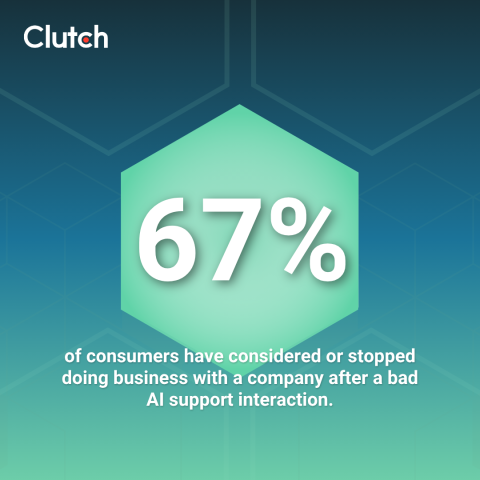
The consequences of getting AI chatbots wrong are significant: 67% of respondents said they had considered or stopped doing business with a company after a bad AI support interaction.
To ensure you implement the best AI customer support software for your company, consider factors such as budget and pricing model, ease of setup, integration compatibility, and AI capabilities. We've also included a list of the best AI customer support tools for small businesses.
Before committing to an AI customer support platform, here's what to evaluate:
Here are some of the top AI customer support tools for small businesses.
| Tool | Starting Price | Free Option | Best For | Top AI Feature |
| Intercom | $29/seat/mo | Trial | Small to mid-sized businesses needing a full-featured support platform | Fin AI agent charges only for successful resolutions ($0.99 each) |
| Freshdesk | $29/agent/mo (annual) | Trial | Budget-conscious teams with high email ticket volumes | Freddy AI comes with auto triage, sentiment analysis, and ticket summarization |
| Tidio | $24.17/mo (100 billable conversations) | Plan | Small e-commerce businesses want live chat and an AI chatbot | Lyro AI resolves up to 67% of customer queries automatically |
| Zendesk Copilot | $19/agent/mo and $50/agent/mo AI add-on | Trial | Mid-market to enterprise teams already using Zendesk | Copilot provides autonomous agents with intelligent triage and intent detection |
| Zoho Desk (Zia) | $8.75/user/mo (annual) | Trial | Budget-conscious teams in the Zoho ecosystem | Zia provides sentiment analysis to help agents prioritize frustrated customers |
| HubSpot Service Hub | $10/seat/mo (annual) | Plan | Businesses scaling within the HubSpot ecosystem | Automated ticket routing and AI-assisted resolution are built into the CRM |
| Gorgias | $360/mo (monthly); $300/mo (annual) | Trial | E-commerce companies on Shopify or BigCommerce | Autonomous post-purchase support and pre-purchase shopping assistant |
| Drift / Salesloft | $125/user/mo | No | Enterprise revenue teams focused on sales-led chat | Intelligent lead qualification and 24/7 AI meeting scheduling |
| Help Scout | $25/user/mo | Trial | Growing businesses needing clean, email-first support | Beacon AI is a virtual agent that resolves queries 24/7 from your knowledge base |
| Chatbase | $32 (monthly); $384 (annually) | Yes | Businesses wanting a fast, no-code AI chatbot on a budget | Custom AI chatbot trained on your own data that's deployable in under 10 minutes |
| Pluno | €850/month for 1,000–3,000 tickets/month, plus €0.90 per AI-resolved ticket; AI Copilot is €49/seat/month | Trial | B2B and software companies handling complex, technical support tickets | Resolves tickets using past support conversations, help-center content, and live data; escalates cases with context for human agents |
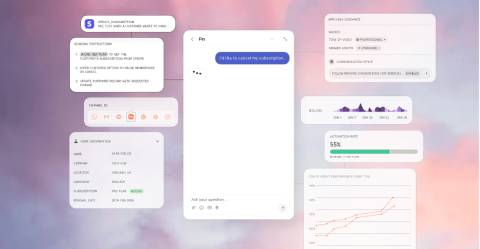
Intercom is a helpdesk with a natively integrated AI agent, Fin. Every customer conversation improves the next one, and your team can collaborate with Fin to deliver perfect customer experiences.
Best for: Small to mid-sized businesses that need a full-featured support platform and can absorb variable costs.
Key AI features: Natively integrated Fin AI agent, conversation summarization, analytics, automated workflows, multi-modal support to boost customer service efficiency.
Pricing: Free trial; tiers range from $29 to $132 per seat per month; $0.99 per outcome for Fin AI add-on.
Pros:
Cons:
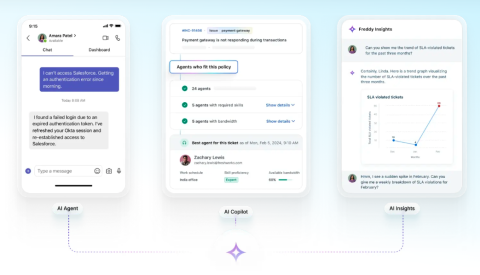
Freshdesk combines every ticket, conversation, customer insight, and AI capability into one powerful workspace. Its AI customer support service is called Freddy AI.
Best for: Small to mid-sized businesses and fast-paced support teams looking for a budget-friendly AI sidekick.
Key AI features: AI Writing Assistant, Auto Triage, Knowledge and Canned Response Suggester, Ticket Summarization, Sentiment Analysis.
Pricing: Free trial; tiers go from $29 to $119 per agent per month, billed annually.
Pros:
Cons:
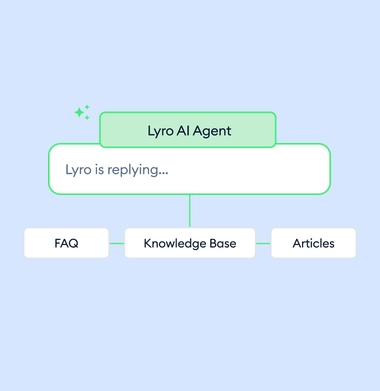
Tidio is an all-in-one customer experience platform that combines AI-driven chatbots, multichannel messaging, and live chat.
Best for: Small to mid-sized businesses and e-commerce stores that want to automate customer service, capture leads, and recover abandoned carts.
Key AI features: Lyro AI that answers up to 90% of customers in seconds, an intuitive interface, and native integrations.
Pricing: Free plan; paid plans start from $24.17per month (100 billable conversations) to $749 per month (custom billable conversations).
Pros:
Cons:
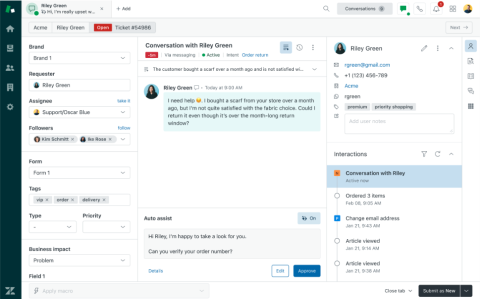
Zendesk Copilot is an AI add-on for the Zendesk platform. It consists of paid add-on tools that automate customer service workflows and assist human agents.
Best for: Mid-market to enterprise-level support operations that already use Zendesk.
Key AI features: Autonomous AI agents that detect customer intent and resolve common issues before human agents step in, Copilot for human agents, and intelligent triage.
Pricing: Free trial; $50 per agent per month paid yearly on top of Zendesk Customer Service solution fees (which range from $19 to $115 per agent per month, paid yearly).
Pros:
Cons:
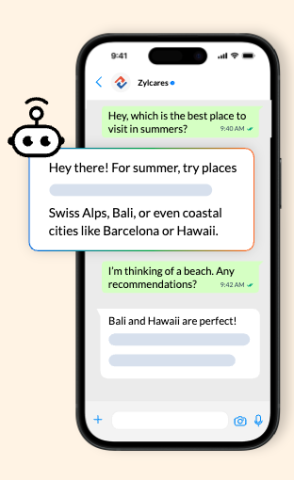
Zoho Desk is a cloud-based customer service and helpdesk platform that unites support requests across email, phone, chat, and social media. Zia is Zoho Desk's built-in AI assistant.
Best for: Budget-conscious small businesses already in or open to the Zoho ecosystem.
Key AI features: Deep ecosystem integration with the Zoho suite, smart AI automation, an Answer Bot, and a Knowledge Base creator to automatically deflect repetitive, common customer questions.
Pricing: Free trial; starts at $8.75 to $50 per user per month, billed annually.
Pros:
Cons:
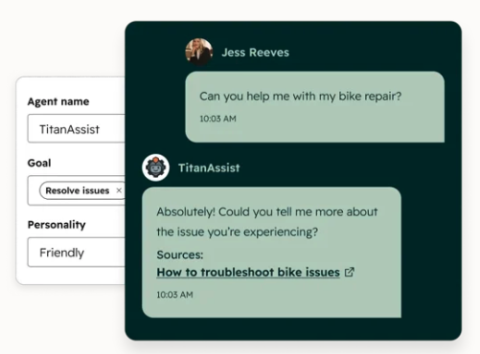
HubSpot Service Hub is a comprehensive customer service software that helps businesses manage support tickets, collect feedback, and build customer-facing knowledge bases. It's directly connected to the main HubSpot CRM.
Best for: Scaling businesses that already use or want to use the broader HubSpot ecosystem.
Key AI features: Automate repetitive tasks, scale customer support, and help human agents with ticket resolution.
Pricing: Free basic version for up to two users; paid plans ranging from $10 to $195 per month per seat.
Pros:
Cons:
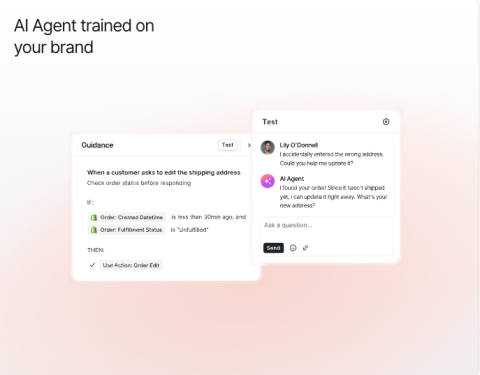
Gorgias is an e-commerce-focused customer service platform. It offers deep integration with platforms such as BigCommerce and Shopify, enabling support agents to manage orders and subscriptions from the helpdesk.
Best for: e-commerce companies.
Key AI features: Autonomous post-purchase support that answers queries about order tracking, FAQs, returns, and shipping delays. It also includes a pre-purchase shopping assistant that analyzes a customer's viewings, purchase history, and cart to provide relevant product bundles and recommendations.
Pricing: Free trial; starting from $360 to $1360 per month when billed monthly, or $300 to $1200 per month when billed yearly, depending on the number of support tickets and automated interactions each month.
Pros:
Cons:
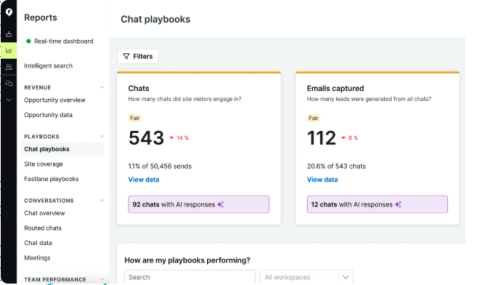
Drift is a B2B conversational marketing and sales platform known for meeting scheduling and lead qualification. In 2024, it was acquired by Salesloft, and as a result, it's now part of a unified platform that combines Salesloft's sales engagement solutions with Drift's conversational AI abilities.
Best for: Enterprise revenue teams that prioritize sales-focused chat.
Key AI features: Intelligent lead qualification, autonomous AI chat agents, 24/7 meeting scheduling, seamless transfers from AI bots to human representatives when complex issues arise.
Pricing: $125 to $165 per user per month before add-ons and annual increases.
Pros:
Cons:
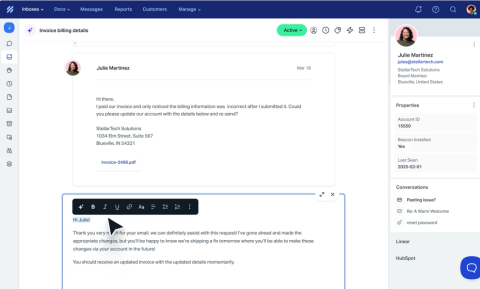
Help Scout is a customer service tool known for its clean, email-like interface and website widget (Beacon) that merges self-service with live chat. However, it lacks advanced AI chatbot automation.
Best for: Growing businesses that only need basic customer service functions.
Key AI features: An AI-powered virtual agent in Beacon that analyzes your knowledge base and website to resolve questions 24/7, an on-demand editing tool that helps agents translate messages and alter response length, and a tool that instantly condenses complex conversation threads with a single click.
Pricing: $25-$75 per user per month, with free demos. $0.75 per resolution for AI Answers add-on (includes three-month free trial).
Pros:
Cons:
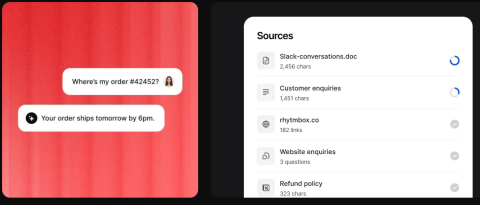
Chatbase is a no-code platform that businesses can use to build custom AI chatbots trained on their own data, including website URLs, documents, PDFs, and FAQs. It can act as an automated lead-generation or customer support agent, answering user questions and integrating with channels like Shopify, Slack, and WhatsApp.
Best for: Businesses needing a fast, budget-friendly, and "plug-and-play" way to capture leads and automate repetitive FAQs.
Key AI features: Ability to run real-world tasks like updating Shopify orders and booking Calendly meetings, seamless handoffs to human agents, omnichannel deployment, and deep analytics.
Pricing: Free plan available; paid plans range from $32 to $400 per month or $384 to $4,800 billed annually; Enterprise plan with custom limits and variable pricing available.
Pros:
Cons:
Pluno is an AI support platform designed for companies dealing with complex product questions and technical tickets. It can resolve tickets using past support conversations, help-center content, and live data. When a case needs a person, Pluno can escalate it with conversation context; its AI Copilot also drafts replies and summarizes ticket threads for agents.
Best for: B2B software companies and support teams handling complex or technical tickets.
Key AI features: Automated ticket resolution, AI-drafted agent replies, ticket summaries, automatic tagging and field filling, and escalations to tools such as Slack, Jira, and Linear.
Pricing: The listed annual-billing price is €850 per month for 1,000–3,000 tickets, plus €0.90 per AI-resolved ticket. AI Copilot costs an additional €49 per seat per month. Pluno offers a 14-day free trial.
Pros:
Considerations:
To choose the right customer support tool for your business, match the tool to your support volume and team size. If you don't expect much growth over the next year and the number of leads is relatively low, you can pick a less scalable tool. However, if you have a large business or expect growth soon, you should choose a tool that scales with your growth, so your human agents won't be overloaded.
Before committing, use free trials or plans. Most platforms on this list offer them. Implement them and ask your team what they think, and write down the results. If the free trials are making work easier for everyone and lead to more issues resolved and happier customers, then you've found the right tool.
You should also prioritize customer support platforms that integrate with tools you already use. For example, if you're already using Zendesk products, Zendesk AI may be your best choice.
AI customer support can be a game-changer. With the right system, you’ll have happier customers and customer support agents. But if you pick the wrong one, your platform might struggle to answer questions efficiently or take a complicated route to pass issues to human agents, causing frustration, unhappy customers, and damage to your reputation.
As such, it's important to assess customer support platforms carefully before buying. Start with free trials, and ensure the tool aligns with your support volume, team size, and existing integrations.