
How to Define Brand Values That Guide Every Business Decision
Brand values are the principles that guide company decisions, define what a brand stands for, and shape how it treats customers, employees, and partners.
Updated February 24, 2026

While AI is everywhere in brand development and marketing, consumers are becoming increasingly wary of brands that feel too artificial. To meet consumers' expectations, humans will need to lead the future of AI in branding.
Since OpenAI released ChatGPT in November 2022, AI in branding has dominated headlines across industries. But as AI-assisted and produced work has become the norm, audiences are increasingly wary of brands that feel overproduced and interchangeable. They're tired of copy that reads too polished, reviews (even when written or said by real people) that feel generic, and other telltale markers of AI or AI-adjacent marketing.
That's why, in 2026, winning brands won't be AI-driven, even if they use AI behind the scenes. They'll be human-led, only using AI to support and enhance creativity, not replace it. This article explores why that shift is already underway and how you can make your marketing feel human again.
Looking for a Public Relations agency?
Compare our list of top Public Relations companies near you
Over three years after ChatGPT's launch, people now use AI-generated content on social media, at work, and in many other settings. Subsequently, consumers are no longer fooled by purely AI-generated marketing, and most can easily distinguish between fully automated output and content shaped by a human usingAI assistance.
Research shows that consumers prefer the latter and are increasingly fatigued by AI that feels automated, lazy, or emotionally flat. Clutch's Brand Authenticity Playbook for 2026 revealed that:

The takeaway for brands is clear: consumers pull back when AI becomes the voice rather than the tool. That's because AI can't replace taste, judgment, emotional intelligence, or brand alignment outside the basics. Humans still need to meet these standards through strong prompts, clear examples, careful review, and editing that aligns with a brand's real voice.
AI for branding only becomes a problem when teams treat the output as "good enough." Used properly, human-led AI can meaningfully support brand development, particularly in idea generation, personalization, competitive research, and maintaining consistency across channels.
Many brands already edit AI-generated content by adjusting sentence length or swapping words to match a brand guide. But as consumers' eye for AI becomes more discerning, surface-level editing won't be enough. Increasingly, brands need to do deeper work, such as reshaping ideas themselves, not just phrasing, so the message actually sounds like them.
In practice, this often means:
Ultimately, AI is most powerful when creatives use it as a starting point, not the final answer, especially when it's trained on real brand assets, past work, and clear editorial standards. The more context teams give an AI system, the more useful it becomes. Even then, human editors still need to make adjustments and confirm that everything is correct, sounds as intended, and is ready to go.
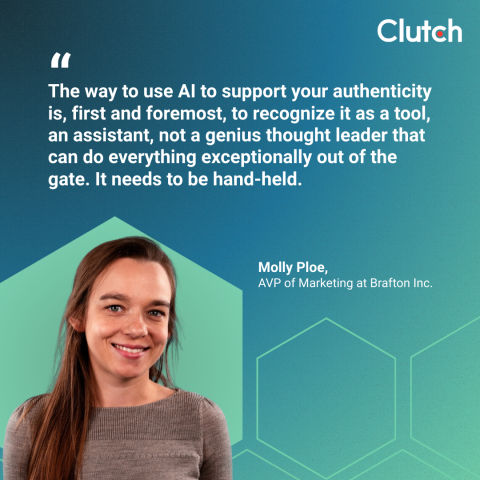
As Molly Ploe, AVP of Marketing at Brafton Inc., puts it, "The way to use AI to support your authenticity is, first and foremost, to recognize it as a tool, an assistant, not a genius thought leader that can do everything exceptionally out of the gate. It needs to be hand-held."
Consumers can smell inauthenticity instantly, especially when content feels generic or overly automated. According to Clutch's 2026 Brand Authenticity Playbook, 59% of consumers notice when tone becomes robotic, and 19% actively distrust AI-generated “human” messaging.
So, what does inauthentic branding or marketing look like in practice? If you look at unedited or barely-edited AI content, you'll notice the following:
Even if the content is accurate, it lacks context, perspective, and specificity, all of which consumers use to decide whether a brand is credible or simply performing relatability.
Ultimately, people want brands with stories, context, and emotional nuance. If teams don't edit AI output with these standards in mind, AI won't just fall flat — it can actively undermine brand authenticity.
In 2026, building consumer trust won't come from using AI faster or more frequently. It will come from using AI with intention. Here's what that looks like.
Human-led AI starts with setting clear boundaries about what AI should handle — typically early drafts, idea generation, research, and pattern analysis — and where human judgment is non-negotiable.
Anything customer-facing should require human review. That's because AI can't fully or consistently manage tone or credibility on its own. You should also establish strong brand voice guidelines to keep human writers and AI grounded in a recognizable identity. Without them, human and AI writers can quickly slide into generic language.
AI for brand building works best as a creative accelerator, not as a replacement for thinking. When teams use it intentionally, it can:
Using AI with intention also means prioritizing value creation over volume. "One of the biggest mistakes brands can make in using AI is what I mentioned earlier: using it to publish, publish, publish, but not actually provide value," says Ploe. "If you overproduce content, not only are you making too much noise for your audience to consume, but you’re also simply not going to have the time to put real thought and analysis into it. Editing and proofing — not to mention the strategy behind the content — still takes time, even if the generation of the content takes far less time than it ever did before."
The third guardrail for ensuring authentic AI brand development is building human oversight directly into the content production system.
Unlike AI, humans can catch tone shifts, cultural missteps, emotional gaps, and subtle contradictions that AI routinely misses. They can also keep a brand's voice consistent and aligned with its stated values over time.
Most importantly, oversight prevents the fastest way to lose trust: polished messaging that contradicts what the brand claims to stand for. "Know when to take the output out of the AI and put human eyes on it," says Ploe. "Understand where AI shines, and where humans are essential."
To remain competitive in 2026, companies can continue using AI in branding, but only after they've built human oversight into content production to ensure authenticity. Thanks to the popularity of AI tools, consumers now have a sharp eye for what's genuinely human and what's AI with only minor tinkering. And since minimally edited AI content often sounds generic, consumers are much more likely to trust brands that only use AI to enhance a brand's human voice, not replace it. Ultimately, authenticity depends on transparency, consistency, and human judgment, not automation alone.
If you're ready to build a future-proof, human-led AI approach, consider partnering with a top-rated branding agency. The right agency will make the job easier by consulting with your team, understanding your goals, developing a strong strategy for attracting and retaining leads, and ensuring execution stays aligned with that strategy.