
How to Define Brand Values That Guide Every Business Decision
Brand values are the principles that guide company decisions, define what a brand stands for, and shape how it treats customers, employees, and partners.
Updated February 24, 2026

Brand trust is the foundation of customer respect and loyalty. It takes time to build, but it could slip away in an instant with these common missteps.
Brand trust is a simple but powerful concept: how strongly do your customers believe your brand will follow through on promises? High brand trust means high brand respect and, by extension, brand loyalty. When you build strong trust with your customers, you influence their purchasing decisions, advocacy for your brand, and willingness to pay more.
Brand trust is a powerful motivating factor in persuading consumers to value your brand and recommend it to others. According to a recent Clutch survey, 70% of consumers are willing to pay more for brands they perceive as authentic, and 62% stated that they often recommend brands they believe to be truly authentic.
Looking for a Public Relations agency?
Compare our list of top Public Relations companies near you
Unfortunately, brand trust is also fragile. Clutch's survey data clearly illustrates the threat to your brand's success if you lose the trust of your customers:
Even well-intentioned brands can erode consumer trust through small, overlooked missteps.
This article examines the top five triggers that destroy consumer trust in brands and provides actionable ways to prevent such failures.
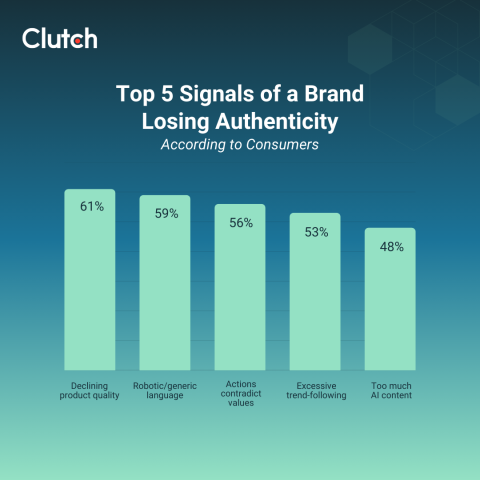
A detectable drop in product quality is a massive red flag for consumers — 61% say that declining product quality clearly signals brand inauthenticity.
Market reactions to high-profile product recalls and failures support this finding, too. For example, the runaway success of Peloton exercise equipment came to a catastrophic halt after the company was forced to recall its treadmills due to severe safety concerns in 2021. In 2023, a massive recall of its exercise bikes saw Peloton lose 20,000 monthly subscribers and suffer a 20% drop in its share price.
Perhaps the worst example of what a decline in product quality can do to a brand is Boeing, which has suffered core operating losses in excess of $30 billion since it was forced to ground its entire fleet of 737 MAX airliners in 2019 due to a safety issue that caused two tragic plane crashes.
You can't perfectly insulate your brand against unexpected product failures or quality lapses, but it is possible to mitigate the risk significantly through regular quality checks. If you discover an issue, communicate clearly with your consumers and craft a well-publicized plan for prompt remediation.
A brand that identifies a problem and says what it is doing to fix it before its customers have noticed looks proactive and invested in protecting the consumer experience.
Trust in brand authenticity also suffers when you rely too heavily on automated or out-of-the-box messaging and communications. In the Clutch brand authenticity survey, 59% of consumers said they notice when a brand's tone feels robotic. Poorly curated AI content, heavily scripted messaging, or campaigns that are simply tone-deaf are avoidable communications missteps that potentially undermine your brand's relationship with consumers.
"You don't win authenticity at the mass level," says Tom Conlon, Founder and CEO of North Street Creative, a New York-based design and strategy studio, "You win it on the one-on-one level."

Make sure your communications keep that human touch, and build human oversight into every campaign to catch and correct any AI overreach or uninspiring messaging. Hold on to your brand voice and personality in your messaging, and look for authentic stories from your employees and customers you can highlight.
When thinking about how to maintain brand trust, alignment of your brand's actions and values is one of the most important things to get right. When a brand's words and actions seem mismatched, 56% of consumers told Clutch they noticed.
This can happen in a variety of ways. You may recall Pepsi's ill-fated 2017 ad featuring Kendall Jenner handing a soda to a riot cop at a protest. The ad was quickly lambasted for what consumers felt was performative social responsibility and an oddly trivializing perspective. Was Pepsi honestly saying that the issues driving the Black Lives Matter protests could be resolved by a "why-can't-we-all-get-along" can of pop distributed by a pretty influencer?
It seemed the brand intended to echo the spirit and success of the "I'd like to buy the world a Coke" campaign of the 1970s. Instead, it suffered a PR embarrassment.
When you make hollow statements that don't seem connected to your core values, consumers can see you as inauthentic. This is one of the criticisms of "greenwashing," when brands make misleading sustainability claims to try to tap into popular environmental causes and concerns.
"Look at who's in the room creating the content," says Tom Conlon, "Are they representative of the audience? Are diverse voices involved? The Kendall Jenner Pepsi ad is what happens when you don't invite your audience into the conversation."
So how can you avoid or minimize these missteps? Start by auditing campaigns for signs of inauthenticity (reflected in consumer reactions) and ensuring that messaging aligns with operational decisions. Be transparent about your brand's limitations, and you may find that recognition of a weakness becomes a strength, as it helps to protect brand confidence.
Marketing attaches great value to staying relevant and on-trend. Brands fear becoming outdated or out of touch. But there's a potential downside to being at the cutting edge of everything: 53% of consumers told Clutch they feel excessive trend-following dilutes brand identity.
Nostalgia, heritage, and consistency are important brand anchors. Tropicana learned this lesson back in 2009. The juice giant invested tens of millions of dollars in a fresh, modern packaging redesign — a state-of-the-art overhaul of the brand's on-shelf appearance that was entirely in line with accepted principles of packaging. And consumers hated it. After a 20% drop in sales, Tropicana switched back to the old packaging. Among the conclusions: The brand had broken the emotional bond it had with its core customer base.
"Invite the audience you want to connect with into the conversation from the beginning," says Tom Conlon on the subject of how to build brand trust. "Ensure diverse voices are at the table, creating your brand messaging and campaigns. Don't just chase trends — stand for something consistent."
Integrate trends selectively and tie innovations directly to your core brand identity.
On the subject of trends that brands chase at the expense of authenticity, 48% of consumers say heavy reliance on AI content reduces their perception of the authenticity of a brand. And 42% say that authenticity increases when it's clear real people are behind a product, be that craftspeople or customer support.
This isn't to say that AI doesn't have a place in your marketing toolbox, but if it starts to feel like it has replaced human involvement entirely, consumers might feel you've put your brand on autopilot. The robots have taken over; authenticity plummets.
"AI can make you 10 times more effective if you use it right," says Tom Conlon. "The key is ensuring everything you produce with AI's help remains authentically yours."
Use AI to assist, but don't skip human review, storytelling, and oversight. Make it clear to your customers that you, not the all-knowing AI algorithm, are in control of your branding and messaging.
What is brand trust? It's a connection you build with your customers, a connection based on the overall reliability and authenticity of your brand. It takes time to establish — customers need to see a pattern of behavior, repeated and reliable proof that your brand follows through on its promises.
And once you build it, brand trust can be lost with just one poorly planned campaign. The essence of brand trust lies in the old adage: "It takes 20 years to build a reputation and five minutes to ruin it."
Protecting brand trust is a continuous strategy. You cannot build and maintain it with a one-time campaign. You need to align actions and values, keep communications clear and transparent, and consistently show your customers you mean what you say.
Hire a branding agency today and get expert help defining your brand identity and building long-term trust with your audience.