
How to Define Brand Values That Guide Every Business Decision
Brand values are the principles that guide company decisions, define what a brand stands for, and shape how it treats customers, employees, and partners.
Updated February 24, 2026

Many consumers make snap judgments about a brand based on “authenticity signals,” but these signals aren’t always clear to internal teams. So, what does your company need to focus on in 2026 to remain authentic in the market?
According to new Clutch data, 97% of consumers say authenticity influences whether they support a brand, which means brand perception can have a major impact on marketing and sales performance.
This article answers what brand perception is, highlighting five key signals that will impact how audiences view your brand. Keep reading to learn how real companies address the challenge of authenticity and how their approach could influence your strategy.
Looking for a Public Relations agency?
Compare our list of top Public Relations companies near you
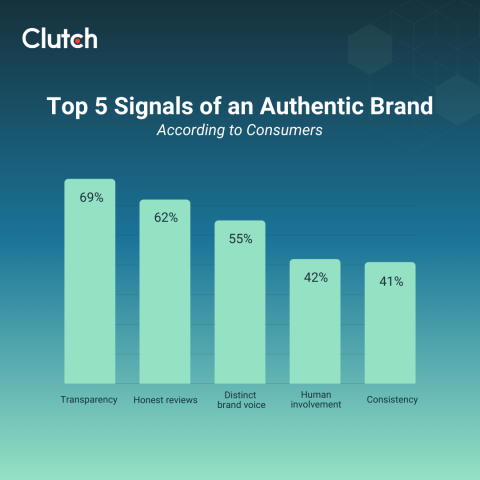
Transparency is the most powerful authenticity signal shaping brand perception today.
A majority (69%) of consumers say being open about processes, business practices, and materials is the strongest indicator of brand authenticity. Doing so lets your target audience peek behind the curtain, helps them understand how the business works, and creates trust.
Scott Darrohn, Managing Partner at fishbat Media, LLC, explains, “Consumers know when you’re hiding something. Being honest about both your wins and struggles builds trust.” As you work toward building an authentic brand in 2026, share more about how your company delivers its distinctive products to the market.
Patagonia frequently publicizes its push for transparency in sourcing and responsible purchasing. The brand shares many details around its production process, including:
Rather than attempting to fit a perfect narrative, Patagonia acknowledges the complexity of its business. It gives customers deep insight into its supply chain, environmental impact, and factory partnerships, which many brands try to hide.
This signals confidence and builds credibility over time. Patagonia’s transparency helps customers trust the brand instinctively and aligns with its niche audience of environmentally conscious outdoor enthusiasts. Over time, this has helped Patagonia develop a reputation as one of the top retail brands not just in its niche but worldwide.
Your business could benefit from a similar transparency strategy, which might look like:
The key is to make transparency a habitual action for your brand. Over time, audiences may stop questioning your motives and feel more authentically connected to the organization.
The most effective brands help customers find authentic reviews. Clutch data shows that 62% of consumers look to real, unfiltered reviews as proof of integrity. This is increasingly important in the era of AI-generated copy, as audiences are becoming skeptical about whether what they encounter online is scripted.
User-generated reviews act as social proof. They influence brand perception by:
Darrohn notes, “Having real customers that actually use or patronize your products gives you a human side people can relate to.” This matters because brand perception isn’t just shaped by what you claim about the brand. It’s also heavily influenced by what others confirm to be true.

Glossier fueled its early growth by leaning into raw customer feedback. It often displays reviews directly on product pages with minimal editing. This shows customers:
Note how the company doesn’t aim for perfection. It shows real customer reviews on every product page, even when they aren't ideal. Researchers say this type of user-generated content (UGC) has a very high level of consumer trust, which reflects positively on the brand's reputation.
Ultimately, the company aims to provide an accurate, transparent, and customer-led view of its products. This approach has helped Glossier connect with digitally native consumers and grow into a major skincare brand.
Brands hoping to replicate Glossier’s approach should focus on highlighting authentic customer voices. Don’t try to control the narrative, but let your audience establish it for you.
You can achieve that by highlighting unedited customer reviews and encouraging video and audio testimonials. The nuance, tone, and body language that customers highlight should increase trust over time — as long as your products are actually valuable to the market.
In a market flooded with similar messaging, sounding unique is becoming increasingly important. According to Clutch data, 55% of consumers associate originality of brand voice with authenticity.
This matters even more in 2026 because AI has lowered the cost of content production and increased the volume of generic language. Using templated phrasing can blur your brand with others and reduce its market recognizability.
Strong voices:
Liquid Death has built its brand on a deliberately unexpected voice. The company emphasizes dark humor and exaggerated intensity, which helps its canned beverages stand out from competitors.
The brand’s tone is consistent across platforms and immediately identifiable. This distinctiveness helped Liquid Death achieve over 100% retail sales growth between 2022 and 2023. The brand's unique voice helps it connect with younger consumers: 80% of Liquid Death consumers are Gen Z or younger Millennial adults.
Liquid Death is more memorable than its competitors, and its social media following reflects that. According to one audit, the company gained over 2.6 million followers on Instagram between March 2024 and 2025 and reached a billion impressions with its posts. This shows how Liquid Death's voice has become a core element of its brand authenticity strategy, shaping perception and driving growth.
You don’t necessarily need to be edgy or comedic to establish a recognizable brand voice. The key is having a clear vision for the brand and remaining disciplined in its execution.
That process starts by documenting brand voice guidelines. Establish standards for tone and boundaries that all employees can reference. You could also create messaging templates that reinforce the brand’s personality across platforms.
Be sure to avoid unrefined AI-generated content. It can accelerate your content output, but dilute your voice. This can damage your brand’s perception and harm sales over time, even if some AI content performs well in isolation.
Authenticity also increases when audiences can see the people behind a brand. According to Clutch data, 42% of consumers say authenticity increases when they know real people are behind the product.
The key insight is that brand perception improves when customers feel they’re interacting with humans, not a faceless company. It’s a trend that may continue to grow as influencer marketing accelerates and consumers increasingly prefer to buy from people they trust.
Ben & Jerry’s consistently highlights the humans behind its brand. The company is constantly sharing human-led content around:
This people-first approach helps the company maintain an authentic, distinct brand within the ice cream industry. That makes Ben & Jerry's feel authentic, which can create loyalty and deeper engagement. The company has become one of the top consumer brands in the food industry, despite being a much younger business than its peers.
Your brand doesn’t necessarily need to share human-led stories at the same rate as Ben & Jerry’s to use this strategy effectively. The key is to show real stories that fit into your broader narratives as they emerge.
For example, you might share a behind-the-scenes look at the production process for a new product. Or you could highlight the people who build and maintain your offerings once a month. Some companies also highlight their founders and executive leadership to show the human faces behind strategies.
Ultimately, trust grows when audiences see the humans behind a brand. Your job is to highlight those voices in ways that contribute to the broader story your company wants to tell.
Following the strategies listed above only occasionally is unlikely to have the desired effect. Clutch data found that 41% of consumers believe consistent messaging is a hallmark of authenticity in branding.
Brand consistency signals reliability. When visuals and tone align across touchpoints, audiences learn what to expect from a brand. This reduces cognitive friction and strengthens a company’s market perception over time.
Darrohn explains, “Every interaction, whether it’s a short reply or answering customers, should consistently and sincerely reflect what your brand stands for.” When brands sound different across channels, audiences begin to question whether the message is authentic.
Warby Parker has maintained a steady ethical narrative throughout its rapid growth. The company consistently focuses on core values around accessibility, social impact, and the customer experience. Even as offerings evolved, the core message has remained the same. Warby Parker has maintained a consistent approach to:
The key lesson is that consistency doesn’t limit evolution. Warby Parker has grown rapidly, transitioning from an online-only startup in 2010 into a physical retailer with 276 stores across North America and an emerging partnership with Target Optical.
The company has introduced a variety of new products and campaigns over its lifespan. But they’ve always connected these new initiatives to existing core values and messaging strategies. For example, despite rapid growth, Warby Parker has stayed true to its Buy a Pair, Give a Pair Program, which has distributed more than twenty million glasses to people in need since the company's founding.
Communicating with the market in a consistently authentic way can be difficult, and typically requires a structured approach. Your company may need to design repeatable processes to reinforce this signal, including:
Consistency is how you turn authentic signals into a long-term shift in brand perception. This becomes much easier when you add steps to your marketing strategy that reinforce consistency with your core values.
Brand perception is built over time, through small, repeated signals that connect the company with its target audience. That means building strategies around the following key authenticity signals:
As Darrohn puts it, “Brand authenticity means being honest about what your brand stands for and having a real connection to your customers. It’s not just about using marketing; it’s about how you show who you are and what brand you want them to see.” In 2026, strong brand perception will come from clear, repeated behavior aligned around these core principles.
Consider partnering with a branding agency if you'd like help with learning how to measure brand perception or creating your initial authenticity strategies.
Marketers measure brand perception with a variety of qualitative and quantitative signals, including: