
How to Define Brand Values That Guide Every Business Decision
Brand values are the principles that guide company decisions, define what a brand stands for, and shape how it treats customers, employees, and partners.
Updated February 24, 2026

From the 1950s, to Y2K, brands are turning to all eras because nostalgia enhances trust and customer loyalty. In fact, a recent Clutch survey found that 70% of consumers say nostalgic branding or marketing makes a product feel more authentic.
From revived logos and retro color schemes to explicit call-backs to early internet culture, nostalgic brands are everywhere these days because nostalgia works.
However, while nostalgia can be a great way to increase brand authenticity, it isn't a cheat code.
Looking for a Public Relations agency?
Compare our list of top Public Relations companies near you
In this article, we'll explore why consumers associate nostalgia with honesty and examine the elements that tap into their emotions. More importantly, we'll explain how to leverage nostalgia without relying on superficiality.
When it works, nostalgic marketing signals familiarity and stability. It provides emotional grounding, priming consumers to remember their good associations with a brand. All of these components ultimately increase consumer trust in your brand.
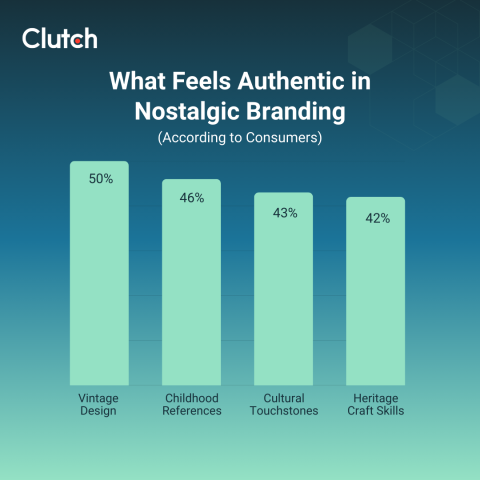
According to Clutch data, consumers say nostalgia feels most authentic when expressed through:
Effective nostalgic branding employs strategies like building community. Paul Kiernan from ThoughtLab notes that nostalgia can unite generations, creating shared cultural moments. It bridges the past and present, forging strong emotional connections.
A social media strategy is one way to capture this feeling of nostalgic community. With consumer involvement, bringing back an old product becomes an event, as it did when Pepsi reintroduced the oh-so-80s Crystal Pepsi.
Retrobranding gives marketers a larger visual toolbox. By blending historical cues with modern design, you can produce images that hook consumers. With so many brands chasing the latest viral trend, looking backwards can make you stand out.
One great example is Coca-Cola. The company keeps its brand consistent, even as it introduces new flavors and caters to consumer preferences for more sugar-free options. The red-and-white color scheme, cursive script, and even the shape of their 20-oz bottle reinforce brand continuity. It's still the same Coca-Cola you loved as a kid, even if you're drinking a limited-edition flavor.
Like Coca-Cola, McDonald's continued use of the "golden arches" logo reinforces its important place in American culture. They've updated the logo over the years, but the basic shape of the arches remains consistent.
LEGO combines old and new by using social media to stay involved with the community. They've also used the competition show LEGO Masters to reach new audiences. These are contemporary strategies, but they're selling a nostalgic story. LEGO offers fun, creative, open-ended play, and it's much the same as it was when you were a kid.
What makes all these examples of nostalgic branding work is that they're rooted in core brand values. Coca-Cola and McDonald's reinforce that they provide classic American experiences for everyone. LEGO reinforces that its toys bridge generations by helping them play well.
Surface-level adoptions of retro design and superficial nostalgia advertising won't cut it. Any company can change its font or pull out an old logo, but consumers will notice if your change is all style and no substance, and adjust their perception of your brand accordingly.
Top branding agencies understand what makes strategic nostalgia different, and can ensure your brand leverages its nostalgic branding effectively and authentically.
Nostaglic marketing typically backfires when it feels gimmicky or presents retro elements with no deeper purpose. When brands are sloppy in their execution, they can also use misaligned cultural references that confuse their core values.
"Nostalgia is not value-neutral," says Mark Lemon, Director of Sign Salad. "It always presents a fiction, and this can be ideologically loaded." Times change, and your brand's former slogans or art style may have picked up some ugly connotations.
According to Lemon, if you want to avoid saying something you don't mean, you need to take the time to understand the connotations your retro symbols have collected in the contemporary world.
Nostalgic marketing isn't as simple as choosing a vintage typeface or airing nostalgia ads. It requires thought and research to express your brand's values and connect with your core consumers.
For example, when Warner Bros. decided to update its logo in 2019, it looked towards the studio's early days in the 1920s and 1930s. The result was a logo that left audiences cold, as they didn't relate to that time period. When Warner Bros. went back to the drawing board, they chose to modernize the logo from the 1980s, a much better choice that connected with its consumers.
When it comes to nostalgia in branding, there are a lot of pitfalls, but a few simple steps will help you use nostalgia to your benefit.
You don't need to carry over every element from your brand's past. Look for things that are still relevant today, whether those are early values or mission statements. You can also look back on your hero products or elements of your visual identity that consumers connected with.
While McDonald's used its marketing muscle to transform the McRib from "McFlop" to cult favorite, it doesn't seem to have the same enthusiasm for reviving the McHotdog. Some products are best left buried in the sands of time.
Give the past a touch-up with tweaks to typefaces, colors, and packaging. Offer fresh photography and maintain a consistent UI. This helps to make your retro moves an authentic part of your branding.
While Burger King's current logo is based on the one introduced in 1969, it's refreshed with a streamlined font, modernized colors, and a slightly different size. The result is a throwback logo that doesn't feel stuck in the past.
Remember, you're not trading in your current identity — you're enhancing it. If there's a logo or product that doesn't represent where you are now, don't use it.
The GameCube was Nintendo's attempt to compete with Microsoft's Xbox and Sony's PlayStation for serious gamers. It didn't work out well for them, so it's not surprising that it's taken them until now to plan GameCube game re-releases. Unlike the first time around, Nintendo is focusing on titles from franchises such as Legend of Zelda and Pokémon that emphasize the brand values of family-friendliness and respect for gaming history.
Consumers have different expectations than they did even 20 years ago. Always couple your nostalgia with clear communication that incorporates customer voices.
Perfume brand Xyrena looks to the past for inspiration, producing scents based on movies such as Halloween and Jaws, but it couples its nostalgia with a strong commitment to cruelty-free cosmetics and LGBT+ representation.
Nostalgia works by tapping into memory and emotion, thereby strengthening trust and authenticity. Nostalgic brands create a sense of constancy. They don't have to chase trends because they've been here before.
When brands use nostalgia to build clear identity systems that are anchored in their heritage, they build trust with consumers. Connect with branding agencies who understand the power and potential of the past.