
How to Define Brand Values That Guide Every Business Decision
Brand values are the principles that guide company decisions, define what a brand stands for, and shape how it treats customers, employees, and partners.
Updated July 14, 2026

AI now sits across digital touchpoints that shape brand perception, from chatbots to images in ad campaigns. Before you scale the next AI use, let’s understand where customer sentiment lies.
In June 2023, Marvel launched Secret Invasion with AI-generated opening credits, and the backlash drowned out the launch-week conversation. Three years on, the same dynamic plays out at smaller scale every week: a brand uses AI to save time, and a chunk of its audience reads it as a shortcut on the relationship.
This article shows brands how to turn those human signals into a durable loyalty advantage. You'll see where AI undermines trust, what consumers reward instead, and a practical playbook for using AI in branding without breaking the connection that earns repeat business.
Looking for a Public Relations agency?
Compare our list of top Public Relations companies near you
Most marketing teams now use AI across various workflows. A 2024 study by the Nuremberg Institute for Market Decisions found that 100% of the 600 marketers surveyed use AI in their activities, from asset creation to media optimization.
S&P Global reports that 60% of organizations investing in AI have implemented generative AI specifically.
Customer service departments were among the first to adopt AI, as the efficiency gains were immediately apparent. Yet broad consumer polling still shows mixed feelings — 45% of U.S. adults dislike the AI chatbot experience. That level of resistance shows that efficiency alone does not guarantee a positive customer experience.
Content creation teams were among the first to incorporate AI into their daily work. They use it to resize product photos, create ad versions, summarize reviews, and draft emails faster.
At the same time, Deloitte's 2025 Connected Consumer study reports that 53% of surveyed consumers already test or regularly use generative AI in daily life. People now encounter AI-generated copy, images, and videos in various aspects of their daily lives, not just in brand campaigns. This makes AI feel more normal. It also means people notice when AI-generated content from a brand feels cheap or untrustworthy. To maintain trust, brands must be transparent when AI is involved and ensure that the output meets the same quality standards as human work.
Targeting strategies and business optimization also benefit from AI adoption. AI tools can scan large sets of customer data to identify valuable audience groups based on past revenue or conversion rates. Teams can then adjust ad spend so that more budget is allocated to the ads that perform best.
AI scales speed and consistency. It automates repetitive tasks and highlights key findings, allowing teams to focus on informed decision-making. Where it goes wrong is when speed beats judgment or when customers feel tricked.
Many customers see value in AI when it saves time or clarifies options. Resistance spikes when AI operates in the background or supplants human judgment in critical moments. The most common friction points fall into five buckets:
The fix, however, is not “less AI," because there are obvious benefits of AI. It's more honest AI disclosure and better guardrails that will lower resistance.
In a market increasingly saturated with AI-generated content, brand loyalty comes down to visible humanity. Clutch's June 2026 survey of 408 consumers mapped which campaign signals drive loyalty most — and which formats stay memorable long after the campaign ends. Two findings stand out:
Together, those numbers point to a counterintuitive opportunity: as AI raises the floor on production quality, it lowers the value of polish itself. What's left as a differentiator is what AI can't manufacture — real people, real stories, real proof.
The strategic implication is clear: don't fight AI on production speed — you'll lose. Compete on the signals AI can't fake. Put founders on camera, name the people behind decisions, and build campaigns that center real customers rather than stand-ins for them.
AI breaks trust when it pretends to be human, scales without oversight, or weaponizes personal data. Each of those failure modes has a recent, named example — and each gives brands a clear line to stay behind.
AI pretending to be a person breaks trust. If a chatbot writes "Hi, I am Sarah from support," and then fails to recognize basic context, the mismatch damages credibility. Customers expect clarity about who or what is responding and a quick handoff when the bot hits its limits.
AI-generated content, without oversight, also damages credibility.
Clutch’s September 2025 study found that 57% of consumers were unable to correctly identify AI-generated photos, despite 66% feeling confident beforehand. That insight cuts both ways. It means that AI-generated visuals often pass as real; yet, when customers later learn that a photo was synthetic and not disclosed, they might feel misled.
Overpersonalization is another risk area. It occurs when a brand uses excessive data, making messages feel intrusive rather than helpful. AI can make this more likely by presenting highly targeted offers to each individual. In one survey, 46% of consumers said tailored promotions feel "creepy."
Deepfakes are another problem. Bad actors can misuse AI tools to impersonate others in scams. For example, the CEO of WPP was targeted with a deepfake voice and video in 2024 to trick a colleague into a fake business deal. Brand safety teams should plan for risks arising from such fake content.
Even when AI supports a goal that customers agree with, the way you use it can still backfire. For example, Levi’s drew criticism in 2023 for its plan to expand representation by adding AI-generated models rather than booking more human models with diverse backgrounds. The company later stated that human models would remain central, yet the backlash had already begun.
The goal is simple: use AI in the parts of your digital experience that represent your brand, in ways that protect what consumers reward. The six practices below map directly to the friction points covered above.
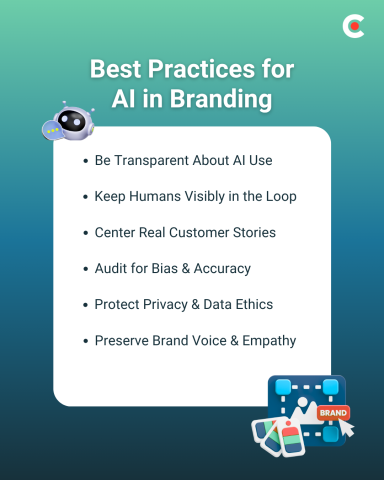
Treat disclosure as part of your brand messaging. Customers don't want surprises when your assets are AI-generated, so use simple labels on AI chatbots and photos. Offer an opt-out where feasible, such as "Talk to a person" in a chatbot. Or provide a setting that lets users turn certain AI features off.
Transparency can be a brand asset. Dove publicly pledged not to use AI to represent real women in its advertising and paired that stance with a creative playbook. The brand's transparency regarding its AI use policy received positive media coverage.
Adopt and maintain a consistent AI disclosure policy. Always label synthetic assets and outline the review process across the organization. Share that policy publicly so it stands as a commitment rather than a case-by-case exception.
AI should support your team, not replace it. For example, in customer service, some tasks are still better handled by humans, and the handoff itself is a trust signal.
A mix of AI and human touch can be the answer to resolving customer pushback. The bot can answer simple questions and gather basic details. When a request is complex, the conversation can move to a person.
For creative work, treat AI output as a draft. Keep humans in charge of final edits and approvals, and credit them where appropriate. Bylines, team pages, founder content, and behind-the-scenes posts all double as "visible humanity" signals — the kind 36% of consumers tied directly to their brand loyalty in our June 2026 survey.
Real-customer stories beat polished creative on memorability. In Clutch's June 2026 survey, 49% of consumers ranked real-customer-story campaigns as the most memorable format of all — ahead of high-production ads, influencer content, and brand-produced creative. The format AI is least able to fake is the one consumers most remember.
Practical moves that operationalize this finding:
Make quality checks part of production. Build a simple workflow for AI outputs that flags risky claims and legal issues. When your systems summarize or answer questions, test accuracy against a known source of truth and track error rates. If the model cites a data point, click through and confirm. If the content references real people, verify the info.
You can also test how AI use affects perception across your ads. If suspected AI content around your ads drags down conversion, consider reducing spend or tightening standards for where your AI-generated content appears.
Customers want help, not surveillance. Keep personalization to a minimum and explain why someone sees a recommendation. Offer controls to turn features off.
Transparent data practices show what your brand stands for and go beyond basic compliance. Publish a plain-language note that answers three questions.
Review the terms of third-party vendors to confirm training rights and retention policies before handing over creative or customer data.
AI for branding should sound like your team at its best. Create a style guide that covers brand voice and banned phrases. Maintain a library of approved examples and make your voice rules accessible to outsourced agencies as well.
When possible, keep creative roles human-led. Use AI to explore variations, but let writers and designers make the final decisions. The Marvel and Sports Illustrated examples show what happens when AI becomes the headline instead of the helper. People sense when a brand uses AI as a shortcut for tasks that a human actually handles better.
AI will be part of every marketing stack in 2027 and beyond. Enterprise adoption is climbing, consumer use is mainstream, and the production-quality floor keeps rising. At the same time, Pew Research Center reports that half of Americans now feel more concerned than excited about AI. The brands that win the next few years will be the ones that balance AI's efficiency with the human signals consumers actively reward.
Clutch's June 2026 survey makes the path forward concrete. When 36% of consumers tie loyalty to seeing real people behind a brand, and 49% remember real-customer stories above any other format, the strategy isn't to fight AI — it's to use AI for the work AI is best at (speed, variation, scale) and reserve human-led production for the signals that earn repeat business.
Five practical moves to start with:
When you implement practices like these, AI in branding enhances campaign speed and quality, rather than introducing risk. You can move faster and use your budget more efficiently without losing the human connection that earns loyalty. If your next campaign uses AI for branding, start with one question: would a reasonable customer feel informed and respected by this choice? If the answer is yes, ship it. If not, revise until it is.
Seeking the ideal partner for AI branding? Compare and choose from a vetted list of top AI consultants listed on the Clutch directory. Clutch helps leaders find the right B2B partners with verified reviews across marketing and creative services.
It can, but not inherently. Clutch's June 2026 survey of 408 consumers found 33% say AI worsens their perception of a brand while only 16% say it improves it — a clear net negative on perception. However, the same survey found that 36% of consumers cite "real people visibly behind a brand" as the strongest single driver of loyalty, which means brands using AI and keeping humans visibly central can avoid the loyalty penalty. AI hurts loyalty when it replaces visible human contribution; it doesn't hurt loyalty when it scales behind the scenes while humans front the brand.
Five rules: disclose AI use plainly, keep humans visibly in the loop, audit outputs for bias and accuracy, protect customer data with opt-outs, and preserve brand voice through editorial review. The single highest-leverage move is disclosure — Clutch's 2025 research found 90% of consumers want brands to label their AI use. Treat transparency as part of your brand messaging, not as a compliance afterthought.
Real-customer-story content. Clutch's June 2026 survey found that 49% of consumers rate real-customer-story campaigns as the most memorable format of all — outperforming polished creative, influencer content, and brand-produced ads. As AI raises the floor on production quality, formats that AI can't credibly fake (verified customer experiences, founder-led content, employee perspectives) become the differentiating signals. Build a recurring customer-story pipeline rather than treating it as an occasional case study.