
Task Automation: How to Cut Repetitive Work
Task automation saves time, gets work done faster, and reduces errors. Learn how to automate repetitive tasks step-by-step and how to decide what to automate.
Updated September 29, 2026

You may not even realize how many of the “influencers” you see on your social media feeds aren’t even human. When it looks like a person, posts like a person, and partners with brands like a person, how can you tell the difference?
You know that social media feed you’ve carefully curated over months and years? If you take a closer look, you might notice something that slipped past you before: Your feed is now populated with creators who don’t exist in the real world. From Lil Miquela to Yang Mun to Lu do Magalu, AI virtual influencers are shilling products, leading marketing campaigns, and engaging audiences with their social media posts.
AI influencers may have moved from the novelty stage to the mainstream, but consumer trust has not made the same leap.
Looking for a Artificial Intelligence agency?
Compare our list of top Artificial Intelligence companies near you
In August 2026, Clutch surveyed 601 consumers regarding their opinions about AI on social media. Most respondents (86%) said they have encountered AI-generated content in their feed, and the majority believe they can tell the difference when they see it.
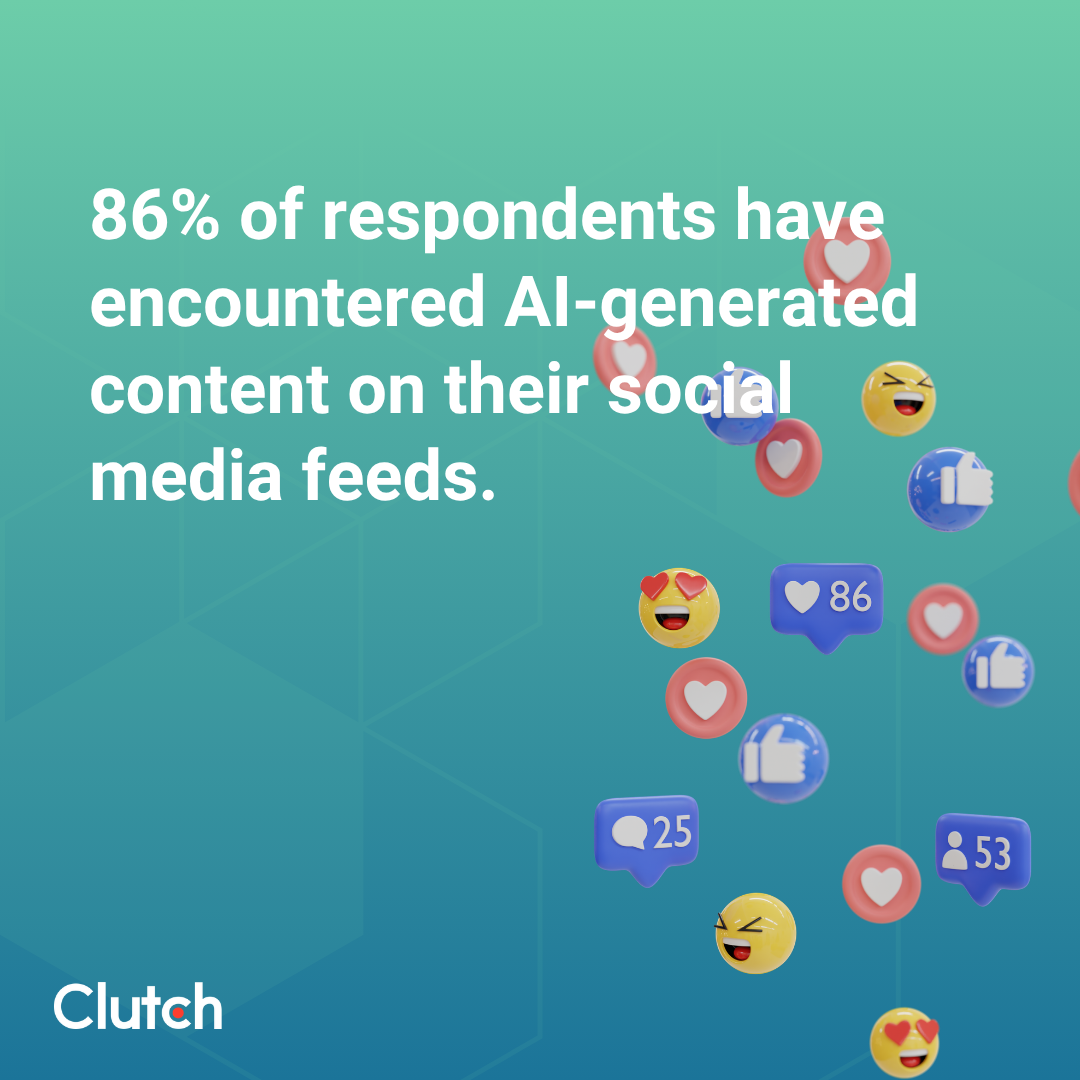
However, their confidence is less reliable than it sounds. Many people who feel certain they can spot an AI influencer still engage with one without realizing it.
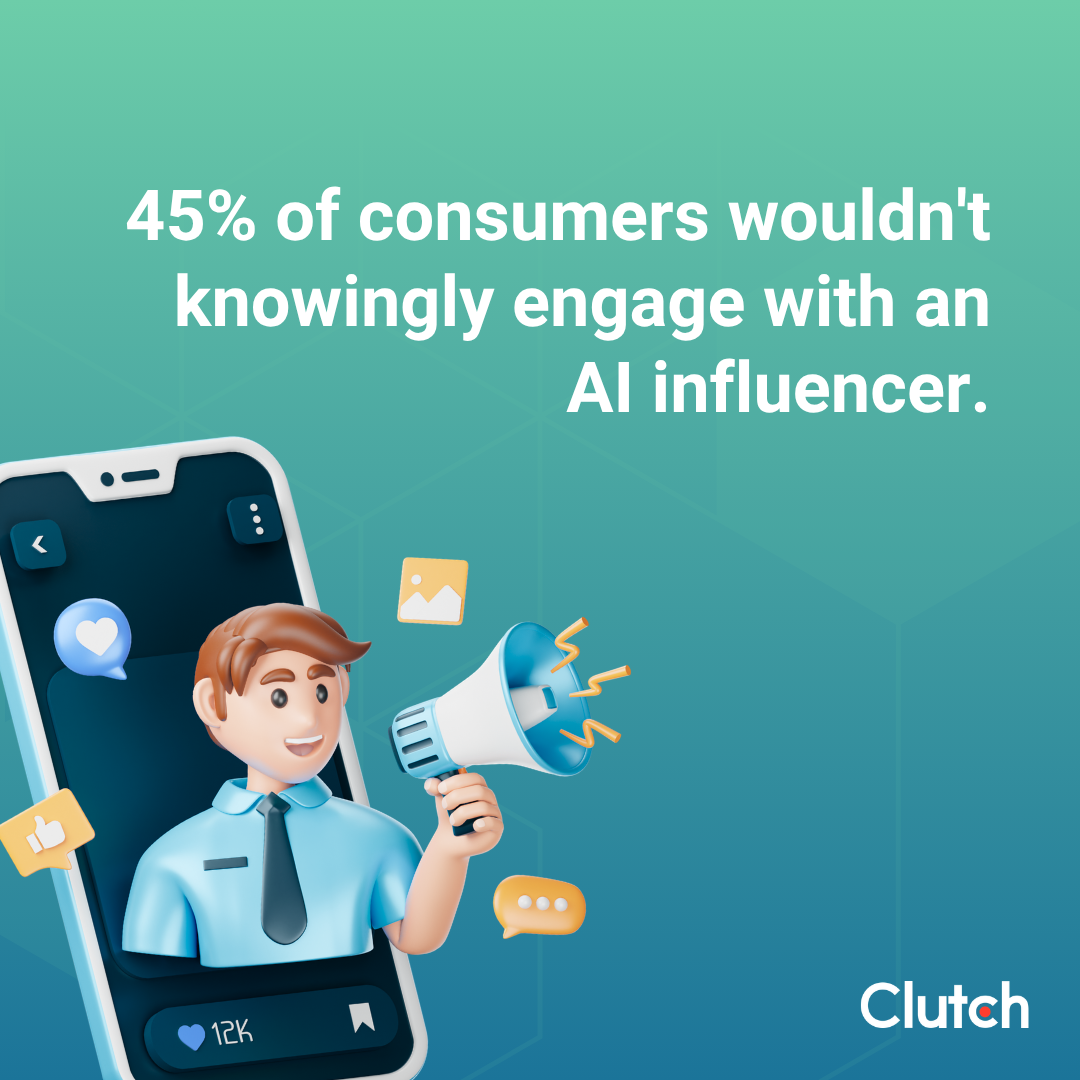
That’s the disconnect we’re examining. If you ask people if they think they can identify an AI influencer, most will say yes with conviction. Ask those same people if they’d trust a product recommendation from one or knowingly follow one, and their confidence evaporates –45% of consumers would not. Recognizing something as artificial, as it turns out, is nowhere near the same as feeling comfortable with it.
An AI influencer is a fully or partly computer-generated persona that operates a social media presence the same way a human creator would, posting content, building a following, and partnering with brands for sponsored deals.
Whether someone calls them an AI influencer, virtual influencer, AI-generated influencer, synthetic creator, or computer-generated influencer, these are interchangeable and mean the same thing: someone who doesn’t exist as a physical human being but runs a social media account.
We should point out, however, the distinction between “virtual” and “AI-generated,” although the two labels blur together colloquially. A studio built Lil Miquela, a virtual influencer, primarily using CGI and animation, directing her heavily frame-by-frame. An AI-generated influencer, in contrast, relies on generative tools to produce images, write captions, or draft replies with far less manual labor per post. Neither term is technically exact, and most creators under the “AI influencer” umbrella borrow techniques from both categories.
Coverage of AI influencers typically sorts them into three commonly cited types:
The category broadens as technology improves, so locking in a strict taxonomy is less important than recognizing that AI influencers span a range of online personas.
Mechanically speaking, how do AI influencers work? It starts with character work that most people never see. A marketing or development team creates a name, a backstory, a personality, and a visual identity, much like an author or movie studio would develop a fictional character for a novel or film. From there, a production team generates the visuals, using 3D modeling, CGI rendering, or generative image tools. Often, they layer in motion capture or facial mapping to give this hyper-realistic persona convincing movement and expression.
What makes an AI influencer seem “alive” has less to do with any individual post and more with volume. Natural-language tools draft captions, respond to comments, and in some cases carry on conversations with followers in near real time. A brand can push out dozens of posts every week without a human typing each caption from scratch.
Even though it’s AI-generated, this usually doesn’t run itself. Usually, a team of real humans oversees every AI influencer. Writing the strategy, planning the content, approving the posts before they go live, and managing the brand partnerships that pay the bills most often fall to actual people. The persona is the front end, or the face of the operation; a studio, an influencer marketing agency, or an in-house marketing team is the back end.
It comes down to operational economics. Fast production and low marginal cost per post, combined with technology democratization, explain why this content category grew as quickly as it did. With AI influencers, there are no location shoots to schedule, no travel budgets to worry about, and no rescheduling when the weather doesn’t cooperate. Any team can produce new content in minutes, write a caption in any number of languages without hiring multiple translators, and never worry about the persona aging, getting tired, breaking character, or having a bad day on (or off) camera.
Looking at virtually any social media platform, you’ll have plenty of opportunities to see what AI influencers are up to. The category has spread beyond fashion, as these AI influencer examples demonstrate.
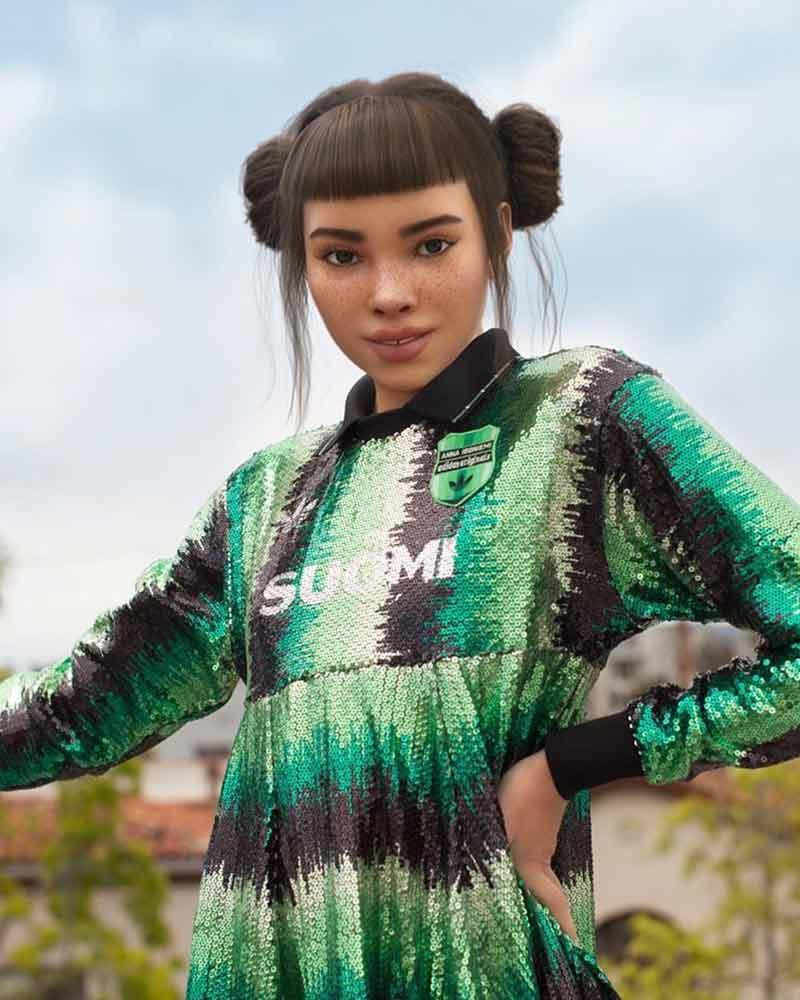
The reference point for the entire category, the virtual influencer named Miquela Sousa (better known as Lil Miquela) launched in 2016 and has since signed brand deals with major fashion houses. She has amassed millions of followers, essentially writing the playbook that everyone who followed her has followed.

A Spanish AI model created by The Clueless agency, Aitana Lopez offers possibly the clearest monetization story in the space. Her creators have been open about earning income from brand partnerships built entirely around a persona with no human body attached.

Lu do Magalu, the mascot-turned-influencer for Brazilian retailer Magazine Luiza, takes a different approach. She’s openly virtual from the start, never pretending she was anything but, and she still functions as one of the retailer's most effective marketing tools. She is also the world’s most-followed virtual influencer, with over 30 million followers across Instagram, TikTok, and Facebook.

Yes, there are even AI influencers in the spirituality sphere. Yang Mun, an AI Buddhist monk whose content features Buddhist guidance rather than product placement, shares ancient Eastern wisdom with his millions of followers across platforms.
Of these examples, some disclose their synthetic nature up front, some don’t clarify it either way, and their reach involves industries from apparel to fitness to religious content.
The appeal of virtual influencers has little to do with technology for technology’s sake. Brands have already decided what AI influencers are simply better at: avoiding the pesky mistakes and potential disgraces human influencers can bring to the table. An AI persona never has an off-brand moment, never gets caught up in a scandal that damages a partnership overnight, and never needs to renegotiate a contract because their life or circumstances have changed. The brand maintains total control over messaging.
Output volume is another reason brands seem to flock to AI influencers. A brand using a synthetic persona can produce and post around the clock, adapt content for multiple markets and languages without hiring separate creators for each region, and scale a campaign up or down without the logistics of coordinating a human creator’s schedule. On the economic side, no travel, no location fees, and no reshoot budget mean lower production costs.
Marketing teams, when weighing an AI influencer against a human ambassador, often frame it as a trade-off between control and authenticity, a framing that data backs up. Total control over brand messaging is worth a lot internally — right up until the audience discovers the persona is synthetic and refuses to believe anything it says.
Fifty-seven percent of consumers told Clutch they’re confident they can identify AI-generated content when they see it. Most people believe that recognizing synthetic content is a problem they’ve already solved for themselves.
The figures become harder to trust when you stop relying on self-reporting and examine behavior. AI influencers are specifically engineered to blur the line between synthetic and real, and plenty of that content slips under the radar of even the most confident users.
Now, consider that about 30% of consumers in our survey said they’ve encountered unlabeled AI content at least 20 times in the past month alone. Put those two numbers together, and you’ll see the divide. People who feel sure they can tell are, by their own accounts, constantly encountering unmarked AI content.
Researchers point to a particular design problem: Even when a persona discloses that it’s AI, that label is usually buried a few taps deep in a bio, and feeds are made for scrolling, not for pausing to ask who is actually posting the content you’re seeing. A disclosure that requires you to stop, click through, and read carefully works against the exact behavior the platform is designed to optimize and even actively rewards.
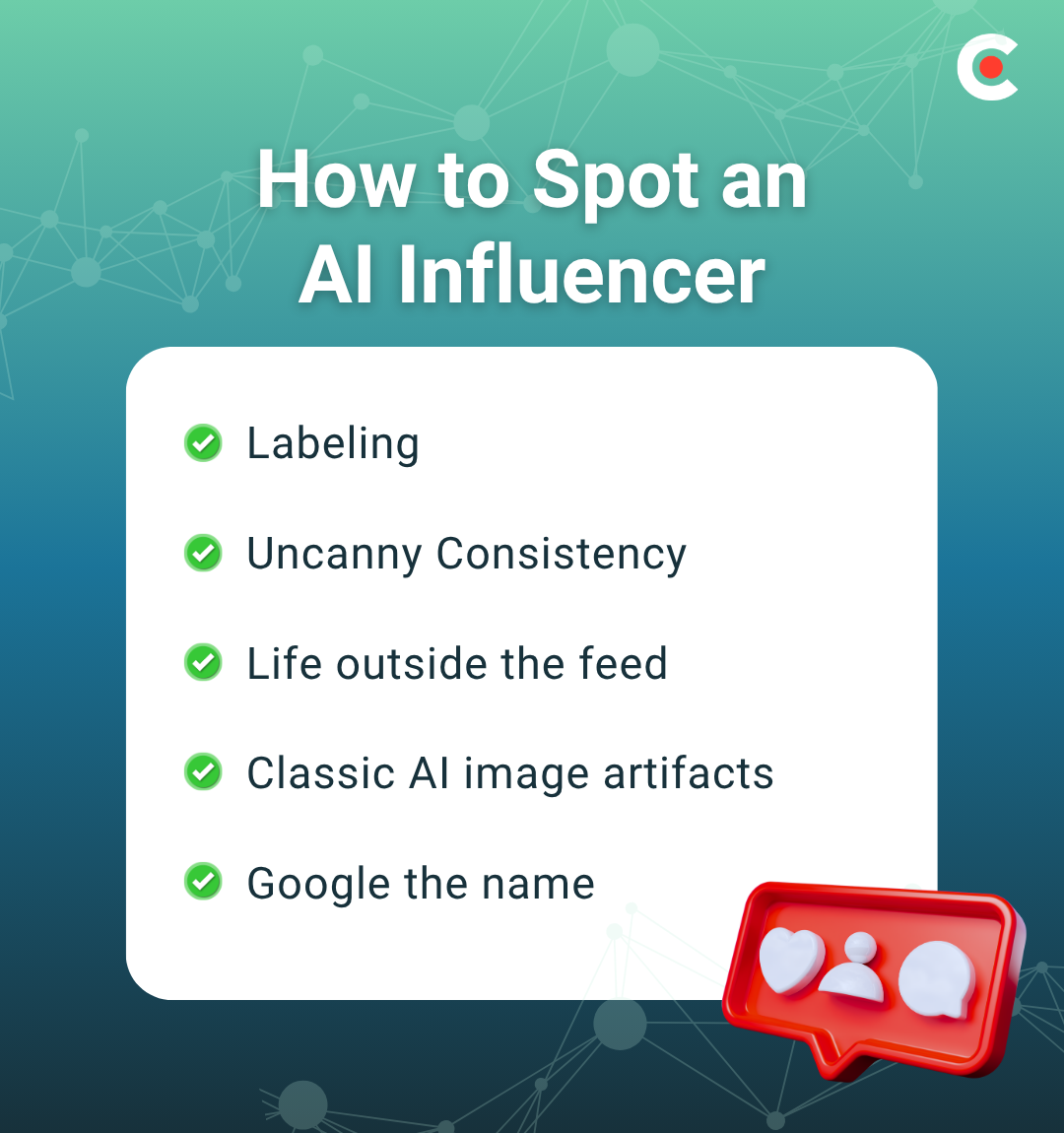
Knowing how to tell if an influencer is AI doesn’t require specific software or specialized training. These few tells make a synthetic persona easier to catch without any special tools:
None of these tells is foolproof, and AI technology is always improving. Still, think of these as habits that make you harder to fool, not a guaranteed test of a persona’s humanity.
Third-party tools also exist for this purpose and flag likely synthetic media, but their limitations mirror the manual checklist. They catch what they were trained to catch, but the generation tools on the other side continually adapt, so no tool or method will spot every AI instance without fail.
In our survey, 45% of consumers said they wouldn’t knowingly engage with an AI influencer. A separate 45% said they wouldn’t trust a product recommendation from one. Even the 57% who feel confident about spotting AI don’t feel reassured by it. Recognition and comfort are two vastly different concepts, and the ability to identify an AI influencer doesn’t translate into a willingness to follow it or take its advice.
The reason ties back to what a recommendation is at its core. A human creator’s endorsement implies lived experience: They tried the product, wore the outfit, or tasted the food, and that experience shaped the opinion they’re sharing. An AI influencer has no experience to draw on — only outputs generated to resemble it. When consumers sense AI in the mix, they question whether any of that experience is genuine, the recommendation stops carrying the weight it otherwise may have, and the consumer’s trust grows ever more fragile.
Fortunately, AI disclosure is moving from an etiquette question to a legal compliance issue. The Federal Trade Commission (FTC) and Meta, the company that owns Facebook, Instagram, and other platforms, now expect disclosure when an endorser isn’t a real person. For now, personas that remain undisclosed or bury their disclosure remain perched on the sharpest edge of the trust problem.
Spotting an AI influencer is only half the challenge. The other half — the one that brands can’t design their way around — is whether people will accept one once they know it’s AI.
AI influencers, once a digital novelty, are now a mainstream presence in your everyday social media feed. Humans build and direct these synthetic personas, and as technology improves, they’re becoming harder to distinguish from genuine human creators.
As our data show, recognition and comfort differ markedly when it comes to virtual creators. Even though 57% are confident they can spot AI content, 45% wouldn’t knowingly engage with an AI influencer, and 45% wouldn’t trust an AI influencer’s product recommendations. It’s understandable, considering recommendations revolve around lived experience.
What are AI influencers and the brands behind them facing in terms of consumer trust? As virtual creators multiply, the deciding factor won’t be whether audiences can tell that the persona is synthetic but whether those brands are honest about it. Realism is important, but transparency is what earns the benefit of the doubt.