AI Coworkers Are Answering the Questions We’re Too Embarrassed to Ask
Workers are now asking AI questions they used to ask their coworker. But how does that impact company culture?
Updated November 5, 2026

Companies are getting better at controlling what AI agents can access. The harder challenge begins after access is granted: deciding what those agents are allowed to decide, how that authority moves across systems, and who remains accountable for the outcome.
When it comes to AI agents, access is often one of the first things teams figure out. They spend time on identities, permissions, API scopes, and the systems an agent should be able to interact with.
The ambiguity usually appears later, when the agent starts using that access to make decisions. At that point, the question moves beyond whether the agent was allowed into a system. It becomes a question of whether anyone explicitly decided what judgment the agent was allowed to exercise once it got there.
Looking for a Artificial Intelligence agency?
Compare our list of top Artificial Intelligence companies near you
The gap appears when access turns into judgment.
A typical agent workflow might involve a CRM, an ERP, a service platform, and internal data sources. The agent gets the customer’s history, checks the relevant policy, makes a decision, updates the record, and starts the next step in the process.
The result can still be wrong. The policy may be incomplete. An exception may not have been considered. Or several actions that are individually allowed may combine in a way the business never intended.
I think of this as the difference between system authority and decision authority.
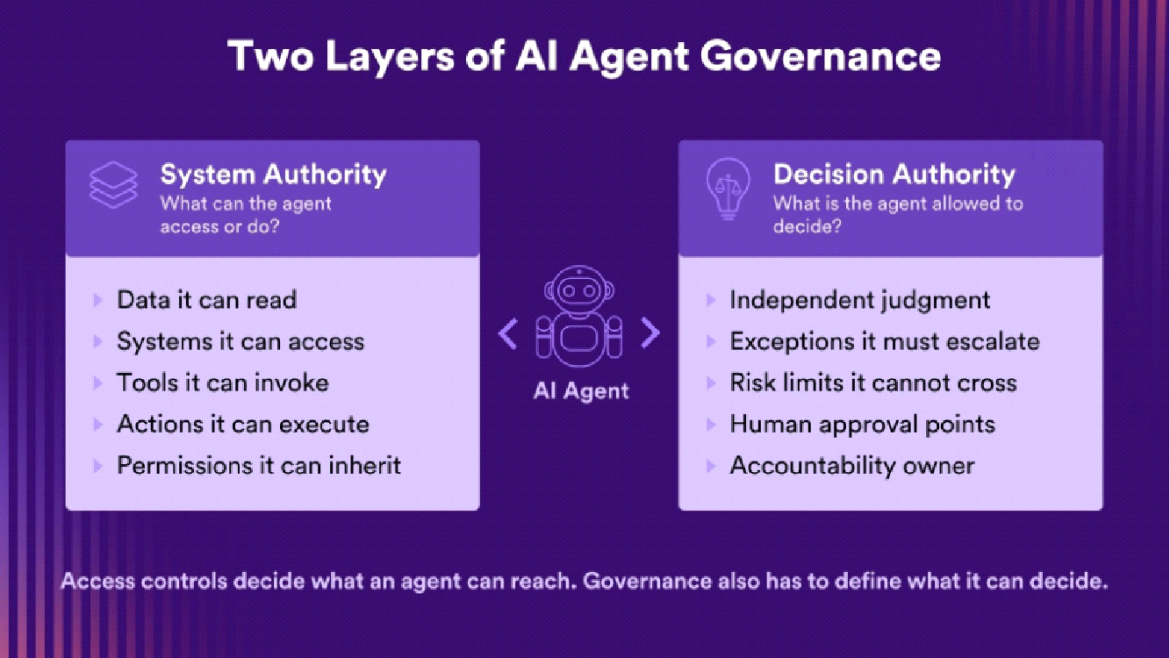
System authority defines the data, applications, tools, and actions an agent can access. Decision authority defines the business judgment an organization is prepared to let an agent exercise without further approval.
Enterprises have years of experience governing the first, but not so much for the second.
In OneTrust’s 2026 survey of 1,200 senior business decision-makers across eight markets, 87% said their organizations encouraged AI-agent use, while only 47% said clear governance, oversight, and controls were in place. Just 5% reported clear coordination and accountability across the AI lifecycle.
The issue is not simply that adoption is outpacing governance. Organizations are assigning work to agents before they have fully settled who holds the authority for that work.
Access control can determine whether an agent may retrieve customer history, modify an account, or call a downstream system. It can also enforce hard limits around what the agent is allowed to do.
What it cannot tell you is whether the business actually intended to delegate the judgment behind that action.
An agent may be fully authorized to adjust an account and still encounter a situation the policy never anticipated. There may be a recent dispute. Customer records may conflict with each other. Several routine actions may also become material when viewed together.
That is where the decision model matters. In some workflows, the agent should gather information and recommend next steps, while a deterministic rule or policy engine makes the final decision. In others, the agent can reasonably decide within defined boundaries and escalate unusual or higher-risk cases.
Human approval does not solve the problem on its own. If the person receiving the escalation does not have the context or authority to assess it properly, the organization has added another step without adding meaningful oversight. The governance model, therefore, has to define more than what the agent can do. It also has to make clear where the agent’s judgment ends.
The problem becomes grave once several agents and systems are involved in the same workflow.
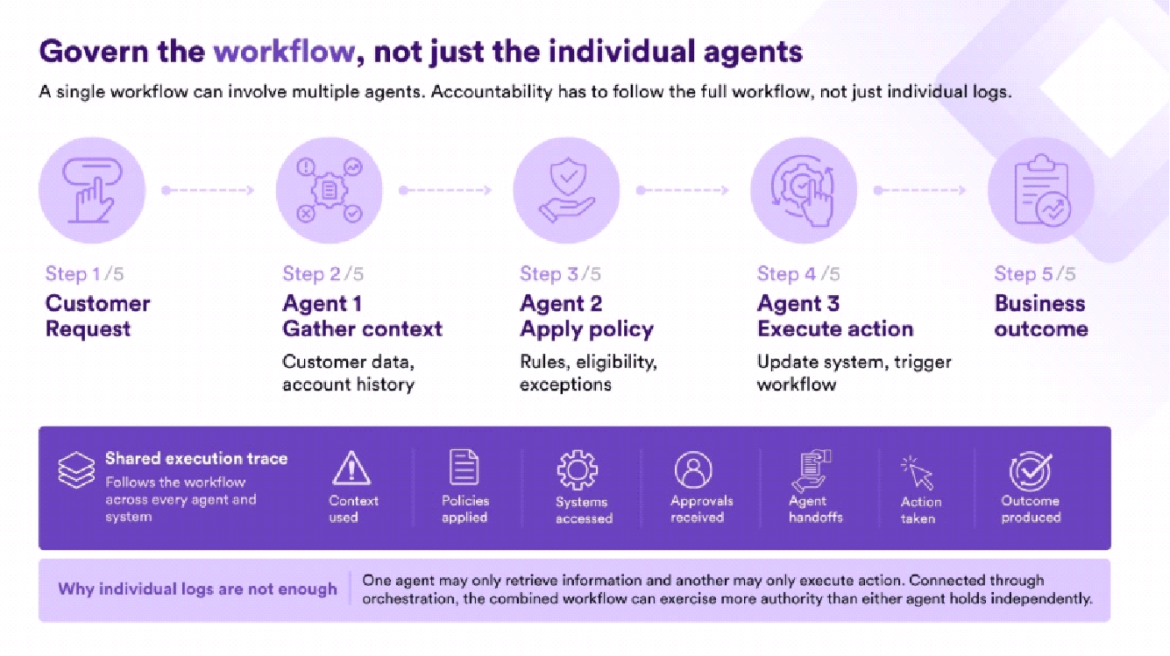
One agent may gather policy information. Another may inspect the account history. A third may execute the approved change. Each of them can have perfectly good logs, and the company can still struggle to answer a basic question later: how did the system arrive at this outcome?
That is why I think about the audit trail at the workflow level, not just at the individual agent level.
You need to be able to follow the work from the initiating request through the context the system used, the policies applied, the systems accessed, the approvals received, the actions taken, and the handoffs along the way.
I would design that trace before the workflow goes live. Waiting until compliance, audit, or an incident asks for it is usually too late.
I also would not describe this as capturing an agent’s private “reasoning.” That is not the governance record you need. What matters is the observable evidence around the decision: what information was supplied, which policy applied, what was authorized, which tools were invoked, and what changed as a result.
That record also has to survive the handoffs between agents.
This matters because multi-agent systems can create more authority than any individual agent appears to have on its own. One agent may only retrieve information. Another may only be allowed to update an operational system. Once they are connected through orchestration, the workflow can retrieve context, interpret it, and act.
So, looking at each agent independently is not always enough. You also have to understand what the full system can do once those capabilities are combined.
We see this in agent programs at Simform when workflows start crossing enterprise data, applications, APIs, approval logic, and downstream processes. The harder governance questions often appear at those boundaries rather than inside the model itself. It is a pattern we also see when building agentic systems for production.
Early agent implementations often start with very different access needs. One workflow needs customer data. Another needs internal documents. The next may need access to an ERP or service platform.
That can be manageable when there are only a few agents. It becomes much harder to govern as the number grows.
At that point, the organization needs a common baseline for how agents access and use enterprise data. That includes identity standards, restricted data classes, read and write limits, approval requirements, credential handling, retention, revocation, and rules for cross-system actions.
Individual agents can then inherit those controls and receive only the additional access their role actually requires.
That creates consistency without flattening everything into a single permission model.
There is an important distinction here. The baseline governs access. Ownership of the decisions made with that access still belongs to the business process.
This is where agent governance moves beyond technical controls.
A production agent needs clear ownership on two sides. Someone has to be responsible for how the system operates, and someone has to be responsible for the business decisions the agent is allowed to make.
Those are not always the same people or teams.
Technology may own how the agent operates, how it connects to other systems, how the technical controls are enforced, and how reliability is maintained. Data and business leaders may own the information and decisions the workflow relies on. Security, risk, legal, and operations may also have a role depending on the process.
The important part is that these responsibilities meet at the workflow level rather than being governed separately.
Otherwise, you can end up with a well-controlled agent and still have no clear answer when it reaches a situation nobody expected.
The escalation path cannot be ambiguous. Someone needs the authority to intervene when the workflow no longer behaves as the organization intended.
That means being able to narrow access, reduce autonomy, pause the workflow, or disable the agent when the risk profile, workflow, or business conditions change.
Governance is only useful if the people accountable for the system can actually act before the same problem repeats.
I do not think an organization needs to solve every enterprise governance question before its first agent goes live. But there is a minimum set of controls that should already be in place.
The agent should have an explicit identity. Permissions should be narrow. Actions should be traceable. Escalation paths should be clear. Technical and business ownership should already be defined.
Production then gives you evidence that a design review cannot fully provide. A live workflow may expose an exception nobody clearly owns, a handoff that loses important context, or a combination of agents that creates more authority than expected.
I would start with a bounded production workflow, watch where accountability becomes unclear, and use those findings to strengthen the wider governance model.
The goal is not to invent governance in production. The controls should already be there. Production simply gives you better evidence about where those controls are too loose, too restrictive, or incomplete.
Before giving an agent meaningful autonomy, I would pressure-test five things.
Be explicit about what the agent can decide independently and where approval or escalation becomes mandatory. Some situations should go to a person. Others may need a deterministic rule, an approval step, or another system to make the final call.
Limit the data, tools, systems, and actions available to the agent to those it actually needs to perform its work. A connected system should not automatically become a capability that the agent can use.
Make sure you can reconstruct what happened across the workflow. Preserve the context used, policies applied, systems accessed, approvals received, agent handoffs, and actions taken.
Assign ownership for both sides of the workflow: the technical controls around the agent and the business decisions being delegated to it. Those responsibilities may sit with different teams, but they need to come together at the workflow level.
Some governance gaps only become visible when a workflow is operating under real conditions. When they do, use those findings to tighten policies, permissions, escalation paths, and ownership before the same issue appears elsewhere.
Not every agent needs the same level of governance.
An internal knowledge agent that helps employees find information should not face the same governance burden as an agent that changes orders, approves exceptions, or triggers financial processes. The level of control should follow the level of authority being delegated.
As agent platforms mature, enterprises will get better at controlling identity, access, observability, policy enforcement, and lifecycle management.
Those controls are important, but they mainly answer a technical question: what can the agent do?
The harder question belongs to the business: how much judgment are we actually willing to hand over?
Once an agent can act without another approval, that boundary needs to be explicit. Which decisions can it make? What conditions require escalation? Who steps in when the case falls outside the expected path? Who remains accountable for the outcome?
Clear boundaries do not reduce useful autonomy. They make it safer to extend because the organization knows where the agent’s authority begins and ends, and who takes over when the workflow moves beyond those limits.