
Is AI Creating Organizational Silos? And What to Do About It
What does it look like when AI creates organizational silos? Learn the signs and tips to improve team communication with Clutch.
Updated November 24, 2026

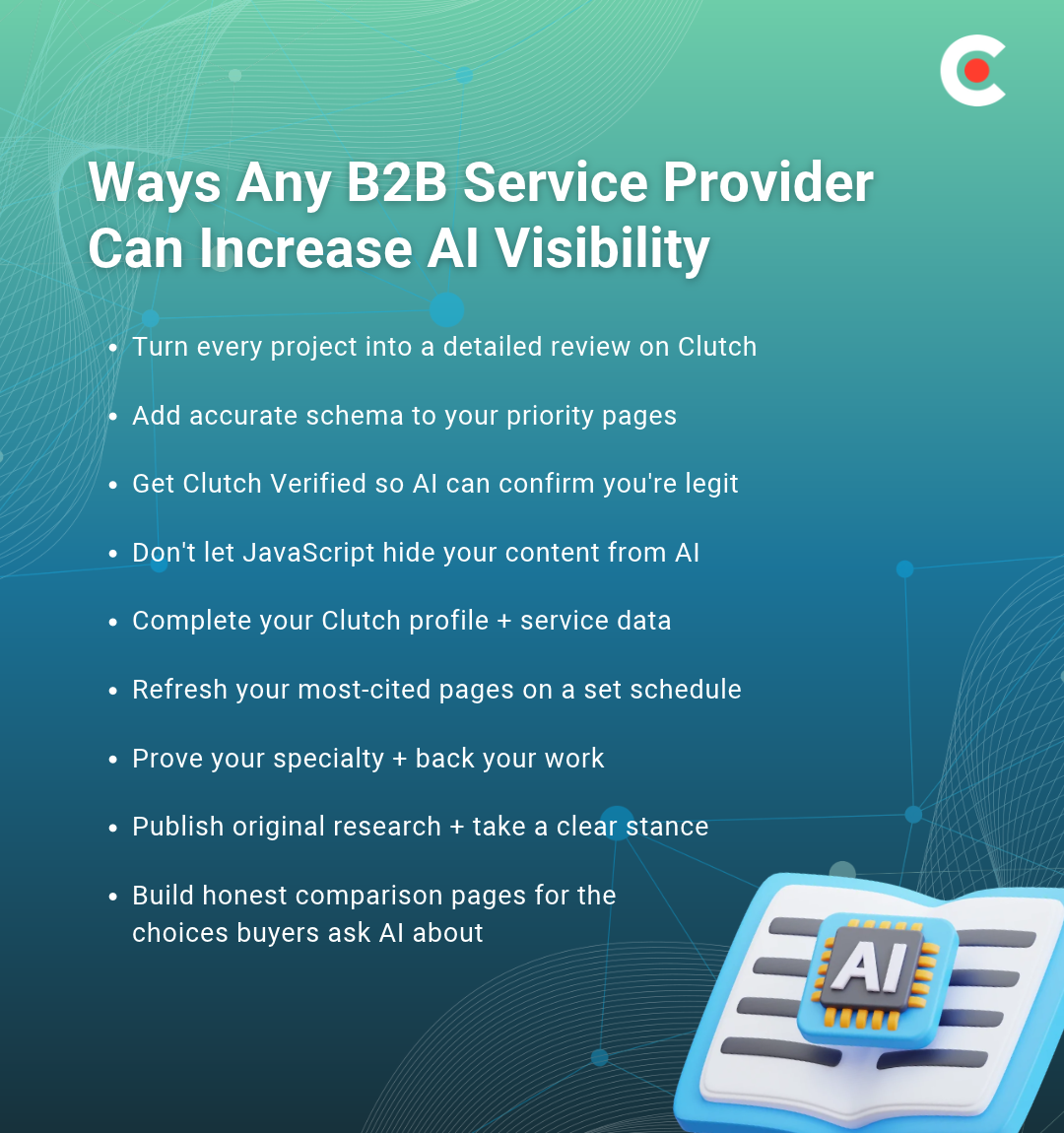
B2B buyers now ask AI for a shortlist before contacting a service provider directly. Clutch and Conductor teamed up on the ten tactics to help your business show up in those AI answers.
A small business looking for a web designer used to search Google, open a few tabs, and build a shortlist by hand. Now, many start by asking an AI assistant of their choice, and the shortlist comes back within seconds. By the time the buyer visits a provider’s website, the first cut has often already been made, and the providers left out may never know they were in the running.
To give service providers a lesson in how to earn a place in those answers, Clutch partnered with Conductor, an AI search and content intelligence platform. That research shows AI engines look for corroboration. Your own website tells an engine what your firm says about itself. Third-party, verified signals tell it whether it is to be believed.
Looking for a Artificial Intelligence agency?
Compare our list of top Artificial Intelligence companies near you
AI engines draw on many kinds of sources, including company websites, review platforms, press coverage, listicles, and social media. The wording of the buyer’s question decides which of those get weight. When buyers frame prompts around proof (with phrases like “based on reviews”), a review platform appears in roughly two-thirds of answers across ChatGPT, Gemini, and Claude. When buyers don’t ask for proof, engines also cite providers’ own websites, agency-published listicles, and Wikipedia.
You can’t control how buyers phrase the question, so you need to show up across the sources engines trust. This guide covers the two you control most directly: steps from us for your Clutch profile and steps from Conductor for your own website, along with a checklist that pulls it all together.
Build review requests into your project routine so your profile keeps gaining recent feedback. Ask about a meaningful milestone, a launch, or the final wrap-up. Send the request to the client-side decision-maker, who can describe what you delivered, how the engagement went, and what changed for their business.
Our team checks the reviewer’s identity and work history using information from their submission and independent research. If there’s too little information to confirm the reviewer or the project, we will likely follow up for supporting details.
If you’re Clutch Verified, Review Enrichment can speed up this process. You supply the project details, your client confirms them, adds a rating and feedback, and submits, reducing the 30-minute process to about 5–10 minutes.
Reviews had the strongest relationship with AI citations among the profile factors we studied. Among providers that had earned at least one citation during the study period, those with 50 or more reviews averaged roughly 27 times as many AI citations as those with zero reviews. Keep asking as projects reach milestones so your profile shows both the depth of your experience and the work you’re doing today.
Schema gives AI engines explicit labels for who you are (Organization), what you offer (Service), and who’s behind your content (Person). Start on the homepage with Organization, WebSite, and WebPage. Give each a distinct @id and reuse those IDs consistently wherever you reference them. Add sameAs links to official profiles, including your Clutch profile, to help engines connect your site to the third-party proof you built in Part 1.
Next, add Service markup to each service page. Define each offering separately, identify your organization as the provider, and specify the areas you serve. That gives the engine clearer information to work with when someone asks for the “best managed IT provider for healthcare in Chicago.” Use Person for team and author bios, Article for case studies and insights, and FAQPage wherever readers can see an actual FAQ.
Keep the markup aligned with the visible page and revalidate it whenever you add, change, rename, or retire a service. Schema makes your content easier to interpret and attribute; citations still depend on what the engine selects for a given answer.
AI assistants look for proof that a business is real before recommending it. Clutch Verified gives them that proof. Clutch checks your business registration and legal status and reviews your business and financial history, which usually includes a CreditSafe business credit check. Once you pass, a Verified badge appears on your profile, visible to buyers and AI assistants alike.
“Buyers are handing the first round of vetting to AI, and AI doesn’t take a provider at its word. It looks for a third party to back up what your website says,” said Greg Carter, VP of Marketing at Clutch. “Reviews make the case for your work. Verification answers the more basic question: are you a real business, and has someone checked?”
Verified profiles also earn 2.1x as many clicks on Clutch as profiles that aren’t verified.
If you’re deciding where to start, verification is one of the lowest-cost ways to show your business is legitimate.
Most AI crawlers read the raw HTML your server sends on the first page load and skip running JavaScript. Open your priority pages with JavaScript turned off. If a service description, client result, or pricing detail disappears, move that information into the server-rendered HTML.
Check testimonial carousels, filterable case study libraries, tabbed service pages, and pricing calculators first. Keep the interactive features and make the underlying facts available on the first load.
“A lot of B2B firms have great websites that AI engines can barely read. If your service pages, case studies, or pricing only load through JavaScript, most AI crawlers never see them. The fix isn't a band-aid; it's getting your critical content into raw HTML and adding complete schema. Treat it as table stakes. It's the cost of doing business in AI search,” said Patrick Reinhart, VP of Services and Thought Leadership at Conductor.
A buyer asking about typical project costs or results in their industry may get a recommendation for a competitor whose site makes those answers easier to find.
A buyer might ask for a Phoenix SEO agency that works with B2B SaaS companies and can take on a $10,000 project. An AI assistant can match you to that request more easily when your profile spells out the services you offer, the clients you work with, and the budgets you can accommodate.
Fill in your service lines and the percentage of work each represents, the industries and client sizes you serve, your rates and minimum project size, your locations, and other team details. Then back up your main services with portfolio examples and case studies that explain the client’s problem, what you delivered, and the outcome. Where you can, pair each one with a verified client review for the same project, so a buyer or AI assistant can see your account of the work alongside your client’s.
A page that earns AI citations today can lose them next quarter if a competitor gives a more current answer. That matters for service providers because buyers ask what’s true now. They want to know what you charge, what your team can deliver, and whether you’ve done similar work recently. A service page that still lists a retired offering gives an engine outdated information to repeat.
Set a quarterly review for pages that already earn citations or drive leads. Start with your top service pages, guides, and research. Replace stale stats and examples, update pricing ranges and team details, and add recent client results where they help answer a buyer’s question.
If your strongest case study is from 2022, add a more recent project that demonstrates what your team can deliver today.
Change the displayed date only after a substantive update. Make sure dateModified reflects the actual revision and that the author markup matches the byline. The same habit applies to the Clutch reviews in Step 2. Recent evidence gives buyers a clearer picture of the work you do today.
Clutch Certified shows where you have review-backed expertise. You earn it automatically for a specific service or focus area when it accounts for at least 10% of your service mix and has at least 3 verified reviews rated 4.0 or higher in the past 24 months. Clutch evaluates each service on a rolling basis, so keep your service allocations accurate and check that your reviews are tagged to the work you’ve delivered.
The Clutch Guarantee gives buyers working with an eligible provider 100% of their initial project fees back when they cancel a covered new engagement in writing within the first 14 days. Clutch publishes your Guarantee status as machine-readable data, so an AI assistant assessing the risk of a new engagement can check whether you offer it.
Each signal gives an assistant a different piece of evidence to help your company be seen as a trusted resource. Verification establishes business legitimacy, certification confirms experience in a specific service, and the Clutch Guarantee shows how you back a new engagement. Together, they all help an assistant explain why you belong on a buyer’s shortlist.
Your firsthand data gives buyers and AI engines a reason to reference your firm by name. A generic “what is cloud migration?” guide covers ground dozens of content marketing teams have already covered. But an analysis of where your last 30 migrations ran over schedule answers a question buyers actually have and makes your firm the primary source for the finding.
Start with information you already collect. Look at anonymized client benchmarks, project outcomes, typical timelines, pricing ranges, or surveys of your own customers. Pick one question that data can answer and state what you found up front. Then explain how many projects or responses you analyzed, what time period they cover, and where the findings apply. Take a clear stance on what your buyers should do with that information.
Publish the key findings, methodology, and tables in crawlable HTML so an engine can find and attribute the numbers. You can offer a downloadable report alongside the page. For a smaller firm, a focused benchmark on a specific service can establish expertise even in a category dominated by larger publishers.
Buyers ask AI to weigh choices for them. They want to know whether to hire an agency or build in-house, how Firm A compares with Firm B, or which providers fit their industry. Start with the questions you hear on sales calls and build comparison pages around those decisions.
Use a real HTML table so readers and engines can access the same details. Compare pricing models, specialties, team size, and differences that affect the engagement, such as who owns implementation or how much work the client’s team handles. Say who each option suits, including when a competitor or an in-house team is the better fit. A balanced comparison gives an engine specific trade-offs it can pull into an answer and gives buyers a reason to trust the page.
Comparison prompts produce the most stable AI recommendations of any intent, according to recent Conductor research, so the company that earns that spot tends to keep it. The study measured consistency across repeated answers to the same prompts. A credible comparison gives AI your account of the trade-offs it might otherwise pull from third-party sites.
Track AI visibility separately for each AI assistant. Each engine finds and weighs sources differently, so the same firm can be a regular pick in one and missing from another. An overall average can hide that gap. Answers also shift from one run to the next, even within the same engine. Build a set of prompts your buyers would actually use, run each one several times, and track how often each engine recommends your firm over time.
On Clutch:
Give AI engines a specific, verifiable reason to recommend your firm. Your website explains which projects you’re the best fit for. Your Clutch profile gives buyers and AI assistants third-party evidence to check those claims.