Task Automation: How to Cut Repetitive Work
Task automation saves time, gets work done faster, and reduces errors. Learn how to automate repetitive tasks step-by-step and how to decide what to automate.
Updated August 25, 2026

B2B buyers used to search, scroll, and click. Now, AI-powered tools can provide a shortlist and then users can act on an answer. The question for businesses is no longer whether you rank; it’s whether the source behind AI’s answer can be trusted. Clutch is at the forefront of building the verified data layer AI relies on to recommend B2B services.
Not long ago, buying a B2B service meant searching, scrolling, and clicking your way through a list of links on Google. But B2B search is evolving.
Buyers now ask ChatGPT, Claude, or Gemini for recommendations and increasingly take the results into account before contacting a vendor, letting the AI answer suffice.
Looking for a Artificial Intelligence agency?
Compare our list of top Artificial Intelligence companies near you
Our own research shows that 56% of consumers believe that for a quick answer, an AI overview or snippet satisfies their need without visiting a source at all. Put those together and you get the uncomfortable truth for providers: the shortlist is being built inside the AI, often before you even know a buyer is looking. By the time a potential client reaches out, the field has already been narrowed, and whether you made the cut comes down to what the AI could find and verify about you, not what you told them yourself.
Our research on modern brand discovery also shows that nearly half of consumers believe AI tools and smarter search, which uses context and intent to deliver more relevant answers, are the single biggest force shaping brands in the future.
Verified, third-party trust signals are the backbone, and that’s where Clutch comes in.
Trust was always part of the buying decision; that isn’t new. What’s new is who does the work of establishing trust – AI.
And that one shift changes what “trust” even means in a buying decision. Trust used to be something a buyer arrived at on their own. Now it’s something a model has to establish on their own behalf. It doesn’t automatically trust a provider; it verifies one. The real deciding factor is the proof: the structured, third-party evidence that can be checked. Trust is what that proof produces.
Think about how this process used to go. Google handed you a page of links and pushed the verification back onto you: you opened dozens of tabs, read the reviews, clicked through portfolios, cross-checked, and then assembled a judgment yourself. The engine surfaced candidates, and then you did the vetting.
An LLM collapses that. It accepts the same evidence and returns a filtered set with the vetting already done. It puts together a response before the buyer sees any options. That decision doesn’t run on keywords or how much the provider markets itself; it runs on trust signals.
While self-promoting content can help, third-party signals like verified reviews and credentials are what verify that claim. The two work hand in hand, and the AI model leans hardest on the part it can confirm from outside sources because that’s the part that took someone else’s judgment to earn.
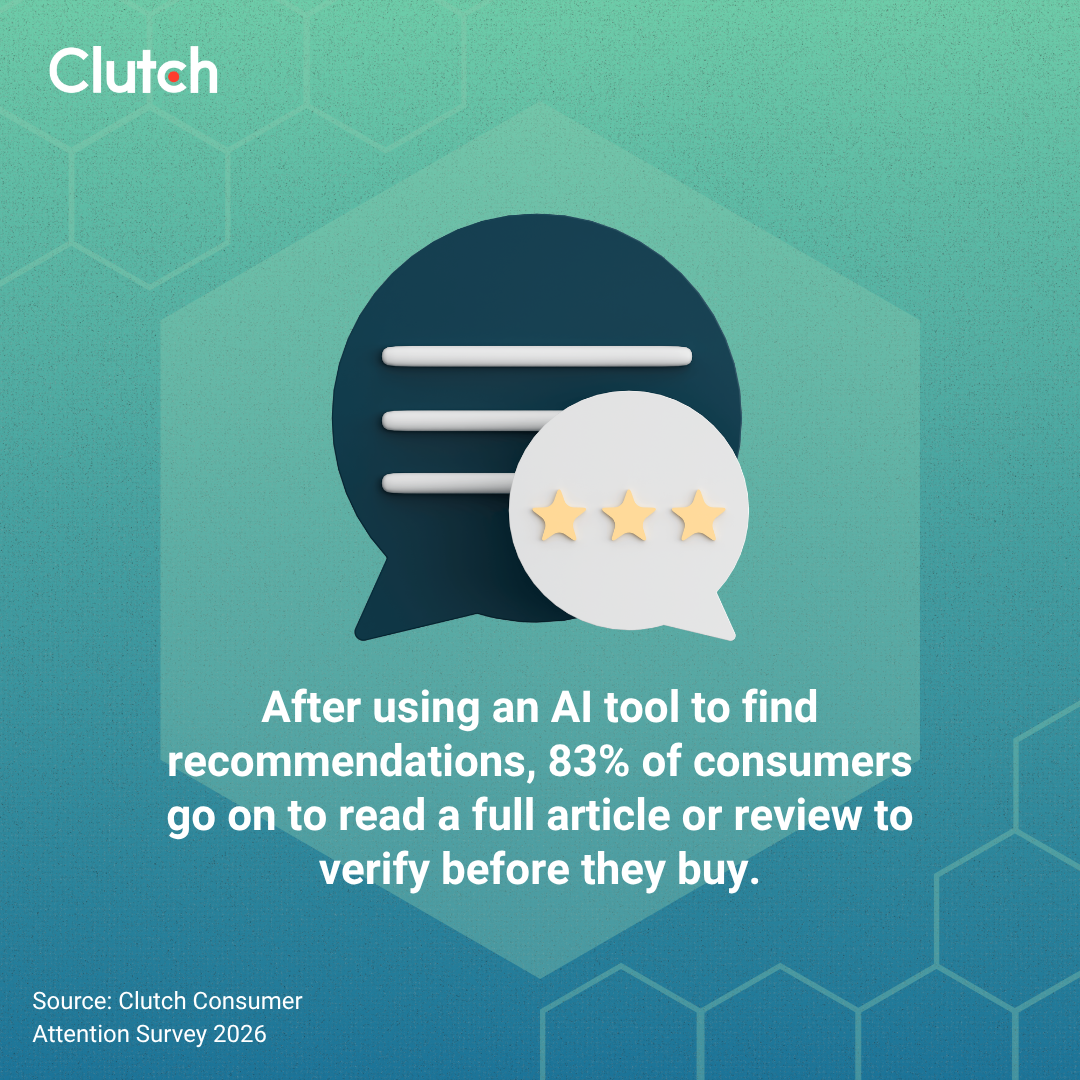
Buyers think the same way. They trust AI recommendations enough to act on them, but they still want proof. Our research on consumer attention showed that after using an AI tool to compare options or find recommendations, 83% of consumers go on to read a full article or review to verify before they buy.
The AI narrows the field; a trusted source closes the decision. That's what a citation to a source they already trust does — it turns an AI's suggestion into a decision they feel good about.
And it’s not just whether they verify when researching; it’s who they trust when they do. When our team surveyed consumers about how reviews shape buying decisions, the data showed that they trust reviews on established third-party platforms far more than those on a brand’s own website. When validation lives somewhere the provider doesn’t control, it carries more weight. That’s exactly the gap a third-party trust layer is built to close.
Here’s an easy way to think about it: every signal a provider leverages makes them more credible to an AI system. Clutch provides several trust marks for providers on our platform, turning third-party verification into something an LLM can rely on.
Because they're structured, third-party, and point in the same direction, reviews are the raw material an AI leans on most. Clutch has a lot of it: 241,000+ verified reviews across 440,000+ profiles (as of August 2026), spanning more than 140 services across 1,200+ locations. Whatever a buyer is looking for, the coverage exists, which means whatever they ask an AI tool, there’s verified evidence for it to pull from.
But reviews aren’t just social proof. Each one is a structured account of the type of work a provider actually delivered, the results it drove, and the type of client it served. The more comprehensively your reviews describe the full breadth of what you do, the more often an AI can connect you to the specific thing a buyer is asking for.
The volume itself moves the needle: going from zero reviews to even a single verified review nearly triples a provider’s average citations. Clutch profiles that rate excellent for AI visibility carry an average of 14x more reviews than untouched profiles. More verified reviews mean a more structured, trustworthy signal for a model to act on.
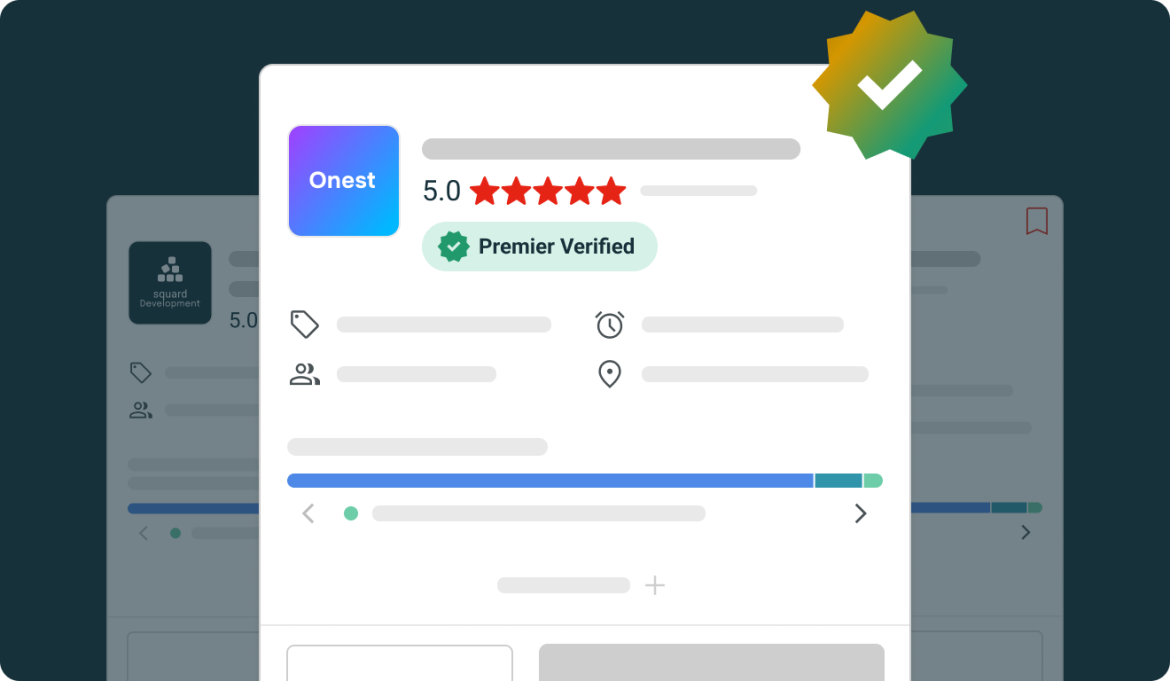
Before an AI recommends a provider, it needs to answer a basic question: is this a real, financially sound business? Clutch Verified settles that. It means a provider has cleared entity documentation, a CreditSafe business credit check, and more.
It's the baseline signal that everything else builds on.
Clutch Verified profiles earn 8.6x more AI citations and 2.1x more clicks than providers who aren't verified.
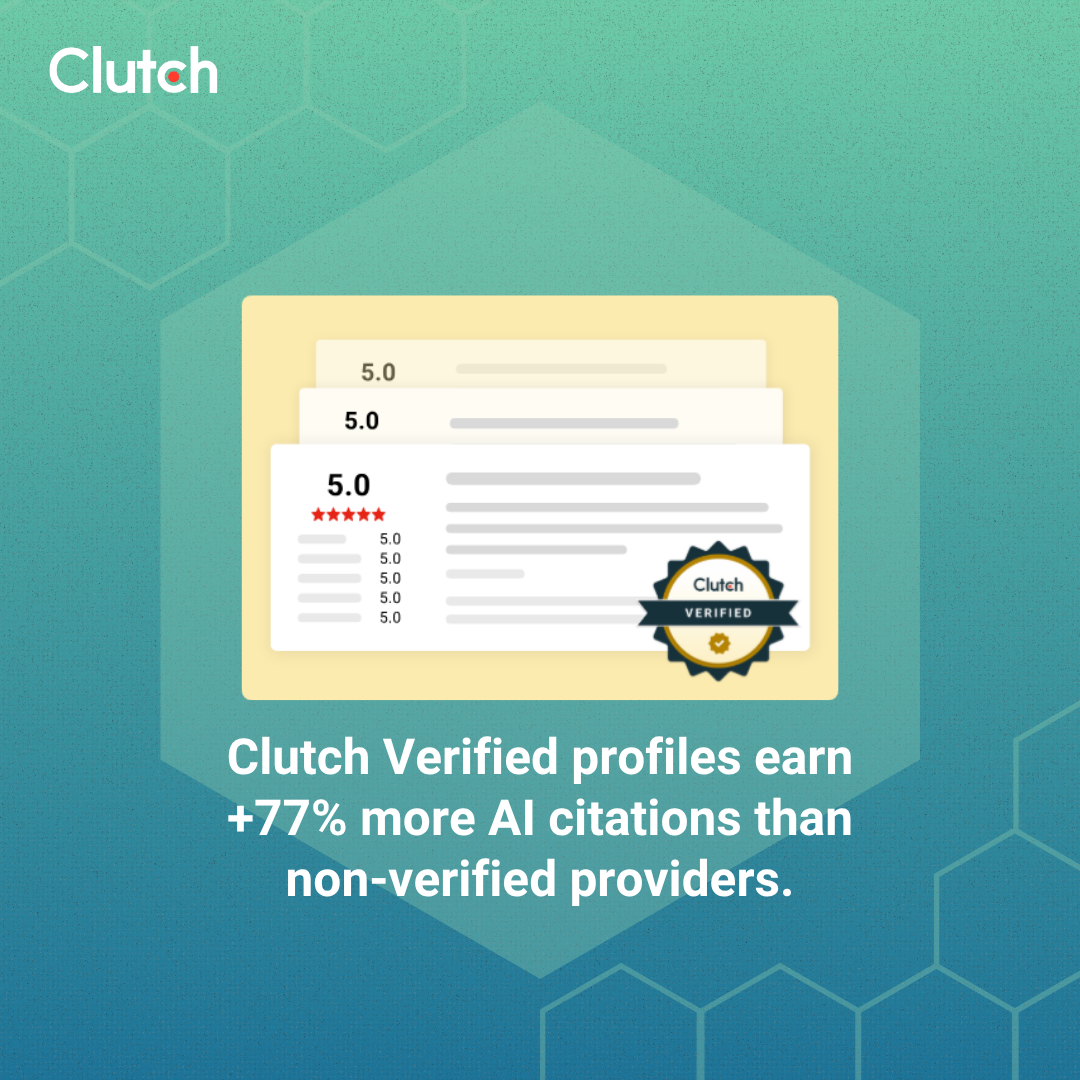
Even after isolating Verified from reviews and other factors, it still independently drives +77% more citations on its own. Of everything on a Clutch profile, reviews are the single biggest driver of AI citations.
Providers with 50+ reviews average roughly 27x more AI citations than providers with none.
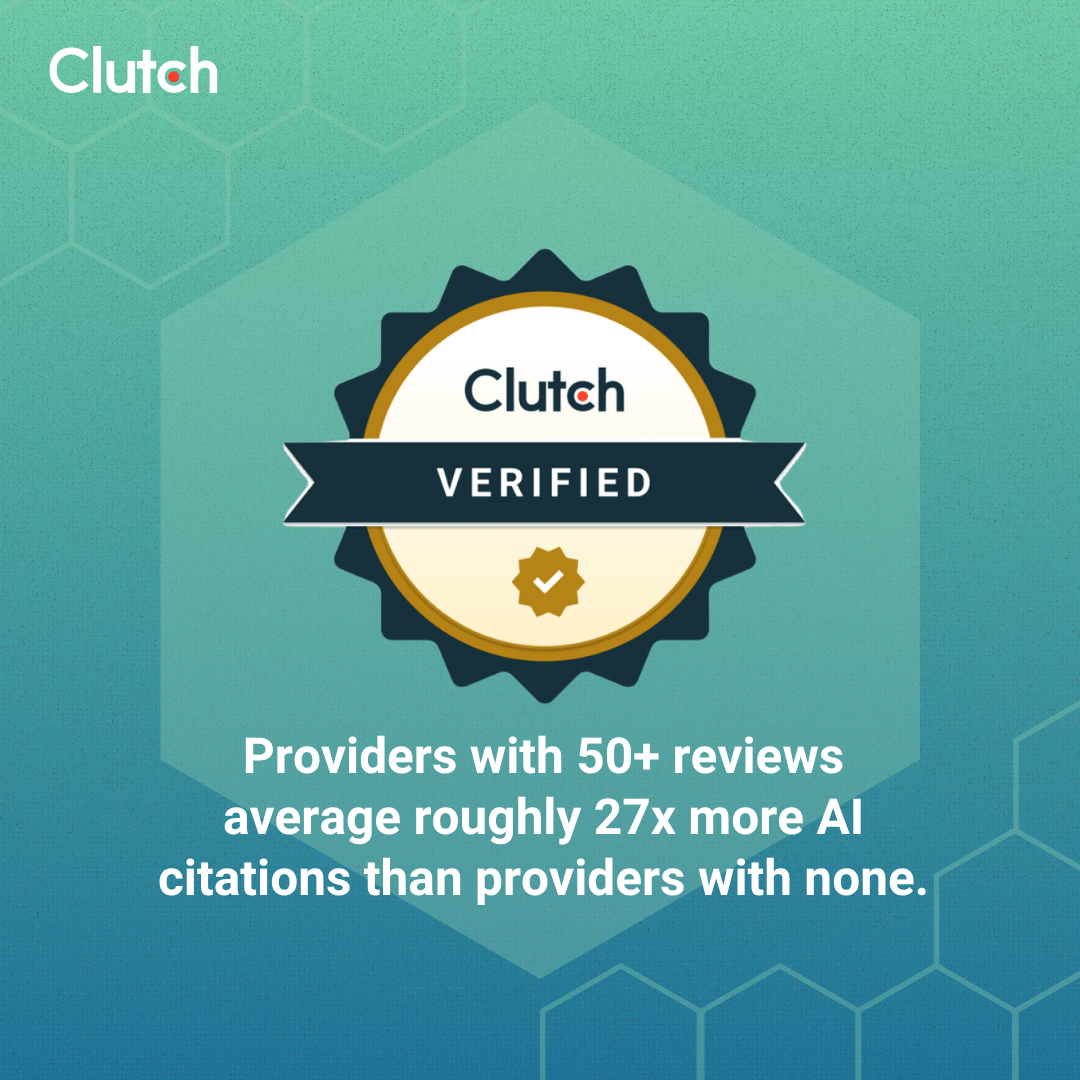
The more verified reviews you have, the more visible you get. Every additional verified review is one more piece of structured, trustworthy signal for AI models to act on.
Ready to get Clutch Verified? Learn more here.
Anyone can list a service. Clutch Certified proves a provider has demonstrated real, review-backed expertise in a specific service or focus area.
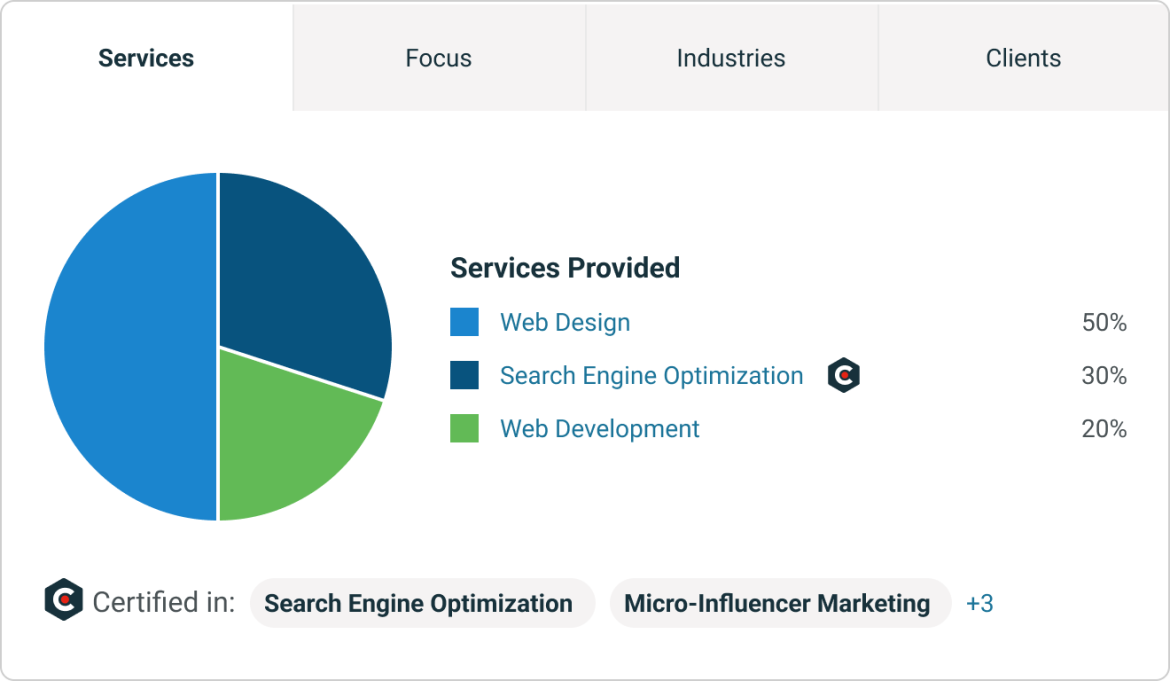
The criterion is specific: at least 3 verified reviews rated 4.0 or higher in the last 24 months, tagged to that service or focus area, plus that area making up at least 10% of the provider's overall mix. There's no application, no committee, and no fee — the distinction is awarded automatically and shows up next to that service on their profile.
The 24-month window also helps keep the distinction current as companies evolvie. Teams, strategies, and service offerings can change over time, so recent reviews help confirm that a provider is still actively delivering a service, rather than relying on outdated information.
It also helps distinguish between services a provider has actually delivered for clients and newer services they may list but haven’t yet had the opportunity to prove through client reviews. Because certification is evaluated per service and on a rolling basis, a provider’s distinctions can evolve with its current expertise and offerings.
Read the full breakdown on how Clutch Certified works and why it matters.
Clutch Guarantee is a 14-day, no-questions-asked, 100% refund of guaranteed fees on new engagements with eligible providers. It lets a buyer start with a new vendor at near zero financial risk. In other words, proof that a provider is willing to stand behind its work from day one.
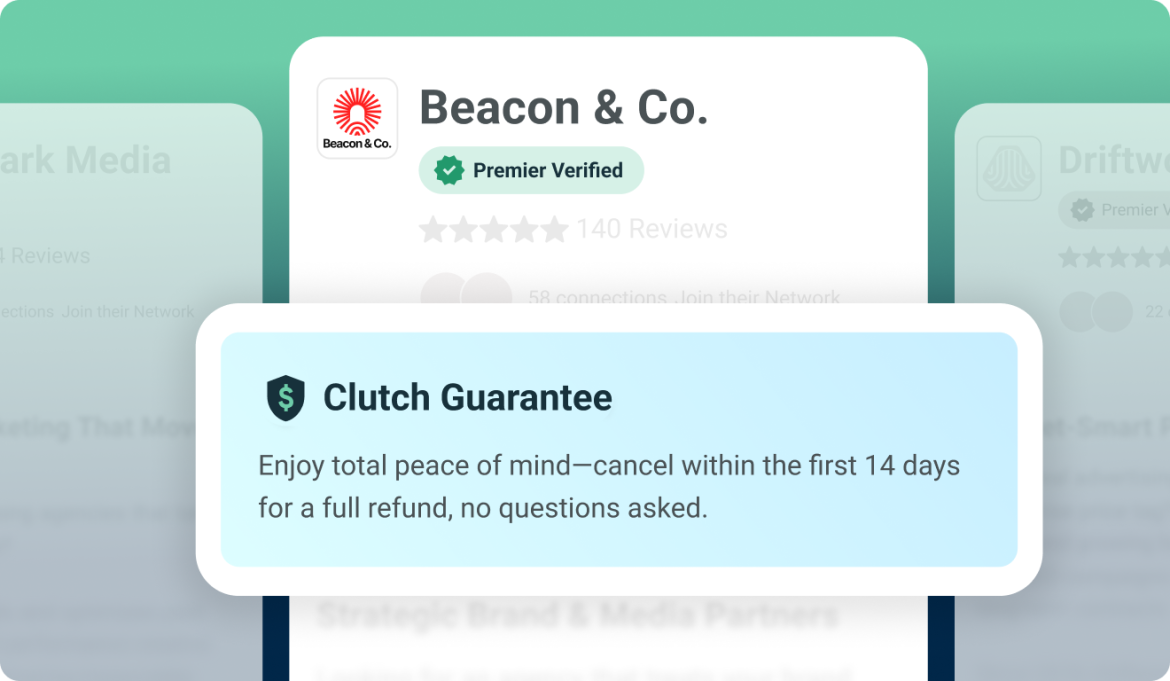
Offering it removes financial risk and backs your commitment with a platform buyers already trust, giving hesitant buyers the confidence to say yes. It also adds another layer of trust to how you show up on Clutch. Buyers aren't the only ones weighing that signal anymore; AI procurement agents are starting to factor it in, too, when deciding who to recommend.
The badge appears on your profile, directory listings, and matched proposals, and your Guarantee status is published as machine-readable structured data so AI agents can verify it programmatically. It's one more trust signal in the mix Clutch feeds to AI search.
Learn more on how to activate Clutch Guarantee.
This isn't a one-way benefit; it works for buyers and providers alike.
For buyers, the stacked signals offer something the open web simply can't: protection. A raw Google search or an unsourced AI answer comes with no verification and no recourse if things go sideways. A provider that's verified, credentialed, and guaranteed makes the hiring decision defensible — not just something you can walk back later.
For providers, each signal you add compounds your visibility: more AI citations, more consideration, more of the de-risked deals buyers now gravitate toward. The message really is that simple — the more signals you bring to the ecosystem, the more recommendable you become.
What you end up with is a flywheel: buyer trust and provider visibility feed each other, and Clutch sits in the middle turning signals into recommendations.
Clutch is moving from a place buyers go to visit to a verified data layer that travels with the buyer, regardless of where they’re asking for recommendations.
And the proof runs through everything above — the 8.6x citation lift for Verified providers, the 27x gap between providers with 50+ reviews and ones with none, the +77% Verified effect that survives every control we could throw at it. Assertion and proof, in one place.
Providers that win in the answer economy aren’t the loudest; they’re the most verifiable. The third-party platforms, like Clutch, supply the verification that AI ends up relying on.
AI citations to Clutch profiles were examined from July 1–31, 2026, and reflect visits to provider profiles from AI answer engines like ChatGPT, Perplexity, and Gemini. The analysis consisted of 5,022 unique providers who received at least one AI citation during the month.
For each product and attribute, we examined both a raw and a fully-controlled effect. The raw effect compares the average AI citation count for providers with that attribute vs. providers without it. The fully-controlled effect uses a statistical model to estimate the independent effect of each attribute while holding all the others constant.