
Generative AI vs. Agentic AI: What's the Difference?
What's the difference between generative AI vs. agentic AI? Clutch explains both types, their impact on your work, and what to consider before using them.
Updated September 9, 2026

Enterprise AI adoption has stopped being a pilot problem and started being a production problem. Here's what separates the companies pulling ahead from the ones still stuck explaining their AI budget to the board.
Every enterprise now has an AI story. Fewer of them have an AI result.
That gap is the real headline of 2026. Adoption numbers keep climbing. Executive confidence keeps climbing with them. But when you ask how much of that activity has actually turned into measurable business value, the room goes quiet.
Looking for a Artificial Intelligence agency?
Compare our list of top Artificial Intelligence companies near you
Deloitte's 2026 State of AI in the Enterprise report, based on 3,235 senior leaders across 24 countries, found that while two-thirds of organizations report efficiency gains from AI, just one in five is currently seeing increased revenue from it, even though 74% hope to.
Ask any enterprise leader whether their company uses AI, and the answer is almost always yes. Deloitte's research shows worker access to AI rose 50% in 2025, and the number of companies with 40% or more of their AI projects in production is expected to double within six months. Individual use is no longer the question.
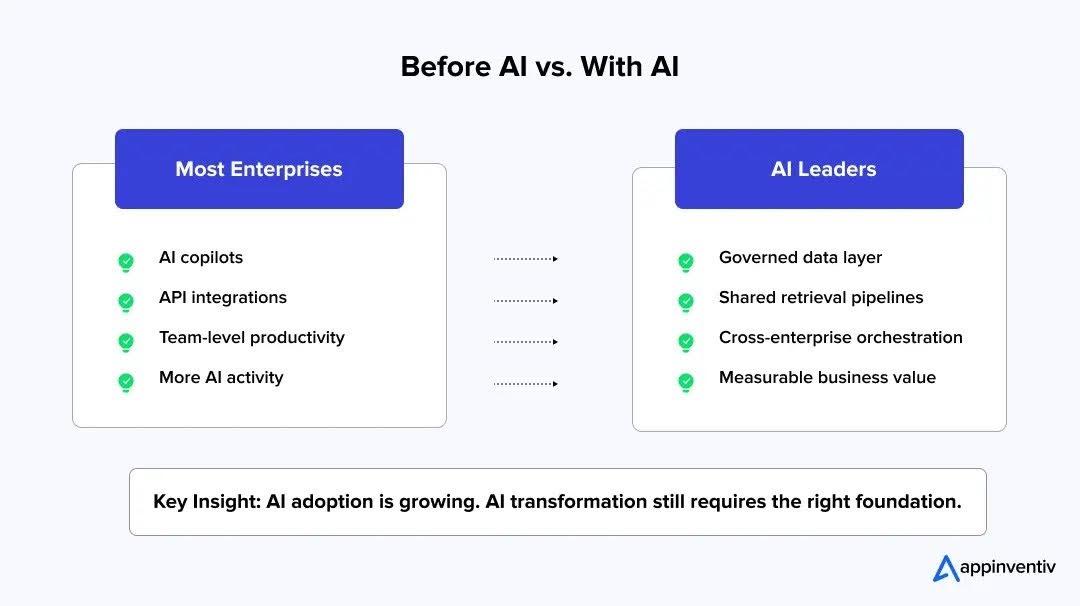
Organizational transformation is. The same report found that only 34% of surveyed organizations are using AI to drive deep transformation, building new products or reinventing core processes. Another 30% are redesigning key processes around it. The remaining 37% are still using AI at a surface level, with little or no change to how work actually gets done.
Look closer at that surface-level group, and a consistent technical pattern shows up. Most of them are running standalone copilots or point solutions bolted onto existing applications through basic API calls. There's no shared data layer, no reusable retrieval infrastructure, no orchestration between tools.
The groups actually transforming have usually done the less visible work first. They consolidate fragmented data sources into a governed data layer, stand up vector databases and retrieval pipelines that multiple applications can draw from, and build evaluation harnesses that catch model drift before it reaches customers.
That's the pattern to understand before anything else: access is up, usage is up, but the bridge between usage and real transformation, the architecture and governance that turn AI activity into AI value, is where most enterprises are still stuck.
If 2025 was the year enterprises experimented with generative AI, 2026 is the year they tried to put autonomous agents into production, and found out how much harder that actually is.
Gartner predicts that over 40% of agentic AI projects will be canceled by the end of 2027, due to escalating costs, unclear business value, or inadequate risk controls. That's not a sign that agentic AI doesn't work. It's a sign that most organizations are deploying it the way they deployed early chatbots, as isolated pilots bolted onto existing workflows, without a clear line to a business outcome.
A demo just needs to complete a task correctly once, in front of an audience that already knows what "success" looks like. A production agent needs to complete that same task correctly thousands of times, across edge cases nobody scripted for.
Most agentic AI budgets go toward the model and the prompt. Most of the actual engineering effort, and most of the reason projects survive past the pilot stage, goes toward everything wrapped around the model.
Skip most of this list, and the project usually still launches. It just doesn't survive real-world use, which is the pattern behind Gartner's forecast of cancellations. Deloitte found that only 20% of organizations have a mature governance model for autonomous AI agents, even as agentic AI usage is set to rise sharply over the next two years.
The organizations that avoid citing Gartner's cancellation statistic don't treat agentic AI as a feature to switch on. They treat it as a redesign of how a specific process runs: which decisions the agent can make autonomously, which require a human checkpoint, and how actions get logged for audit.
Gartner's own guidance is blunt: agentic AI should be pursued only where it delivers clear, measurable value, not because a competitor announced it first. This is also why more enterprises are bringing in an AI development company at the redesign stage rather than after a pilot has already stalled, since process mapping and risk assessment are far cheaper to do before an agent is live than to retrofit around one that's already causing problems.
Strip away the vendor language, and the enterprises getting real value from AI in 2026 are doing a small number of things differently, at both the strategic and technical level.
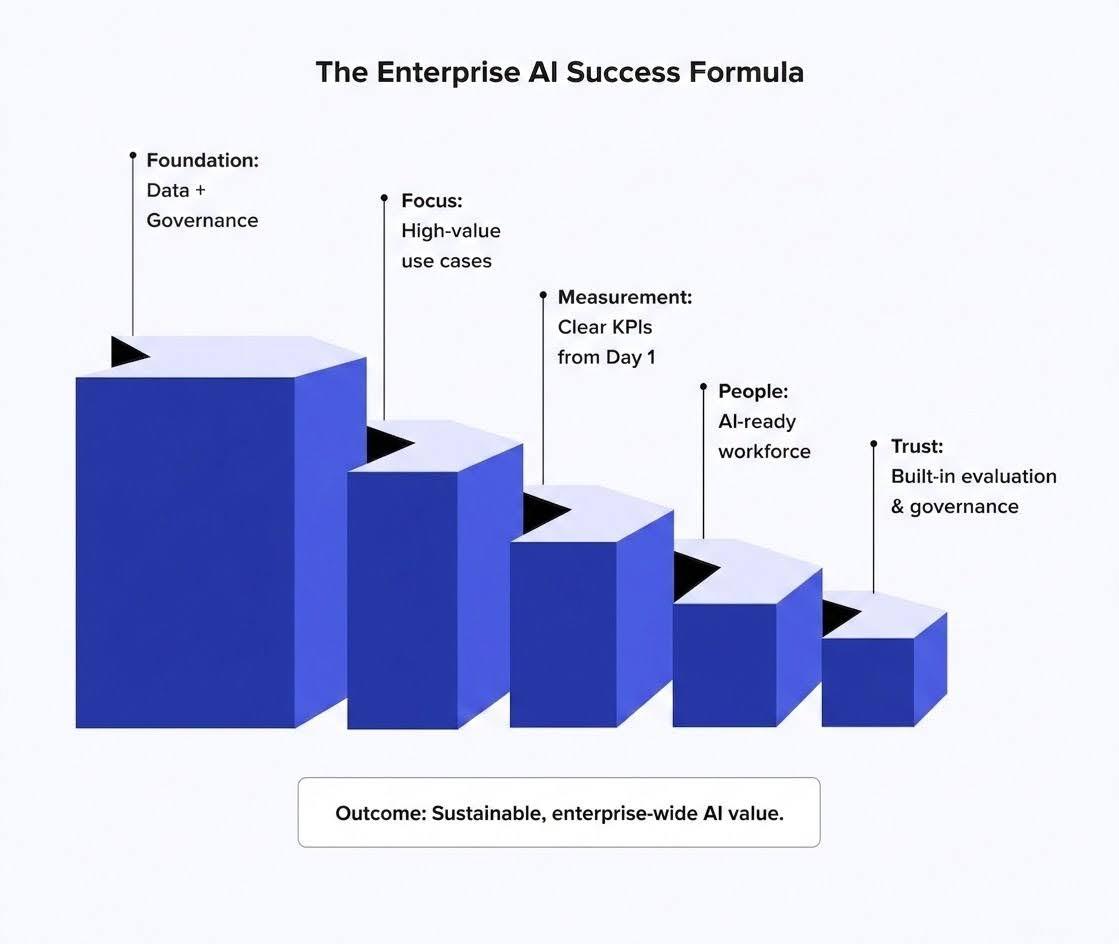
None of this is exotic. It's an engineering discipline applied to a genuinely new technology, which is exactly why it's harder than it sounds.
The other defining shift in 2026 is who's now accountable for AI decisions.
Through 2025, AI governance largely resided within IT and data science teams. That's changing fast. Deloitte's research is clear on this point: enterprises in which senior leadership actively shapes AI governance achieve significantly greater business value than those that delegate the work to technical teams alone.
This shows up in very practical, technical ways. Sign-off on high-risk AI use cases increasingly requires executive and legal review before a model goes into production, not just an engineering green light. Data and cybersecurity governance now have to account for autonomous systems making decisions and taking actions in real time, which means access controls, rate limits, and kill switches on agents get treated with the same seriousness as production database permissions.
Organizations that once measured AI success purely in efficiency gains are now expected to answer harder questions about model provenance, training data sourcing, and how a given output can be traced back to the inputs and reasoning that produced it. Enterprises that built governance, logging, and evaluation into their AI programs from the start aren't slowed down by this shift. The ones who treated it as an afterthought are now scrambling to instrument systems already running in production.
The strategic question for enterprise leaders in 2026 isn't "should we use AI?" That question is settled. The real questions are narrower and harder, spanning both strategy and architecture:
Enterprises that can answer these clearly, and back them with the right data and orchestration infrastructure, before writing a statement of work, are the ones translating AI spend into AI value this year. Enterprises that can't are the ones contributing to Gartner's 40% cancellation statistic in 2027. It's also a large part of why demand for an AI development company has shifted upstream, from "help us build this model" to "help us figure out which three processes are actually worth automating and what the data foundation needs to look like first."
AI adoption insight in 2026 isn't slowing down. But the free pass for experimentation without accountability is over. The organizations pulling ahead aren't the ones using the most AI. They're the ones who stopped asking whether to adopt it and started asking, rigorously, what it needs, technically and organizationally, to actually work.