
Task Automation: How to Cut Repetitive Work
Task automation saves time, gets work done faster, and reduces errors. Learn how to automate repetitive tasks step-by-step and how to decide what to automate.
Updated September 29, 2026

Generative AI is popular in the workplace because it saves workers time. Agentic AI takes it up a notch by automating entire task sequences and running in the background while you work on something else. We’ll explore the differences between generative AI vs. agentic AI, how they change how people work, and what to consider before moving from generative to agentic AI.
Since OpenAI launched its flagship tool, ChatGPT, in late 2022, generative AI has become a common tool for many workers. With its ability to draft emails, summarize documents, write code, brainstorm ideas, and more, workers quickly adopted ChatGPT because it fit naturally into their existing workflows.
Now, workers aren’t just using AI to generate outputs. Many are building their own AI agents that perform tasks, run autonomously, and operate inside company systems without a human overseeing or prompting every step. That’s a massive leap from the reactive capabilities of generative AI, and most people still haven’t fully reckoned with what that leap means.
Looking for a Artificial Intelligence agency?
Compare our list of top Artificial Intelligence companies near you
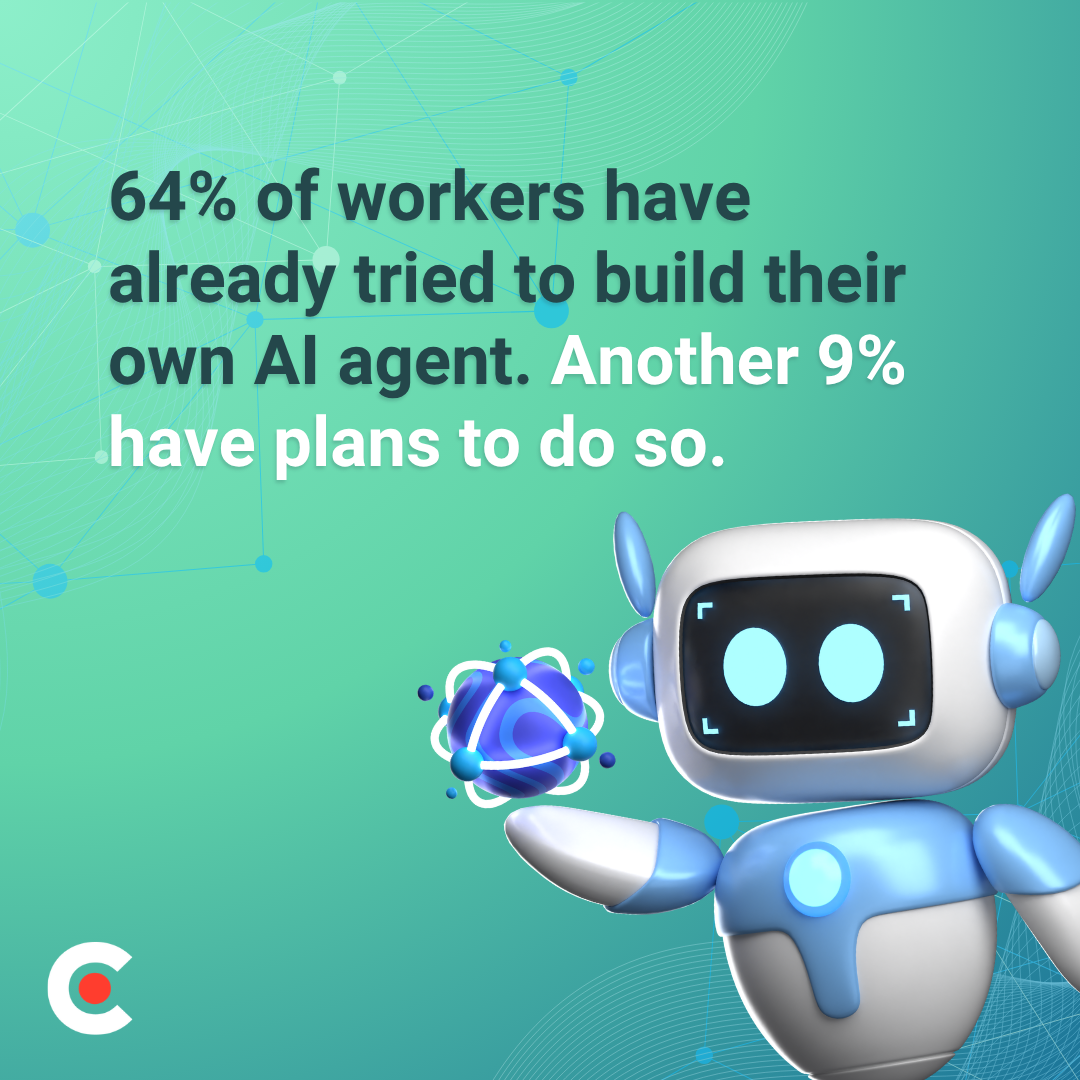
According to a recent Clutch survey, 64% of full-time workers have already taken a stab at creating their own AI agent, and another 9% plan to do so. Of those who’ve tried, 95% have succeeded, with 71% accomplishing the task in under a week.
"Not long ago, building an agent meant pulling in a dev team,” says Marcin Sulikowski, Co-CEO of web development and design agency Naturaily. “Now someone in sales or support can stand one up to solve their own bottleneck."
If workers are already building agents at this scale, the obvious questions follow: What exactly is an AI agent? How is this type of AI different from the generative AI tools we’ve all been using for years? Most importantly, what does this mean for how we get work done and how organizations should respond?
We’ll explain what generative AI and agentic AI are, how they’re used, and what distinguishes them. We’ll also look at how agentic AI works in practice and what businesses and workers should consider before moving from generative AI to agentic AI.
Generative AI takes an input, like a prompt, an image, or a document, and creates new content, such as text, images, audio, video, and code. It does this by predicting what should come next based on patterns it learned from existing data, essentially synthesizing its training data to answer the user’s request.
By nature, generative AI is reactive. It waits for a prompt, responds, and stops. Unless prompted again, it doesn’t take follow-up actions. It doesn’t retain persistent memory of a task across sessions unless its developers specifically designed it to do so.
Some examples of generative AI at work include:
In each of these examples, the AI receives a prompt, generates a response, and waits for the next human input before taking any further action.
Generative AI is best for tasks involving:
Any task in which the output is the deliverable and a human subsequently reviews or acts on it is a potential use case for generative AI.
Agentic AI autonomously executes multiple steps to achieve a defined objective, using tools, reasoning through problems, and adjusting its approach along the way with minimal human supervision.
Generative AI can produce an answer when given a prompt. An AI agent goes further by determining what needs to happen next and taking action to advance a task. Rather than simply generating a response, an agent can interpret an objective, break it into steps, use external tools or information, evaluate what happened, and decide what to do next.
For example, imagine asking an AI agent to research potential vendors for a software project. A generative AI tool could summarize information from the material you provide or compile information it finds online.
In contrast, an agent could search for vendors, gather information from multiple sources, compare them against your criteria, organize the findings, and produce a shortlist. If it encounters missing information or an unexpected result, it can adjust its approach rather than stopping after its first response.
Creating an AI agent doesn't necessarily mean building an AI system from scratch. Depending on the tool, users can create an agent by describing what they want it to accomplish and configuring the instructions, tools, data, and permissions it needs to complete the task.
A typical setup involves several steps:
The amount of technical knowledge required varies considerably. Some platforms provide visual interfaces and prebuilt integrations that allow non-developers to configure an agent without writing code. Others provide coding environments that give developers more control over the agent's logic, tools, and behavior.
Once configured, an agent typically operates on a recurring basis rather than following a fixed sequence of instructions from a person.
This loop is what gives agentic AI its autonomy. The agent doesn't need a person to provide a new prompt after every step. Instead, it can use the results of one action to determine what to do next.
The difference between generative and agentic AI becomes clearer when you look at what happens after the initial request.
Consider a marketing employee who wants to turn a new piece of research into a campaign. With generative AI, the employee might ask for a blog outline, social posts, or an email draft and then decide what to do with each output. An AI agent could coordinate more of that workflow itself. It might review the research, identify relevant findings, draft campaign assets, check them against predefined requirements, organize the files, and send the completed materials for review.
The agent still operates within the permissions, tools, and instructions it has been given. But instead of requiring the worker to direct every individual action, it can move between steps and respond to the results along the way.
Clutch's research shows how workers are already using this capability. Among workers who have built their own AI agents, 83% use them to write, edit, or summarize content, 64% for research, and 56% for data entry and processing.
Examining generative AI vs. agentic AI reveals differences in multiple areas, which we’ve summarized in this simple comparison table.
| Tool | Generative AI | Agentic AI |
| Autonomy | Reactive; waits for human prompts and stops after one response unless prompted again | Proactive; operates independently over multi-step workflows to reach an objective |
| Memory | Stateless; forgets context or history after the single turn or session ends | Stateful; maintains persistent memory of past actions, goals, and context |
| Tool Use | Rare; focuses strictly on internal pattern matching and generation | Dynamic; actively calls external APIs, databases, and software tools; sends messages, fills forms, and triggers workflows |
| Output Type | Single static media asset like text, images, audio, or code | Completed actions, live system updates, or multi-part reports |
| Error handling | Hallucinates or fails silently; provides plausible-sounding but wrong answers without realizing they made an error | Self-corrects; tests its own work, evaluates failures, and tries alternative paths to fix errors automatically |
| Human Oversight | Continuous; a person must prompt, review, and execute each step | Supervisory: a person sets guardrails and reviews exceptions or outcomes |
An important note about agentic AI is that its autonomous nature introduces additional risk that generative AI doesn’t pose. We’ll cover this in more depth near the end of this piece.
Generative AI and agentic AI affect workflows, output, and daily work differently.
AI agents handle the repetitive, multi-step tasks that used to chew up hours of valuable working time. Better still, the technology performs these tasks without waiting for the worker to prompt it each time.
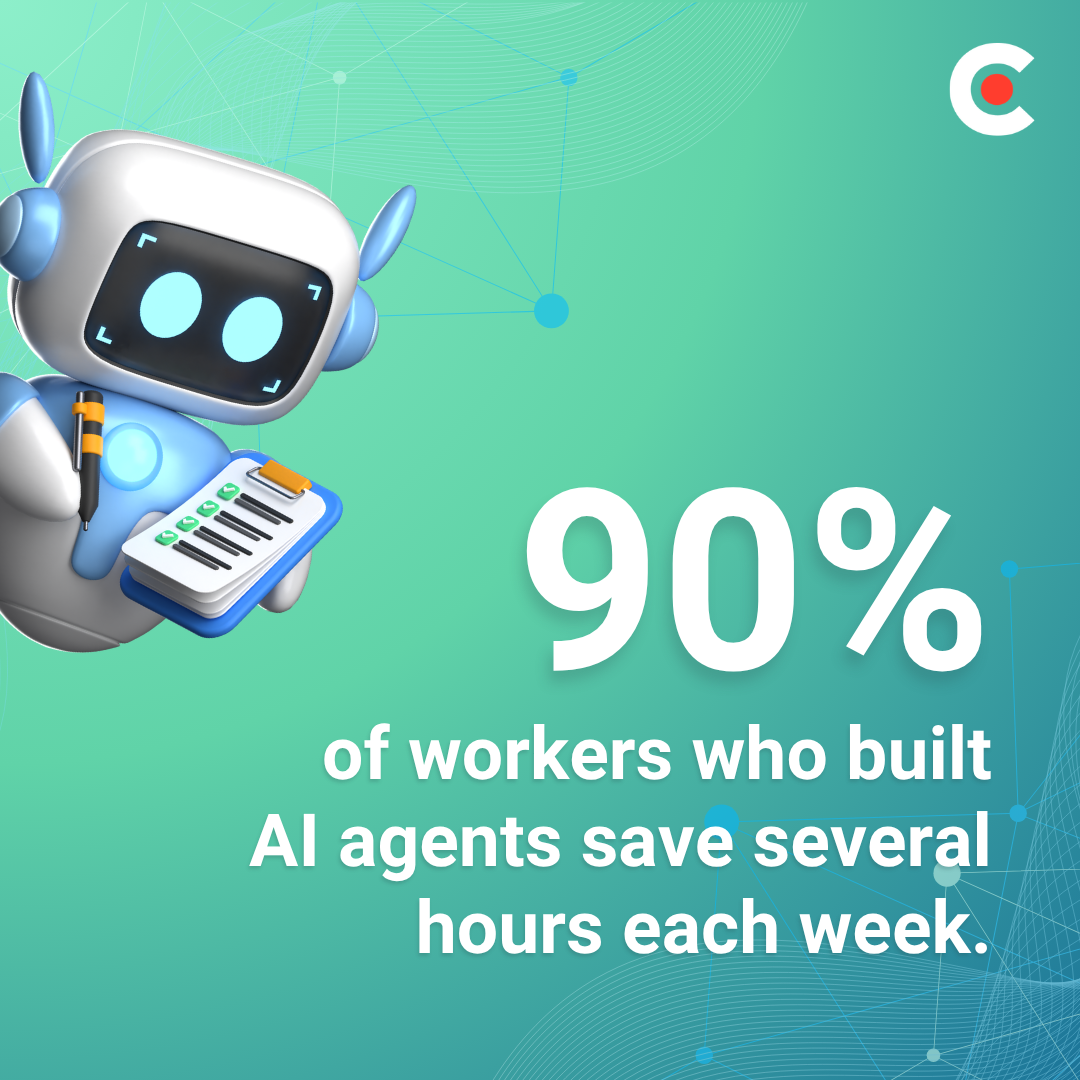
Clutch’s data show that 90% of workers who built AI agents save several hours each week. Eighty percent complete tasks faster, and 39% report gaining more time for important strategic work once agentic AI takes the mundane, repetitive tasks off their plates. In fact, 78% of workers who built their own AI agents did so specifically to automate repetitive tasks.
These aren’t just IT professionals or developers, either. Among workers who build AI agents, 57% are individual contributors, and 54% hold non-technical roles. By department, marketing (29%) and IT/operations (32%) lead the agent-building charge
Learn more about How Marketers Are Using AI Agents.
While building, 89% took an experimental, learn-as-you-go approach. This tells us that these people are largely workers solving their own bottlenecks rather than formal organizational deployments.
While generative AI accelerates individual tasks, agentic AI fully automates entire sequences of tasks and can run in the background while the worker performs a completely different, unrelated task. Agentic AI provides next-level time savings.
Upgrading from generative to agentic AI entails various risks and governance considerations. The main risk of using agentic AI doesn’t exist with generative AI: Mistakes happen before a human can catch them. With generative AI, human oversight is a given. A person reads the draft before it goes out.
An AI agent, on the other hand, might send the email before anyone notices the error.
“Building a working agent prototype is easy now,” says Hammad Maqbool, AI Lead at AI-first digital engineering partner Phaedra Solutions. “Making it reliable, secure, and maintainable once it's in production is the hard part.”
Ninety-five percent of workers who built agents report encountering problems. Their agents:
Nate Botelho, Founder of award-winning web development company Temper And Forge, says, "When an AI agent sends something externally that it shouldn't have, the fallout can extend well beyond an embarrassing email."
This is where poor AI governance can negatively impact your team. Most workers are building AI agents without formal oversight, and companies only catch onto issues after an agent makes a mistake. Although 90% of employers ask their workers to scale or document the agents they build, those guardrails tend to come after they have already experimented, not before.
“Companies do not need a perfect governance framework before employees can experiment,” says Igor Epshteyn, CEO at custom software development and consulting company Coherent Solutions, “but they do need a few critical guardrails from the beginning.”
Before allowing a worker to experiment with creating their own AI agents, your organization should ask these essential governance questions:
Putting guardrails in place ahead of time as part of your company’s AI strategy can help prevent costly reputational damage, severe security breaches, and the unpredictable risks posed by misaligned AI behavior.
Learn more about Agentic AI and How It’s Transforming Business.
Generative AI changed how workers create content and other media assets, while generative AI extends that shift by automating entire workflows and operating autonomously within company systems.
But there’s a reason for workers to use both within their workflows. Workers can use generative AI for tasks such as writing, brainstorming, analysis, and communication, while agentic AI handles more complex, multi-step processes. Together, this can help workers become more efficient and effective.
Learn more about How to Set Up Your Business with AI: From Basics to AI Agents.