
Task Automation: How to Cut Repetitive Work
Task automation saves time, gets work done faster, and reduces errors. Learn how to automate repetitive tasks step-by-step and how to decide what to automate.
Updated September 8, 2026

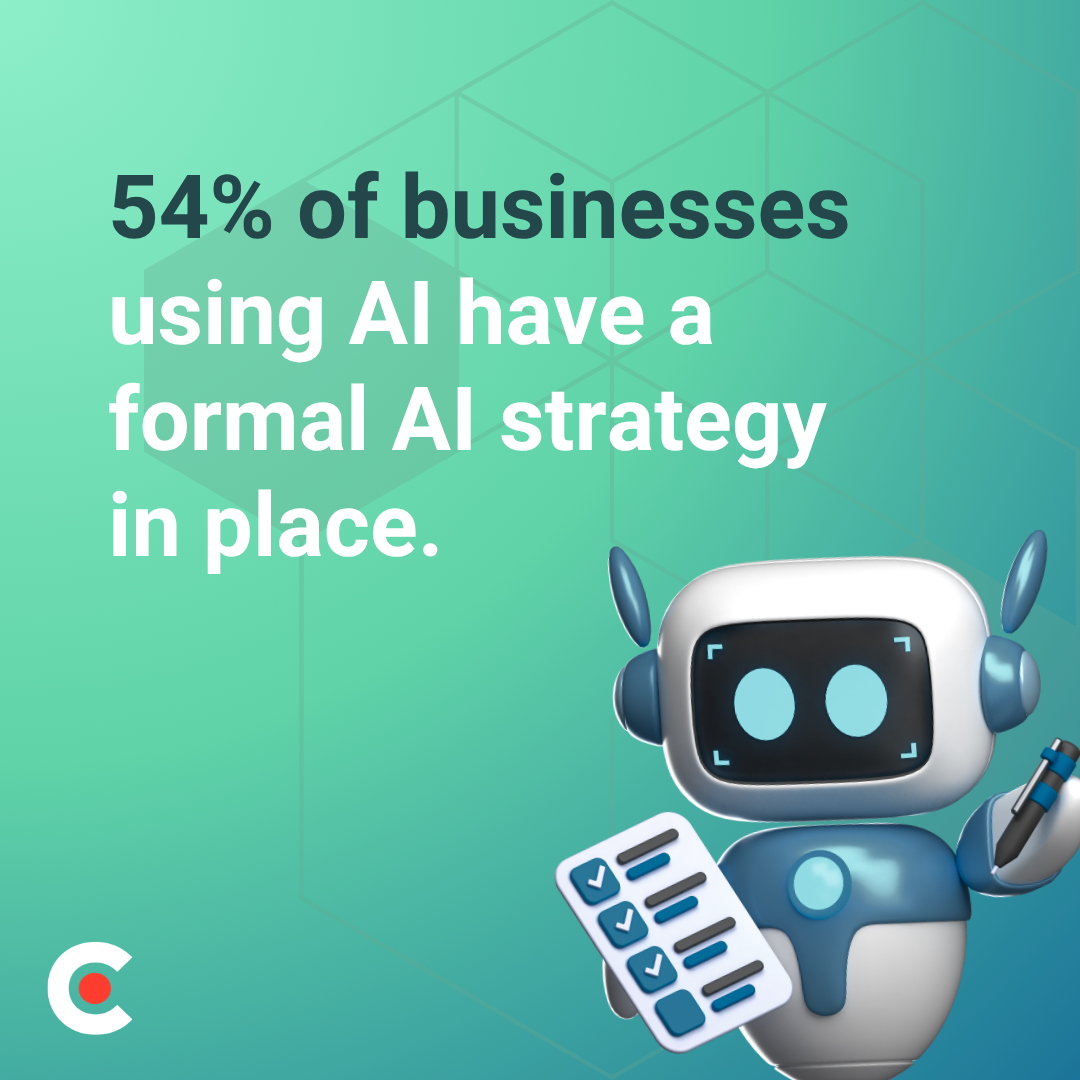
While most businesses use AI in some capacity, only 54% have a formal AI strategy in place — a gap that too often leads to wasted budgets and pilot projects that slowly fizzle out. With clear guidelines, your company can build an AI implementation strategy from scratch, regardless of your size or technical expertise.
Businesses are finding more uses for AI every day, whether it's perfecting content with long-standing tools like Canva or Grammarly or using large language models like Claude to generate draft slide decks and marketing copy.
Surprisingly, however, only 54% of businesses using AI have a formal AI strategy in place, according to a Clutch survey of 600 small businesses. This means many organizations are using AI ad hoc, with no stated or consistent AI workflow.
Looking for a Artificial Intelligence agency?
Compare our list of top Artificial Intelligence companies near you
An effective AI strategy can close the gap between expectations and practical usage. Rather than just a list of approved tools, a carefully crafted plan helps you implement AI in a way that drives adoption across your team, ties each initiative to a specific business objective, and gives leadership a clear way to measure whether it's working.
Without a plan, it's nearly impossible to pinpoint which of your AI investments are actually saving time, cutting costs, or improving return on investment (ROI), and which are just running in the background with little to show for it.
Explore how businesses of any size or technical maturity can build from scratch a comprehensive strategy for AI implementation and use.
An AI strategy is a documented plan for how your business will use artificial intelligence to reach its goals. It's a set of organization-wide goals and practices, not simply a list of tools you're testing.
Without guidelines, one team might conduct research with a chatbot on a work account, while another starts using a free-tier writing tool to compose emails.
An AI strategy replaces ad hoc usage with deliberate, goal-aligned implementation. Your strategy should answer three questions:
Part of your strategy should include what tools are allowed in your office and the specific tasks they're used for. For example, you might approve work accounts for ChatGPT Enterprise and Claude Enterprise to generate newsletter copy, while prohibiting employees from entering company data into personal AI accounts.
To ensure the AI strategy guides your employees' actual AI use, leadership must explain the plan and keep it accessible to team members, rather than burying it on a drive or mentioning it once in a meeting and then forgetting it. Without visibility, teams can drift back to doing AI their own way, with no managerial oversight or way to tell who approved what.
With AI capabilities advancing faster than most businesses can absorb, creating a robust AI strategy is vital to staying on top of the technology. A clear plan keeps AI adoption intentional and protects you from expensive experiments that go nowhere.
Creating a robust AI strategy starts with determining business goals, rather than focusing on AI capabilities.
Common goals include:
Run each goal through three filtering questions:
Goals that hold up against all three questions are ready to move into the next stage of the process. A goal that stalls on one of them isn't ready, indicating the business needs to fix the underlying gap first.
Ultimately, the lesson at step one is that the organizations getting the most from AI started with a specific problem, not a technology budget.
Defining your goals narrows the field, but it rarely leaves you with a single clear objective. Businesses must determine what goals are worth pursuing and which to tackle first.
To prioritize AI use cases, distinguish between quick wins and moonshots. Quick wins have high impact and low complexity, so they take less to implement. Moonshots also have high impact, but they entail greater complexity and a much longer timeline before they have an effect.
Consider using a 2x2 prioritization matrix to sort the options. Plot each potential use case on two axes: impact (how much value it would create) and feasibility (how difficult it would be to implement given your current data, tools, and team). The use cases that land in the high-impact, high-feasibility corner are your starting point.
As a general rule of thumb, resist the pull toward the most exciting idea in the room. Start with one or two use cases that have clear data, a measurable outcome, and buy-in from the stakeholders who'll use the output.
Once you've defined your business goals, evaluate where your data, technology, and talent stand to determine if you’re ready to scale AI.
Start by evaluating your data readiness. Ask yourself: Is your organization's data clean, organized, and accessible? AI models are only as reliable as their training data and input data, and poor data quality is the most common reason AI projects fail. If you discover fragmented or poorly labeled data sources too late in the process, fixing this can be challenging and expensive.
Then, examine the other tools you use. Is your infrastructure cloud-based? Do your current tools support application programming interface (API) integrations? Your company doesn’t need to be on the cutting edge, but it’s important to understand where you’re starting from before committing to a new tech development roadmap.
Finally, consider whether you have the in-house technical expertise to build and maintain the AI solution or whether you’ll need to hire or outsource. Assess your team’s experience with AI development, data management, integrations, security, and ongoing maintenance.
A simple AI implementation may be manageable with your existing team, while more complex projects—such as building custom AI agents, connecting AI to proprietary data, or integrating it into existing software—may require specialized expertise.
This is one of the most consequential early decisions, so it's worth having a clear framework to guide the choice:
Rather than choosing one, it's also possible to mix options. For instance, you could buy an off-the-shelf AI tool for everyday productivity, outsource the development of a custom customer-facing application, and build the AI component that sets your offering apart in-house.
An AI roadmap turns your strategy into execution. It sequences initiatives by priority, assigns owners, sets timelines, and identifies dependencies between projects.
A three-phase structure works well for most organizations:
Start your implementation with a pilot. Pick one use case, run a time-boxed experiment, measure the results, and then decide whether to scale or pivot. A measured approach is how AI strategies survive contact with reality, instead of collapsing under the weight of an overambitious first attempt.
Be sure to set realistic timelines from the outset. Pilot projects typically take three to six months to yield meaningful data, while material returns on AI investments may take 12 to 18 months. Setting expectations early helps avoid mid-project dropouts that waste all the time and resources invested up to that point.
Clear governance is what distinguishes organizations that scale AI responsibly from those that face irreversible problems. It can’t be an afterthought, yet it’s often considered only after something has already gone wrong.
Establish your governance framework from the outset to cover the following:
Ownership of AI governance usually falls to a senior IT or operations leader in mid-market businesses. Larger organizations may need a dedicated AI governance committee with representation from legal, IT, and business units that use the tools day-to-day.
Adding AI governance policies after deployment is expensive and often incomplete. Instead, build governance into your AI strategy from the start to catch problems early and avoid costly fixes later.
Most AI adoption strategies don’t fail because the technology wasn't the right choice or good enough. They fail because employees don’t use them. Change management problems are often overlooked, yet they can cause the most damage.
If you want your team to embrace new AI tools, start by being transparent. Directly explaining early on how AI will and won’t affect employees’ roles should be a key part of a responsible AI rollout, not a soft afterthought. Keeping quiet about the plans can stir up anxiety, making workers hesitant to engage with AI if they suspect it could affect their data privacy or replace them.
The numbers back this up. The same Clutch survey of 600 businesses found that 66% remain concerned about the risks of using AI in their organizations, and Pew Research reports that 52% of workers are worried about the future impact of AI in the workplace. Mitigate these concerns with transparency from the start.
Most new technology requires some degree of training, but it should be customized for each team depending on their needs and skill level. Identify which teams need AI literacy training, the ability to understand outputs and prompt tools effectively, and which teams need hands-on technical training.
AI literacy training could be a half-day workshop that explains the difference between traditional AI for analytics and generative AI for creation. Hands-on technical training may look like a data team learning to perfect writing prompts for a specific industry or task.
Most companies track AI performance using the wrong metrics. They focus on indicators like model accuracy, uptime, and API response time — all technical measures, not business ones. These numbers only show if the system is operating, not if it’s delivering value.
Instead, you should connect AI outputs to business KPIs such as cost savings, hours saved per week, revenue influenced, customer satisfaction scores, and error rate reduction. These are the signals that leadership cares about and that justify continued investment.
You should also build in a feedback loop from the start. Quarterly reviews, model retraining schedules, and structured user feedback from the people relying on the output day-to-day all belong in this loop.
Unmonitored AI is liable to drift, and drifting AI causes damage before anyone notices. For example, a recommendation tool trained on last year's customer behavior could continue to run fine at a technical level while steadily recommending the wrong things to this year's customers.
A few common mistakes tend to appear in the AI strategies that end up stalling:
You can prevent most of these mistakes by following the steps to develop a clear AI strategy: setting goals, evaluating your readiness, establishing a roadmap, establishing governance, and finally getting your people involved early so they'll adopt AI tools and understand how to use them.
Building a strategy for your AI implementation is more about making smart business decisions than just focusing on the technology. It begins with setting clear goals, not picking tools.
The gap between using AI effectively in the moment and having a coordinated strategy is where budgets get wasted, pilots stall, and risks quietly grow. Closing this gap means creating a plan that starts with business goals, then moves through readiness, roadmap, governance, and people.
The companies putting comprehensive AI strategies in place now will have a big edge on the technology in two to three years. To stay ahead, it’s worth starting sooner rather than later — the window won’t stay open forever.
If your business is ready to shift from ad hoc AI use to a consistent, reliable, and compliant strategy, teaming up with an experienced AI development partner could be a game-changer. AI experts can collaborate with your teams to turn your vision into a tangible edge, while you concentrate on what you do best.
Browse Clutch's directory of AI development companies to find a partner suited to your needs.