
Task Automation: How to Cut Repetitive Work
Task automation saves time, gets work done faster, and reduces errors. Learn how to automate repetitive tasks step-by-step and how to decide what to automate.
Updated August 27, 2026

Small businesses using AI aren't just experimenting. Most of them are already operating at a sophisticated level. But sophisticated doesn't mean complete — and the gaps that remain are the ones that matter most.
AI adoption among small businesses has moved well beyond casual experimentation. Clutch surveyed 600 small businesses already using AI to understand how they’re using the technology, what they’re investing in, and what separates basic AI use from more mature adoption.
The key finding: small businesses using AI are more advanced than you might expect.
Looking for a Artificial Intelligence agency?
Compare our list of top Artificial Intelligence companies near you
To measure AI maturity, Clutch developed the AI Maturity Index, a scoring framework that looks beyond whether a business uses AI and evaluates how systematically it has integrated the technology into its operations. The index scores businesses from 0 to 100 across six weighted pillars, including:
Together, these pillars capture the different pieces that contribute to meaningful AI adoption, from having the right technology and data to training employees and establishing clear policies for responsible use.
Businesses are then placed into one of four maturity tiers: Leaders (75–100), Adopters (50–74), Experimenters (25–49), or Beginners (0–24).
Among small businesses already using AI, 59% score as Leaders. These aren’t businesses dabbling in AI. They’re making meaningful investments, using AI across their operations, and putting the foundation in place to get more value from it.
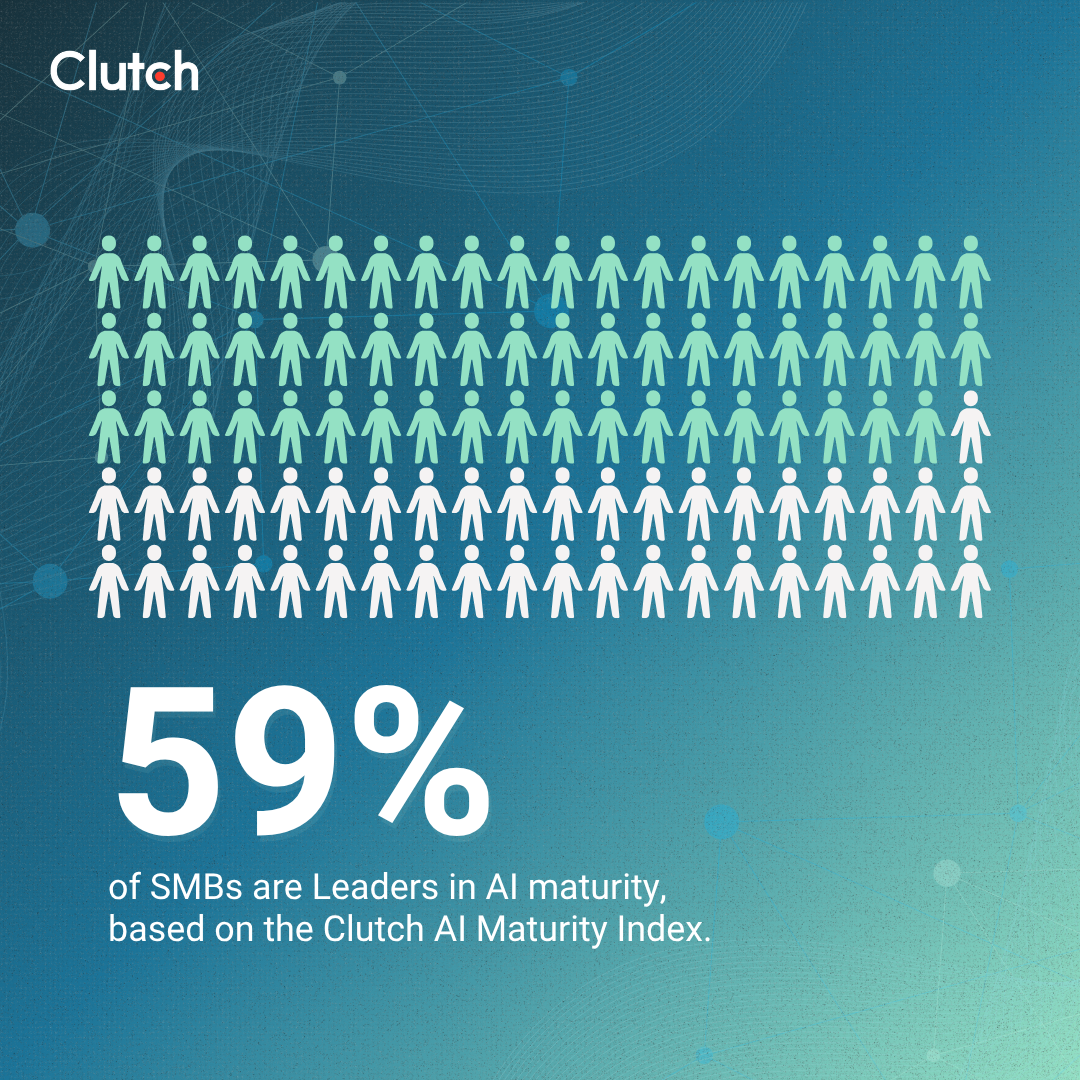
But even the most mature businesses aren’t doing everything right. Leaders still have gaps in areas such as strategy, data readiness, and governance that could limit their ability to scale AI effectively.
Here’s what the data tells us about where small businesses are getting AI right and where they still have work to do.
AI is now highly accessible and affordable for just about anyone, whether they’re using it for personal or professional purposes. As a result, simply using AI is no longer a differentiator among SMBs.
The more important question is: How seriously are businesses investing in it, and how effectively are they putting it to work?
Businesses that have invested in AI are more advanced than people may realize. This investment goes far beyond employees occasionally turning to ChatGPT to write emails or summarize documents. Instead, they’re investing in AI tools, employee training, and new workflows that can fundamentally change how their teams work. They’re also developing AI guidelines and policies to ensure employees use these tools safely, securely, and responsibly.
For small businesses in particular, these investments can have a major impact. While smaller companies may not have the resources or staff of larger enterprises, AI can help them do more with what they already have. Depending on how it’s used, it helps them reach more customers, automate repetitive tasks, streamline operations, and ultimately increase revenue.
For many small business leaders, AI is no longer something to experiment with on the sidelines; it’s becoming an investment in how their businesses operate and grow. Our research reflects this shift:
Based on the metrics typically used to signal organizational readiness — strategy, training, and adoption — these businesses look like mature AI adopters. They aren’t simply experimenting with ChatGPT or testing AI individually. They’re building the processes, skills, and infrastructure needed to integrate AI more deeply into their organizations.
This level of investment shows that AI adoption is moving beyond experimentation and becoming part of how small businesses operate.
For companies that have yet to make similar investments, the gap could become increasingly difficult to close as competitors build stronger AI capabilities, develop more efficient workflows, and find new ways to use AI to support growth.
It’s easy to assume that larger businesses would be the most advanced AI adopters. After all, they typically have larger budgets, dedicated IT teams, and more resources to invest in new technology. But even very small teams and solopreneurs are adopting AI at relatively high levels, suggesting that company size is not a major factor in AI maturity.
There is a meaningful gap between the smallest and largest businesses, but it is less dramatic than you might expect. Among businesses with 101–200 employees, 69% qualify as AI adoption leaders, compared with 51% of businesses with 2–10 employees.
That is an 18-point difference, but it also means that more than half of the smallest businesses in our research are already operating at an advanced level in AI adoption.
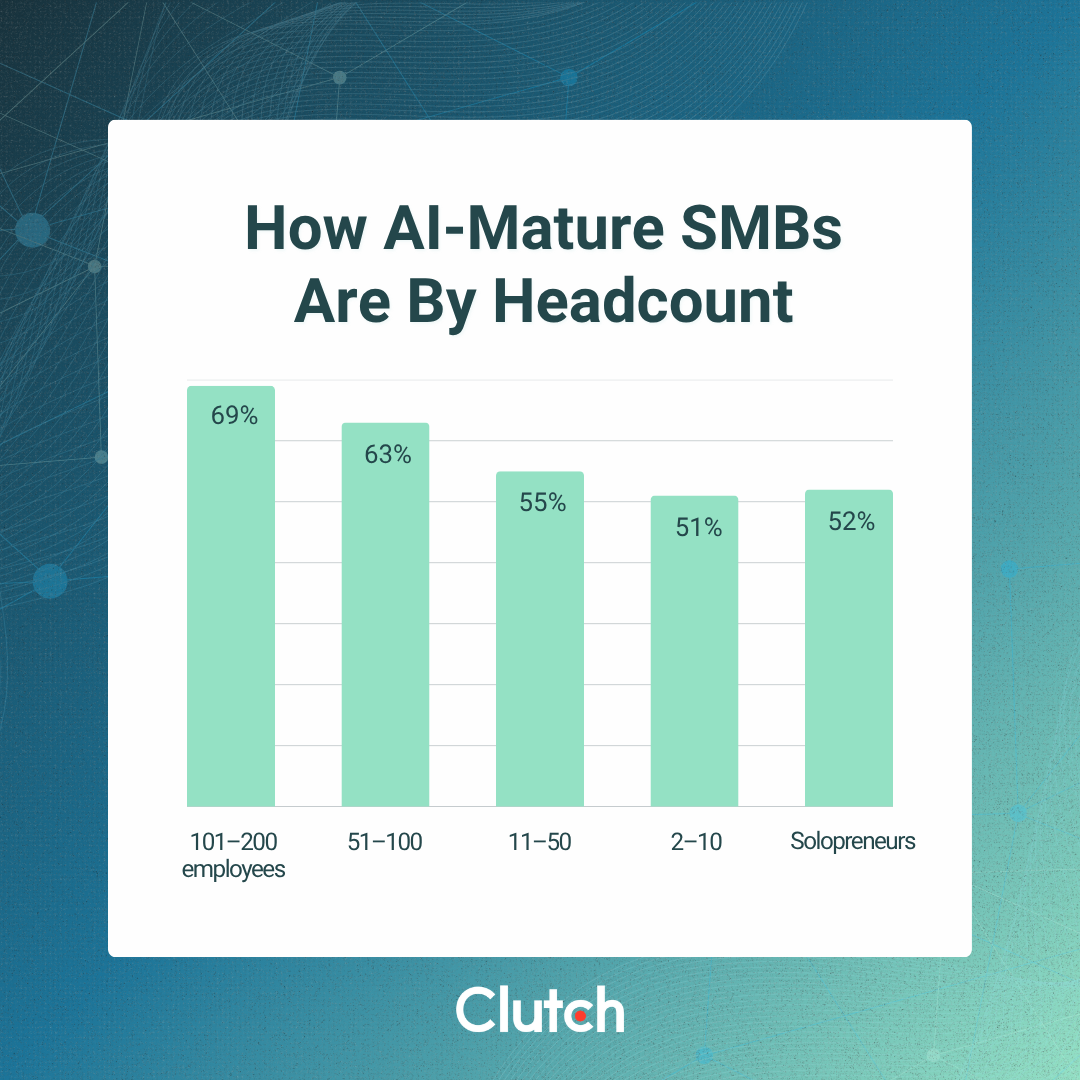
Solopreneurs (52%) are also surprisingly advanced. With no team to train or organization-wide processes to implement, individual business owners can still make AI a meaningful part of how they work.
Ultimately, small doesn’t have to mean behind. While larger companies may have more resources to invest in AI, SMBs can still reach high levels of AI maturity by being intentional and strategic about how they use it. The businesses operating at the highest levels have made AI a deliberate part of their operations, regardless of how many people are on the team.
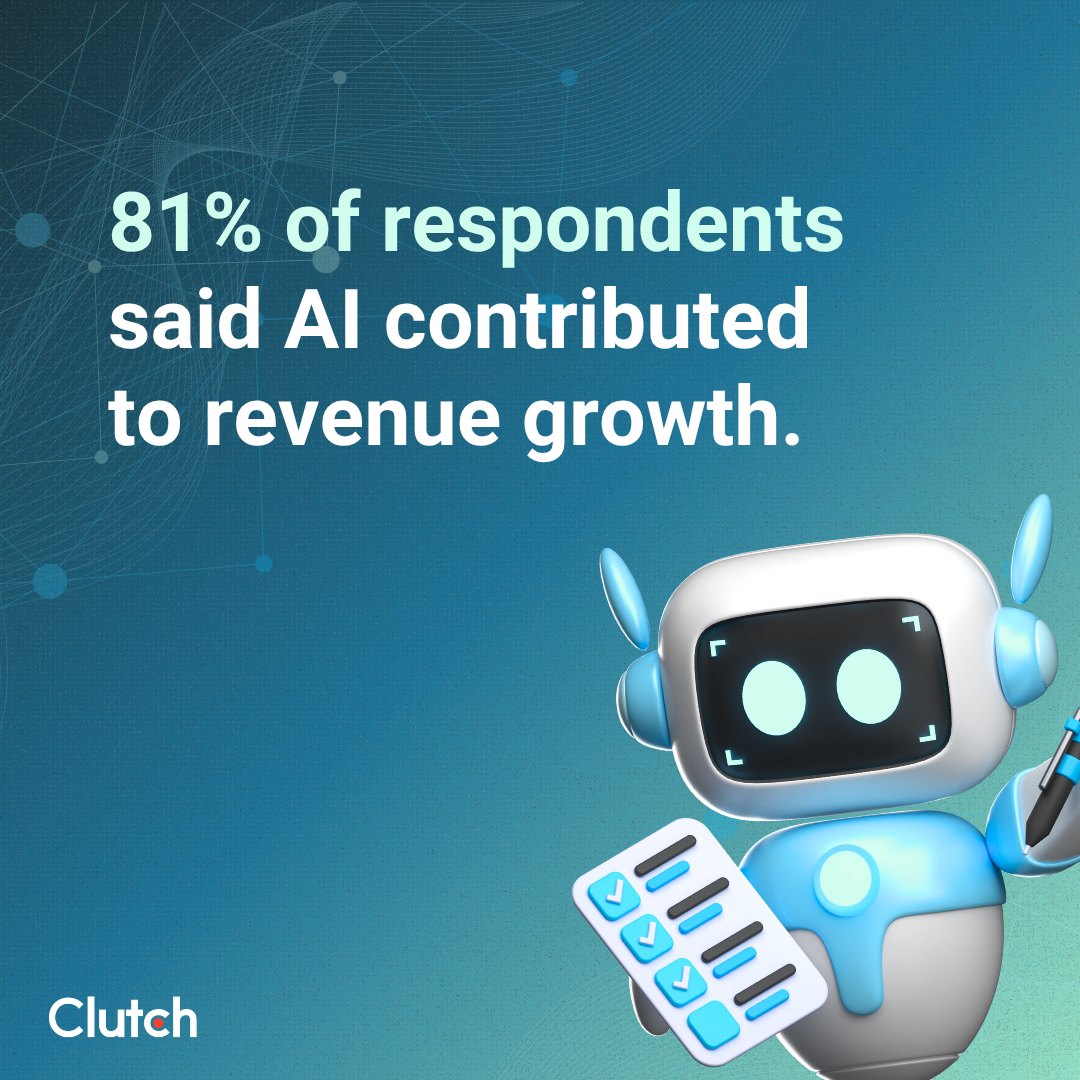
AI is already delivering measurable results for small and midsize businesses, with 83% reporting positive outcomes and 81% saying it has contributed to revenue growth.
The areas where businesses are seeing the greatest impact are largely tied to everyday work and productivity.
Saving time on repetitive tasks is the most common benefit, with 63% of businesses reporting an impact in this area. But the benefits extend well beyond efficiency. More than half (55%) say AI has improved the quality of their written content or communications, while nearly half (49%) use it to generate ideas or solve creative problems. Others are seeing benefits in customer service, sales and marketing, financial management, and hiring.
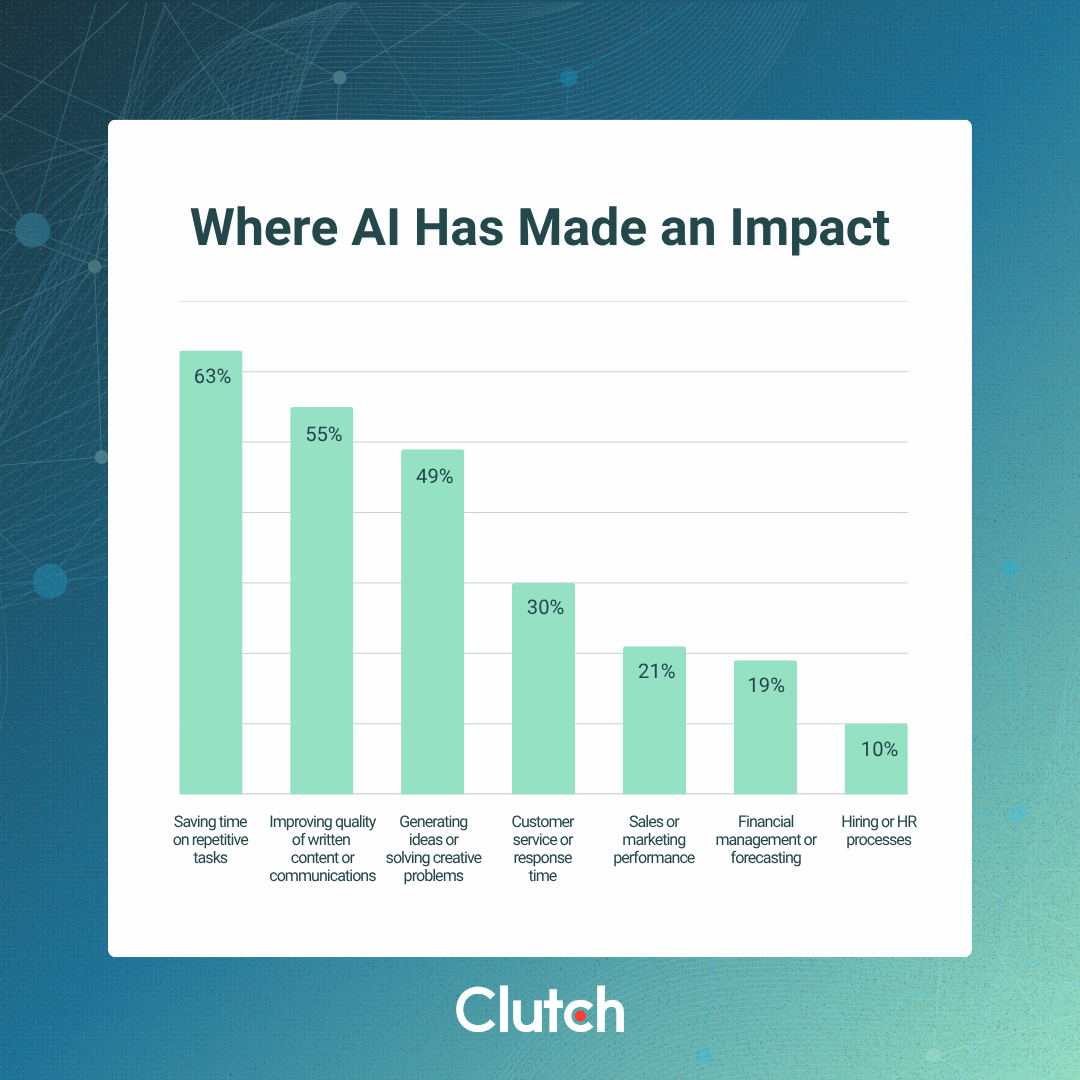
Business leaders don’t need to completely transform their business for AI to have a meaningful impact. Improving several everyday processes can add up to significant gains in productivity, efficiency, and revenue.
SMBs that invest in the right tools, train their teams, and integrate AI into the workflows where it can deliver the most value are more likely to see those gains compound over time.
Learn more about how small businesses can leverage AI more effectively here.
While cost is the biggest hurdle companies cite when implementing AI, with 33% identifying it as a barrier, AI adoption doesn’t necessarily require a large budget. For many small businesses, the cost of getting started is relatively affordable.
Half of small businesses (50%) spend between $50 and $500 per month on AI tools. Another 11% spend less than $50 per month, while 15% rely exclusively on free tiers.
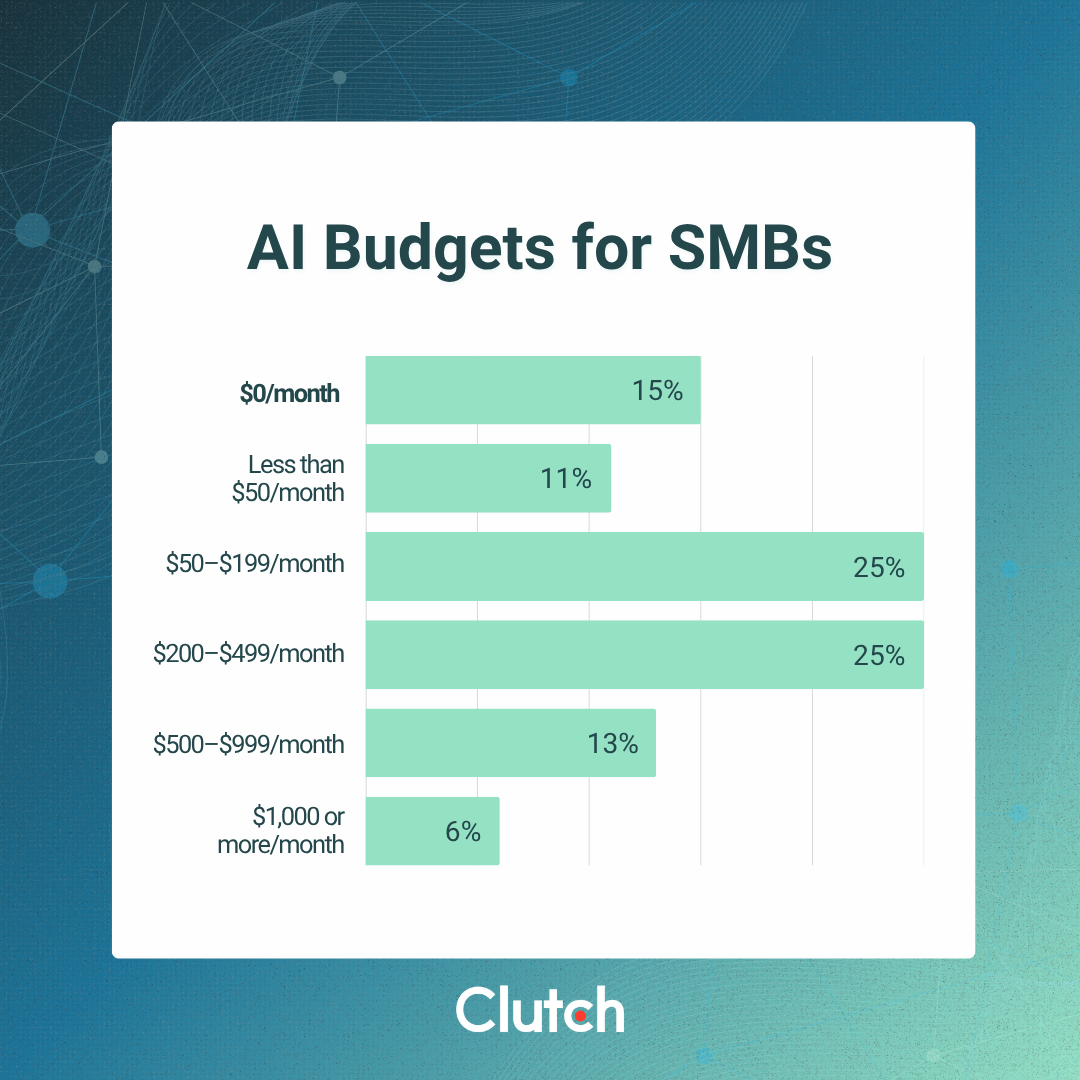
These numbers suggest that businesses don’t need a massive AI budget to start seeing value. Even relatively modest investments in tools such as ChatGPT, Claude, and other AI-powered software can help small teams automate routine tasks, improve productivity, and accomplish work that might otherwise require additional staff or resources.
Of course, the cost of AI can increase significantly as businesses move beyond off-the-shelf tools and pursue more sophisticated capabilities. Using ChatGPT or Gemini to speed up existing processes is one thing, but building custom AI systems for customer support, automation, or complex workflow development is another.
Businesses developing agentic workflows or custom AI platforms may need to invest significantly more in development, infrastructure, and ongoing maintenance. On Clutch, the average AI development project costs between $10,000 and $49,999.
For SMBs making larger AI investments, that spending is increasingly becoming a deliberate part of their technology strategy. More than half (53%) have a budget specifically allocated to AI, while another 25% fund AI spending through an operations or software budget.
Rather than treating AI as a small discretionary expense, these businesses are making room for it in their budgets, signaling that they see the technology as a worthwhile investment in productivity, efficiency, and growth.
Despite strong levels of AI adoption, even the most advanced AI users have room to improve. Survey responses suggest that many SMBs need to strengthen their AI strategy, data readiness, and governance to scale their use of AI effectively and build a strong foundation for future growth.
Even among those who use AI regularly, only 54% have a formal AI strategy, and an equal share measures the impact of AI using defined metrics. However, developing a clear AI strategy and measuring the impact of AI tools are essential to implementing them effectively and maximizing their value.
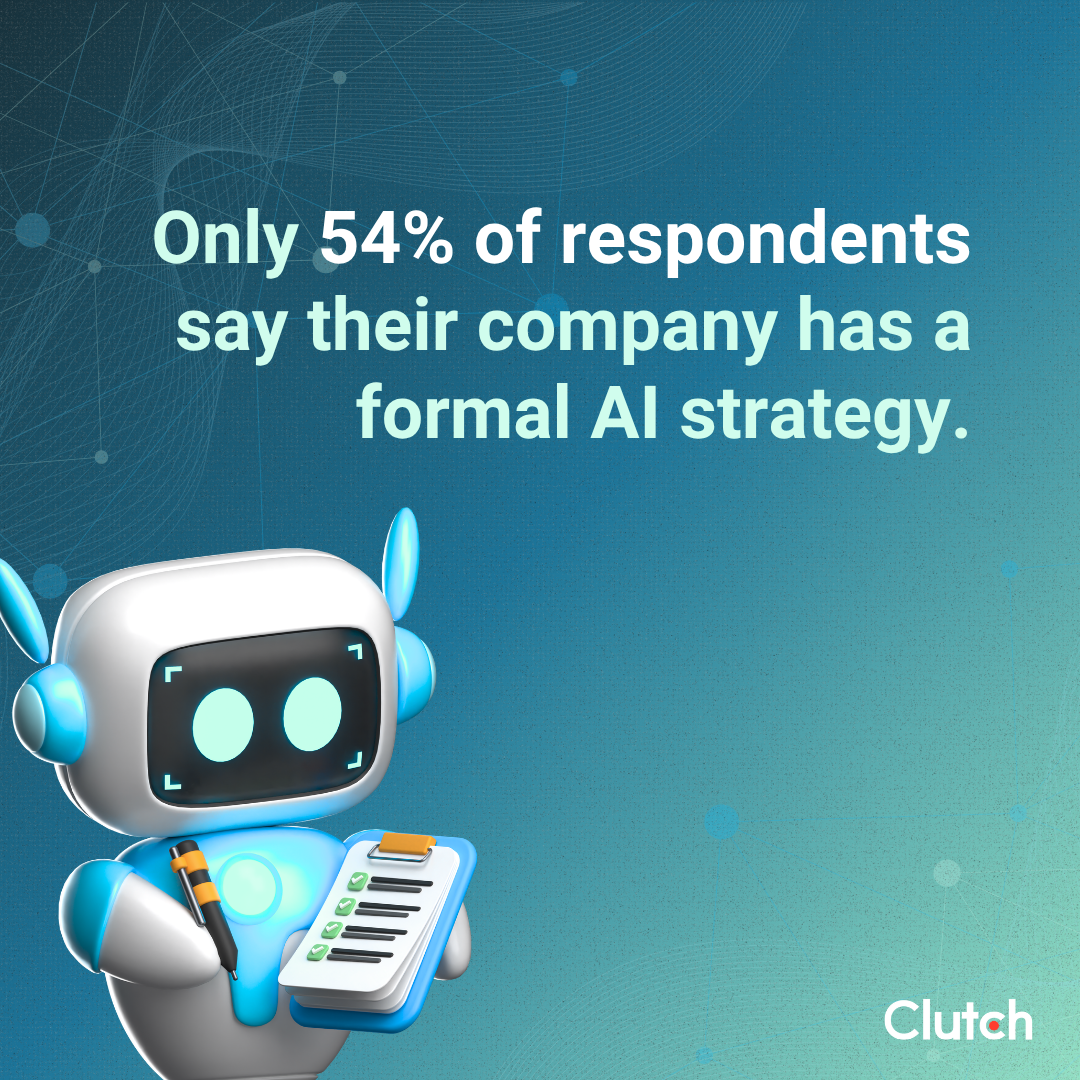
An AI strategy, which is a framework for implementing AI to support specific business goals, can help you prioritize investments, establish responsible-use guidelines, and determine how successful applications can scale across the organization.
Without one, companies risk more than just wasted spending and fragmented adoption: they increase the likelihood of exposing sensitive company or customer information, and without guidelines, AI-generated work may vary in accuracy and quality.
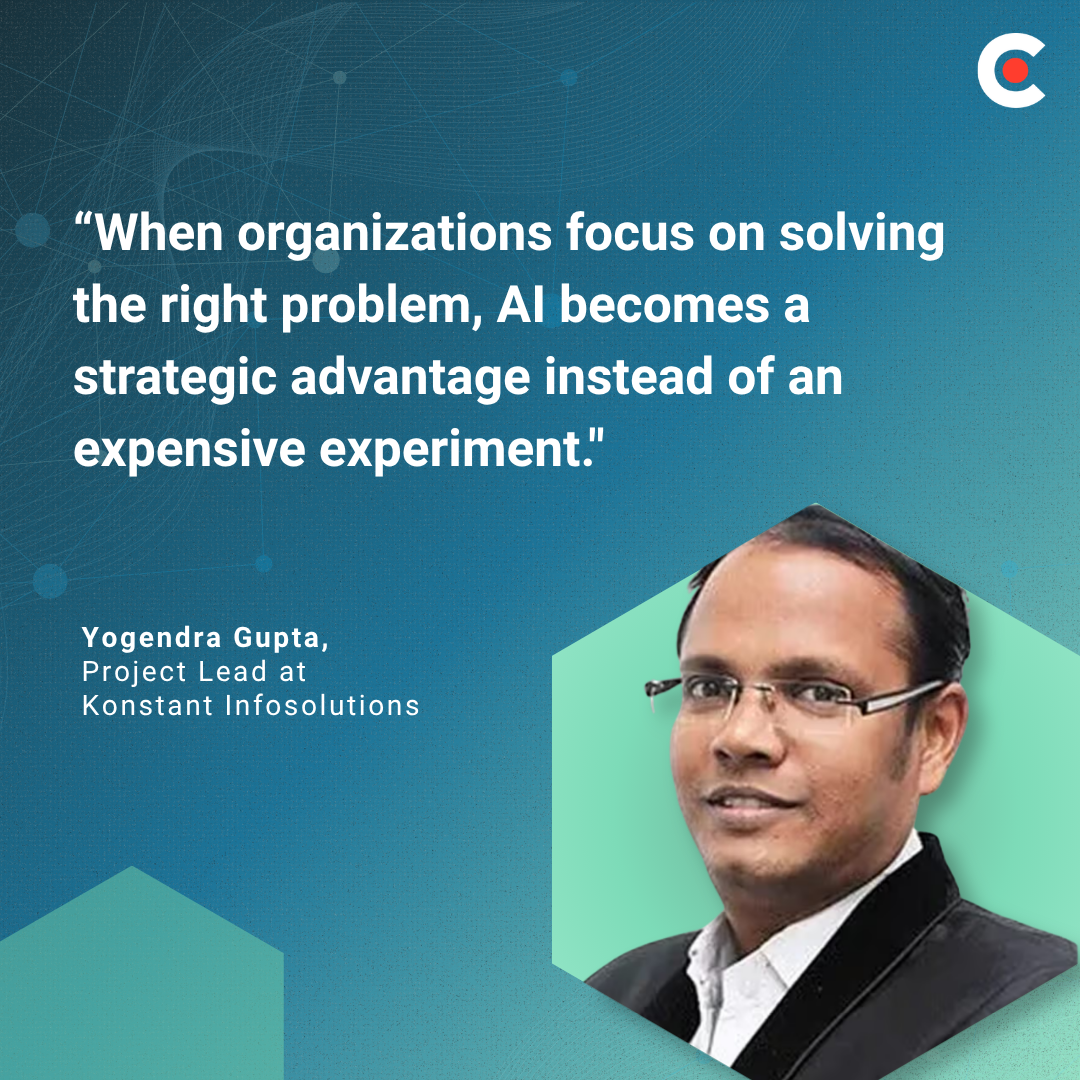
“Successful AI implementation doesn't start with the technology itself — it begins with a clear business objective,” said Yogendra Gupta, Project Leader / Tech Lead Mobile/Cloud at Konstant Infosolutions. “When organizations focus on solving the right problem, AI becomes a strategic advantage instead of an expensive experiment."
Measuring the impact of the AI solution is just as important as the strategy, too. “Most small businesses have no baseline for how long the current process takes or what it costs in errors or what markets it could open up, so when the AI version ships, there’s no way to prove it worked because there are no KPIs to measure the work against,” said John Griffin, Co-Founder of Spiral Scout. And that has a huge impact on project success: “The project doesn’t get killed, it just gets quietly abandoned,” he said.
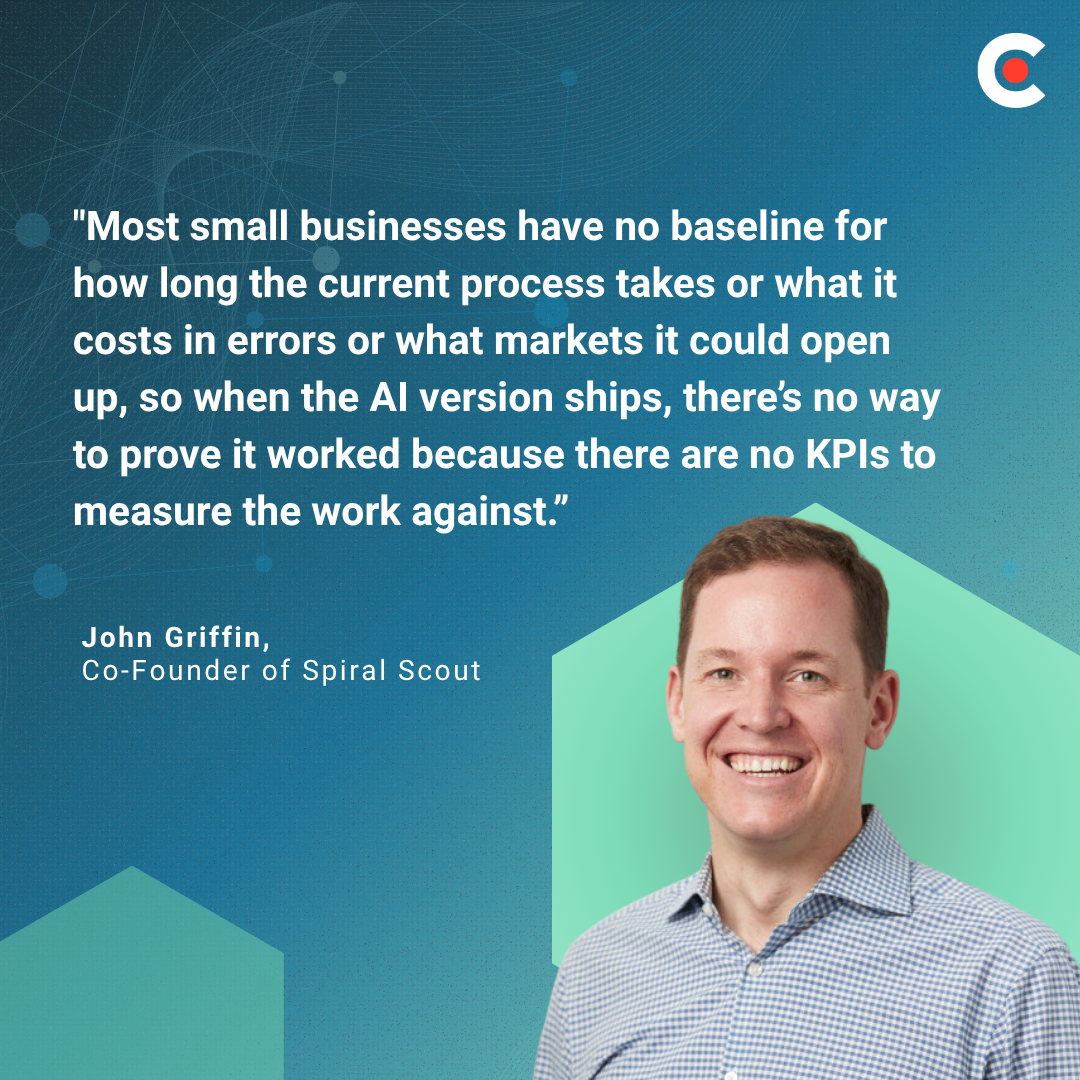
Especially as SMBs begin to explore new or complex ways to incorporate AI into their operations and workflows, they need to know what has had an impact in the past, what else can be streamlined, and what they should prioritize going forward.
While 94% say their data is accurate and 87% have some integrations in place, only 54% say their data is actually clean and centralized.

Businesses may feel confident in the quality of their data, but without the infrastructure in place to keep it organized, up to date, and accessible, they are limited in what they can accomplish because AI is only as useful as the data it can access and interpret.
“AI systems depend on the quality and consistency of the information they receive,” said Khawar Qayyum, Co-Founder and Program Director at Phaedra Solutions. “Businesses should clean and centralize their data, document their workflows, and clarify how information moves between teams before selecting a solution.”
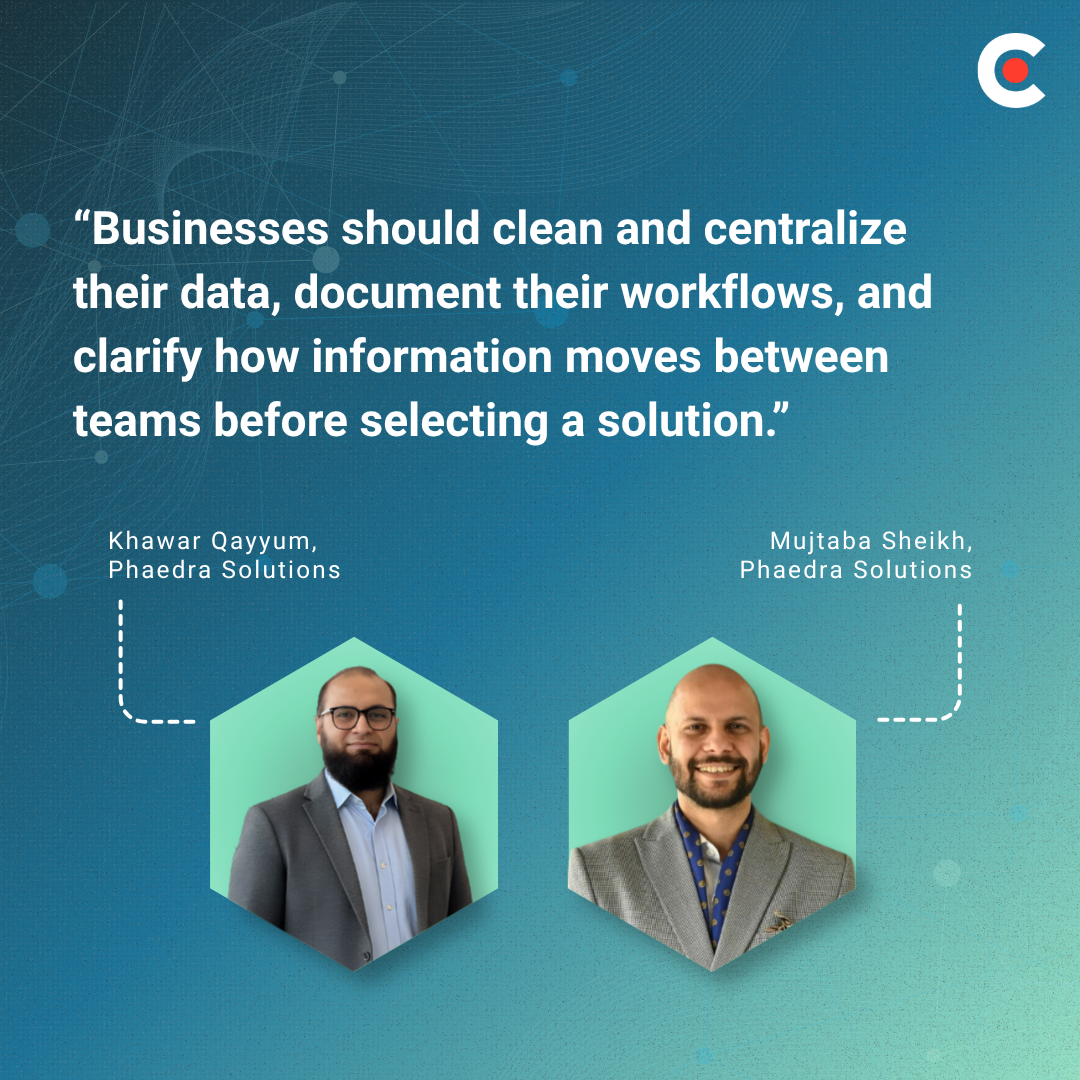
This can be a challenge for many companies, though. “Business data is often incomplete, inconsistent, or spread across multiple systems,” added Mujtaba Sheikh, a Digital Product Architect for Design & Engineering at Phaedra Solutions. “It must be organized, standardized, and made accessible before it can reliably support an AI solution.”
While this isn’t an issue for workers simply using AI to generate content, it becomes a major challenge for more complex AI use, such as developing custom AI tools, integrating AI with CRM and financial workflows, automating reporting, or building AI agents that can act on business information.
Sixty-six percent (66%) of respondents say they're concerned about the risks of using AI in their business, but 38% say their organization still doesn’t have formal guidelines for how employees can use AI. Instead, employees are making their own calls on what AI to use, how to use it, and what to do with the outputs.
Unfortunately, that inconsistency can create unnecessary risk. When employees follow different standards for AI use, businesses have less control over the quality, security, and accuracy of the work AI produces. They may also be more likely to expose sensitive data or use AI in ways that create compliance or privacy concerns.
Proper data governance can help SMBs manage these risks by establishing clear rules for how data is collected, stored, accessed, and used. It can also help businesses comply with industry regulations and reduce the risk of data breaches and privacy violations.
For most small businesses, you only need a few basic guardrails. A clear, one-page AI policy that covers acceptable use, output review, and data handling can address many common risks while giving employees clear direction on how to use AI responsibly.
Unsurprisingly, businesses that have already invested in AI and seen meaningful results are looking to expand their use of the technology, with many turning their attention to increasingly sophisticated AI applications.
Most (62%) are looking to leverage AI agents, while nearly half (46%) are planning to integrate AI with existing business software, and 42% plan to use AI for data analysis.
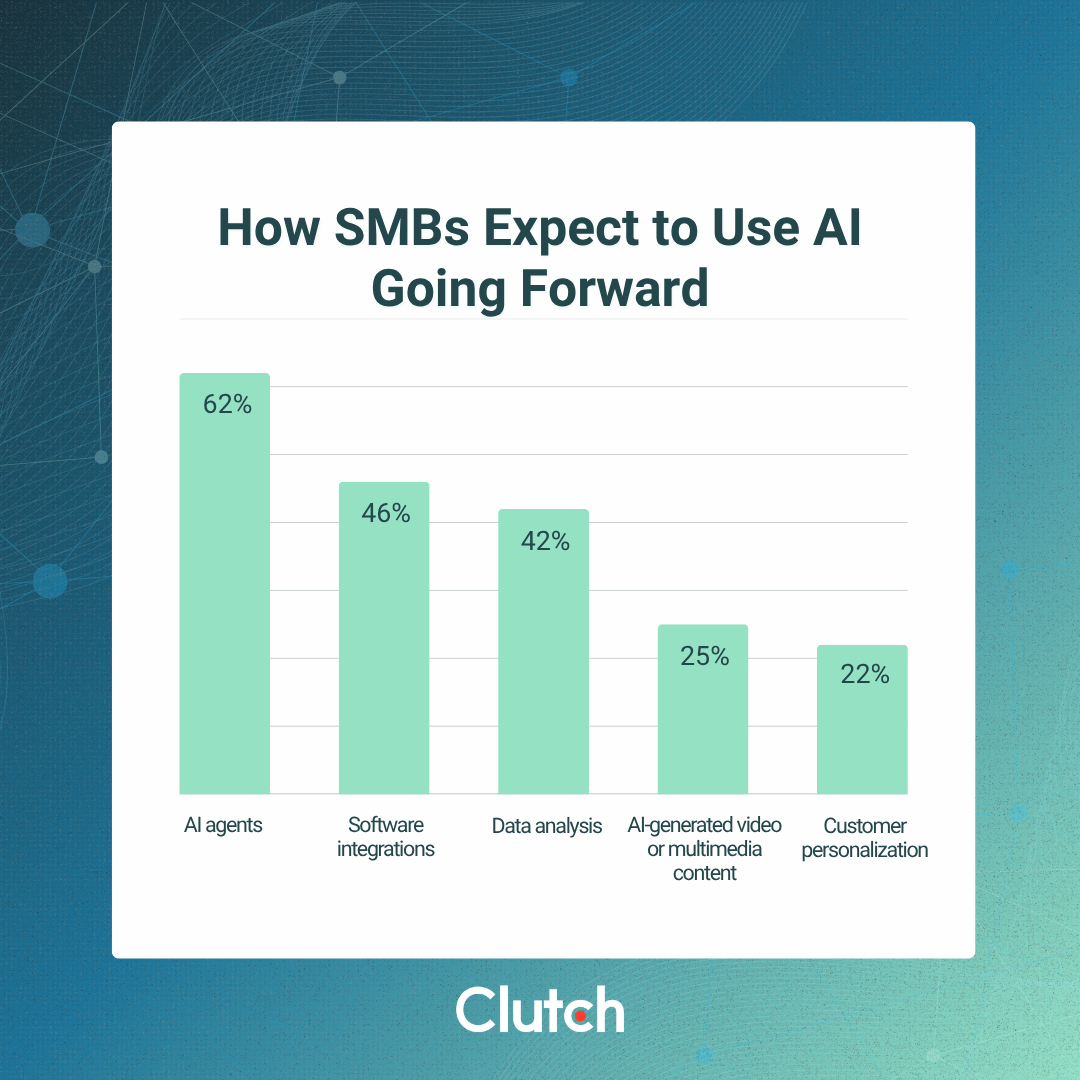
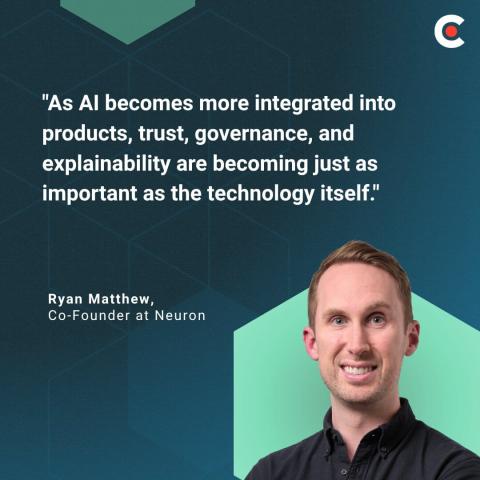
This appears to be consistent with trends that many development companies are seeing as well. “Clients are moving beyond AI chatbots and looking for AI native, agentic experiences that help users complete work,” says Ryan Matthew, the co-founder of Neuron. “We're also seeing growing demand for AI-powered summarization, insight generation, and workflow automation that simplifies complex enterprise platforms.”
Each of these use cases goes beyond simply using a standalone AI tool. For them to be effective, businesses need the right foundation in place, including a clear AI strategy, reliable data, and basic governance.
“As AI becomes more integrated into products, trust, governance, and explainability are becoming just as important as the technology itself,” said Morrison.
That’s especially true for those looking to leverage AI agents and software integrations, which need access to business systems and data to do their jobs effectively. Businesses that start addressing these gaps now will be in a much better position to take advantage of what AI can do over the next 12 months.
AI maturity is less about how many AI tools a business has adopted and more about how it uses them.
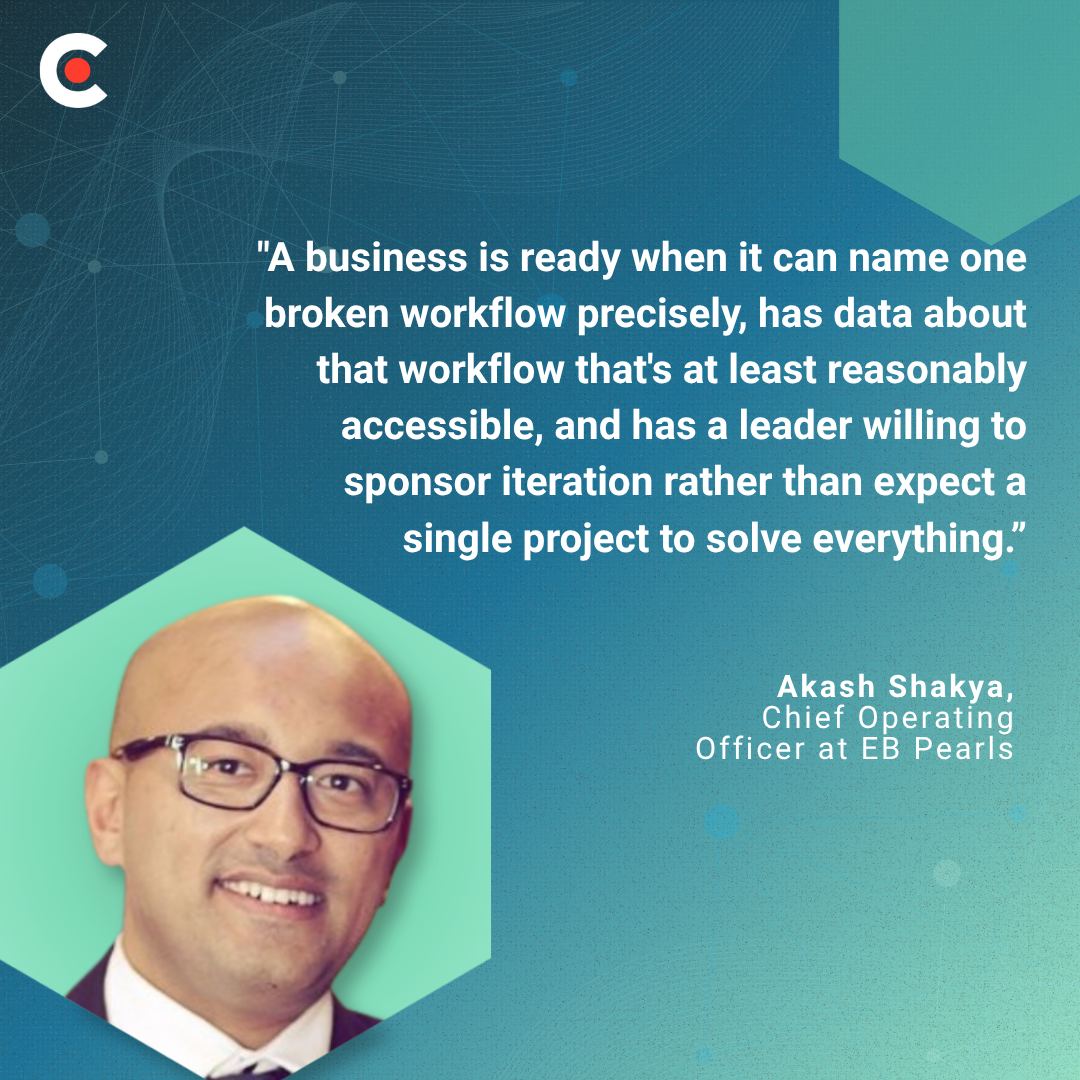
“Readiness has almost nothing to do with company size or budget. It's about specificity,” explains Akash Shakya, Chief Operating Officer at EB Pearls. “A business is ready when it can name one broken workflow precisely, has data about that workflow that's at least reasonably accessible, and has a leader willing to sponsor iteration rather than expect a single project to solve everything.”
Companies that connect AI investments to business goals, measure their results, prepare their data, and establish clear guidelines will be better positioned to scale AI as their needs evolve. Here’s what you need to know to prepare your team for future AI use:
That same focus on understanding the business need is important when companies start identifying new AI use cases. Rather than looking for places to add AI and working backward, businesses should first understand how their workflows operate, where employees are running into bottlenecks, and where automation could create meaningful value.
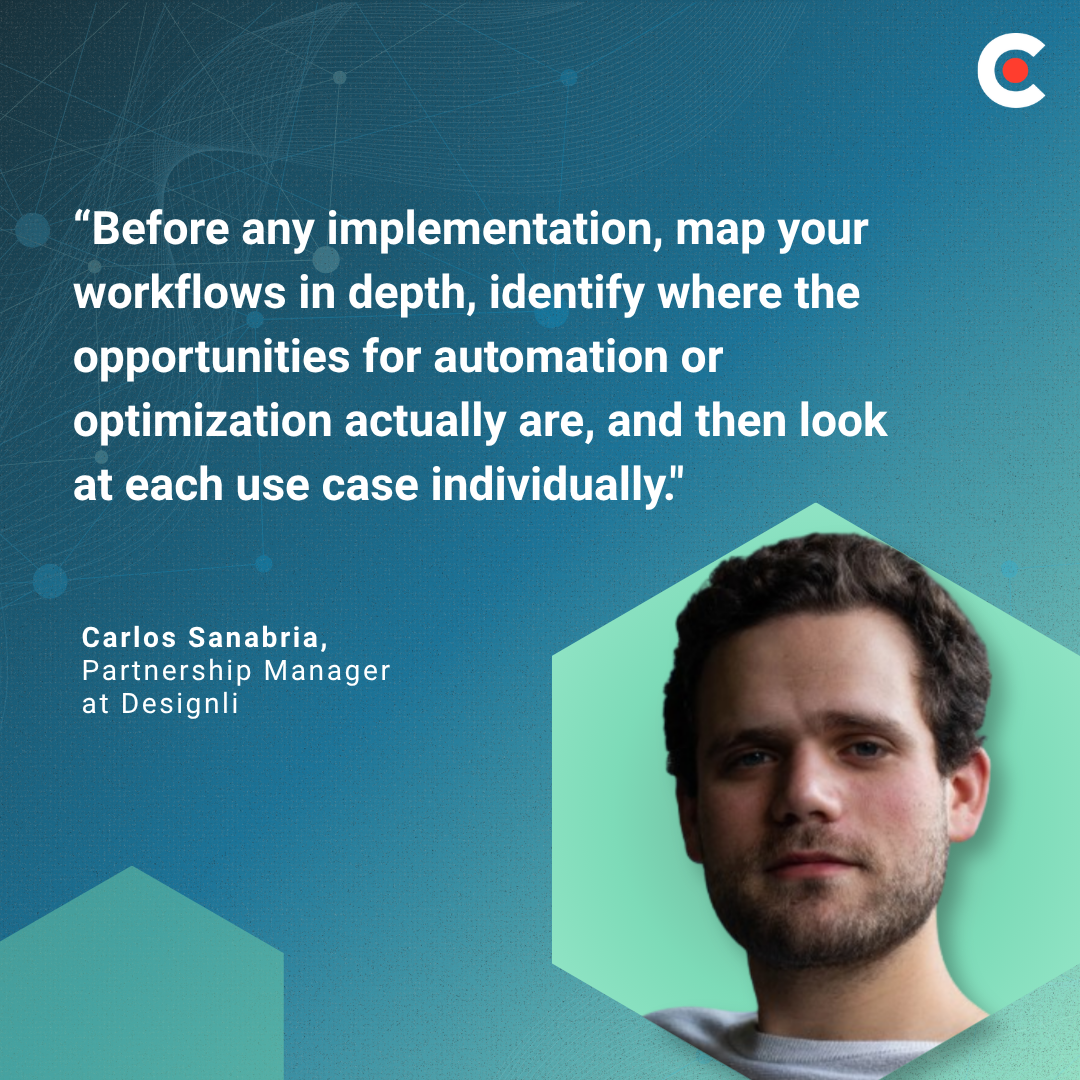
“Before any implementation, map your workflows in depth, identify where the opportunities for automation or optimization actually are, and then look at each use case individually,” advises Carlos Sanabria, a Partnership Manager at Designli. “This isn't a one-size-fits-all solution. Every step of workflow automation needs its own analysis and its own tailored agent configuration. When companies skip that, they're guessing at which bottleneck to fix and which tool fits it.”
Many SMB employees are already using AI at an advanced level, but expanding into more sophisticated applications requires more than simply adding new tools. Businesses need the right strategy, policies, and infrastructure in place to make sure AI is effective, secure, and aligned with their goals.
More companies are giving AI access to business data and systems, which makes clear guidelines and strong data practices increasingly important. Without them, businesses may struggle to manage risks or scale across the organization.
Businesses that strengthen these foundations now will be in a better position to expand their AI capabilities and turn their investments into meaningful growth over the next year.
Clutch surveyed 600 full-time workers who use AI at work in August 2026 using the polling site SurveyMonkey. All respondents were based in the United States between the ages 18-99; 49% were male and 51% were female.
Participants were asked a series of multiple-choice and single-selection questions about their experience using AI in their job search process. All respondents were required to complete the survey in full to be included in the final analysis.