
Task Automation: How to Cut Repetitive Work
Task automation saves time, gets work done faster, and reduces errors. Learn how to automate repetitive tasks step-by-step and how to decide what to automate.
Updated September 3, 2026

To remain competitive and raise their productivity, companies are diving headfirst into AI implementation, but that eagerness doesn't guarantee they're prepared to use the technology effectively. The difference between enthusiasm and actual AI readiness is where most AI initiatives stall.
Companies around the world are racing to implement AI. The potential cost savings and business benefits are clear, but pressure to keep up with competitors is also driving adoption. For many companies, AI is quickly becoming a necessity. But many organizations aren’t fully prepared to implement AI effectively or get the most out of it.
A team may be eager to experiment with AI, but without the right infrastructure, skills, policies, and data in place, those efforts can lead to inconsistent results, security risks, and wasted investment.
Looking for a Artificial Intelligence agency?
Compare our list of top Artificial Intelligence companies near you
So, how do you know if your team is actually ready for AI? In this article, we’ll break down what AI readiness means, the key areas businesses should evaluate, and how to identify and close the gaps standing between your team and more effective AI adoption.
AI readiness is the extent to which a company is prepared to successfully adopt, deploy, and scale AI strategies and tools. Having AI tools installed doesn’t necessarily mean you’re ready. It also requires data, technology, talent, governance, and company culture.
While AI maturity measures how advanced, repeatable, and integrated your company’s existing AI capabilities are over time, AI readiness determines whether your organization has the fundamental prerequisites to deploy AI. In other words, AI readiness is about whether you are prepared to develop and scale your organizational AI use, while AI maturity is about how far along you are.
Your company might have cutting-edge infrastructure, but still fail to implement AI successfully because the team doesn’t trust the tools, or the data is disorganized.
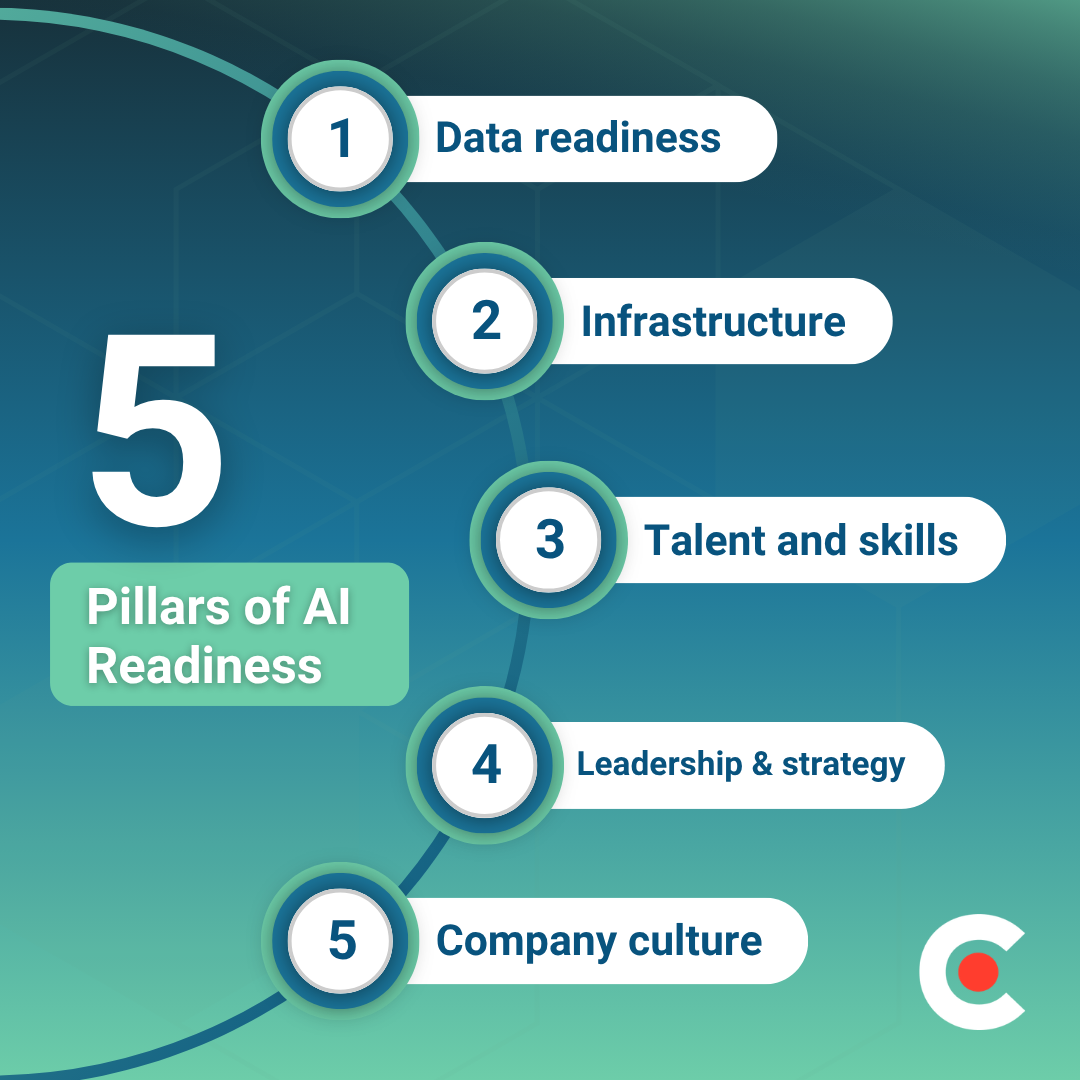
Determining whether your company is truly AI-ready requires looking beyond the AI tools you use. You can determine your AI readiness by assessing five distinct areas:
An AI system is only as good as the data you feed into it, and most leadership teams overestimate how ready their data truly is. A recent Clutch survey of full-time workers found that 94% of respondents feel confident that their company data is accurate, but only 54% say it’s actually clean and organized.
Data readiness encompasses four related issues: quality, accessibility, governance, and volume.
For instance, information in your CRM could be up to date, but if finance, sales, and support each maintain a separate version of the same customer record, your AI system can’t determine which information is accurate. Disconnected data can lead to inconsistent or unreliable outputs.
Siloed data, inconsistent formats, and limited data access are all red flags. Before attempting to implement your AI initiative, your organization must clean and centralize its data, establish data stewardship, and document its workflows. Then confirm that the AI system has access to the data.
Most SMBs don’t need to build AI infrastructure from scratch. Whether your existing tech stack, such as cloud storage, business software, and API integrations, can support the tools your company wants to bring in is more important.
A retailer with a structured, accessible product catalog can quickly add features like AI-powered virtual try-on, which is now common on apparel and eyewear e-commerce sites, because they already have the tools in place to scale their AI use. In contrast, a construction firm still running paper-based estimates may take longer to implement AI, even if the AI tool they’re interested in is simple to use.
Compute capacity and integration points are more important once you move past chatbot-style tools. Security-conscious organizations, particularly in finance or healthcare, increasingly rely on private cloud environments to secure sensitive data while still allowing AI systems to access the information they need. A private cloud enables encrypted data, customized access, and real-time information processing without exposing sensitive data to the open internet.
Before evaluating a new AI vendor, determine what your current stack will realistically support. Can your infrastructure handle the integration points a given tool requires? What would we need to change, rebuild, or replace to make it work?
Your workforce is often the area that is furthest behind. To successfully implement AI systems, the organization must get everyone on board. Marketing coordinators, operations managers, and finance analysts all need the working knowledge to prompt effectively and catch inaccuracies.
Without basic AI training, employees either won’t use the tool or will carelessly act on inaccurate outputs. Neither outcome is good for business.
The data demonstrates this. A Clutch survey found that 45% of employees don’t know their company’s guidelines for using AI, and only 33% have gone through formal training. Meanwhile, directors and above report noticeably higher productivity gains from AI than their junior colleagues, possibly because they’re nearly twice as likely to have received training.
Ask who on your team already has hands-on experience with AI. From there, determine whether the smarter investment is hiring new talent or upskilling the people who already understand your business.
AI initiatives rarely fail because the technology itself doesn’t work. It's more common for businesses not to have an AI strategy. Instead, employees are using AI tools for one-off cases, making it difficult to measure the impact of AI use. Others are missing opportunities to use AI or are using it inappropriately.
Publicis Sapient’s 2026 Global Enterprise AI Report found that 73% of organizations regularly use AI across operations, yet only 10% describe it as core to business operations. That’s a 63-point chasm pointing to leadership, not tooling, as the real constraint.
Your AI strategy is a written framework connecting your AI investments to your business goals. It should include defined use cases, ownership and accountability, and success metrics. It should also determine which calls humans should handle and who steps in when something goes wrong.
Before assuming you have this handled, look closely at your AI documentation, or if your plan requires significant further discussion and development. Are you prioritizing real business value, or is the team chasing every opportunity that arises?
Many leadership teams underestimate the importance of company culture, even though it can significantly impact AI adoption.
If employees worry that AI will eventually replace them rather than support them, adoption rates will remain low. Anxiety over job safety is not uncommon: 92% of job seekers are concerned AI could reduce the number of jobs in their fields in the next 5 years.
Leadership must directly address these concerns to reassure staff and identify how AI can help the team as a whole.
Keep your team in mind during this transition. Your staff needs permission to experiment, fail, and raise concerns without feeling attacked or blamed. If they feel judged for questioning the AI, they’ll stop using it, and that’s a larger risk than productivity loss. Have an unambiguous AI policy in place so they know what’s acceptable, and let them explore.
Find out how your team actually feels about AI, and listen carefully so you don’t hear only what you want to hear. Ask them whether leadership has been clear about the role AI will play or if a lack of transparency has fed into their anxieties.
Turning the five pillars into a practical self-audit doesn’t require hiring a consultant or launching a six-month project. Most companies can put together a picture of where they stand by working through these three steps.
Walk through your organization’s data, infrastructure, talent, leadership, and culture one at a time, and note where the company actually stands rather than where leadership wants to position it.
Gather and consider input from those outside the executive team. Frontline employees often see the true state of data quality and tool adoption more clearly than the higher-ups who are creating a strategy.
Determine which pillars require the most work to get up to speed. Many companies find that they’re lagging in a few areas, which can help them strategize moving forward.
List the necessary fixes in order of priority. For instance, if your company data and infrastructure are strong but you notice a significant skills shortage, it makes more sense to invest primarily in training rather than purchasing more software.
If your organization is already using AI, measuring your organization on the Clutch AI Maturity Index is a useful way to determine your starting point.
Regardless of industry and company size, the most common hurdles for businesses struggling to implement AI are:
Once your team understands their shortcomings, the next question is whether to close those gaps internally or to hire AI experts.
Resolving these issues in-house may take longer, but it gives your team the experience to handle future projects quickly and efficiently. Finding the right vendor and defining a clear project scope can speed up AI implementation and help ensure the investment pays off.
Signs that keeping your AI readiness project in-house is a good idea include having:
Conversely, indications that you might be better off seeking external help include:
For finding reliable partners, Clutch’s directory of highly reviewed, vetted AI developers and IT services firms is a great place to start.
AI readiness is about building the foundation your company will need as AI becomes more deeply integrated into your business.
As your AI investments grow, so will the demands on your data, infrastructure, employees, and processes. Companies that address these gaps early will be better positioned to adopt more advanced AI applications without having to rebuild their systems in the future.
Start by assessing your readiness across the five pillars: data, infrastructure, talent, leadership, and culture. You don’t need to fix everything at once. Focus on the gaps that could create the biggest barriers to your next AI investment, then build from there.
The goal isn’t to be perfectly AI-ready today. It’s to build an organization that can keep adapting as AI evolves.